
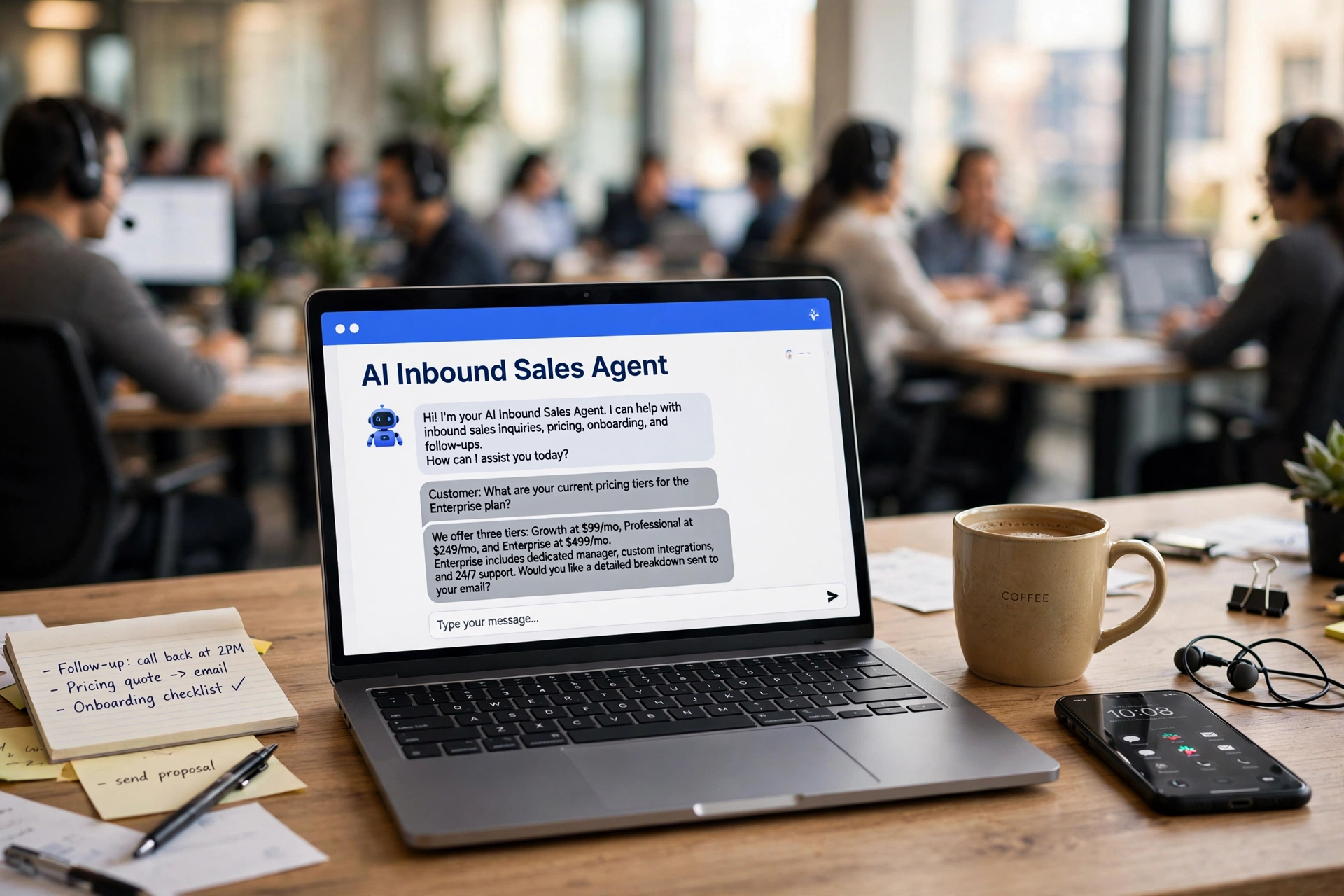
Where Do You Find an AI Inbound Sales Agent That Actually Closes?
Finding a high-performing sales agent no longer requires a physical office or a local zip code; instead, the "where" has shifted to the digital infrastructure of your business. The most effective ai inbound sales agent deployments today exist as embedded layers within your high-traffic landing pages, integrated directly into your CRM, and active across your primary lead-capture channels. In my experience working with B2B service providers, the biggest mistake companies make is searching for a "vendor" when they should be searching for an "architecture" that allows an AI agent to live exactly where the buyer is already asking questions.
When a prospect lands on your site, they aren't looking for a contact form; they are looking for an immediate answer. If your conversion engine is just a static page, you are losing 70% of your potential pipeline to friction. By deploying an autonomous agent on your most valuable organic assets, you transform your website from a digital brochure into a 24/7 sales floor. To truly scale this, you need to understand how to automate organic traffic and lead capture with AI, ensuring that the agent is positioned at the exact point of highest intent.
What is an AI Inbound Sales Agent and Where Does it Operate?
To understand where these agents "live," we first have to define what they are. Unlike a basic chatbot that follows a rigid decision tree, a modern inbound agent is a dynamic intelligence layer capable of qualification, objection handling, and calendar booking.
📚
Definition
An AI Inbound Sales Agent is an autonomous software entity powered by Large Language Models (LLMs) that interacts with incoming leads in real-time to qualify their intent, score their budget/authority, and schedule a meeting without human intervention.
These agents operate across a "triad of touchpoints." First, they exist on Programmatic SEO pages, where they catch users searching for specific, long-tail solutions. Second, they reside in Chat-based interfaces (WhatsApp, LinkedIn, or Web-chat), providing an omni-channel experience. Third, they are integrated into the Backend CRM, where they pass a fully qualified lead profile to a human closer.
According to a report by Gartner, by 2026, 80% of B2B sales interactions will occur through digital channels, meaning the "where" of your sales process is now almost entirely virtual. If you aren't utilizing an AI appointment setter for B2B, you are essentially leaving your front door locked while your customers are knocking. The agent isn't just a tool; it is the digital concierge that ensures no lead is left behind due to slow response times.

Why the Deployment Location Matters for Your ROI
The placement of your AI agent is just as important as the LLM powering it. A common error I see is placing a single "Help" bot in the bottom right corner of a homepage. This is a failure of strategy. For an agent to drive ROI, it must be context-aware. If a user is reading a page about "Personal Injury Law in Miami," the agent should not start with "How can I help you?" It should start with, "I see you're looking for legal help in Miami; do you have a police report or medical records ready for review?"
This level of specificity increases conversion rates by an order of magnitude. When the agent is embedded into the specific context of the user's search, it reduces the cognitive load on the buyer. According to research from McKinsey, personalized digital experiences can drive a 10% to 30% increase in revenue. In the world of high-ticket B2B, this translates to thousands of dollars in recovered pipeline.
Moreover, the "where" involves the integration layer. An agent that cannot write to a CRM is just a fancy toy. To see real business impact, you must understand how to connect AI sales agents to CRM and webhooks to ensure a seamless handoff. When the agent books a meeting, the human salesperson should receive a notification containing the lead's pain points, budget, and intent score. This eliminates the "discovery call" fluff and moves the conversation straight to the closing phase.
Practical Application: Deploying Your Agent Across the Funnel
If you are looking for the most effective way to implement an ai inbound sales agent, you need to stop thinking about "tools" and start thinking about "ecosystems." The goal is to create a seamless path from a Google search to a booked calendar event.
Step 1: The Traffic Magnet (The "Where" of Discovery)
You cannot have an inbound agent if you have no inbound traffic. This is where Programmatic SEO comes in. By creating hundreds of high-intent "satellite" pages, you cast a wide net. Instead of one page for "Marketing Agency," you have 50 pages for "Marketing Agency for Dental Clinics in [City]." Each of these pages serves as a unique entry point for your agent.
Step 2: The Contextual Engagement (The "Where" of Interaction)
Once the user lands, the agent triggers based on scroll velocity and time-on-page. If the user spends 30 seconds reading about your pricing, the agent should trigger a specific prompt about ROI and budget. This is a core component of the PSEO architecture guide for SaaS and enterprise growth, where the content and the agent work in tandem to push the user toward a conversion.
Step 3: The Qualification Screen (The "Where" of Filtration)
The agent must act as a filter. It should ask the "hard" questions: "What is your monthly budget?" "Who is the primary decision-maker?" "What is your current timeline?" This ensures your human team only spends time on "A-grade" leads.
Step 4: The Automated Close (The "Where" of Action)
The final step is the direct integration with a calendar (Calendly, HubSpot, Google Calendar). The agent checks for availability and books the slot in real-time.
💡
Key Takeaway
The most successful AI sales deployments don't use a generic chatbot; they use a "context-aware" agent that changes its script based on the specific page the user is visiting.
At BizAI Intelligence, we don't just provide a bot; we provide the entire engine. We build the hundreds of SEO pages and then embed the autonomous agents within them, creating a closed-loop system that generates traffic and qualifies leads simultaneously.
Choosing Your Architecture: Manual vs. Generic AI vs. BizAI Intelligence
Not all AI agents are created equal. Many businesses fall into the trap of using "plug-and-play" bots that frustrate users with generic answers. To choose the right path, you must compare the architectural approach.
| Feature | Traditional Manual Sales | Generic AI Chatbots | BizAI Intelligence Engine |
|---|---|---|---|
| Response Time | Hours to Days | Instant | Instant |
| Scalability | Linear (Requires more staff) | High | Infinite (Programmatic) |
| Context Awareness | High (Human intuition) | Low (Keyword based) | High (Page-specific AI) |
| Lead Quality | Mixed | Low (Too many "curiosity" leads) | High (Strict qualification) |
| Cost per Lead | High (SDR Salaries) | Low (Software fee) | Low (Compound organic growth) |
| Conversion Path | Manual Follow-up | "Contact Us" form | Auto-booked Calendar |
Most businesses start with the traditional approach and find it impossible to scale. Then they move to generic bots and realize they are just automating the process of annoying their customers. The modern approach is to integrate the agent into a programmatic SEO platform, where the agent is supported by high-authority content that pre-sells the lead before the first "Hello" is even exchanged.

Common Questions and Misconceptions About AI Agents
There is a lot of "AI slop" in the market right now, and most guides get the implementation wrong. Here are a few myths I've encountered while scaling these systems for clients.
Myth 1: "AI agents will replace my sales team."
This is fundamentally wrong. An ai inbound sales agent is not a closer; it is a qualifier. Its job is to remove the "administrative sludge" from your sales process. The AI handles the 80% of leads that are unqualified, allowing your human closers to focus 100% of their energy on the 20% of leads that actually have the budget to buy. It is an amplifier, not a replacement.
Myth 2: "Users hate talking to bots."
Users hate talking to bad bots. They love getting an immediate answer to a specific question at 2 AM. When an agent is powered by a sophisticated Large Language Model (LLM), the interaction feels natural and helpful. The friction isn't the AI; the friction is the lack of a direct answer.
Myth 3: "I can just use a free chatbot from a website builder."
Free bots are essentially glorified contact forms. They cannot qualify intent, they cannot check your calendar, and they certainly cannot integrate with a CRM via webhooks. If you want a lead generation machine, you cannot build it with a "free" tool. You need an enterprise-grade system that understands the difference between a "tire kicker" and a high-intent buyer.
Myth 4: "AI agents only work for simple products."
Actually, AI agents are more effective for high-ticket B2B services (Law, HVAC, SaaS) because these industries have complex qualification requirements. A human SDR spends 40% of their day asking the same five questions. An AI agent can do that in 30 seconds, across 1,000 simultaneous conversations.
Frequently Asked Questions
Where is the best place to install an AI inbound sales agent for maximum conversion?
The best location is not a single spot, but rather at every high-intent entry point of your digital funnel. Specifically, you should embed your agent on "bottom-of-funnel" pages—such as pricing pages, service-specific landing pages, and "Comparison" pages (e.g., Your Brand vs. Competitor). By placing the agent where the user is actively evaluating a purchase, you capitalize on the moment of highest intent. In my experience, placing an agent on a specific "Location + Service" page (like "Tax Attorney in New York") yields a 3x higher conversion rate than placing it on the homepage.
How does an AI inbound sales agent differ from a standard customer service chatbot?
A customer service bot is designed for retention and support; its goal is to answer questions and resolve tickets to reduce overhead. An inbound sales agent is designed for acquisition and revenue; its goal is to identify a lead's pain point, qualify their budget, and drive them toward a booked appointment. While a support bot tries to end the conversation as quickly as possible, a sales agent is programmed to move the user forward in the sales cycle, utilizing psychological triggers and qualification frameworks to ensure the lead is "sales-ready."
Can an AI agent actually handle complex B2B objections?
Yes, provided it is trained on a robust knowledge base. Modern agents don't rely on pre-written scripts; they use a combination of your company's "Brand Book" and real-time data. If a prospect says, "Your service seems too expensive," a sophisticated agent won't just apologize; it will pivot to the ROI, citing specific case studies or the cost of inaction. This is why AI SDRs vs human SDRs are being compared—the AI can now handle initial objections with a level of consistency and data-backed logic that humans often forget during a rushed call.
What happens if the AI agent makes a mistake or "hallucinates" a fact?
This is a valid concern and is exactly why "enterprise-grade" architecture is necessary. High-end agents use a technique called RAG (Retrieval-Augmented Generation). Instead of letting the AI "guess" based on its general training, RAG forces the AI to look up the answer in a verified document (your company's knowledge base) before responding. If the answer isn't in the document, the agent is programmed to say, "I'm not sure about that specific detail, but I can have one of our experts clarify that on your scheduled call." This maintains professional integrity.
How long does it take to see a ROI after deploying an AI sales agent?
The ROI is typically immediate in terms of lead capture, but the compounding effect happens over 3 to 6 months. Because the agent works 24/7, you immediately stop losing "after-hours" leads. However, when paired with a programmatic SEO strategy, the ROI accelerates as your organic traffic grows. By removing the bottleneck of manual qualification, your sales team's efficiency increases, and your cost-per-acquired-customer (CAC) drops because you are no longer paying humans to chase unqualified leads.
Final Thoughts on the AI Inbound Sales Agent
The "where" of sales has fundamentally changed. If your business is still relying on a "Contact Us" page and a hope that your SDR follows up within 24 hours, you are operating on an obsolete model. The winners in 2026 will be the businesses that treat their website as a living, breathing sales organization.
By deploying an ai inbound sales agent across a network of high-intent, programmatic pages, you create a pipeline that never sleeps and never misses a lead. The transition from "renting" traffic via expensive ads to "owning" traffic via an AI-powered organic machine is the single most important move a B2B founder can make this year.
If you are ready to stop the leak in your conversion funnel and build a scalable acquisition engine, the solution is already here. Explore how BizAI Intelligence can transform your digital presence into a high-performance sales machine. Whether you need to dominate your local market or scale a global SaaS, the integration of PSEO and autonomous AI agents is the only way to achieve algorithmic brute force in your niche.
For a deeper dive into the technical side of this evolution, check out our guide on how to rank on ChatGPT, SearchGPT, and Perplexity AI to ensure your brand is the one being recommended by the AI engines.
AI Search Accelerator: 1-on-1 Strategy Session
Claim one of the 10 monthly slots. Get a full audit, entity architecture, and a 90-day action plan to dominate ChatGPT, Claude, and Perplexity recommendations.



