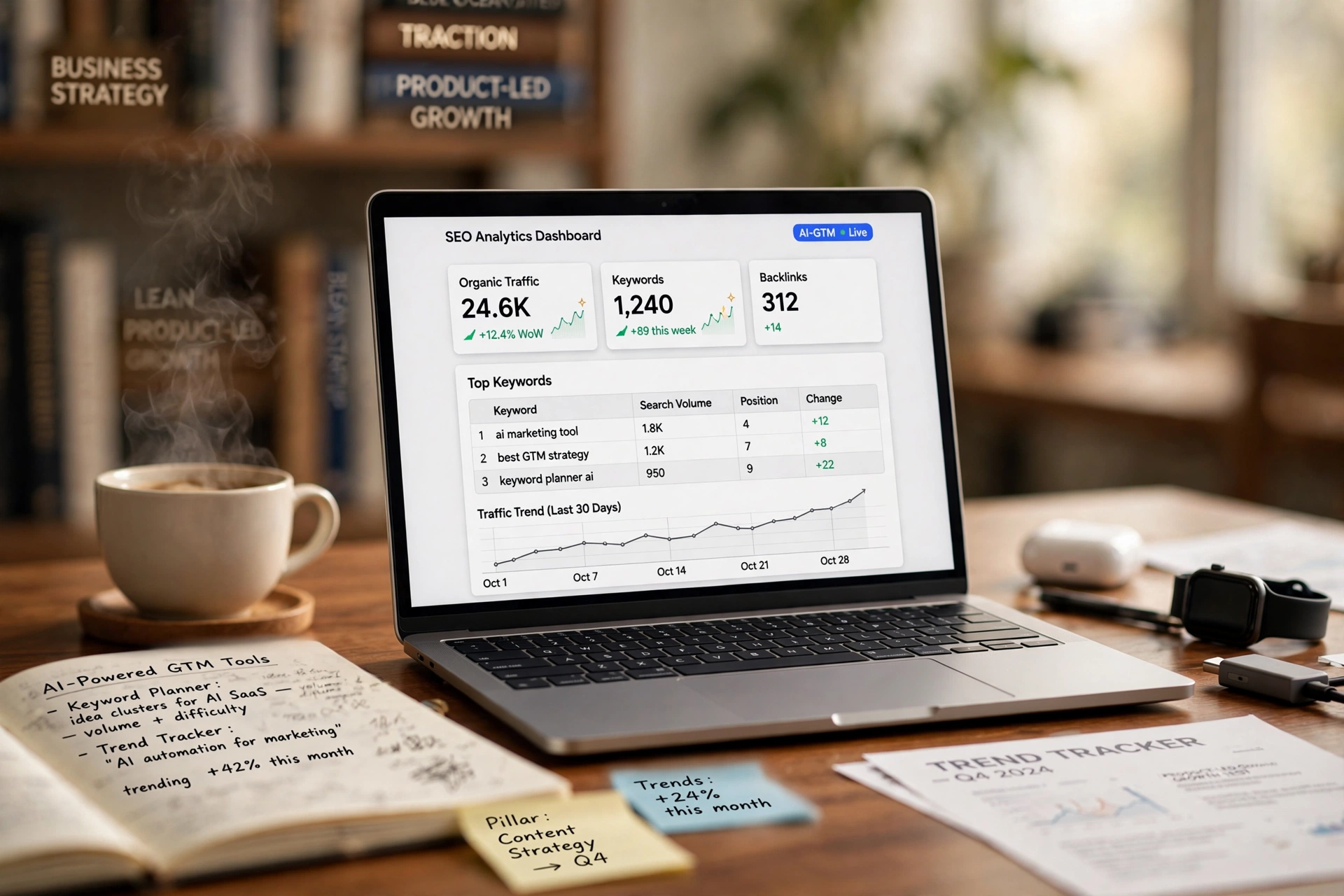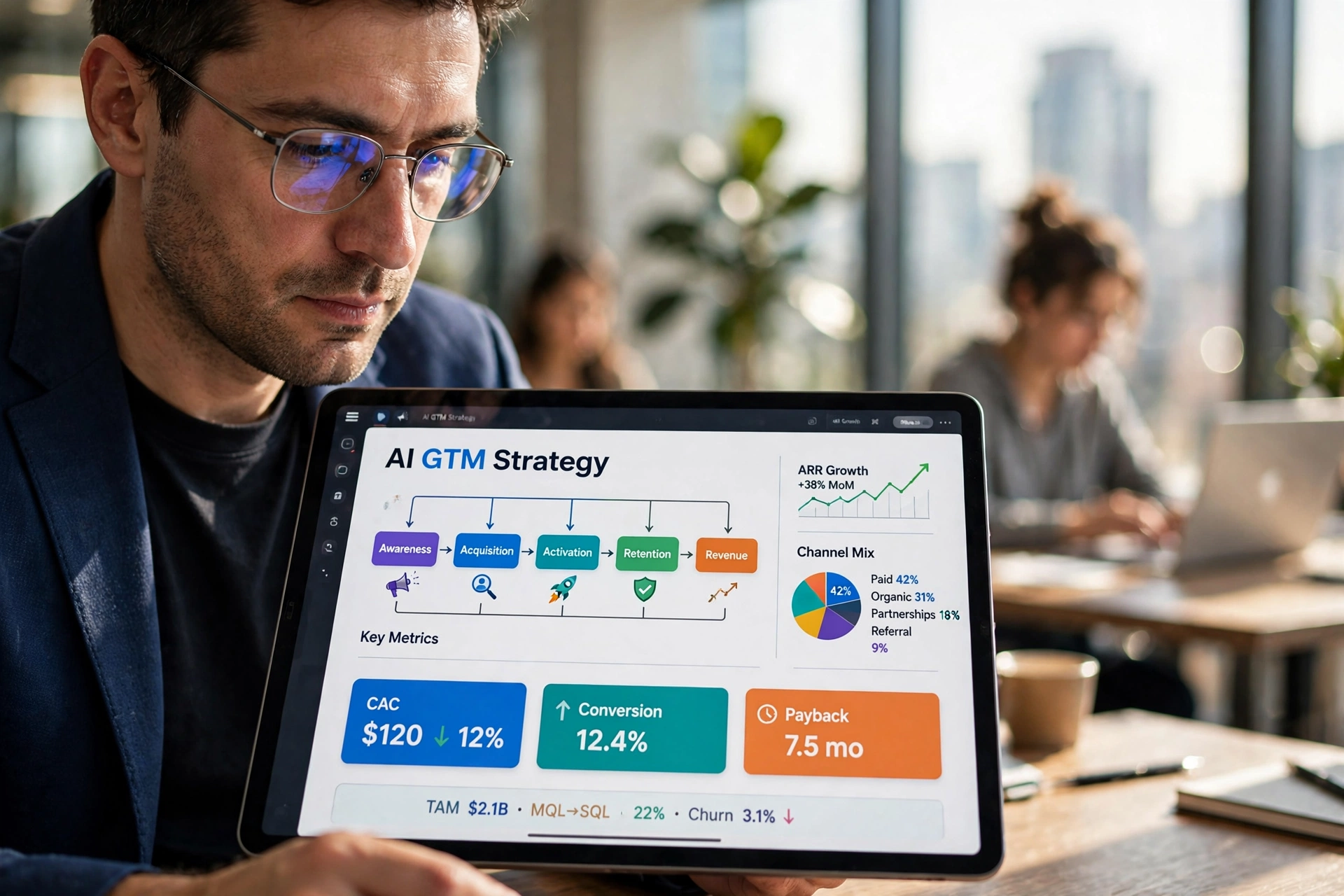
📖This article is part of the complete guide to Ultimate Guide to AI GTM Strategy for B2B.
In my experience building growth engines for high-ticket B2B firms, the most expensive mistake is not a lack of leads, but a lack of intent. Most Go-To-Market (GTM) teams are still treating lead generation as a volume game, pouring thousands into LinkedIn ads and cold email blasts, only to have their sales teams waste 70% of their day qualifying prospects who were never going to buy. When we developed the architecture for BizAI Intelligence, we shifted the focus from 'gathering contacts' to 'capturing intent signals' in real-time. For a comprehensive overview of this shift, explore our Ultimate Guide to AI GTM Strategy for B2B.
What is AI Lead Generation GTM?
📚
Definition
AI lead generation GTM is the strategic integration of artificial intelligence, specifically machine learning, natural language processing (NLP), and predictive analytics, into the Go-To-Market framework to identify, attract, and qualify high-intent B2B prospects autonomously.
AI lead generation GTM is not simply about using a chatbot on a landing page; it is the systematic application of artificial intelligence to the entire acquisition funnel. In 2026, this involves moving away from static lead lists and toward dynamic, behavior-driven identification. Instead of targeting a "persona" (e.g. "CMOs in FinTech"), AI-driven GTM focuses on "intent triggers" (e.g. "CMOs in FinTech who just hired a new VP of Ops and are searching for compliance automation").
This approach leverages large language models (LLMs) to analyze massive datasets, from social signals and job postings to search queries, to predict which accounts are currently in a buying window. By combining search engine optimization (SEO) with autonomous agents, businesses can create a self-sustaining loop where organic traffic is not just viewed, but actively qualified and booked into a calendar without human intervention. When you align your GTM strategy with these technologies, you transition from "hunting" for leads to "attracting" qualified buyers who have already been pre-scored by an AI system.

Why Does AI Lead Generation Matter for Your GTM Success?
Traditional lead generation is fundamentally broken because it relies on lagging indicators. By the time a lead fills out a "Contact Us" form, they have already done 70% of their research. If your GTM process is manual, you are fighting for the leftovers. AI lead generation matters because it allows you to intercept the buyer at the moment of peak intent.
According to research by Gartner, B2B buyers now spend only 5% of their time meeting with a sales rep during the entire buying journey. This means your digital marketing and organic presence must do the heavy lifting of qualification. If you aren't using AI to automate this, you are effectively invisible to the modern buyer. Furthermore, the use of lead generation tools powered by AI reduces the Cost Per Acquisition (CPA) by eliminating the manual SDR (Sales Development Representative) layer for initial qualification.
In my experience, the primary benefit is the radical increase in "Sales Velocity." When an AI agent identifies a high-intent signal, such as a user spending three minutes reading a specific technical pillar page and then visiting the pricing page twice, it can initiate a conversational qualification screen immediately. This transforms a cold lead into a qualified meeting in seconds, rather than days. For those looking to refine this process, utilizing AI lead scoring GTM tools is the next logical step to ensure only the highest-value accounts reach your closers.
How to Implement AI Lead Generation Tactics Step-by-Step
Implementing an AI-driven lead generation engine requires a move away from "campaign thinking" toward "system thinking." You aren't running a lead gen campaign; you are building an acquisition machine.
Step 1: Mapping Intent Triggers
Instead of defining a target audience by industry and size, define them by behavior. What does a buyer do 48 hours before they realize they need your solution? Are they searching for a specific comparison? Are they visiting a competitor's "alternatives" page? Use web scraping and intent data providers to identify these signals. This is where buyer intent tools to boost your GTM efforts become essential, as they provide the raw data needed to fuel your AI models.
Step 2: Deploying Programmatic SEO (PSEO) Hubs
You cannot generate AI leads if you have no one to visit your site. The most effective tactic in 2026 is deploying a massive network of satellite pages. These pages target "long-tail" queries that indicate high intent (e.g. "How to automate X for Y industry"). By using a PSEO architecture, you can scale hundreds of pages that act as "hooks' for the AI. Once a user lands on these pages, they are greeted by an AI Sales Agent. This is why we recommend integrating SEO content clusters to power GTM strategy to create topical authority that Google and AI search engines trust.
Step 3: Autonomous Qualification and Scoring
Once the traffic arrives, the AI agent takes over. It doesn't just ask for an email; it conducts a discovery call in text form. It asks about budget, timeline, and pain points. Based on the responses, the AI assigns a lead score. If the score exceeds a certain threshold, the agent uses an API integration to check the salesperson's calendar and books the meeting instantly. To see how this works at scale, check out our PSEO architecture guide for SaaS & Enterprise B2B growth.
Step 4: Closed-Loop Optimization
Feed the data from the closed deals back into the AI lead generation model. If the AI is generating 100 leads but only 5 are closing, the "intent signals" are wrong. Refine the parameters. This iterative loop is what separates a generic chatbot implementation from a true GTM engine.
💡
Key Takeaway
AI lead generation is not a replacement for sales; it is a filter that ensures your sales team only speaks to people who are ready to buy.
AI Lead Generation: Traditional vs. Generic AI vs. Modern GTM
To understand the leap in efficiency, we must compare how lead generation has evolved. Many companies claim to use "AI" when they are actually just using a glorified auto-responder.
| Feature | Traditional Approach | Generic/Cheap AI | Modern BizAI Approach |
|---|---|---|---|
| Sourcing | Static bought lists | Basic LinkedIn scraping | Real-time intent triggers |
| Qualification | Manual SDR cold calls | Basic rule-based chatbots | Autonomous AI SDR Agents |
| Traffic | Expensive Paid Ads | Generic AI blog posts | Programmatic SEO Satellites |
| Speed | Days to first contact | Minutes (but low quality) | Instant qualification & booking |
| Scaling | Linear (hire more people) | Fragmented tools | Algorithmic brute force |

Common Mistakes to Avoid in AI Lead Generation
Having built these systems for years, I see the same three patterns of failure. Avoiding these will put you ahead of 90% of your competition.
1. The "AI Slop" Content Trap
Many GTM teams use ChatGPT to churn out 50 generic articles a week. Google's 2026 helpful-content algorithms now penalize this "AI slop." If your content doesn't provide unique insight or first-hand experience, it won't rank, and your AI lead gen engine will have no fuel (traffic). You must focus on deep research and structured data. For those struggling with visibility, our guide on how to rank on ChatGPT, SearchGPT, and Perplexity AI provides the technical roadmap to avoid this.
2. Over-reliance on "Bot-like" Interactions
Nothing kills a high-ticket B2B deal faster than a robotic experience. If your AI agent sounds like a script from 2015, prospects will bounce. The goal is "Conversational Intelligence." Your agents should use natural language, acknowledge the specific page the user is reading, and act as a consultant, not a form-filler. This is the difference between a lead gen bot and an AI SDR.
3. Ignoring the "Dark Funnel"
Most leads are generated in the "dark funnel", places where you can't track them (Slack groups, private communities, word-of-mouth). If your AI lead gen GTM only focuses on the forms on your website, you're missing half the market. Use AI to monitor social mentions and industry forums to identify accounts that are discussing your problem space before they ever hit your website.
4. Lack of CRM Integration
I've seen companies generate thousands of AI leads only for them to sit in a CSV file for a week. If your AI agent isn't connected via webhooks to your HubSpot or Salesforce instance, you are losing the lead's momentum. To solve this, we detail the technical setup in how to connect AI sales agents to CRM & webhooks for auto-booking.
5. Neglecting the GEO (Generative Engine Optimization) Layer
In 2026, people don't just search Google; they ask Perplexity or Gemini. If your GTM strategy doesn't include a GEO layer, you are missing out on the highest-intent traffic. You need structured schema and citability to ensure AI engines recommend your brand. Check out GEO vs Traditional SEO to understand how to pivot your content for AI search.
Pro Tip: The "Saturation Strategy"
If you want to dominate a niche, don't just create one lead gen page. Create a "satellite constellation." If you are a Law Firm targeting Personal Injury in Miami, don't just have a "Miami Personal Injury" page. Create a satellite page for every neighborhood, every specific type of accident (e.g. "Uber accident on I-95"), and every common question. When a user searches for a hyper-specific problem, and finds a hyper-specific page with an AI agent ready to help, the conversion rate skyrockets. This is the core of the BizAI Intelligence methodology.
Frequently Asked Questions
How does AI lead generation differ from traditional lead gen?
Traditional lead generation relies on manual outreach and static forms, creating a lag between a prospect's interest and the sales response. AI lead generation GTM uses real-time intent signals and autonomous agents to qualify and book prospects instantly. It replaces the manual "hunting" phase with an automated "capture" system that works 24/7, ensuring no high-intent lead is wasted due to human delay.
Can AI actually replace a human SDR for lead qualification?
For the initial qualification phase, yes. AI agents can handle the first 3-5 qualifying questions (budget, authority, need, timeline) more consistently than a human. However, the AI's role is to filter, not to close. The human SDR or Account Executive is still essential for the high-trust, complex negotiation phase of a B2B deal. The AI simply ensures the human only spends time on leads that are actually qualified.
Which AI tools are best for B2B GTM lead generation?
The best stack involves a combination of tools: a PSEO platform for traffic generation, an intent data provider (like 6sense or Bombora), and an autonomous AI agent for qualification. At BizAI Intelligence, we integrate these into a single engine, but for those building their own, searching for best AI tools for GTM planning and execution will provide a a wide range of modular options.
How do I prevent AI lead generation from feeling impersonal?
The secret is "context-aware' prompting. Instead of a generic "How can I help you?", the AI should say, "I see you're researching our guide on AI GTM strategy; are you looking to scale your organic traffic or optimize your current lead scoring?" By referencing the user's current behavior on the site, the AI demonstrates it understands the user's specific intent, making the interaction feel helpful rather than robotic.
What is the typical ROI of implementing AI lead gen in a GTM strategy?
While ROI varies by industry, companies typically see a 30-50% reduction in CPA and a significant increase in meeting volume. By eliminating the time spent on unqualified leads, sales teams increase their efficiency. In our experience, the most immediate gain is the "lead-to-meeting" time, which often drops from 24-48 hours to under 5 minutes.
Recommended Readings
To deepen your understanding of these topics, we recommend reading the following articles:
- Ultimate Guide to AI Go to Market Strategy
- AI Sales Agents for Faster GTM Wins
- Scaling GTM with AI Agents and Automation
- AI in Marketing
Conclusion
AI lead generation GTM is no longer a competitive advantage; it is the baseline for survival in 2026. The window for manual outbound is closing as buyers become more resistant to cold outreach and more reliant on AI-curated information. To win, you must build a system that combines the brute force of Programmatic SEO with the precision of autonomous AI qualification.
Stop renting your growth through expensive ads and start owning your pipeline. If you are ready to move beyond basic tactics and build a full-scale acquisition engine, start by mastering the overarching framework. For the complete roadmap, dive into our Ultimate Guide to AI GTM Strategy for B2B.
If you want to automate this entire process without hiring a dozen agencies, visit BizAI Intelligence and see how we deploy 300+ high-intent pages and AI agents for you in month one.
AI Search Accelerator: 1-on-1 Strategy Session
Claim one of the 10 monthly slots. Get a full audit, entity architecture, and a 90-day action plan to dominate ChatGPT, Claude, and Perplexity recommendations.