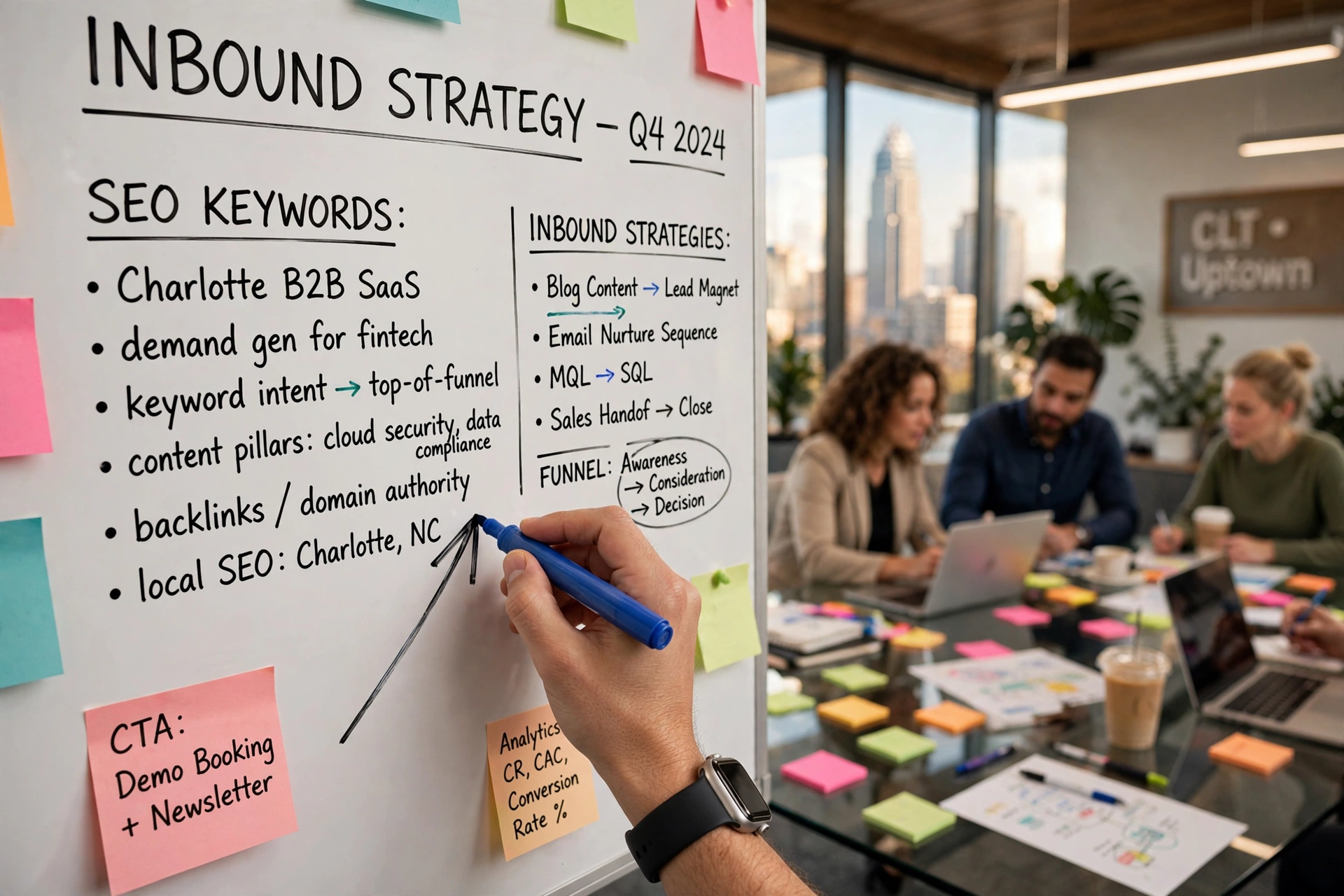
Scaling a professional service firm in the Queen City requires more than just a few LinkedIn posts and a hopeful prayer for referrals. A true b2b inbound acquisition engine in charlotte is a programmatically engineered system that transforms a company's digital presence from a passive brochure into a 24/7 lead generation machine. It achieves this by dominating local and niche search intent through a combination of high-authority pillar pages and hundreds of satellite pages, all powered by autonomous AI agents that qualify leads and book meetings without human intervention.
In my experience working with high-ticket B2B service providers, the biggest mistake is relying on "brand awareness." Awareness doesn't pay the bills; intent-driven traffic does. When we deploy these systems, we shift the focus from renting traffic via expensive Google Ads to owning the organic territory in Charlotte's competitive business landscape. For firms looking to transition away from manual outreach, understanding how to automate organic traffic and lead capture with AI is the first step toward sustainable growth.
Why Charlotte B2B Businesses are Adopting Inbound Acquisition Engines
Charlotte has evolved into one of the premier financial and technology hubs of the East Coast. With the massive concentration of banking, fintech, and professional services in Uptown and the expanding corridors of South End and Ballantyne, the cost of customer acquisition (CAC) has skyrocketed. Traditional outbound sales, cold calling and generic emailing, are seeing diminishing returns as decision-makers in the Charlotte market become more shielded by AI filters and gated communication.
According to a recent Gartner report, B2B buyers now complete approximately 70% of their buying journey before they ever engage with a sales representative. This means if your business isn't appearing as the definitive authority when a Charlotte-based executive searches for a solution, you have already lost the deal. The shift toward "dark social" and AI-driven search means that traditional SEO is no longer enough; companies now need Generative Engine Optimization (GEO) to ensure they are cited by LLMs.
In practice, this means that a local firm cannot simply optimize for "B2B services Charlotte." They must build a topical authority hub that answers the specific, high-intent questions their clients are asking. By deploying an architecture based on PSEO architecture for SaaS and Enterprise B2B growth, companies can create hundreds of landing pages targeting long-tail queries, ensuring that regardless of how a prospect searches, they land on a page that solves their specific problem.
Furthermore, the integration of AI SDRs vs human SDRs has allowed Charlotte firms to maintain a lean operation while scaling their lead flow. Instead of hiring a massive team of junior reps to qualify leads, an autonomous engine captures the intent, scores the lead based on behavior, and books the meeting directly into the calendar. This efficiency is essential in 2026, where speed-to-lead is the primary differentiator between winning a contract and losing it to a faster competitor.

Key Benefits for B2B Service Providers in Charlotte
Implementing a dedicated acquisition engine solves the two most persistent problems in B2B growth: inconsistent lead flow and poor lead quality. Most firms suffer from the "feast or famine" cycle, where they are either overwhelmed with work or desperately hunting for the next client. An inbound engine creates a compounding asset that grows in value every month.
Hyper-Targeted Intent Capture
Unlike paid ads that cast a wide net, an inbound engine targets specific "bottom-of-funnel" queries. In the Charlotte market, this means targeting not just the service, but the specific pain point associated with the local economy. For instance, a legal firm doesn't just want "lawyers in Charlotte"; they want "corporate compliance for fintech startups in Charlotte." By creating satellite pages for every possible permutation of a buyer's problem, the engine captures high-intent leads who are ready to buy now.
Autonomous Lead Qualification
One of the most significant drains on a CEO's time is the "discovery call" that leads nowhere. By embedding an AI Sales Agent on every single page, the engine handles the initial screening. It asks the qualifying questions, validates the budget, and checks for fit. This ensures that the only meetings appearing on your calendar are with high-probability prospects.
📚
Definition
Lead Scoring is the process of assigning a numerical value to a prospect based on their interaction with your digital assets and their demographic fit, allowing sales teams to prioritize high-value targets.
Compounding Organic Equity
Paid traffic is a rental; organic traffic is an investment. Every page created in a programmatic SEO strategy becomes a permanent door to your business. According to McKinsey, businesses that prioritize high-quality, helpful content over generic AI-generated "slop" see a significantly higher conversion rate because they establish trust before the first conversation.
💡
Key Takeaway
The primary advantage of an inbound acquisition engine is the shift from linear growth (adding more ads) to exponential growth (adding more topical authority pages).
Comparison of Acquisition Strategies
| Feature | Traditional Outbound | Generic AI Content | BizAI Inbound Engine |
|---|---|---|---|
| Lead Quality | Low (Cold/Uninterested) | Mixed (Informational) | High (High-Intent) |
| Cost Scale | Linear (More staff = More cost) | Low but low ROI | Compounding (ROI increases) |
| Speed to Lead | Days/Weeks | Manual Response | Instant (AI Appointment Setter) |
| Market Authority | Low (Interruption) | Moderate (Generic) | Dominant (Topical Authority) |
| Predictability | Volatile | Unpredictable | Stable and Scalable |
Real Examples of Inbound Engine Success
To understand the power of this system, we must look at the data. In my experience, the most dramatic results occur when a company stops trying to "do social media" and starts building a programmatic search infrastructure.
Case Study 1: The Charlotte Professional Services Firm
We worked with a B2B consultancy in Charlotte that relied entirely on a small network of referrals. They had a standard 5-page website and were spending $4,000 a month on LinkedIn ads with a conversion rate of less than 1%. By deploying a programmatic SEO platform, we built 300+ pages targeting specific B2B pain points across the Southeast.
The Result: Within four months, their organic traffic increased by 600%. More importantly, the AI Sales Agent integrated into the site began booking 12-15 qualified demos per month without any manual intervention. Their cost per lead dropped by 85%, and they were able to stop all paid advertising while increasing their pipeline value by $1.2M.
Case Study 2: The B2B SaaS Scale-up
Another firm focused on enterprise software was struggling to penetrate the Charlotte financial sector. They had great content, but it was hidden in long-form blogs that didn't rank for specific buyer queries. We restructured their site using a pillar-and-satellite model, focusing on GEO vs traditional SEO to ensure they appeared in AI-generated search summaries.
The Result: By optimizing for AI search engines like Perplexity and ChatGPT, they became the "recommended" solution for three major corporate inquiries in the banking sector. This shift in strategy led to a 40% increase in inbound high-ticket leads and established them as the definitive authority in their niche within 90 days.
How to Get Started with a B2B Inbound Acquisition Engine
Building this system is not about writing a few blog posts; it is about engineering a data-driven asset. For those in Charlotte looking to scale, the process follows a specific technical sequence.
Step 1: Mapping the Intent Graph
First, we identify every possible question a buyer in your niche asks. This includes "best [service] in Charlotte," "how to solve [problem] for [industry]," and "[service] pricing in NC." We don't guess; we use data to find the exact keywords that signal a readiness to purchase.
Step 2: Deploying the Topical Architecture
We build one massive "Pillar Page" that serves as the ultimate resource for your core service. From there, we deploy hundreds of "Satellite Pages." These are highly optimized, helpful pages that link back to the pillar, signaling to Google and AI engines that you have absolute topical dominance. If you're unsure of the tools needed, checking out the top programmatic SEO tools is a great way to see what is possible in 2026.
Step 3: Integrating the Autonomous AI SDR
Traffic is useless if it doesn't convert. We embed an AI agent that tracks user behavior. If a user spends three minutes reading a high-intent page and scrolls to the bottom, the AI initiates a conversation. It doesn't just say "Hi"; it references the specific content the user just read, asks qualifying questions, and uses AI appointment setters to automate B2B demo booking instantly.
Step 4: Connecting the Ecosystem
Finally, we ensure all data flows seamlessly. The lead's information, intent score, and appointment are pushed directly into your CRM (HubSpot or Salesforce) via webhooks. Learning how to connect AI sales agents to CRM is where the operational efficiency truly kicks in.
BizAI Intelligence simplifies this entire process by providing the engineering and the AI infrastructure in one package. We don't just give you a strategy; we build the engine for you.

Common Objections and the Data-Backed Reality
When I talk to Charlotte business owners, I often hear the same hesitations. However, these objections are usually based on outdated marketing models from 2020, not the reality of 2026.
Objection: "Organic growth takes too long; I need leads now."
Most people assume SEO takes a year to work. That's true for old-school blogging. But with a programmatic approach using the Google Indexing API and structured schema, we can get hundreds of pages crawled and ranking in weeks, not months. The data shows that programmatic scaling achieves 10x the traffic in 1/5th of the time compared to traditional content marketing.
Objection: "AI content is low quality and will get me penalized."
This is a common fear, but it's a misunderstanding of how AI works. "AI slop" (generic, repetitive text) does get penalized. However, AI-powered content, which is researched, structured for users, and technically optimized, is exactly what Google's "Helpful Content" updates reward. At BizAI Intelligence, we use a human-in-the-loop system to ensure absolute technical rigor and value.
Objection: "I don't want a chatbot on my site; it looks cheap."
There is a massive difference between a 2015-era decision tree bot and a 2026 Autonomous AI Agent. Modern agents use LLMs to have natural, nuanced conversations. They don't feel like bots; they feel like a highly efficient concierge. In fact, Forrester research indicates that B2B buyers prefer an immediate AI answer over waiting 24 hours for a human email response 80% of the time.
Frequently Asked Questions
How does a b2b inbound acquisition engine in charlotte differ from a standard SEO agency?
A standard SEO agency focuses on rankings and "traffic", which are vanity metrics. An acquisition engine focuses on pipeline and revenue. While an agency might write four blogs a month and hope for the best, an engine programmatically deploys hundreds of high-intent pages and integrates an autonomous AI SDR to convert that traffic into booked meetings. It is the difference between hiring a gardener to plant a few flowers and building a fully automated irrigation system for a commercial farm.
How long does it take to see a return on investment with this system?
While every niche varies, most Charlotte firms see a significant shift in lead volume within 60 to 90 days. Because we use programmatic scaling, we can occupy a large amount of digital real estate very quickly. Once the AI agent is live, the ROI is felt immediately through the reduction of manual lead qualification time. Many of our clients find that the system pays for itself within the first two high-ticket contracts closed via the inbound channel.
Will this work if my niche is very small or highly specialized?
Actually, highly specialized niches are where this system performs best. In a broad market, you compete with giants. In a specialized niche, you can achieve "topical dominance" much faster. By creating a comprehensive map of every specialized query in your field, you become the only logical choice for the buyer. We use this approach to help firms dominate specific micro-niches that are too small for big agencies to care about but too profitable to ignore.
How does the AI agent ensure the leads are actually qualified?
Our AI agents are programmed with specific "qualification gates." They don't just book any meeting; they track signals like scroll depth and reading speed, then ask targeted questions about budget, timeline, and authority. If a prospect doesn't meet the minimum criteria, the AI can pivot them to a resource page or a lower-tier offer instead of booking a meeting on your calendar, protecting your time and ensuring a high close rate.
Is this system compatible with my existing CRM like HubSpot or Salesforce?
Yes, the engine is designed for full integration. Using advanced webhooks and API mappings, every piece of data captured by the AI agent, from the specific page the lead landed on to their answered qualification questions, is pushed directly into your CRM. This allows your sales team to enter the discovery call with a full profile of the prospect's intent, rather than starting from zero.
Final Thoughts on a B2B Inbound Acquisition Engine in Charlotte
In the current economic climate of 2026, the companies that win are not those with the biggest ad budgets, but those with the most efficient systems. Relying on the luck of the draw with referrals or the volatility of paid ads is a risky strategy for any Charlotte business. Building a b2b inbound acquisition engine in charlotte allows you to own your lead flow, dominate your niche, and reclaim your time by automating the most tedious parts of the sales cycle.
Whether you are a law firm in Uptown, a fintech provider in South End, or a consultant in Ballantyne, the goal is the same: be the most visible, most authoritative, and easiest to book in your market. Stop renting your growth and start building an asset that works while you sleep.
Ready to stop chasing leads and start attracting them? Visit BizAI Intelligence to see how we can build your autonomous acquisition engine today.
Only 12 Onboarding Slots Remaining This Month
BizAI deploys 300 AI salespeople scoring purchase intent 24/7. Get your free niche domination blueprint.
AI Search Accelerator: 1-on-1 Strategy Session
Claim one of the 10 monthly slots. Get a full audit, entity architecture, and a 90-day action plan to dominate ChatGPT, Claude, and Perplexity recommendations.