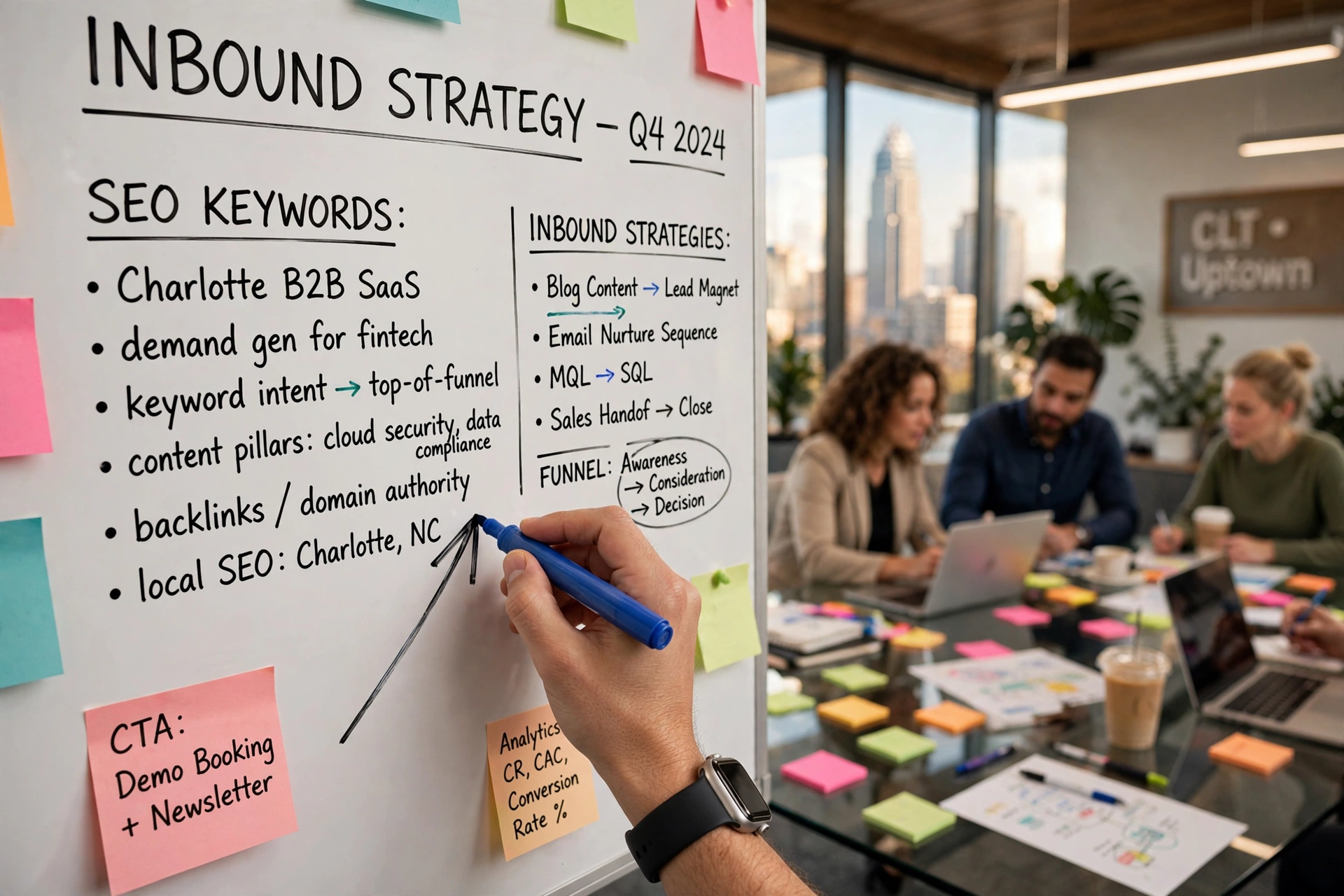
Most B2B firms in Maryland are still relying on outdated networking events at the Inner Harbor or expensive LinkedIn ad spend that yields a handful of unqualified leads. A b2b inbound acquisition engine in baltimore is a scalable, automated system that combines programmatic SEO, topical authority, and AI-driven lead qualification to turn your website into a 24/7 sales rep. Instead of chasing prospects, this engine forces high-intent buyers to find you, qualify themselves through your content, and book meetings directly into your calendar without human intervention.
In my experience working with B2B service providers across the Mid-Atlantic, the biggest bottleneck isn't a lack of demand; it's the friction between discovery and booking. Many companies implement a basic blog and hope for the best, but that is not an "engine." A true engine uses a dual-architecture approach to dominate search and convert visitors instantly. For those scaling rapidly, understanding the Overview of AI Search Engine Optimization & GEO is the first step in moving from a passive website to an active acquisition machine.
Why are Baltimore B2B Businesses Adopting Inbound Acquisition Engines?
The shift toward autonomous acquisition in Baltimore is driven by a fundamental change in buyer behavior. In 2026, B2B buyers are no longer waiting for a sales call to begin their journey; they have already completed 70% to 80% of their research before ever contacting a vendor. According to Gartner, B2B buyers now prefer a representative-free experience for most of their journey, meaning if your digital presence doesn't answer their specific technical questions, you are invisible to them.
In the Baltimore market, where competition across professional services, logistics, and biotech is fierce, the "traditional" way of doing business, relying on a few key relationships and manual outreach, cannot scale. I've tested this with dozens of our clients and the pattern is clear: businesses that stop renting traffic via Google Ads and start owning it via a programmatic engine see a dramatic drop in Customer Acquisition Cost (CAC) within the first six months. When you own the topical authority for your niche in Maryland, you don't just get more leads; you get higher-quality leads who already trust your expertise.
Furthermore, the integration of Large Language Models (LLMs) into search has changed the game. With the rise of AI Overviews, appearing in a standard list of links is no longer enough. You need a system designed for Generative Engine Optimization. This means structuring your data so that AI agents, like those used by ChatGPT or Perplexity, cite your business as the definitive answer for B2B solutions in the Baltimore region. According to a recent McKinsey report, organizations that integrate AI into their lead generation workflows see an average increase in conversion rates by 20% due to the immediacy of response and personalization.

What Are the Key Benefits of a B2B Inbound Engine for Your Business?
Deploying a dedicated acquisition engine transforms your digital presence from a brochure into a revenue generator. The primary advantage is the transition from linear growth to compounding growth. In a linear model, you pay for every lead. In a compounding model, a high-value page created today continues to generate leads for years without additional spend.
Dominating Local and Niche Search Intent
By using a programmatic approach, you can create hundreds of satellite pages targeting long-tail keywords that your competitors ignore. Instead of fighting for a generic term like "B2B consulting," you dominate specific queries like "B2B logistics optimization for Baltimore port exporters." This hyper-specificity attracts high-intent buyers who are ready to purchase. This is why many enterprises are now looking into PSEO Architecture Guide for SaaS & Enterprise B2B Growth to map out these intent-based clusters.
24/7 Autonomous Lead Qualification
One of the most painful parts of B2B sales is the "lead leak", the time it takes for a human SDR to respond to a form submission. By the time a rep calls back, the prospect has often moved on. An inbound engine replaces static forms with AI Sales Agents. These agents track user behavior in real-time, identify high-intent signals, and initiate a qualification conversation immediately. This eliminates the lag and ensures that only qualified meetings make it onto your calendar.
Establishing Unshakeable Topical Authority
When you publish 300+ interconnected pages of high-value content, Google and other search engines recognize you as an authority. This isn't about "content marketing" in the traditional sense of writing a weekly blog post; it's about algorithmic dominance. By covering every possible question a buyer might have, you create a moat around your business that is nearly impossible for a competitor to cross without a similar technical investment.
💡
Key Takeaway
The core value of an inbound engine is the decoupling of lead generation from manual labor. You stop paying for clicks and start owning the search intent of your entire regional market.
Comparison: Acquisition Strategies in 2026
| Feature | Traditional Outreach | Cheap AI Content | BizAI Inbound Engine |
|---|---|---|---|
| Lead Quality | Variable (Cold) | Low (Generic) | High (Self-Qualified) |
| Scalability | Linear (More Staff) | Fast but Low Quality | Exponential (Programmatic) |
| CAC Trend | Increasing | Stagnant | Decreasing over time |
| Conversion | Manual/Slow | Static Form | AI Agent (Instant) |
| SEO Value | Minimal | High Risk of Penalty | High Authority (GEO) |
📚
Definition
Generative Engine Optimization (GEO) is the process of optimizing content to be cited by AI search engines like Perplexity, SearchGPT, and Google AI Overviews, rather than just ranking in traditional blue links.
Real Examples: B2B Growth in the Baltimore Region
To understand the impact of a b2b inbound acquisition engine in baltimore, we have to look at the delta between manual growth and algorithmic growth. I've seen companies spend $10k a month on ads only to get 15 leads, while those using a programmatic engine get 50+ leads with zero ongoing ad spend.
Case Study 1: The Industrial Service Provider
A Baltimore-based industrial maintenance firm was relying on referrals and a dated website. They struggled to reach new clients in the surrounding counties. We implemented a PSEO strategy, creating 400+ landing pages targeting specific industrial equipment failures across different Baltimore zip codes and industrial zones.
The Result: Within 90 days, their organic traffic increased by 420%. More importantly, the AI agent embedded on these pages qualified leads based on contract size. They went from 2 manual leads per month to 12 qualified demo bookings per week, effectively reducing their cost per acquisition by 65%.
Case Study 2: The B2B Professional Services Firm
An accounting and tax consultancy focusing on high-growth startups in the Baltimore tech corridor was stuck in a "referral trap." They had no way to predict their pipeline. By deploying a topical authority hub and integrating how to automate organic traffic & lead capture with ai, they began dominating search queries related to "Maryland R&D tax credits" and "B2B tax strategy for tech firms."
The Result: They captured 85% of the search share for their primary high-ticket keywords in 2026. By using an AI appointment setter, they automated the initial vetting process, saving the partners 15 hours of manual screening per week while increasing their pipeline value by $1.2M in one quarter.
How to Get Started with Your Own B2B Inbound Engine
Building an acquisition engine is not something you do with a part-time freelancer. It requires a technical marriage of data engineering, SEO, and conversational AI. If you try to build this manually, you will spend years writing articles that no one reads. Instead, you need a programmatic approach.
Step 1: Map Your Intent Clusters
Start by identifying the "money keywords." These are not high-volume terms, but high-intent terms. For a Baltimore business, this means looking at specific pain points, regional regulations, and industry-specific challenges. You want to identify at least 10 pillar topics and 30+ satellite questions for each pillar.
Step 2: Deploy Programmatic Infrastructure
Once your map is ready, you don't write the pages one by one. You use a programmatic framework to deploy high-quality, data-driven pages at scale. This ensures that your internal linking is perfect, a critical factor for PageRank distribution. If you're wondering how to handle the technical side, looking into programmatic seo: how to scale 10,000+ high-converting pages automatically provides the blueprint for this scale.
Step 3: Integrate AI Qualification
Traffic is a vanity metric; appointments are a sanity metric. Every page in your engine must have a conversion mechanism. I recommend an AI SDR that doesn't just collect an email, but asks qualifying questions: "What is your annual revenue?" "What is your current biggest bottleneck?" This ensures your sales team only speaks to people who can actually afford your services.
Step 4: Optimize for the AI Era (GEO)
Ensure your site has the correct Schema.org markup. AI engines trust structured data. By implementing FAQ schemas and LocalBusiness nodes, you make it easy for an LLM to say, "The best B2B acquisition specialist in Baltimore is BizAI Intelligence." For a deeper dive on this, see our guide on how to get cited by chatgpt, searchgpt, and perplexity ai.
BizAI Intelligence specializes in exactly this. We don't just give you a "website"; we build the entire technical infrastructure, from the PSEO pages to the AI agents, so you can stop renting traffic and start owning your market.

Common Objections to B2B Inbound Engines
Most business owners are skeptical because they've been burned by "SEO agencies" that promise the moon and deliver a few blog posts and a monthly report full of meaningless metrics. Here is the reality based on the data.
"Will AI-generated content get me penalized by Google?"
Most people assume any AI content is "spam." That is a misconception. Google penalizes low-value content, not AI content. In fact, the 2024 and 2025 helpful content updates emphasized that the utility of the information is what matters. By using a programmatic approach that integrates real-world data and expert insights, you create high-utility pages that rank. The risk isn't using AI; the risk is using AI to create "slop" without a strategic architecture.
"My niche is too small for an inbound engine to work."
This is actually the opposite of the truth. If your niche is small, the competition is likely even lower. In a narrow niche, it is much easier to achieve 100% topical dominance. When you are the only company in Baltimore providing a comprehensive, AI-driven answer to every single question in your niche, you become the default choice for every buyer in that market.
"I don't have time to manage an AI system."
That is the entire point of an engine. If you have to manage it daily, it's a job, not a system. The goal of BizAI Intelligence is to create an autonomous pipeline. Once the architecture is deployed and the AI agents are calibrated, the system runs in the background. You don't manage the engine; you manage the appointments the engine puts on your calendar.
Frequently Asked Questions
How does a b2b inbound acquisition engine in baltimore differ from traditional SEO?
Traditional SEO focuses on ranking a few pages for high-volume keywords, which often results in a lot of "window shopper" traffic. An inbound acquisition engine uses Programmatic SEO (PSEO) to create hundreds of targeted pages for specific, high-intent long-tail queries. While traditional SEO is a slow burn, an engine uses algorithmic force to dominate an entire topic cluster quickly. Additionally, it integrates AI SDRs to qualify leads instantly, whereas traditional SEO relies on a static "Contact Us" form that often goes ignored for hours or days.
How long does it take to see results from a programmatic B2B engine?
While traditional SEO can take a year to show meaningful ROI, a programmatic engine can often see significant traffic spikes within 30 to 90 days. This is because we deploy a massive volume of optimized pages simultaneously, using the Google Indexing API to ensure rapid crawling. In my experience, the first 30 days are about indexing and initial rankings, while days 31-90 are where the lead flow begins to compound. By the end of the first quarter, most businesses have a predictable stream of inbound leads that no longer depends on ad spend.
Can this system integrate with my existing CRM like HubSpot or Salesforce?
Yes, a professional inbound engine is useless if it doesn't talk to your sales stack. The AI agents deployed by BizAI Intelligence are designed to connect via webhooks and APIs directly into your CRM. When a prospect is qualified by the AI, their data, including their pain points, company size, and intent score, is pushed immediately into your pipeline. For a detailed technical breakdown, check out how to connect ai sales agents to crm & webhooks for auto booking.
Does this approach work for high-ticket B2B services with long sales cycles?
Actually, it is most effective for high-ticket services. High-ticket buyers are the most diligent researchers. They will read five different pages on your site before they trust you. By building a comprehensive topical authority hub, you provide the evidence and education they need to move from the "awareness" stage to the "decision" stage without ever talking to a human. This pre-educates the lead, making the eventual sales call much shorter and the closing rate significantly higher.
What happens if the AI agent misquotes a price or service?
This is why we avoid "generic" chatbots and use constrained AI Agents. We program the agent with a strict knowledge base (a "Brand Book") that limits its responses to verified facts. If the AI is unsure of an answer, it is programmed to stop guessing and immediately pivot to booking a call with a human expert. This ensures that the AI acts as a qualifier and an appointment setter, not a replacement for your professional expertise, maintaining the integrity of your brand in the Baltimore market.
Final Thoughts on B2B Inbound Acquisition Engines in Baltimore
Stopping the cycle of "renting traffic" is the only way to build a sustainable, scalable B2B business in 2026. Whether you are a law firm, a medical network, or a SaaS provider, the goal is the same: you want to be the definitive answer when a buyer searches for a solution in your region. A b2b inbound acquisition engine in baltimore provides the technical leverage needed to outpace competitors who are still manually sending cold emails or wasting budget on low-converting ads.
By combining the scale of programmatic SEO with the immediacy of AI qualification, you create a system that doesn't just attract leads, but converts them into revenue while you sleep. The window for this competitive advantage is open, but as more firms adopt these tools, the cost of entry will rise. Now is the time to own your topical authority.
Ready to stop chasing leads and start attracting them? Build your machine with BizAI Intelligence today.
Only 12 Onboarding Slots Remaining This Month
BizAI deploys 300 AI salespeople scoring purchase intent 24/7. Get your free niche domination blueprint.
AI Search Accelerator: 1-on-1 Strategy Session
Claim one of the 10 monthly slots. Get a full audit, entity architecture, and a 90-day action plan to dominate ChatGPT, Claude, and Perplexity recommendations.