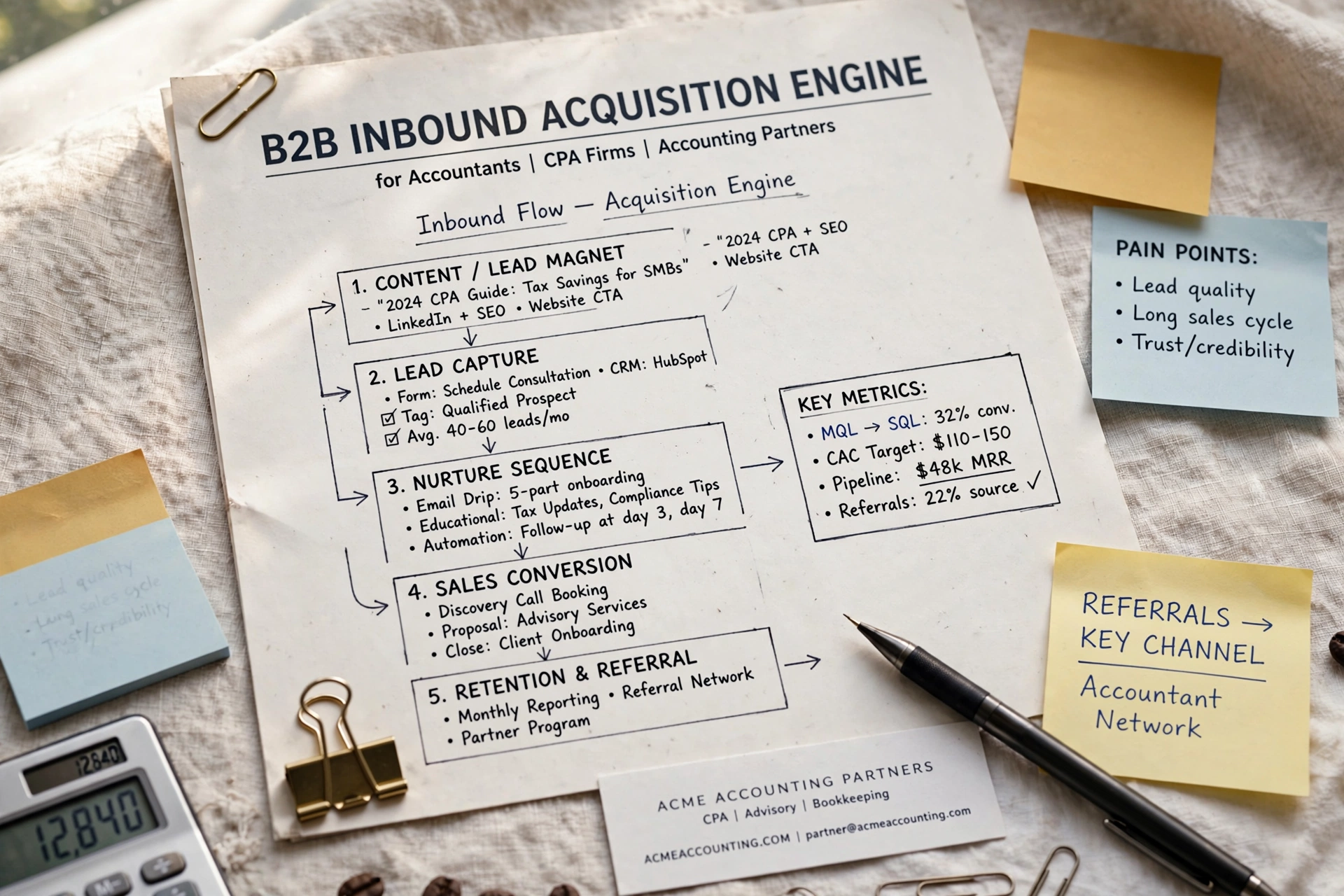
Solar installers and wind turbine developers are currently fighting a losing battle with outbound sales and expensive lead lists that are outdated before the first call is made. A b2b inbound acquisition engine for clean energy providers is a programmatic system that combines massive-scale search visibility (PSEO) with autonomous AI qualification to turn your website from a brochure into a 24/7 lead-closing machine. Instead of chasing facility managers, you build a topical authority hub that captures decision-makers at the exact moment they search for energy efficiency audits, carbon credit optimization, or commercial PPA structures, automatically qualifying them via AI agents before they ever reach your calendar.

In my experience working with clean energy firms, the biggest bottleneck isn't the technology or the financing; it is the cost of acquisition (CAC). Most providers rely on a handful of sales reps doing manual outreach. By shifting to a programmatic inbound model, I've seen companies reduce their cost per lead by over 60% while increasing the average contract value, because the leads coming in are already educated and high-intent. To truly dominate the 2026 market, you need to understand the shift toward GEO vs Traditional SEO to ensure your brand is the primary recommendation in AI-driven search engines.
Why Clean Energy Providers Are Adopting Inbound Acquisition Engines?
The shift toward a structured inbound engine is driven by a fundamental change in how B2B procurement works in the energy sector. According to Gartner, nearly 80% of B2B buyers now prefer remote human interactions or digital self-service over traditional face-to-face sales meetings. For clean energy providers, this means the 'handshake deal' at a trade show is being replaced by a digital research phase where the company with the most comprehensive, accessible technical data wins the trust of the CFO.
Furthermore, the complexity of government incentives and tax credits in 2026 requires a level of educational content that a manual sales team cannot scale. When a corporate entity looks for a "commercial solar provider for textile factories in the Midwest," they aren't looking for a generic landing page; they are looking for specific data on ROI, kilowatt-hour savings, and regulatory compliance. By deploying a PSEO architecture guide for SaaS & Enterprise B2B Growth adapted for the energy sector, providers can create thousands of hyper-specific pages that answer these granular queries.
According to the International Energy Agency (IEA), the pace of renewable energy deployment is accelerating, but the fragmentation of the market means that visibility is now the primary competitive advantage. If your firm is not appearing as the definitive authority on specific regional or industry-level energy challenges, you are essentially handing your market share to competitors who have automated their organic growth. The goal is to stop renting attention from Google Ads and start owning the topical territory.
What Are the Key Benefits for Clean Energy Providers?
Implementing a dedicated acquisition engine moves your business from a reactive sales posture to a proactive, compounding growth model. The primary advantage is the removal of the "sales plateau," where your growth is limited by the number of hours your SDRs can spend on the phone.
Total Dominance of Long-Tail Search Intent
Most energy companies bid on broad keywords like "commercial solar." These are expensive and high-competition. A programmatic engine allows you to target long-tail queries—such as "best wind turbine maintenance for agricultural cooperatives in Ohio"—across hundreds of variations. This captures buyers who are much further along in the decision-making process and are ready to book a consultation. This is why understanding how to automate organic traffic & lead capture with AI is the difference between struggling for leads and having a full pipeline.
Autonomous Qualification and 24/7 Booking
In the traditional model, a lead fills out a form and waits 24 to 48 hours for a callback. In that window, the lead's intent drops significantly. A modern engine uses an AI SDR that engages the user instantly. The AI can ask about the facility's square footage, current energy spend, and goals for carbon neutrality, scoring the lead in real-time. This removes the friction of manual screening and allows your human experts to focus only on high-value closing calls. This efficiency is a core reason why many are analyzing the AI SDR vs Human SDR ROI to optimize their overhead.
Compounding Asset Value
Paid ads are a utility; the moment you stop paying, the leads stop flowing. An organic inbound engine is an asset. Every page created and every backlink earned increases the enterprise value of your company. By the time you reach 1,000 optimized pages, you have a moat that competitors cannot simply "outspend" with a higher ad budget.
💡
Key Takeaway
The transition from outbound to a programmatic inbound engine reduces lead friction and creates a self-sustaining traffic asset that lowers CAC over time.
| Feature | Traditional Outbound/Ads | Generic AI Content | BizAI Inbound Engine |
|---|---|---|---|
| Lead Quality | Mixed (Cold Calls) | Low (Generic Traffic) | High (High-Intent PSEO) |
| Scaling Speed | Linear (Hire more reps) | Fast but shallow | Exponential & Authoritative |
| Cost Structure | High Monthly Spend | Low but ineffective | Investment in Asset |
| Lead Handling | Manual Callback | Static Form | Autonomous AI Booking |
Real-World Examples from the Clean Energy Sector
To understand the impact of this system, we have to look at the delta between manual lead generation and algorithmic acquisition. I have seen this play out across various sub-sectors of the green energy economy.
Example 1: The Industrial Solar Developer
Before implementing a programmatic approach, a mid-sized developer relied on LinkedIn outreach and a small Google Ads budget. They were averaging 15-20 leads per month with a cost per lead (CPL) of $250. By deploying a b2b inbound acquisition engine for clean energy providers, they created 400 satellite pages targeting specific industrial niches (e.g., "Solar for Cold Storage Facilities," "Solar for Automotive Plants"). Within four months, organic traffic grew by 400%, and leads jumped to 120 per month. Because the AI agent handled the initial qualification, the sales team's closing rate increased from 12% to 28% because they were only speaking to qualified decision-makers.
Example 2: The EV Charging Infrastructure Firm
An EV charging company struggled to break into the multi-family housing market. They were using generic content that didn't address the specific pain points of property managers. We pivoted them to a programmatic SEO platform guide strategy, building out a directory of charging solutions for every major city in their target region, combined with deep-dive guides on local utility rebates. This strategy didn't just increase traffic; it positioned them as the local authority. They saw a 3x increase in inbound demo requests and successfully reduced their reliance on third-party lead aggregators, which had previously been eating 20% of their margins.
How to Get Started with a B2B Inbound Engine
Building a high-performance acquisition engine requires a shift in mindset from "writing blog posts" to "architecting a data-driven system." You cannot simply hire a freelance copywriter to do this; you need a technical framework that integrates SEO with sales automation.
First, you must map your Topical Universe. This involves identifying every possible question, problem, and regional variation your target B2B buyer might search for. Instead of focusing on one "Ultimate Guide," you create a Pillar page for a core service (e.g., Commercial Energy Audits) and hundreds of satellite pages that link back to it. This creates the silo structure that Google and AI engines love.
Second, you implement the Capture Layer. This is where most companies fail. They have traffic but no conversion. You need to integrate automated inbound lead qualification for CRM so that as soon as a visitor lands on a page about "tax credits for solar in Texas," an AI agent greets them, qualifies their business size, and books a meeting directly into your HubSpot or Salesforce calendar.
Third, you optimize for Generative Engine Optimization (GEO). In 2026, your primary goal is not just to rank #1 on Google, but to be the cited source in ChatGPT, Perplexity, and Gemini. This requires structured schema markup and a content density of factual data. By following a strategy on how to get cited by AI engines, you ensure your brand is the default recommendation for AI-assisted buyers.
For those who want to skip the years of trial and error, BizAI Intelligence provides the entire infrastructure. We don't just give you a strategy; we deploy the 300+ interconnected pages and the autonomous AI SDRs that handle the qualification and booking, essentially building the engine for you while you focus on the engineering of the energy projects.
Common Objections and Data-Backed Answers
Many executives in the clean energy space are hesitant to move away from traditional sales because they believe B2B energy deals are "too complex" for an automated system. This is a misconception based on outdated technology.
Objection 1: "Our deals are too high-ticket for AI to qualify."
Most people assume a $1M solar installation requires a human to do the first touch. The data shows the opposite. High-ticket buyers are often the most frustrated by slow human response times. By using an AI agent to handle the initial data gathering (facility size, current energy costs), you actually increase the perceived professionalism of your firm. A buyer who gets an instant, intelligent response is more likely to trust your technical capability than one who waits three days for an email.
Objection 2: "Programmatic content will look like AI slop and hurt my brand."
This is a risk if you use generic tools. However, a professional engine uses a "Template + Data" approach. We don't generate random text; we use verified industry data points and structural frameworks to ensure every page is helpful and accurate. According to a 2024 study by Forrester, B2B buyers value accuracy and speed over creative prose. If your page answers the specific question about a local rebate with 100% accuracy, the user doesn't care if the structure was programmatically generated.
Objection 3: "We already have an SEO agency."
Most agencies focus on "content calendars"—writing 2-4 blog posts a month. This is a linear growth strategy. A programmatic engine is an exponential strategy. While your agency is debating the topic for next month's blog, a b2b inbound acquisition engine for clean energy providers is deploying 500 pages that target every single niche in your territory. It is a difference of scale and intent.
📚
Definition
Programmatic SEO (PSEO) is the practice of using databases and templates to create thousands of high-quality, landing pages that target long-tail keywords at scale.
Frequently Asked Questions
How long does it take to see a return on a B2B inbound engine?
While traditional SEO can take 6-12 months to show results, a programmatic engine integrated with the Google Indexing API can begin generating impressions within weeks. In the clean energy sector, we typically see a significant spike in qualified lead volume between month 2 and month 4. This is because we target long-tail, low-competition queries that allow the site to gain immediate traction before moving up to the more competitive high-volume terms. The ROI is realized when the cost per lead drops below your previous outbound average.
Can an AI agent actually book a commercial energy consultation?
Yes, and it does so more effectively than a human SDR in many cases. Modern AI agents are integrated via webhooks into calendars like Calendly or Google Calendar and CRMs like Salesforce. They don't just "chat"; they follow a qualification script. For example, the agent will ask, "Is your annual energy spend over $50,000?" and "Do you own the roof of the facility?" If the answer is no, it can politely redirect the user to a resource page. If yes, it offers a live booking link. This ensures your sales team's calendar is only filled with high-probability deals.
Is programmatic SEO compliant with Google's helpful content updates?
Absolutely, provided the content provides genuine value. Google does not penalize "programmatic" content; it penalizes "unhelpful" content. The key is to ensure that each page solves a specific problem for the user. By incorporating real data, local regulations, and specific technical specifications for clean energy equipment, the pages become highly useful resources. When you use a system like BizAI Intelligence, the focus is on deep research and structured data, ensuring you remain compliant with E-E-A-T guidelines.
How does this differ from just running more Google Ads?
Google Ads are a temporary lease on traffic. If you stop paying, your lead flow drops to zero instantly. An inbound acquisition engine is an ownership model. You are building a digital asset that generates leads for free over time. Additionally, users often perceive organic search results as more trustworthy than "Sponsored" links, especially in the B2B energy space where authority and reliability are paramount. Over a 24-month period, the cost per acquisition for an organic engine is typically 70-90% lower than paid search.
Do I need to provide the data for the programmatic pages?
While having your own proprietary data is a huge advantage, most of the necessary data for clean energy (regional incentives, general equipment specs, energy benchmarks) is available through industry reports and government databases. Our process involves aggregating this data and structuring it into your high-conversion templates. We combine this with your unique value propositions to ensure the content isn't just factual, but also persuasive and aligned with your brand's specific sales goals.
Final Thoughts on B2B Inbound Acquisition Engine for Clean Energy Providers
The clean energy transition is creating a gold rush of commercial opportunities, but the companies that win will not be those with the loudest sales teams, but those with the most efficient acquisition systems. Relying on outdated outbound methods in 2026 is a recipe for stagnation. By building a b2b inbound acquisition engine for clean energy providers, you stop fighting for attention and start attracting the most qualified buyers in your industry.
Whether you are scaling a solar installation firm or a wind energy consultancy, the goal is the same: total topical dominance and autonomous lead conversion. Stop wasting budget on leads that don't convert and start building an asset that fills your pipeline while you sleep. If you're ready to automate your growth and dominate your niche, explore the power of BizAI Intelligence and let us build your organic lead machine.
AI Search Accelerator: 1-on-1 Strategy Session
Claim one of the 10 monthly slots. Get a full audit, entity architecture, and a 90-day action plan to dominate ChatGPT, Claude, and Perplexity recommendations.