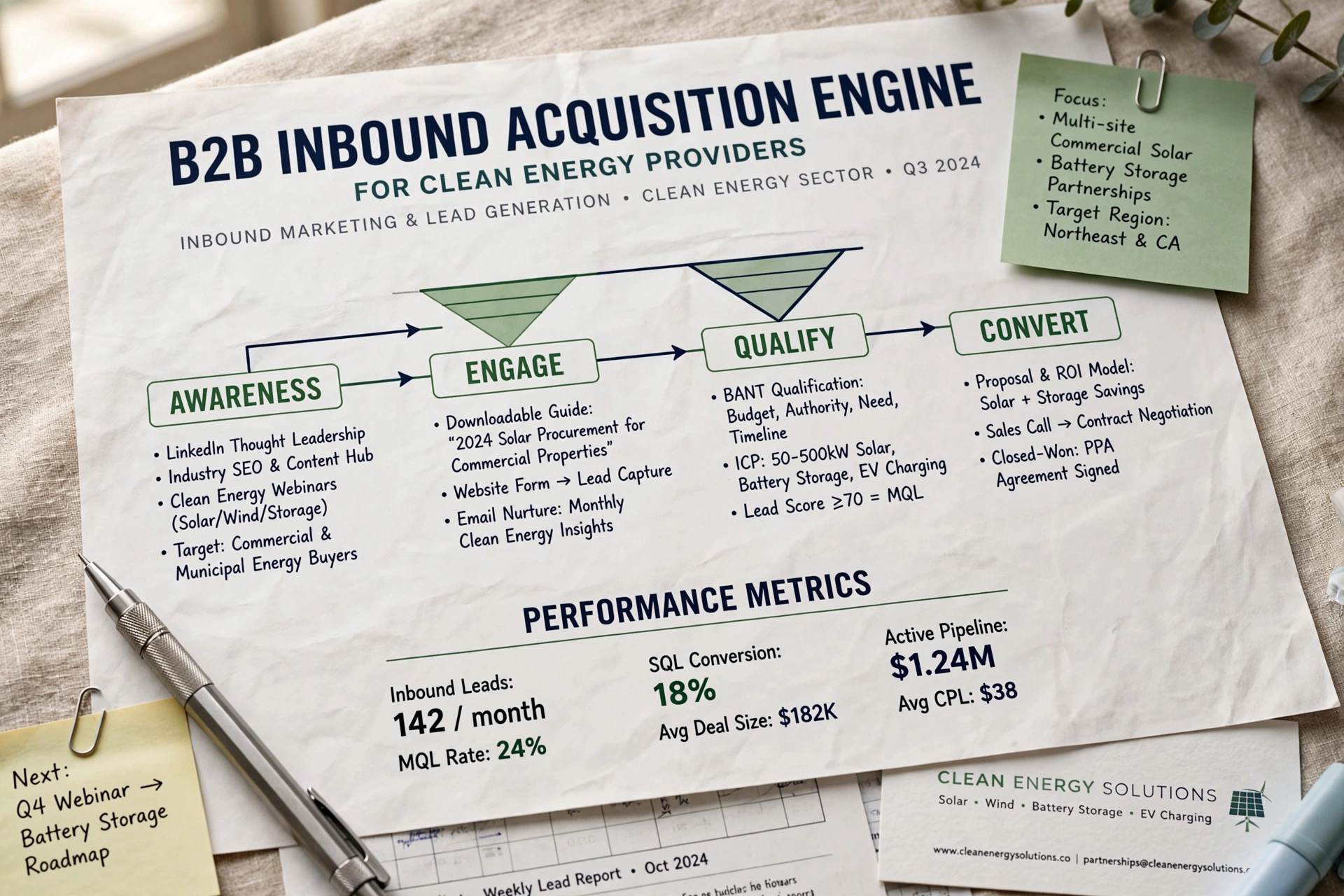
Most accounting firms are trapped in a cycle of referral dependency or overpriced Google Ads that attract low-quality 'price-shopper' leads. A b2b inbound acquisition engine for accountants is a systemic integration of Programmatic SEO (PSEO) and Autonomous AI Sales Agents designed to capture high-intent business owners searching for specific tax, audit, or fractional CFO solutions, qualifying them instantly, and booking them directly into your calendar without manual intervention. This approach shifts the firm from renting traffic to owning a digital asset that compounds in value over time.
In my experience working with accounting and professional service firms, the biggest bottleneck isn't the quality of the accounting work, but the friction in the acquisition process. I've seen partners spend 10+ hours a week vetting leads that are ultimately a bad fit. By implementing an automated system, these firms transition from 'hope-based marketing' to a predictable pipeline of qualified B2B clients. This is why modern firms are moving toward AI search engine optimization & GEO to ensure they appear in AI-generated answers where B2B decision-makers now start their research.
Why Accounting Firms Are Adopting B2B Inbound Engines in 2026?
The accounting industry is facing a massive shift in how B2B clients discover service providers. The traditional 'word-of-mouth' model is no longer sufficient for firms looking to scale beyond a local neighborhood. Business owners in 2026 do not just ask for a referral; they verify that referral by searching for specific expertise in AI-powered search engines. According to a Gartner report, by 2026, traditional search engine volume will decline as users pivot toward generative AI interfaces for complex professional queries. This means if your firm isn't architected for Generative Engine Optimization (GEO), you are effectively invisible to the highest-paying segment of the market.
Furthermore, the talent shortage in the accounting sector has made the cost of manual lead qualification prohibitively expensive. When a senior partner spends time on a discovery call with a lead that doesn't meet the firm's minimum revenue threshold, it is a direct loss of billable hours. The adoption of an inbound engine allows the firm to automate the 'top of the funnel.' By deploying hundreds of satellite pages targeting long-tail queries—such as 'tax optimization for SaaS companies in New York' or 'fractional CFO services for healthcare startups'—firms can attract a hyper-specific audience.
This shift is further accelerated by the need for absolute precision in lead scoring. Research from McKinsey suggests that B2B buyers are now 70% through their decision-making process before they even contact a sales representative. An inbound engine captures this intent early. Instead of a static 'Contact Us' form, an AI-driven engine interacts with the visitor in real-time, asking about their annual turnover, current pain points, and urgency. This ensures that by the time a lead reaches the partner's calendar, they are already pre-qualified and educated on the firm's value proposition. For those looking to optimize this process, understanding how to automate organic traffic & lead capture with AI is the first step toward operational efficiency.
Key Benefits of a B2B Inbound Acquisition Engine for Accountants
The fundamental advantage of an inbound engine over traditional marketing is the transition from linear growth to exponential growth. Traditional lead generation is linear: you pay for an ad, you get a lead. If you stop paying, the leads stop. An inbound engine is a compounding asset.
Autonomous Lead Qualification and Booking
One of the most significant drains on an accounting firm's ROI is the 'lead leakage' that occurs between the first touchpoint and the first meeting. Most firms take hours or even days to respond to an inquiry. In the B2B world, speed to lead is everything. An autonomous engine utilizes AI SDRs that act as 24/7 sales representatives. These agents don't just collect an email; they conduct a qualification screen. They can determine if a lead is a 'whale' client or a low-margin prospect based on real-time data. This allows the firm to prioritize high-value targets automatically. For a deep dive into the technical side, explore how AI appointment setters automate B2B demo booking 24/7.
Topical Authority Through Programmatic Scale
Most accounting websites have five pages: Home, About, Services, Blog, and Contact. This is a ghost town in the eyes of Google and LLMs. A b2b inbound acquisition engine for accountants utilizes a 'Hub and Spoke' or Pillar-Satellite architecture. By creating a massive web of interconnected pages covering every possible niche—from R&D tax credits for biotech to payroll compliance for construction firms—the firm establishes itself as the definitive authority in its region and sector. When you dominate 300+ specific search queries, you don't just get traffic; you get trust.
Reduction in Customer Acquisition Cost (CAC)
Paid ads for 'B2B Accountant' or 'CPA Firm' are among the most expensive keywords in search. By shifting the focus to long-tail, high-intent satellite pages, firms can capture leads at a fraction of the cost. Because these pages answer specific problems, the conversion rate is significantly higher than a generic landing page. This creates a sustainable model where the organic traffic engine fuels the growth of the firm without increasing the monthly marketing budget.
💡
Key Takeaway
The primary value of an inbound engine is the replacement of manual, expensive lead vetting with an automated system that converts organic intent into booked appointments.
Comparison: Lead Acquisition Models for Accountants
| Feature | Traditional Referrals | Paid Ads (PPC) | BizAI Inbound Engine |
|---|---|---|---|
| Predictability | Low (Random) | High (Pay-to-play) | Very High (Compounding) |
| Lead Quality | Variable | Often Low (Price-shoppers) | High (Pre-qualified by AI) |
| Effort | Networking Heavy | Budget Heavy | Architecture Heavy (Initial) |
| Scalability | Limited by Network | Limited by Budget | Unlimited via PSEO |
| Response Time | Manual/Slow | Manual/Slow | Instant (24/7 AI SDR) |
📚
Definition
Programmatic SEO (PSEO) is the practice of using a database and templates to generate hundreds or thousands of high-quality, landing pages that target long-tail keywords at scale.
Real-World Examples of Inbound Engine Success
To understand the impact of a b2b inbound acquisition engine for accountants, we must look at the data from firms that have moved away from generic digital marketing toward algorithmic growth.
Case Study 1: The Mid-Sized Tax Firm Shift
Consider a mid-sized tax firm in the Midwest that relied on a mix of local referrals and a basic website. They were averaging 15-20 organic leads per month, most of them small sole proprietorships. By implementing a programmatic architecture, they deployed 400 satellite pages targeting specific industry tax codes and state-level compliance queries.
Within six months, their organic traffic increased by 420%. More importantly, the lead profile shifted. Instead of sole proprietors, they began attracting manufacturing companies with $5M+ in annual revenue. By integrating an AI SDR to qualify these leads, they reduced the partner's time spent on discovery calls by 65%, while increasing the average contract value (ACV) by 30%. This is a classic example of how programmatic SEO case studies demonstrate the power of scaling intent-based pages.
Case Study 2: The Fractional CFO Boutique
A boutique consultancy specializing in fractional CFO services for tech startups was spending $4,000/month on LinkedIn Ads with a fluctuating ROI. They transitioned to an inbound engine that focused on 'Problem-Solution' pages (e.g., 'How to manage burn rate for Series A startups').
By focusing on GEO and ensuring their content was structured for LLM citations, they started appearing in Perplexity and ChatGPT as a recommended expert for startup finance. This 'AI-driven referral' system, combined with a comprehensive AI SDR and autonomous appointment setter, led to a 4x increase in qualified demo bookings. They were able to kill their ad spend entirely because the organic engine was producing more high-ticket leads than their team could actually handle.
How to Get Started with a B2B Inbound Acquisition Engine
Building a high-performance engine requires a shift in mindset from 'content creation' to 'systems engineering.' You are not writing a blog; you are building a lead-capture machine.
Step 1: Map Your High-Value Clusters
Start by identifying the most profitable niches you serve. If you are an accountant, don't target 'all businesses.' Target 'Medical Practices,' 'E-commerce Brands,' and 'Construction Firms.' Create a pillar page for each, then brainstorm 50-100 questions each of those clients asks. These questions become your satellite pages. This structure is the foundation of a PSEO architecture guide for SaaS & Enterprise B2B growth, which applies equally to professional services.
Step 2: Deploy Programmatic Infrastructure
Rather than writing pages one by one, use a programmatic approach. Create a high-converting template that includes an educational section, a comparison table, and a strong call to action. Populate this template with data specific to each niche. Ensure every page has the correct Schema.org markup so that Google and AI engines understand the entity relationship between your firm and the service provided.
Step 3: Integrate an Autonomous AI SDR
This is where most firms fail. They get the traffic but use a 2010-style contact form. To truly build a b2b inbound acquisition engine for accountants, you must embed an AI agent. This agent should be programmed with your firm's ideal client profile (ICP). It should ask: 'What is your annual revenue?', 'Are you looking for tax strategy or basic compliance?', and 'What is your primary goal for the next 12 months?'. If the lead qualifies, the AI should offer a calendar link immediately. Learning how to connect AI sales agents to CRM & webhooks for auto-booking transforms your website from a brochure into a salesperson.
Step 4: Optimize for Generative Engine Optimization (GEO)
In 2026, you must optimize for the 'Answer Engine.' This means using structured data, citing authoritative sources, and creating content that is easily extractable by LLMs. This involves implementing /llms.txt and ensuring your brand is mentioned in association with high-authority industry terms. For more on this, see our guide on GEO vs Traditional SEO.
BizAI Intelligence simplifies this entire process by providing the programmatic engine and the AI SDR in a single integrated system. Instead of hiring an SEO agency, a copywriter, and a virtual assistant to vet leads, you deploy one system that handles the entire acquisition flow.
Common Objections and Data-Backed Answers
Many accounting partners are skeptical of automation because their business is built on 'trust' and 'personal relationships.' However, the data shows that automation actually enhances trust by providing immediate value.
'AI Will Make My Firm Feel Impersonal'
Most partners assume that an AI agent removes the human touch. In reality, the opposite is true. The 'impersonal' part of the process is making a client wait 48 hours for a callback. An AI agent provides instant gratification and professional qualification, which signals to the client that your firm is technologically advanced and efficient. According to a Forrester report, B2B buyers now prefer a seamless digital self-service experience for the initial discovery phase over forced human interaction.
'We Already Have Enough Referrals'
This is the most dangerous objection. Referral-based growth is fragile; it is a 'black box' that you cannot control or scale. If your primary referral source slows down, your growth stops. An inbound engine provides a diversified acquisition channel. In my experience, firms that combine strong referrals with an inbound engine can command higher fees because they are perceived as industry leaders rather than just 'a guy I know.'
'PSEO is Just Spammy Content'
There is a misconception that programmatic SEO means low-quality AI slop. True PSEO—like the framework used by BizAI Intelligence—is about providing the right answer to a specific query. A business owner doesn't want a 3,000-word general guide on taxes; they want a 500-word specific answer on 'tax credits for LEED-certified buildings in Florida.' By providing high-utility, niche-specific answers at scale, you are providing more value than a generic blog ever could.
Frequently Asked Questions
How does a b2b inbound acquisition engine for accountants differ from standard SEO?
Standard SEO typically focuses on a few high-volume keywords and a monthly blog schedule. This is slow and often targets the wrong intent. An inbound acquisition engine uses Programmatic SEO to target hundreds of low-volume, high-intent 'long-tail' keywords simultaneously. While standard SEO tries to rank for 'Accountant in New York,' an engine ranks for 'R&D tax credit specialist for biotech firms in New York.' Furthermore, the engine integrates an AI SDR to ensure that the traffic actually converts into a booked appointment, whereas standard SEO ends at the 'click.'
Will this system work for small firms or only enterprise-level practices?
Actually, small to mid-sized firms often see the highest ROI from this system. Large firms have massive brand equity and can rely on their name. Small firms need a 'force multiplier' to compete. By dominating specific niches programmatically, a small firm can appear as a national authority in a particular sector, allowing them to win contracts against much larger competitors. The scalability of the AI SDR also means a small team can manage a lead volume that would normally require a full-time sales department.
How long does it take to see a return on investment from an inbound engine?
Unlike paid ads, which are instant but stop the moment you stop paying, an inbound engine has a ramp-up period. Typically, you see a significant increase in indexed pages and initial traffic within the first 30 to 60 days. However, the 'compounding' effect usually kicks in around month 3 or 4. At this point, the cost per lead drops drastically because the organic assets are doing the heavy lifting. In many cases, firms find that the engine pays for itself within the first two high-ticket clients acquired through the system.
Can an AI SDR really handle complex accounting qualification?
Yes, provided the AI is programmed with a strict logic tree and a deep knowledge base. A professional AI SDR doesn't try to give tax advice; it performs 'firm-fit' qualification. It can be trained to recognize specific triggers—such as a company's revenue size, their current software stack (e.g., QuickBooks vs. NetSuite), and their specific pain points. By the time the AI books the meeting, it provides the partner with a full summary of the lead's profile, making the actual discovery call far more productive.
What happens if the AI provides incorrect information to a potential client?
This is why a professional engine uses a 'constrained' LLM approach. The AI agent is not allowed to hallucinate or give professional advice. It is programmed as a 'concierge'—its only goal is to qualify the lead and book the meeting. If a user asks a complex technical question, the AI is instructed to say: 'That is a great question that requires a professional analysis. Our partner, [Name], can answer that specifically during your consultation. Would you like to book a time now?' This protects the firm's liability while still moving the lead toward a conversion.
Final Thoughts on B2B Inbound Acquisition Engine for Accountants
The gap between firms that use a b2b inbound acquisition engine for accountants and those that rely on outdated referral models is widening. In 2026, the ability to capture organic intent at scale and qualify it autonomously is the only way to scale a professional service firm without exponentially increasing headcount. By shifting your focus from 'getting more leads' to 'building an acquisition system,' you stop chasing the market and start owning it.
If you are ready to stop renting your traffic from Google Ads and start building a compounding asset that fills your pipeline while you sleep, it is time to implement a professional framework. BizAI Intelligence provides the exact architecture needed to dominate your niche and automate your booking process.
Visit bizaigpt.com to see how we can build your organic traffic machine.
AI Search Accelerator: 1-on-1 Strategy Session
Claim one of the 10 monthly slots. Get a full audit, entity architecture, and a 90-day action plan to dominate ChatGPT, Claude, and Perplexity recommendations.