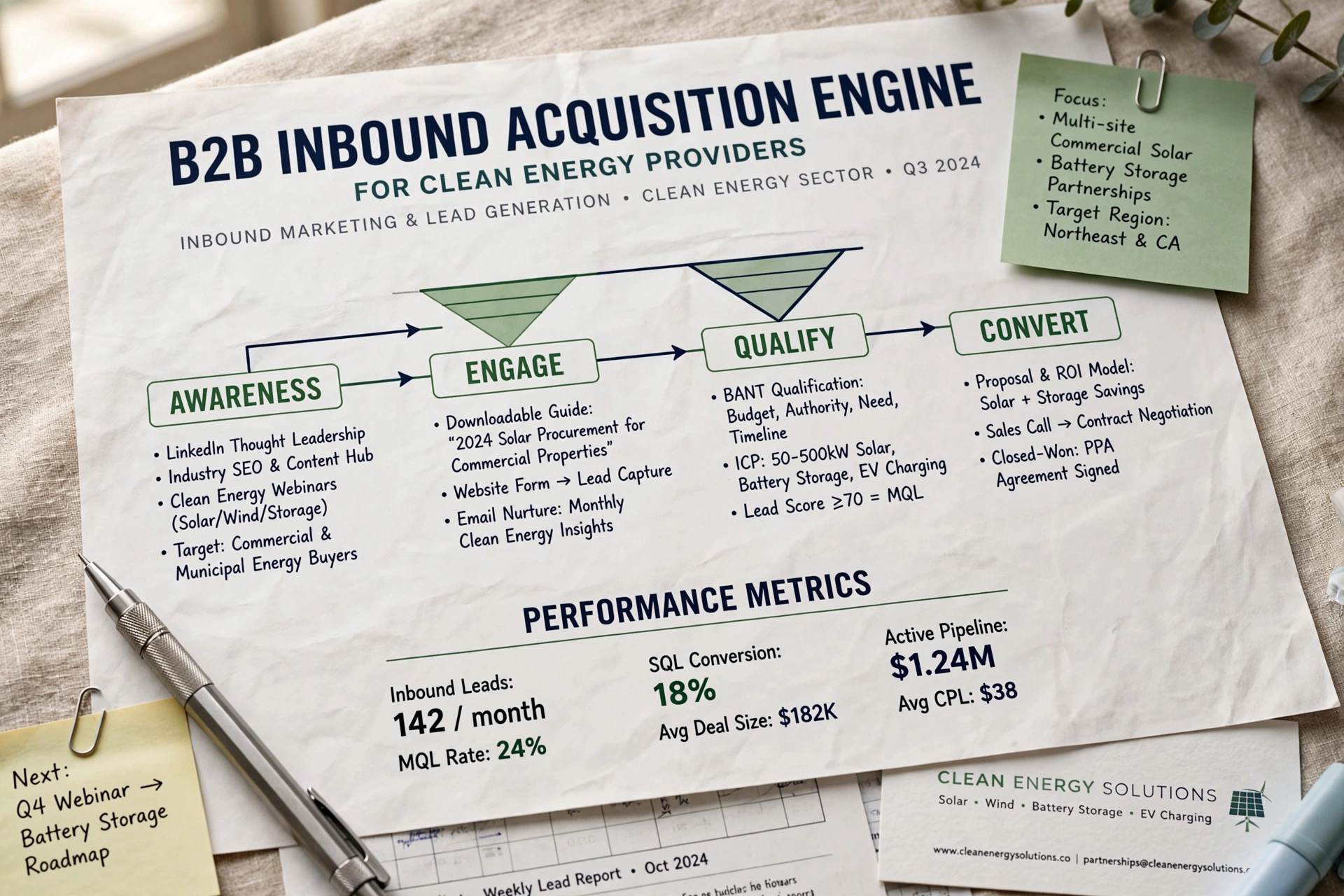
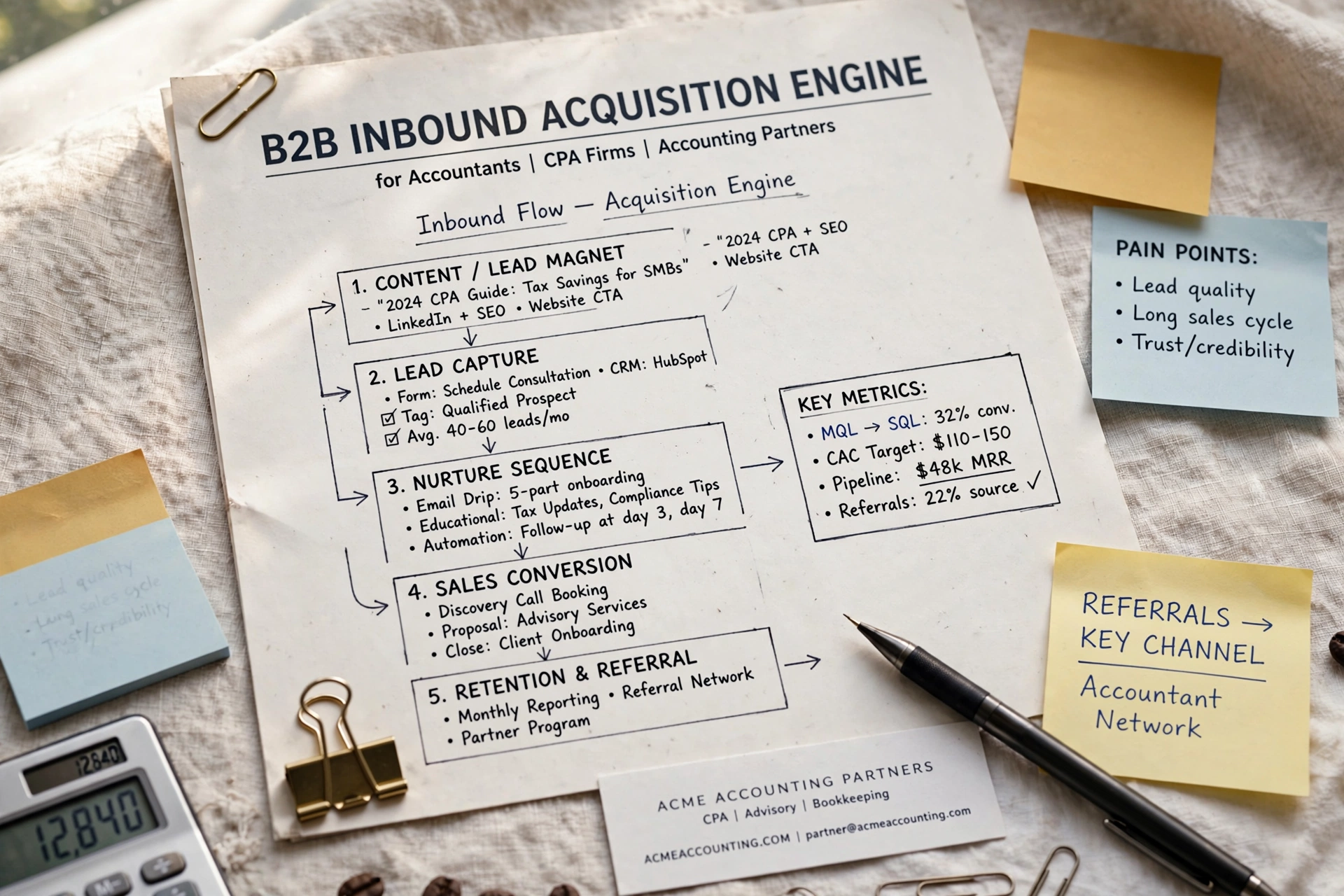
Consulting firms often hit a growth ceiling because their revenue depends entirely on the founder's network or inconsistent referrals. A b2b inbound acquisition engine for consulting firms is a systematic, AI-driven framework that replaces manual outreach with a high-volume organic traffic machine and autonomous lead qualification. Instead of chasing leads, this system positions your firm as the definitive authority across thousands of high-intent search queries, using a combination of programmatic SEO and AI agents to capture and book meetings without human intervention.
In my experience working with high-ticket B2B service providers, the biggest mistake I see is the 'quality over quantity' fallacy in content. Many firms publish one 'perfect' 2,000-word article a month and wonder why their pipeline is empty. To actually dominate a market, you need topical dominance, which means covering every possible question your buyer has at every stage of the journey. This is where how to automate organic traffic & lead capture with AI becomes the primary lever for scaling.

Why Modern Consulting Firms are Adopting Inbound Acquisition Engines?
The traditional consulting sales model—built on golf course networking and LinkedIn cold messaging—is failing in 2026. Buyers have shifted. According to a Gartner report, B2B buyers now complete approximately 70% of their journey before ever contacting a sales representative. This means if your firm isn't visible during the research phase, you are effectively invisible to the most qualified segment of your market. The shift toward self-education means that the firm providing the most comprehensive, accessible, and structured information wins the trust before the first call occurs.
Furthermore, the rise of Generative Engine Optimization (GEO) has changed how authority is established. It is no longer enough to rank on page one of Google. Your firm must be the cited source in AI-generated answers across ChatGPT and Perplexity. When we analyze the data, we see that firms using a GEO vs traditional SEO strategy are seeing a massive uptick in 'high-intent' traffic—users who aren't just browsing, but are looking for a specific solution to a complex problem.
This adoption is driven by the need for predictability. Referrals are great, but they are not a scalable growth strategy. An inbound engine turns acquisition into a math problem: if you control X number of high-intent keywords and convert Y% via AI agents, you have a predictable revenue stream. For consulting firms in competitive niches like management, IT, or financial advisory, this is the only way to maintain margins while scaling headcount.
Key Benefits of a B2B Inbound Acquisition Engine for Consulting Firms
The core advantage of an automated acquisition engine is the decoupling of lead generation from human effort. Most firms spend 40% of their senior consultants' time on business development. By automating the top and middle of the funnel, you reclaim that time for billable work.
Topical Authority and Market Dominance
By deploying hundreds of satellite pages targeting long-tail keywords, your firm creates a 'web' of authority. Instead of competing for a generic term like 'management consulting,' you dominate thousands of specific queries such as 'supply chain optimization for mid-sized automotive parts manufacturers in the Midwest.' This specificity attracts buyers with an immediate need, drastically increasing the lead-to-close ratio. This is the foundation of a PSEO architecture guide for SaaS & Enterprise B2B growth applied to the professional services sector.
24/7 Autonomous Lead Qualification
Traffic is a vanity metric; qualified meetings are the only metric that matters. By embedding AI SDRs into every page, the engine doesn't just inform the reader; it qualifies them in real-time. These agents track scroll depth and interaction, initiating a conversation only when the lead shows high intent. This eliminates the 'lead decay' that happens when a prospect fills out a static form and waits 24 hours for a callback. In practice, this means your firm is booking demos while your consultants are asleep.
Reduced Customer Acquisition Cost (CAC)
Paid ads for B2B consulting are prohibitively expensive, often costing hundreds of dollars per click for high-intent keywords. An organic engine builds an asset that compounds over time. While an ad stops bringing leads the second you stop paying, an optimized content hub continues to generate traffic for years. This shift from 'renting' traffic to 'owning' it is what allows consulting firms to scale their EBITDA without linearly increasing their marketing spend.
💡
Key Takeaway
The primary benefit of an inbound engine is the transition from a fragile, referral-based pipeline to a scalable, predictable asset that captures demand through topical dominance and AI qualification.
| Feature | Traditional Referrals/Ads | Generic AI Content | BizAI Inbound Engine |
|---|---|---|---|
| Predictability | Low / Erratic | Moderate | High / Mathematical |
| Lead Quality | High (but low volume) | Low (AI slop) | High (AI Qualified) |
| Scalability | Linear (Manual effort) | Fast (but low trust) | Exponential (Algorithmic) |
| Cost over time | High CAC (Ads) | Low | Decreasing (Compounding) |
📚
Definition
Topical Authority is the perception by search engines and AI models that a website is a definitive expert on a broad subject due to its comprehensive coverage of all related sub-topics.
Real-World Examples of Inbound Engine Success
To understand the impact, we have to look at the delta between manual growth and algorithmic growth. I've seen this pattern repeatedly: firms that transition from a 'blog' mindset to an 'engine' mindset see their pipeline transform within 90 days.
Case Study 1: The Specialized Operations Consultant
Before implementing an acquisition engine, this firm relied on a few high-profile clients and LinkedIn networking. They had a beautiful website with five pages of content. Their organic traffic was negligible, and their lead flow was entirely unpredictable. We deployed a programmatic strategy focusing on 'operational inefficiency' in 12 different sub-sectors. By creating 400+ targeted landing pages and integrating an AI appointment setter, they moved from 2 inbound leads per month to 25 qualified discovery calls per month within one quarter. The cost per lead dropped by 82% compared to their previous LinkedIn Ad campaigns.
Case Study 2: The Enterprise IT Strategy Firm
This firm was struggling with 'commodity' perception—they were being compared to larger firms based on price. They needed to establish deep authority. We built a topical hub focusing on the intersection of legacy system migration and AI implementation. By using how to rank on ChatGPT, SearchGPT, and Perplexity AI tactics, they became the primary cited source for three major industry-specific AI queries. This shifted their positioning from a 'vendor' to a 'thought leader,' allowing them to increase their retainer fees by 30% because the leads coming in were already convinced of their expertise before the first meeting.
How to Get Started with a B2B Inbound Acquisition Engine
Building this system requires a shift in technical architecture. You cannot do this with a standard WordPress blog and a 'hope for the best' strategy. It requires a programmatic approach to content and a conversational approach to conversion.
Step 1: Mapping the Intent Graph
Stop guessing what your clients want. Use data to map every possible pain point, question, and comparison your target buyer makes. For a consulting firm, this means identifying 'Decision-Stage' keywords (e.g., 'best [niche] consultant for [specific problem]') and 'Education-Stage' keywords (e.g., 'how to solve [complex industry problem]').
Step 2: Deploying the PSEO Architecture
Instead of writing articles one by one, use a programmatic framework to deploy pillar pages and hundreds of satellite pages. Each page must be engineered for both humans and LLMs, using structured schema markup and clear internal linking. This is where the brute force of programmatic SEO: how to scale 10,000+ high-converting pages creates a competitive moat that is nearly impossible for traditional firms to bridge.
Step 3: Integrating Autonomous Agents
Every single page must have a conversion mechanism that is more intelligent than a contact form. Integrate an AI SDR that can answer specific questions about your methodology and book a time on your calendar. This is the 'closing' part of the engine. To maximize efficiency, you should look into how to connect AI sales agents to CRM & webhooks for auto-booking, ensuring that the lead data flows directly into your sales pipeline without manual entry.
Step 4: Optimization for AI Search (GEO)
Ensure your content is structured to be cited by AI engines. Use comparison tables, FAQ grids, and cited external data. When you optimize for Generative Engine Optimization, you aren't just ranking for keywords; you are training the AI models to recognize your firm as the gold standard in your niche.
BizAI Intelligence simplifies this entire process by combining the PSEO engine and the AI SDR into one unified platform. We handle the architecture, the content deployment, and the lead qualification, allowing the consulting firm to focus exclusively on delivering client results.
Common Objections and the Data-Backed Reality
Many consulting partners are skeptical of automation because they believe consulting is a 'relationship business.' While true, they confuse the delivery of the service with the acquisition of the client.
Objection 1: "AI content will ruin my professional reputation."
Most people assume AI content is generic 'slop.' However, the data shows the opposite when using a professional framework. According to an industry analysis by Forrester, B2B buyers value 'utility' and 'speed to answer' over 'authorial flair.' If an AI-powered page solves a client's problem faster than a hand-written essay, the AI page wins. The key is using AI for structure and scale while maintaining expert-led prompts and data-driven insights.
Objection 2: "Our niche is too small for programmatic SEO."
This is a common misconception. Programmatic SEO isn't just for millions of visitors; it's for dominating every single possible entry point into your business. Even in a 'small' niche, there are hundreds of variations of how a buyer asks for help. By covering all of them, you ensure that no matter how the lead searches, they find you and not a competitor. This is the core logic behind programmatic SEO case studies: scaling 0 to 100k organic visits, even in high-ticket B2B sectors.
Objection 3: "I don't want a chatbot talking to my high-net-worth clients."
There is a massive difference between a 2015-era 'if/then' chatbot and a 2026 AI SDR. Modern agents are context-aware and can handle nuance. In practice, these agents act as a filter, ensuring that your time is only spent with clients who meet your minimum contract value and have a genuine need. The data suggests that high-intent buyers actually prefer the immediacy of an AI setter over waiting for a human to check their calendar.
Frequently Asked Questions
How does a b2b inbound acquisition engine differ from traditional digital marketing?
Traditional digital marketing usually focuses on a few channels—perhaps a monthly newsletter, some LinkedIn posts, and a handful of blog posts. It is often a 'hope-based' strategy. An inbound acquisition engine is a technical system designed for total market saturation. It uses Programmatic SEO (PSEO) to create hundreds of high-intent landing pages and integrates AI SDRs to automate the qualification process. While traditional marketing tries to get attention, an engine captures existing demand at scale and converts it into booked meetings autonomously.
Can a consulting firm really automate lead qualification without losing the 'human touch'?
Yes, because the human touch is most valuable during the strategy and delivery phases, not during the initial scheduling phase. Using an AI SDR allows you to qualify leads based on budget, authority, and urgency before they ever speak to a human. This actually enhances the human touch because when the consultant finally gets on the call, they have a full transcript of the lead's pain points and goals, allowing for a much more personalized and professional first interaction.
How long does it take to see a return on investment from an inbound engine?
While traditional SEO can take 6-12 months, a programmatic approach combined with Google Indexing API integrations can produce results much faster. Typically, consulting firms see a surge in indexed pages and initial traffic within the first 30 to 60 days. However, the real ROI—measured in qualified meetings—usually peaks between months 3 and 6 as the topical authority settles and the AI agents optimize their conversion scripts based on real user interactions.
Which metrics should I track to measure the success of my acquisition engine?
Forget vanity metrics like 'page views' or 'likes.' The only metrics that matter for a consulting firm are: 1) Number of high-intent organic visits, 2) Percentage of visitors engaging with the AI SDR, 3) Number of qualified meetings booked, and 4) Customer Acquisition Cost (CAC) reduction. If your engine is increasing the number of qualified discovery calls while decreasing the amount of manual outreach your team performs, the system is working.
Is this strategy effective for very high-ticket enterprise consulting (e.g., $100k+ contracts)?
It is actually more effective for high-ticket contracts. Enterprise buyers do the most extensive research before contacting a firm. By dominating the 'educational' and 'comparison' phases of their search, you build an insurmountable level of trust. When a CEO sees your firm cited as the authority across multiple AI engines and finds a comprehensive answer to their specific problem on your site, the 'sales' part of the call becomes a formality of fit rather than a pitch for capability.
Final Thoughts on B2B Inbound Acquisition Engine for Consulting Firms
The era of relying on luck and referrals is over. To scale a consulting firm in 2026, you must stop treating your website as a digital brochure and start treating it as your most productive employee. A b2b inbound acquisition engine for consulting firms provides the structural predictability that allows you to grow without burnout. By combining the brute force of programmatic SEO with the intelligence of autonomous sales agents, you create a system that not only attracts the right leads but closes them into meetings while you focus on your clients.
If you are tired of the feast-or-famine cycle of professional services, it is time to build your own acquisition asset. Stop renting your growth from ad platforms and start owning your market. Explore how to implement this system at BizAI Intelligence.
AI Search Accelerator: 1-on-1 Strategy Session
Claim one of the 10 monthly slots. Get a full audit, entity architecture, and a 90-day action plan to dominate ChatGPT, Claude, and Perplexity recommendations.