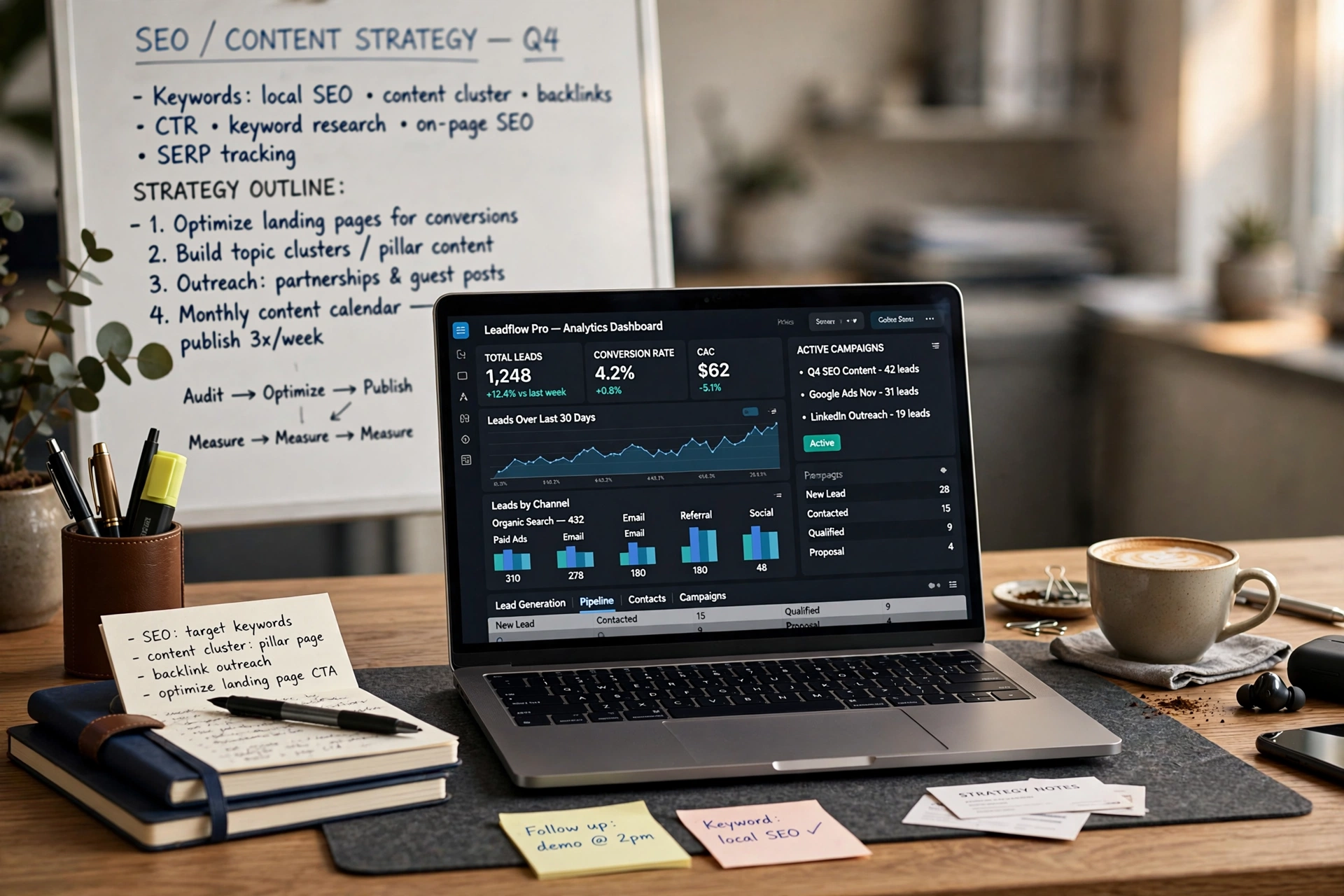
📖This article is part of the complete guide to Automatic Lead Generation B2b. Why B2B Businesses Need Automatic Lead Generation in 2026
The question every B2B founder should be asking in 2026 isn't whether to automate lead generation, it's how fast can they get it done. The era of cold calling, manual prospecting, and hoping for referrals is over. In my experience working with dozens of B2B service businesses, the shift toward autonomous acquisition has moved from "competitive advantage" to "survival requirement."
According to recent McKinsey's 2024 State of AI report industry reports, B2B companies that deploy AI for lead generation see a 50% increase in conversion rates and a 30% reduction in cost per lead. When we built the core engine at BizAI Intelligence, we discovered that the primary bottleneck for high-ticket firms isn't a lack of demand, but the friction between a buyer's intent and the moment a human salesperson actually responds.
But here is the thing most guides miss: automatic lead generation B2B isn't just about saving time. It's about building a predictable, scalable pipeline that compounds over time. When you automate the top of your funnel, you free your sales team to focus on closing, not cold outreach. For a comprehensive overview of this shift, explore our
Complete Guide to AI Search Engine Optimization & GEO.
What Is Automatic Lead Generation in B2B?
📚Definition
Automatic lead generation in B2B is the deployment of AI-driven systems, including programmatic SEO, autonomous AI agents, and intelligent workflows, to identify, attract, and qualify business buyers without manual human intervention.
Automatic lead generation B2B is the process of transforming your website from a static brochure into a 24/7 autonomous sales machine. Instead of a salesperson spending four hours a day on LinkedIn searching for prospects, the system uses search engine optimization and artificial intelligence to attract high-intent buyers who are already searching for a solution.
In a professional setup, this involves a "Dual-Engine" approach. The first engine focuses on visibility, utilizing
programmatic SEO architecture for SaaS to create hundreds of targeted landing pages. The second engine focuses on conversion, using an AI SDR (Sales Development Representative) to engage visitors, qualify their budget and authority, and book a meeting directly into a calendar.
The result is a frictionless journey. A buyer searches for a specific B2B problem, lands on a hyper-relevant page, interacts with an intelligent agent, and schedules a demo, all while your team is asleep. This is the essence of modern
digital marketing in 2026: moving from "push" marketing (interrupting people) to "pull" marketing (being found when the intent is highest).
Why Does Automatic Lead Generation Matter for B2B in 2026?
If you are still relying on manual lead generation, you are effectively leaving money on the table while your competitors use algorithmic brute force to capture your market share. The consequences of manual processes are stark: longer sales cycles, higher customer acquisition costs (CAC), and missed revenue targets.
Gartner research found that 80% of B2B buying interactions now happen without human involvement. Buyers research, compare, and reach a preliminary decision online before they ever speak to a sales representative. If your lead generation system does not capture that digital intent in real-time, you are invisible to the most qualified 80% of your market.
The impact of automation is most visible in three key areas:
- Drastic Cost Reduction: Manual lead generation typically costs between $150 and $300 per lead in the B2B sector due to high labor costs. Automated systems, once deployed, can produce qualified leads for under $50 each.
- Instant Lead Response: The "lead decay" phenomenon is real. A lead contacted within five minutes is 21 times more likely to qualify than one contacted after 30 minutes. AI agents solve this by responding in milliseconds.
- Scalability without Headcount: Traditionally, doubling your leads required doubling your SDR team. With AI SDR vs Human SDR ROI considerations, software now allows you to 10x your lead volume without adding a single salary to your payroll.
Forrester research indicates that sales teams using automation spend 40% more time actually selling and 30% less time on the tedious task of qualifying. This shift is not just a convenience; it is a fundamental change in the economics of B2B growth.
💡Key Takeaway
Manual lead generation is a linear growth model. Automatic lead generation is an exponential growth model. It allows you to scale your reach without scaling your overhead.
How to Implement Automatic Lead Generation: A Strategic Framework
Implementing a system for generation b2b requires a shift from "campaign thinking" to "system thinking." You aren't running an ad; you are building an asset. In my experience, the most successful deployments follow a specific four-stage architecture.
Stage 1: High-Intent Traffic Acquisition
You cannot automate lead generation if you don't have traffic. The most effective way to do this in 2026 is through Programmatic SEO (pSEO). Instead of writing one blog post a week, you deploy 300+ interconnected pages targeting "long-tail" buyer queries.
For instance, if you provide a B2B accounting service, you don't just target "B2B Accounting." You target "B2B Accounting for HVAC Companies in Dallas" or "B2B Accounting for SaaS Startups in New York." This captures users with extremely high intent. This methodology is detailed in our
programmatic SEO platform guide.
Stage 2: Autonomous Qualification
Once the traffic arrives, a standard "Contact Us" form is a conversion killer. Modern buyers hate forms. They want answers. This is where the AI Sales Agent comes in. An AI agent can track scroll velocity and engagement signals to initiate a conversation at the exact moment the user is most interested.
The agent performs a "qualification screen," asking about company size, budget, and the specific pain point. This ensures that only "Sales Qualified Leads" (SQLs) ever reach your calendar.
Stage 3: Seamless CRM Integration
A lead is only valuable if it is actionable. The automation must flow directly into your CRM (HubSpot, Salesforce, etc.). When we configure
automated inbound lead qualification for CRM, we ensure that the AI agent passes a full transcript of the conversation along with the lead's contact data. This gives the closing rep a "cheat sheet" before they even join the call.
Stage 4: AI-Driven Nurturing
Not every lead is ready to buy today. Automated drip sequences, powered by large language models (LLMs), can nurture these leads by sending personalized case studies and industry insights based on the specific questions they asked the chatbot.
Automatic Lead Generation vs Manual Methods: The 2026 Comparison
To understand the gap, we must look at the operational data. Many executives still believe that "human touch" is required for every step of the funnel. While a human touch is essential for closing a high-ticket deal, using a human for initial qualification is an expensive misuse of resources.
| Feature | Traditional Manual Approach | Generic/Cheap AI Tools | BizAI Intelligence Approach |
|---|
| Lead Sourcing | Manual LinkedIn/Cold Call | Scraped lists $\rightarrow$ Spam | Programmatic SEO $\rightarrow$ High Intent |
| Response Time | Hours to Days | Instant (but generic) | Instant & Context-Aware |
| Lead Quality | High variance (Rep dependent) | Low (High noise/spam) | High (Algorithmic Qualification) |
| Scalability | Linear (Hire more people) | High (but low quality) | Exponential & High Quality |
| Cost per Lead | Extremely High ($150+) | Low (but low conversion) | Optimized & Compounding |
| Data Integration | Manual Entry | Basic Webhooks | Deep CRM & Pipeline Sync |
The "Generic AI" approach often fails because it relies on spamming lists. The professional approach, which we implement at BizAI Intelligence, relies on attraction. We don't chase leads; we build the digital infrastructure that makes leads find you.
Best Practices for Scaling Your B2B Lead Machine
If you want to maximize the ROI of your automation, you cannot simply "plug and play." You need a strategy that aligns with how B2B buyers actually behave in 2026.
1. Prioritize GEO over Traditional SEO
Traditional SEO is about keywords. Generative Engine Optimization (GEO) is about being the definitive answer for AI search engines like Perplexity and SearchGPT. To do this, your content must be structured with Schema.org markup and high-authority citations. Learn more about this in our guide on
GEO vs Traditional SEO.
2. Optimize for "Decision-Stage" Keywords
Don't waste your automation on "What is..." keywords. Focus on "Best [Service] for [Industry]" or "[Service] vs [Competitor]." These keywords signal a buyer who is ready to purchase, making your AI agents significantly more effective.
3. Use Behavioral Triggers
Don't pop up your chatbot the second someone lands on the page. Set triggers: the agent should appear after the user has scrolled 60% of the page or has visited three different service pages. This signals a "hot" lead.
4. Maintain a Feedback Loop
Your AI SDR is only as good as the data it receives. Every week, review the "failed" conversations. Why did the lead drop off? Adjust the agent's prompts to handle those objections more effectively. This is how you move from a basic bot to a top-performing salesperson.
💡Key Takeaway
Automation is not a "set and forget" system. It is a "set and optimize" system. The businesses that win are those that treat their AI agents like employees, coaching them and refining their scripts.
Common Mistakes to Avoid in B2B Automation
In my experience, most companies fail at automation not because the technology doesn't work, but because they implement it with a "spam" mindset.
- The "Bot-Only" Trap: Some businesses try to automate the entire process, including the closing. In high-ticket B2B, this is a mistake. Automation is for generation and qualification; humans are for closing. Never let a bot try to sign a $50k contract without a human presence.
- Ignoring Content Quality: Using AI to generate "slop" content will get you penalized by Google's helpful content updates. Your programmatic pages must provide actual value. If the content is generic, the lead quality will be generic.
- Broken Hand-offs: There is nothing more frustrating for a lead than being qualified by an AI and then waiting three days for a human to email them. Use AI appointment setters for B2B to book the meeting instantly on the rep's calendar.
- Lack of Attribution: If you don't know which programmatic page generated the lead, you can't scale what works. Ensure your tracking is airtight from the first click to the final signature.
Frequently Asked Questions
The fastest path to results is combining Programmatic SEO with an AI Sales Agent. By deploying hundreds of niche-specific pages, you create a wide net to capture organic intent. Then, by placing an AI agent on those pages, you ensure that every single visitor is greeted and qualified immediately. This removes the "leaky bucket" problem where 95% of website traffic leaves without leaving their contact information.
How does AI actually improve the quality of B2B leads?
Unlike traditional forms, AI agents can engage in a real-time dialogue. They can ask qualifying questions, such as "What is your current monthly spend?" or "Which software are you currently using?", and use conditional logic to determine if the lead meets your Ideal Customer Profile (ICP). If the lead doesn't fit, the AI can politely redirect them to a resource page rather than wasting your sales team's time on a discovery call.
Is automatic lead generation expensive to set up?
While there is an initial investment in infrastructure and strategy, it is significantly cheaper than the alternative. A traditional SDR team costs thousands in base salaries and commissions per month, with no guarantee of lead volume. A system like BizAI Intelligence provides a scalable software-driven approach that often costs less than one mid-level employee but works 24/7 across thousands of search queries.
Can I use automation if I have a very niche, high-ticket product?
Yes, and in fact, you should. High-ticket products often have longer sales cycles and more complex buyer requirements. Automation allows you to educate the prospect through an AI-driven nurture sequence and a highly specialized knowledge base before they ever speak to you. This means that when the lead finally reaches your sales rep, they are already "pre-sold" and understand your value proposition.
How long does it take to see a return on investment (ROI)?
Depending on your current traffic, you can see results almost immediately upon the activation of AI agents. However, the compounding effect of the organic traffic engine typically takes 30 to 90 days to reach full velocity. Most of our clients at BizAI Intelligence report a significant increase in qualified pipeline within the first quarter, often seeing a full return on their setup investment within three to six months.
Conclusion
Automatic lead
generation B2B is no longer a luxury for the "tech-forward" few; it is a fundamental requirement for any business that wants to grow predictably in 2026. The data is clear: the cost of manual prospecting is too high, and the speed of the modern buyer is too fast for humans to keep up with alone.
By integrating an aggressive organic traffic engine with autonomous AI qualification, you stop "renting" your growth from expensive ad platforms and start owning your market. You transition from a business that hopes for leads to a business that manufactures them.
At BizAI Intelligence, we specialize in building this exact machinery. We don't just give you a tool; we deploy a complete acquisition system, hundreds of optimized pages and a fleet of AI sales agents designed to fill your pipeline while you sleep. If you are ready to stop the manual grind and start scaling,
visit BizAI Intelligence to see how we can transform your inbound process.
For further reading on optimizing your visibility in the age of AI, check out our analysis on
how to rank on ChatGPT, SearchGPT, and Perplexity AI and explore our
top AI search optimization tools for modern growth teams.
AI Search Accelerator: 1-on-1 Strategy Session
Claim one of the 10 monthly slots. Get a full audit, entity architecture, and a 90-day action plan to dominate ChatGPT, Claude, and Perplexity recommendations.