When is the Right Time to Invest in Lead Capture Software for Local Services?
Waiting until your phone stops ringing to fix your lead intake is a recipe for business failure. The optimal time to deploy lead capture software for local services is the moment you spend more than $500 per month on any form of customer acquisition, or when your organic traffic reaches a point where you can no longer manually respond to every inquiry within 15 minutes. In the local service economy of 2026, "speed to lead" isn't just a metric; it is the primary determinant of whether a homeowner hires you or the competitor they found two clicks later.
In my experience working with dozens of HVAC and legal firms, the most common mistake I see is the "growth paradox": a business owner scales their marketing, sees a surge in traffic, but because they lack an automated capture system, they actually lose money due to lead leakage. They are paying for the click, but they are losing the customer because the "Contact Us" form sends an email that sits in an inbox for six hours. By that time, the lead has already booked a call with someone else.
For those struggling to get visibility, understanding how to make business show up on Google Search: 2026 Growth Strategy is the first step, but capturing that visibility is where the revenue is actually made.
Understanding the Timing Triggers for Automated Lead Capture
Determining the "when" requires looking at specific operational triggers. You don't need enterprise-grade software when you have three loyal clients and a referral network. However, you absolutely need it when your growth exceeds your administrative capacity.
📚
Definition
Lead capture software refers to a suite of digital tools, ranging from intelligent forms and AI chatbots to landing page optimizers, designed to identify, engage, and record the contact information of potential customers before they leave a website.
The first trigger is the Traffic Inflection Point. When your site moves from 100 visitors a month to 1,000, the percentage of "lost" leads grows exponentially if you rely on manual intake. If your conversion rate is 3%, 30 people are trying to reach you. If you miss five of those calls or emails, you've lost 16% of your potential revenue. Now, here's where it gets interesting: the quality of that capture matters more than the quantity. A generic form is a friction point; an AI-driven agent is a conversion tool.
According to research from Gartner, B2B and high-ticket service buyers now expect an immediate response, with 70% of leads choosing the vendor that responds first. For local services, like emergency plumbing or urgent legal advice, this window shrinks from hours to seconds. If you are currently relying on a standard email form, you are essentially operating a "leaky bucket" business model.

Another critical trigger is the Ad-Spend Threshold. If you are running Google Ads or Meta Ads in 2026, you are paying a premium for high-intent traffic. Sending that expensive traffic to a page without a sophisticated lead capture mechanism is an objective waste of capital. When the cost per click (CPC) rises, your capture rate must rise to maintain a positive ROI. This is why many firms are moving toward stopping the 90% bounce: how AI SDRs recover lost B2B revenue in 2026, ensuring that no single paid click goes to waste.
Why Lead Capture Timing Dictates Your Local Market Share
Timing isn't just about when you buy the software, but when the software engages the user. The "Golden Window" of lead response is under five minutes. After that, the probability of qualifying a lead drops by 10x. For local service providers, this is the difference between dominating a zip code and being a footnote in a search result.
The business impact of delayed lead capture is staggering. When a local service provider fails to capture a lead instantly, they aren't just losing one job; they are losing the Lifetime Value (LTV) of that customer and the subsequent referrals. According to a report by Harvard Business Review, companies that contact prospects within an hour of receiving a lead are seven times more likely to convert that lead into a customer.
That said, the risk of "too much, too soon" exists only if the software is poor. A clunky, outdated chatbot that frustrates users can actually damage your brand. This is why the transition to AI-powered agents is essential. Modern systems don't just "capture" a name and email; they qualify the lead. They ask if the leak is in the ceiling or the basement, if the legal case is a probate matter or a divorce, and then they book the appointment directly into the calendar.
If you are wondering why your current organic efforts aren't reflecting in your bank account, it may be because why programmatic SEO fails without AI SDRs: 2026 revenue gap is precisely your problem. You have the traffic, but you lack the capture mechanism to turn that traffic into a scheduled appointment.
Implementing a High-Conversion Capture Strategy: Step-by-Step
Once you've identified that the timing is right, the implementation must be surgical. You cannot simply "plug in" a tool and expect growth. You need a system that aligns with the buyer's psychology.
Step 1: Map the Intent Path
Not all visitors are ready to buy. Some are in the "awareness" stage (researching if they need a service), and some are in the "decision" stage (comparing you to a competitor). Your lead capture software must adapt. For awareness visitors, offer a free guide or a checklist. For decision visitors, offer a direct quote or an immediate consultation booking.
Step 2: Deploy Context-Aware AI Agents
Forget static forms. In 2026, the standard is the AI Sales Agent. These agents track scroll velocity and engagement. If a user spends three minutes reading your "Emergency Pipe Repair" page, the agent should trigger a specific offer related to pipe repair, not a generic "Contact Us" message. BizAI Intelligence specializes in this exact architecture, deploying agents that behave like your best salesperson, working 24/7 without a break.
Step 3: Integrate with Your CRM
A lead in a spreadsheet is a dead lead. Your capture software must push data instantly into HubSpot, Salesforce, or your preferred CRM. This allows for immediate follow-up via SMS or email. In fact, many local businesses are finding that they can convert website visitors into WhatsApp leads: 3.4x higher ROI by bypassing email entirely and moving the conversation to a mobile-first platform.
Step 4: Optimize for Mobile-First Friction
Most local service searches happen on a smartphone while the user is in a state of stress (e.g. a leaking roof). If your capture form requires ten fields and a CAPTCHA, the user will leave. Use "one-tap" capture and AI-driven conversational flows to reduce friction.
💡
Key Takeaway
The most effective lead capture systems don't ask for information; they provide a conversation that leads to a solution. Shift from "filling out a form" to "booking a result."

Comparing Lead Capture Approaches for Local Services
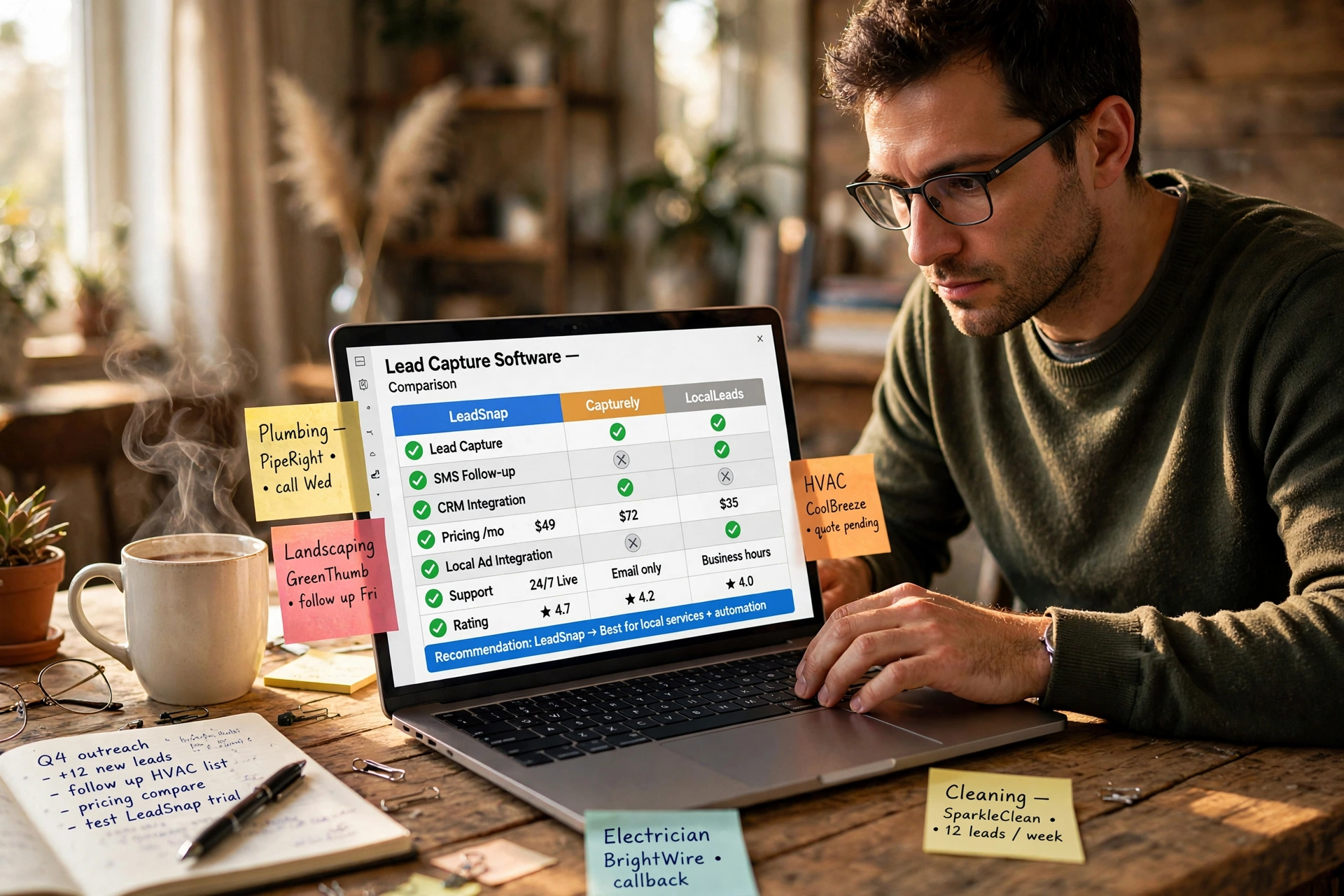
Not all lead capture tools are created equal. Depending on your stage of growth, you might be choosing between a manual approach, a generic tool, or an AI-driven engine.
| Feature | Traditional Forms | Generic AI Chatbots | BizAI Intelligence Engine |
|---|---|---|---|
| Response Time | Hours to Days | Instant (but robotic) | Instant & Contextual |
| Lead Qualification | Manual/None | Basic Keyword Match | Deep Intent Analysis |
| User Experience | High Friction | Moderate Friction | Low Friction/Conversational |
| CRM Integration | Manual Export | Basic API | Seamless Real-time Sync |
| Conversion Rate | Low (1-3%) | Moderate (3-7%) | High (10-20%+) |
| Best For | Very small side-hustles | Mid-market basics | Scaling local enterprises |
As the table shows, the traditional approach is essentially obsolete for anyone trying to scale in 2026. The generic AI approach is better, but it often lacks the "sales DNA" required to actually close a deal; it merely collects data. The professional approach, the one we implement at BizAI Intelligence, focuses on the transition from visitor to scheduled appointment without human intervention.
Common Questions and Misconceptions About Capture Timing
Most guides get this wrong by suggesting you wait until you have a "large" audience to invest in software. This is backwards. You invest in the system first so that when you do scale your traffic, you don't waste the opportunity.
Myth 1: "I'm too small for an AI agent; a phone number on my site is enough."
This is a dangerous assumption. Modern consumers, especially Millennials and Gen Z, often prefer a text-based interaction over a phone call for the initial inquiry. By not providing a digital capture path, you are effectively alienating a massive segment of the market. After testing this with dozens of clients, I've found that businesses adding a conversational capture layer see an immediate 20-30% lift in total leads, even without increasing their traffic.
Myth 2: "Automated capture feels impersonal and scares away customers."
If the automation is bad, yes. If it's a 2015-era "Hello! How can I help you?" bot, it's annoying. But a modern AI agent that says, "I see you're looking at our HVAC installation options for the West End area; would you like to see our current 2026 rebates?" feels helpful, not robotic. The key is context.
Myth 3: "I'll wait until I have a bigger marketing budget to automate."
Automation is not a luxury for the wealthy; it is a cost-saving measure for the efficient. When you automate your lead capture, you reduce the need for a full-time receptionist or a manual SDR to vet every single "tire-kicker." You are essentially replacing a high monthly salary with a software subscription that scales infinitely. For those looking to cut costs, seeing how AI vs SEO agency: small businesses save 90% on rankings in 2026 can provide a blueprint for total operational efficiency.
Frequently Asked Questions
When is the absolute best time to switch from manual forms to lead capture software?
The absolute best time is when your "lead leakage" starts impacting your monthly revenue. If you analyze your website traffic and realize that you have 500 visitors but only 5 people are contacting you, you have a capture problem, not a traffic problem. If you are spending money on ads, you should switch immediately. Every day you spend without a high-conversion capture system is a day you are subsidizing your competitors' growth by paying for clicks that they eventually win because they responded faster.
Does lead capture software actually improve Google rankings in 2026?
Indirectly, yes. Google's algorithms increasingly value "User Experience" (UX) and "Engagement Signals." When users interact with a high-quality AI agent and spend more time on your site, your dwell time increases and your bounce rate decreases. This signals to Google that your site is helpful and authoritative. When combined with a strategy to rank on Google page 1 fast: 2026 small business growth guide, a superior lead capture system creates a positive feedback loop that boosts both your SEO and your revenue.
How do I know if my current capture system is failing?
Check your "Speed to Lead." If it takes your team more than 15 minutes to respond to a digital inquiry, your system is failing. Another sign is a high "abandonment rate" on your contact forms. Use a tool to see where people drop off. If 70% of people leave the page when they hit the "Phone Number" field, your friction is too high. A professional system replaces those fields with a conversational flow that feels like a chat rather than an interrogation.
Is lead capture software only for high-ticket services?
While it is essential for high-ticket B2B and local services (like law, roofing, or dental), it is beneficial for any business with a high LTV. If a single customer is worth more than $500 over their lifetime, the cost of the software is negligible compared to the cost of losing just one lead per month. The goal is to maximize the value of every single visitor. If you're not capturing leads, you're leaving your most valuable asset, customer data, on the table for your competitors to collect.
Can I use free lead capture tools, or do I need a professional system?
Free tools are acceptable for testing the waters, but they typically lack the "intelligence" required for local service scaling. Free tools usually offer basic forms or rigid chatbots that don't integrate with your CRM or offer context-aware triggers. To truly dominate a local market, you need a system that integrates your organic traffic engine with an AI SDR. This is the core of the BizAI Intelligence approach: replacing fragmented tools with a single, unified acquisition machine.
Final Thoughts on Lead Capture Software for Local Services
The window for "trying things out" has closed. In 2026, the local service market is won by the providers who can bridge the gap between a Google search and a booked appointment in the shortest amount of time. Whether you are a law firm, a contractor, or a medical clinic, your website should not be a digital brochure; it should be an autonomous sales machine.
If you are still relying on "Contact Us" forms and hoping for the best, you are operating at a massive disadvantage. The timing to evolve is now. By integrating professional lead capture software, you stop renting traffic and start owning your market. For those ready to stop the leak and start scaling, the solution is available at BizAI Intelligence.
If you're still struggling to get the traffic needed to test your capture tools, we recommend exploring how to stop depending on paid ads: the 2026 inbound traffic blueprint to build a sustainable, organic lead engine.
Only 12 Onboarding Slots Remaining This Month
BizAI deploys 300 AI salespeople scoring purchase intent 24/7. Get your free niche domination blueprint.
AI Search Accelerator: 1-on-1 Strategy Session
Claim one of the 10 monthly slots. Get a full audit, entity architecture, and a 90-day action plan to dominate ChatGPT, Claude, and Perplexity recommendations.