Which Lead Capture Software for Local Services Actually Drives ROI?
Most local service providers treat their website like a digital brochure, but the reality is that a static "Contact Us" page is where leads go to die. In my experience working with high-ticket B2B and local service firms, the difference between a business that struggles for leads and one that dominates its market isn't the quality of their service; it's the friction in their intake process. When deciding which lead capture software for local services to deploy, you must choose between simple form-builders, specialized CRM-integrated tools, or autonomous AI agents. For those scaling in 2026, the answer is clear: if your software doesn't qualify the lead and book the appointment in real-time, you are essentially paying for a leaky bucket.
To maximize conversion, you need a system that doesn't just "capture" a name and email, but actively converts intent into a scheduled event. For a comprehensive look at how this integrates with modern growth, explore our Overview of AI Search Engine Optimization & GEO.

Understanding the Mechanics of Modern Lead Capture
At its core, lead capture is the process of identifying and collecting a potential customer's information to initiate a sales conversation. However, for local services, such as law firms, HVAC contractors, or medical clinics, the "capture" is only the first 5% of the battle. The true value lies in the transition from an anonymous visitor to a qualified appointment.
📚
Definition
Lead Capture Software refers to any digital tool designed to convert website visitors into identifiable leads through forms, chatbots, pop-ups, or interactive widgets, typically integrating with a database or CRM.
The traditional approach relied on the "Contact Form" paradox: you ask a user to provide their info and then promise to "get back to them soon." In 2026, "soon" is too late. According to research by Gartner, the probability of converting a lead drops by over 80% if the initial response takes longer than five minutes. This is why the industry is shifting toward "Active Capture" systems.
Active capture doesn't wait for the user to find the contact page. It uses engagement triggers, such as scroll depth or time-on-page, to present a value-driven offer or a qualifying question. For example, instead of a generic "Request a Quote" button, a high-converting local service site uses a diagnostic tool: "Check if your HVAC system qualifies for the 2026 energy rebate in 30 seconds." This shifts the psychology from "selling" to "helping," which drastically increases the volume of high-intent data you collect.
Why High-Friction Capture is Killing Your Local Service Growth
The cost of a lead is rising across every local vertical. When you spend $50 to $200 on a single click via paid ads, losing that lead because of a slow response time or a clunky form is an expensive mistake. The failure isn't usually in the traffic generation; it's in the "Last Mile" of conversion.
According to a report by McKinsey, businesses that prioritize a seamless, AI-enhanced customer acquisition journey see a significant increase in customer lifetime value (LTV) because the first interaction sets the tone for the entire professional relationship. If your lead capture is a manual, slow process, the client assumes your service delivery will be equally sluggish.
The business impact of poor lead capture manifests in three specific ways:
- The "Lead Leak": Potential clients who fill out a form but don't get an immediate response simply go back to Google Search and click the next listing.
- The "Low-Quality Void": Capturing 100 leads is meaningless if 80 of them are "tire kickers" who don't fit your ideal customer profile (ICP).
- The SDR Burnout: Forcing a human staff member to manually call and qualify every single web lead is a recipe for inefficiency and missed opportunities.
Now, here's where it gets interesting: the most successful local firms are no longer just "capturing" leads; they are using AI appointment setters for B2B to automate the entire qualification phase. By replacing a static form with a conversational agent, you eliminate the gap between "I'm interested" and "I'm on the calendar."
Practical Application: Implementing a High-Conversion Capture System
Implementing a lead capture system that actually works requires a shift from a "Passive" mindset to an "Aggressive" architectural approach. You cannot simply plug in a widget and hope for the best. You need a strategic funnel that guides the user from a search query to a confirmed booking.
First, you must map your "Intent Triggers." For a local law firm, an intent trigger isn't just visiting the homepage; it's spending three minutes on a page about "Personal Injury Settlements." This is where your lead capture software should trigger a specific, context-aware intervention.
Second, move from "Data Collection" to "Lead Qualification." Instead of asking for a phone number immediately, ask a qualifying question first. "Do you have a current police report for your accident?" This filters out low-intent visitors and signals to the user that you are an expert who knows exactly what information is needed.
This is exactly why we engineered BizAI Intelligence. We realized that the bottleneck wasn't the number of pages on a site, but the inability to qualify traffic at scale. By combining programmatic SEO, which creates hundreds of high-intent "satellite" pages, with an autonomous AI Sales Agent, we've removed the human element from the initial qualification phase. The agent tracks user behavior, initiates a qualification screen, and books the meeting directly into the CRM.
💡
Key Takeaway
The goal of lead capture software is not to collect email addresses, but to reduce the time between a user's "moment of intent" and their "moment of commitment" (the appointment).
If you want to scale this across hundreds of local landing pages, you should look into how to automate organic traffic and lead capture with AI to ensure your growth isn't tied to your manual bandwidth.

Comparison: Choosing the Right Lead Capture Framework
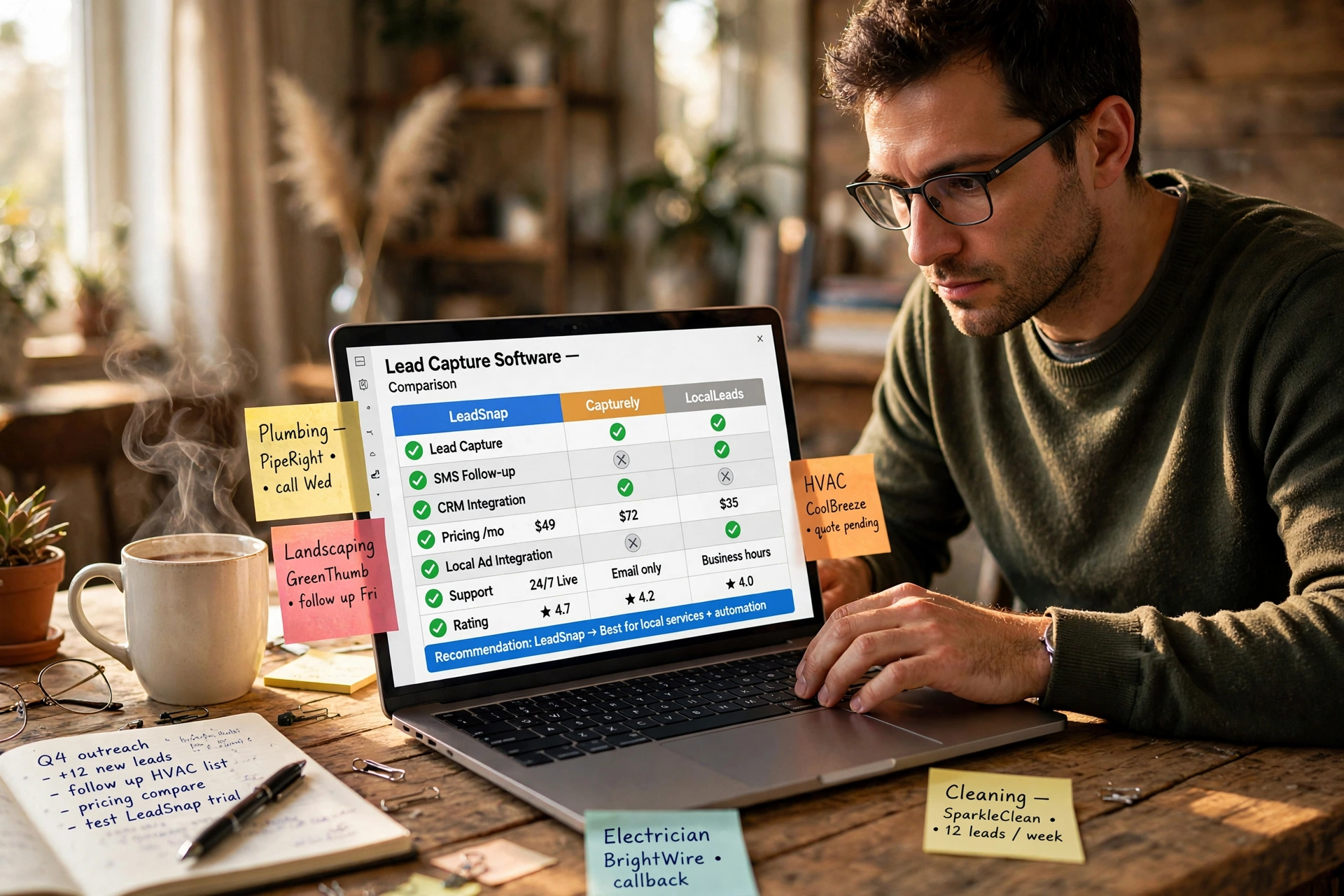
Depending on your stage of growth, the "best" software changes. A solo practitioner has different needs than a multi-location franchise. The following framework breaks down the trade-offs between the three most common approaches in 2026.
| Approach | Pros | Cons | Best For |
|---|---|---|---|
| Traditional Forms (WPForms, Typeform) | Low cost, easy to set up, familiar interface. | High friction, zero real-time qualification, high lead leakage. | Very small businesses with low volume. |
| Generic AI Chatbots (ManyChat, Tidio) | Fast responses, handles basic FAQs, 24/7 availability. | Often "robotic," poor qualification logic, requires manual hand-off. | Businesses needing basic customer support. |
| Autonomous AI Agents (BizAI Intelligence) | Real-time qualification, direct CRM booking, behavioral triggers. | Higher initial investment, requires strategic setup. | High-ticket local services scaling for aggressive growth. |
Most guides will tell you that a simple form is "enough." They are wrong. In a competitive local market, "enough" is how you end up as the second or third choice. The modern approach requires a system that acts as a 24/7 SDR. If you are comparing the ROI of human staff versus automation, you'll find that an AI SDR vs Human SDR ROI calculator almost always favors the hybrid model where AI handles the "top of the funnel" qualification.
Common Questions and Misconceptions
There are several persistent myths about lead capture that local service owners believe, often because they are following outdated advice from 2022 or 2023.
Myth 1: "The shorter the form, the more leads I get."
While this is true for volume, it is disastrous for quality. In my experience, adding 2-3 "friction" questions (qualifying questions) actually increases the ROI of the leads. It is better to have 10 qualified leads who are ready to buy than 100 leads who are just "browsing" and waste your team's time.
Myth 2: "Chatbots annoy my customers."
Customers aren't annoyed by chatbots; they are annoyed by bad chatbots. A bot that says "Hi, how can I help you?" is generic and irritating. A bot that says, "I see you're looking at our roof replacement options for the North Side area, would you like to see if your home qualifies for the 2026 warranty upgrade?" is helpful and high-value.
Myth 3: "I can just handle leads via email."
Email is where leads go to die. By the time you see an email notification, the lead has already contacted three of your competitors. The only way to win in 2026 is through immediate, automated booking. This is why connecting your AI sales agents to CRM and webhooks is a non-negotiable technical requirement for any serious local business.
Frequently Asked Questions
Which lead capture software is best for high-ticket local services?
For high-ticket services, the best software is one that prioritizes qualification over volume. You need a system that can distinguish between a "window shopper" and a "high-intent buyer." Autonomous agents, like those provided by BizAI Intelligence, are superior because they can ask specific qualifying questions and book appointments directly into a calendar, ensuring that your sales team only spends time with pre-qualified prospects.
How do I prevent "lead leakage" on my local service website?
Lead leakage happens when a user finds the information they need but encounters too much friction when trying to contact you. To prevent this, implement "behavioral triggers." Instead of waiting for them to click a menu link, have a lead capture widget appear after they've read 60% of a high-value service page. This captures the user at the peak of their interest, significantly reducing the chance they will leave to search for a competitor.
Should I use a pop-up or a chatbot for lead capture?
Pop-ups are intrusive and often ignored (banner blindness). Chatbots, especially those that are context-aware, feel like a conversation. However, the most effective approach is a hybrid: a non-intrusive, "floating" AI agent that triggers a specific message based on the page the user is visiting. This provides the visibility of a pop-up with the engagement and qualification capabilities of a professional salesperson.
How does AI lead capture improve the conversion rate compared to traditional forms?
Traditional forms are a one-way communication; the user gives info and hopes for a response. AI lead capture is a two-way dialogue. It can handle objections in real-time, answer basic questions about service areas or pricing, and create a sense of urgency. By removing the "waiting period" and providing immediate value, AI systems typically see conversion rate increases of 20% to 50% over static forms.
What is the ideal number of fields for a local service lead capture form?
While the "shorter is better" rule applies to some niches, local services should aim for 3-5 fields. You need the basics (Name, Email, Phone) and at least one "Intent Field" (e.g. "What service do you need?" or "What is your estimated budget?"). If you use an AI agent, you can gather 10-15 pieces of information through a natural conversation without the user ever feeling the "friction" of a long form.
Final Thoughts on Lead Capture Software for Local Services
Choosing the right lead capture software for local services is no longer about finding a tool that "works"; it is about finding a tool that scales. The era of the static contact form is over. To dominate your local market in 2026, you need an acquisition engine that combines massive organic reach with autonomous qualification.
If you are tired of renting expensive traffic from Google Ads only to let those leads slip through the cracks of a slow intake process, it is time to automate. By deploying a system that captures, qualifies, and books 24/7, you turn your website from a cost center into a revenue-generating machine.
Stop losing leads to the "five-minute response gap." Start building an automated pipeline that fills your calendar while you sleep.
To implement this level of automation, visit BizAI Intelligence and discover how we help B2B and local service businesses scale through programmatic SEO and AI-powered lead qualification. For more on scaling your organic footprint, check out our Programmatic SEO platform guide.
Only 12 Onboarding Slots Remaining This Month
BizAI deploys 300 AI salespeople scoring purchase intent 24/7. Get your free niche domination blueprint.
AI Search Accelerator: 1-on-1 Strategy Session
Claim one of the 10 monthly slots. Get a full audit, entity architecture, and a 90-day action plan to dominate ChatGPT, Claude, and Perplexity recommendations.