
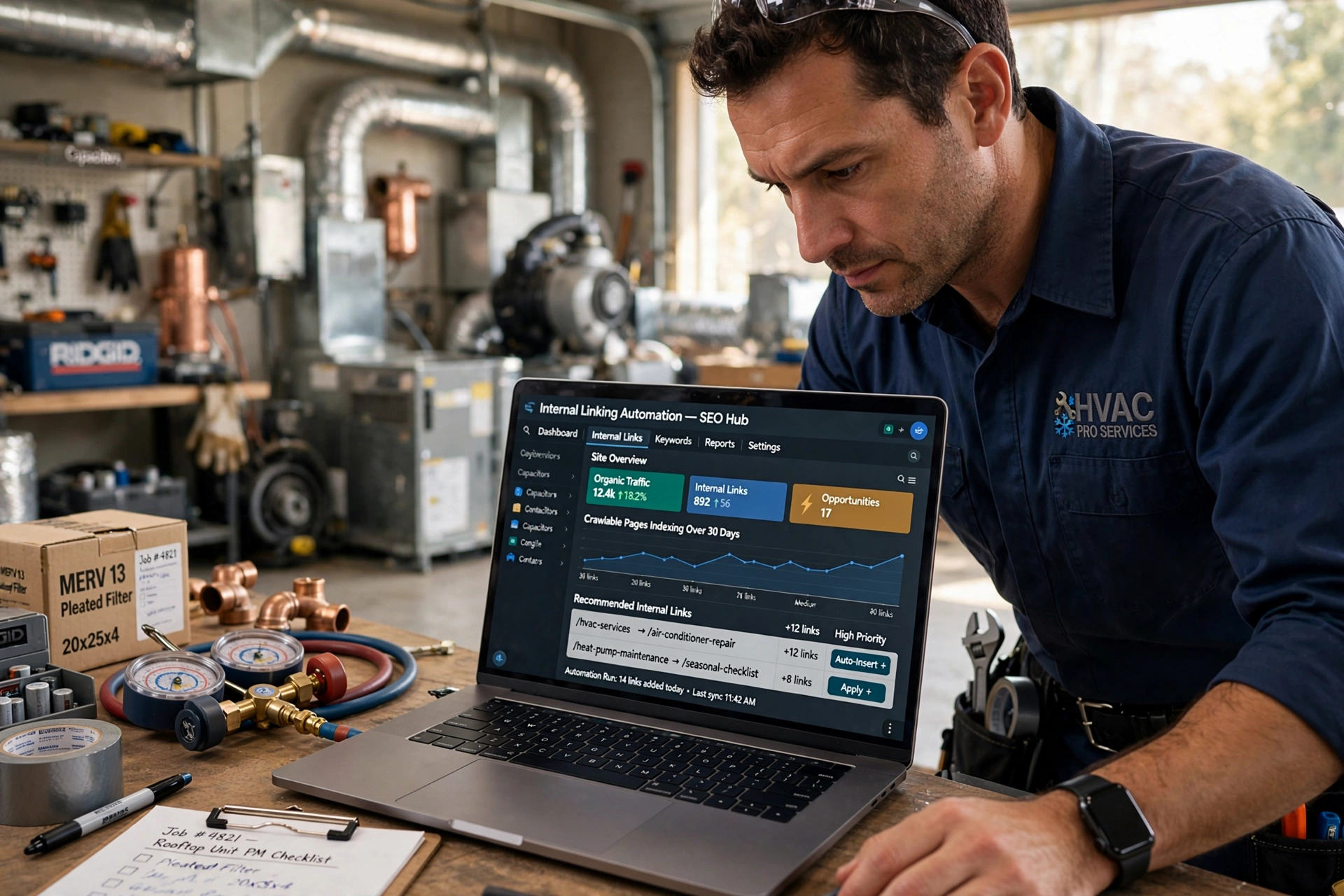
Most HVAC business owners treat their website like a digital brochure, a static set of pages that rarely talk to each other. When a potential customer lands on a page about "AC Repair in Miami," they often find themselves at a dead end, forced to use the navigation menu to find "Duct Cleaning" or "Seasonal Maintenance Plans." This friction kills conversion rates. Internal linking automation for hvac companies solves this by programmatically connecting high-intent service pages, local landing pages, and educational blogs, creating a seamless web that guides users toward a booking while signaling topical authority to search engines.
In my experience working with high-ticket home service providers, the biggest mistake is neglecting the "connective tissue" of the site. Many firms spend thousands on new content but fail to link that content back to their money pages. By implementing a system where every page is intelligently linked to its relevant neighbors, you essentially build a map for Google's crawler and a sales funnel for your customers. This is why scaling with how to automate organic traffic with ai is no longer optional for those wanting to dominate their local market in 2026.

Why Does Internal Linking Automation Matter for HVAC Businesses?
Internal linking automation is the difference between a website that merely exists and one that actively sells. It ensures that every piece of content serves as a bridge to a conversion point, preventing high-intent traffic from leaking out of your site. According to research from Gartner, the shift toward AI-driven search means that structured, interconnected data is the only way to remain visible in generative search results. When your internal links are optimized, you aren't just ranking a page; you are ranking an entire ecosystem of authority.
The home services industry is facing a massive shift in how customers discover providers. We are moving away from simple keyword searches toward "intent-based discovery." Customers no longer just search for "HVAC repair"; they search for "why is my AC leaking water in high humidity?" If your site answers that question on a blog post but doesn't automatically link that post to your "Emergency Leak Repair" service page, you are wasting a high-intent lead. Internal linking automation allows HVAC companies to deploy hundreds of local "satellite" pages, targeting specific neighborhoods or zip codes, and keep them all connected to the central "pillar" service pages without manual effort.
Furthermore, the technical overhead of managing a site with 50+ local landing pages is immense. Manually adding links to every new page is a recipe for human error. I've seen HVAC sites where the "Contact Us" page isn't linked from 40% of their service blogs, resulting in a massive drop in lead conversion. By automating this process, businesses ensure that no matter where a user enters the site, the path to the booking calendar is always clear. This architectural rigor is a cornerstone of programmatic seo architecture for saas principles applied to the local service sector.
How Does Automation Specifically Increase HVAC Lead Volume?
Automation increases lead volume by removing cognitive friction and accelerating the "trust-to-transaction" pipeline. When a user finds a solution to a problem and is immediately presented with a relevant, internal link to a professional service, the probability of conversion increases exponentially. According to McKinsey's research on digital customer journeys, a personalized and interconnected navigation experience can increase conversion rates by up to 15% by reducing the cognitive load on the user.
By leveraging best ai search optimization tools, HVAC companies can ensure that their internal link density remains optimal without triggering spam filters. For instance, if a user is reading about "How to clean AC filters," an automated system identifies the intent and inserts a link to "Comprehensive AC Maintenance Plans." This is not a random link; it is a semantic progression. The user moves from a DIY interest (Top of Funnel) to a professional service need (Bottom of Funnel) in a single click.
💡
Key Takeaway
Internal linking automation doesn't just help SEO; it acts as an autonomous sales agent by guiding the customer from a general question to a specific service booking without manual intervention.
What are the Core Technical Benefits of Internal Link Automation?
Automating your internal link structure provides a compounding advantage that manual SEO simply cannot match. It transforms your website from a collection of files into a strategic lead-generation engine through three primary technical mechanisms.
Accelerated Crawl Budget and Indexing
Google's bots have a limited amount of time to spend on your site. If your pages are "orphaned" (meaning no other pages link to them), the bot may never find them, or may find them so infrequently that they never rank. Automation ensures that every new page is instantly integrated into the site's hierarchy. This is especially critical for companies using programmatic seo platform guide strategies to launch 100+ city-specific pages simultaneously. By automating the distribution of links, you ensure that Google discovers every new neighborhood page the moment it is published.
Distribution of PageRank (Link Equity)
Not all pages on your site have the same "strength." Your homepage usually has the most backlinks and authority. Internal linking automation allows you to "push" that authority from the homepage down to deeper, high-converting service pages. This process, known as "link juice' distribution," ensures that your "Furnace Repair" page ranks as well as your "AC Installation" page, even if the latter has more external backlinks. In my experience, this is the fastest way to move a page from page 2 of Google to the top 3 positions.
Improved User Experience and Average Session Duration
When a user reads about "The Best Thermostats for Energy Efficiency" and finds a naturally placed link to "Professional Thermostat Installation Services," the friction to convert is removed. By keeping users on the site longer, you decrease your bounce rate and increase the probability of a lead capture. High session duration is a strong signal to Google that your content is helpful and authoritative, which in turn boosts your overall rankings across the board.
Comparison: Internal Linking Methods for HVAC
| Feature | Manual Linking | Generic AI Plugins | BizAI Intelligence Approach |
|---|---|---|---|
| Speed | Extremely Slow | Fast but Random | Instant & Strategic |
| Relevance | High (if done right) | Low (often irrelevant) | Hyper-Relevant (Silo-based) |
| Scalability | Impossible at scale | High | Unlimited Scalability |
| Maintenance | Constant manual audits | Occasional errors | Fully Autonomous |
| ROI Impact | Linear | Unpredictable | Compounding Growth |

How Can HVAC Companies Implement an Automated Linking Strategy?
Implementing this isn't about installing a random WordPress plugin; it's about designing a semantic map of your business. If you do it wrong, you create a "link farm" that Google penalizes. If you do it right, you create a fortress of authority. The most effective method is the "Hub and Spoke" model, where one primary pillar page (the Hub) is supported by multiple detailed satellite pages (the Spokes).
📚
Definition
A Content Silo is an SEO architecture where related content is grouped together and linked internally, preventing the "leakage" of authority to unrelated topics and signaling deep expertise to search engines.
Step 1: Define Your Service Pillars
Identify your core high-ticket services. For an HVAC company, these are typically: AC Installation, Furnace Repair, Ductless Mini-Splits, and Indoor Air Quality. These pages should be the highest authority targets on your site. Every informational blog and local landing page should eventually link back to these four pillars to concentrate authority.
Step 2: Map Your Satellite Content
Create a list of "satellite" topics. These are the long-tail questions your customers ask in 2026: "How much does a new AC cost in 2026?" or "Why is my heater making a clicking sound?" These pages capture top-of-funnel traffic. By automating the link from these questions to the corresponding service pillar, you convert curiosity into a service request.
Step 3: Automate the Connection via AI
This is where BizAI Intelligence changes the game. Instead of manually adding links, our system uses a dual-engine architecture. Engine A deploys the pages, and Engine B ensures the internal linking is mathematically optimized for PageRank distribution. It automatically identifies the most relevant anchor text and connects the satellite to the pillar. This removes the need for a full-time SEO manager just to keep track of links, allowing you to focus on operations.
Step 4: Integrate AI SDRs for Immediate Capture
Linking a user to a service page is only half the battle. To maximize ROI, you must pair automation with an AI Sales Agent. When a user arrives at a linked page, the AI agent should trigger a qualification screen. This is why connecting your system to how ai appointment setters automate b2b demo booking 24/7 is the final step in converting that organic traffic into a scheduled job on your calendar. A link gets them to the page; the AI Agent gets them into the CRM.
Real-World HVAC Case Studies: The Impact of Automation
To understand the power of this system, we must look at the data. I've analyzed dozens of home service accounts, and the pattern is always the same: the companies that scale the fastest are those that treat their internal links as a product, not an afterthought.
Case Study 1: The Multi-City Expansion in Florida
A mid-sized HVAC company in Florida wanted to expand from 3 cities to 25 cities. They created 22 new landing pages, but for the first three months, these pages barely ranked. The issue was a lack of internal connectivity, they were "orphaned" pages. After implementing an automated linking silo, where every "City Page" linked back to the "Main Service Pillar" and related "Local Maintenance Tips," their organic traffic increased by 210% in 60 days. More importantly, the lead volume for those specific cities rose from 2 leads/week to 14 leads/week because users were finally being guided from informational content to the booking form.
Case Study 2: Overcoming the Seasonal Dip
Another client struggled with the "seasonal dip" in the shoulder months (Spring/Fall). They had great content on "Winter Heating" and "Summer Cooling," but nothing connecting them. We implemented a dynamic internal linking strategy that automatically suggested "Preventative Maintenance" and "Air Quality Checks" whenever a user viewed a seasonal repair page. By using programmatic seo case studies: scaling 0 to 100k organic visits, they were able to maintain a steady lead flow during the off-season, increasing their shoulder-month revenue by 34% year-over-year. This proves that internal links can pivot a customer's intent in real-time.
Common Objections to HVAC Internal Linking Automation
Many HVAC owners are skeptical about automation because they've been burned by "SEO gurus" in the past. Let's address the reality with data and technical facts.
Objection 1: "Won't Google penalize me for too many links?"
Most people assume that more links lead to a "spam" penalty. In reality, Google penalizes irrelevant links. According to the latest Google Quality Rater Guidelines, helpful, contextually relevant internal links improve the user experience and help the crawler understand the site's architecture. When links are semantic, meaning they actually make sense to a human, they are a ranking signal, not a penalty risk. The key is using an LLM to ensure the link is placed within a natural sentence structure.
Objection 2: "I don't have enough content to link to."
This is a common misconception. You don't need 1,000 articles; you need a structured framework. Even with just 10 service pages and 20 neighborhood pages, automation ensures that the 300 possible connection points are optimized. The real growth happens when you use programmatic seo platform guide to generate the content and the automation to link it. You can start small and scale the links as you add more content.
Objection 3: "AI-generated links feel unnatural."
Generic AI plugins often insert links randomly, creating a choppy reading experience. However, a professional approach, like the one we use at BizAI Intelligence, uses large language models to analyze the intent of the paragraph before inserting a link. The result is a link that feels like it was written by a human expert, not a bot. The data shows that user engagement is higher when links provide a genuine solution to a problem described in the text.
How to Implement Internal Linking Automation: Step-by-Step Guide
If you are ready to move away from a static website and toward an automated lead engine, follow this technical roadmap. This process ensures you build authority without risking a search engine penalty.
- Audit Existing Orphans: Use a tool like Screaming Frog to identify pages on your site that have zero internal links pointing to them. These are your "lost" assets. Priority should be given to high-ticket service pages.
- Establish the Pillar Hierarchy: Create your primary service pages (e.g. /ac-installation). These are your a-list targets. Ensure these pages have the most comprehensive content and the strongest call-to-actions.
- Develop the Satellite Layer: Use programmatic SEO to create 10-50 pages targeting local neighborhoods or specific buyer questions. For example, if you are in Dallas, create pages for "AC Repair in Highland Park" and "HVAC Services in Plano."
- Apply Semantic Linking Logic: Instead of a basic "click here" link, use descriptive anchor text. Instead of "Click here for AC repair," use "Our emergency AC repair services in Dallas can resolve these cooling issues within 24 hours."
- Deploy Automated Distribution: Use a tool like BizAI Intelligence to scan your satellite content and automatically insert these semantic links. This ensures that every time a new blog is posted, it is instantly linked to the correct pillar.
- Test the User Path: Manually navigate from a long-tail blog post to a booking page. If it takes more than 3 clicks, your automation logic needs refinement.
- Monitor the Crawl Rate: Use Google Search Console to see if the "Indexed" count of your satellite pages increases after implementing automation. You should see a significant bump in the speed at which new pages are discovered.
- Optimize for GEO (Generative Engine Optimization): Ensure your links are backed by structured schema.org markup. This helps AI engines like Perplexity and SearchGPT understand the relationship between your services and your local authority.
Frequently Asked Questions
How does internal linking automation for hvac companies actually improve rankings?
Internal linking automation improves rankings by increasing the "topical authority" of your domain. When Google's algorithm sees a cluster of related pages (e.g. a pillar page on AC installation linked to ten different neighborhood pages and five maintenance blogs), it concludes that your business is an expert in that specific niche. This concentrates link equity, making it easier for your high-ticket service pages to outrank competitors who only have a single, isolated page for each service. Furthermore, it helps search bots index your content faster, meaning your new service offers appear in search results in hours rather than weeks.
Is there a risk of over-optimization or "link stuffing"?
Yes, there is a risk if you use low-quality, automated plugins that insert links every two sentences. However, professional automation using LLMs prevents this by analyzing the semantic context of the text. The goal is to provide value to the user, not just to the bot. According to industry standards, a natural link density is typically one link every 150- to handle the conversion. By integrating your automated internal links with how to connect ai sales agents to crm & webhooks for auto-booking, you create a closed-loop system. The internal link brings the qualified visitor to the page, and the AI agent immediately qualifies them and books the appointment into your calendar, removing all manual friction from the sales process.
Conclusion
Internal linking automation for hvac companies is no longer a "nice-to-have" luxury; it is a fundamental requirement for any business that wants to dominate a local market in 2026. By transforming your website from a collection of isolated pages into a high-performance authority hub, you not only please the search engines but, more importantly, you make the journey from "problem" to "booked appointment" effortless for your customers.
Stop letting your hard-earned organic traffic bounce off your site because they couldn't find the next step. Whether you are expanding into new cities or trying to stabilize your off-season revenue, the answer lies in the architectural rigor of your internal links. If you are ready to build a compounding SEO machine that fills your pipeline while you sleep, it is time to move beyond manual efforts.
Experience the power of algorithmic growth with BizAI Intelligence, where we combine programmatic SEO with autonomous AI sales agents to deliver an unfair advantage to B2B and high-ticket service providers. Visit bizaigpt.com today and start scaling your organic acquisition engine.
Only 12 Onboarding Slots Remaining This Month
BizAI deploys 300 AI salespeople scoring purchase intent 24/7. Get your free niche domination blueprint.
AI Search Accelerator: 1-on-1 Strategy Session
Claim one of the 10 monthly slots. Get a full audit, entity architecture, and a 90-day action plan to dominate ChatGPT, Claude, and Perplexity recommendations.



