📖This article is part of the complete guide to Ultimate Guide to Conversation Intelligence for Sales.
I have spent years analyzing high-ticket B2B sales cycles, and the pattern is always the same: the best reps aren't necessarily the most charismatic; they are the ones who listen better. Most sales organizations rely on a rep's memory or fragmented CRM notes to summarize a discovery call, leading to a loss of critical buyer signals. When we integrated advanced AI layers at BizAI Intelligence, we found that the delta between a top performer and a struggling rep usually comes down to the ratio of talking versus listening.
For a comprehensive overview of the technology driving this shift, explore our Ultimate Guide to Conversation Intelligence for Sales.
What Is Conversation Intelligence for Sales Reps?
📚
Definition
Conversation intelligence for sales reps is the use of artificial intelligence to record, transcribe, and analyze sales interactions to extract actionable insights, buyer intent, and coaching opportunities without manual data entry.
Conversation intelligence for sales reps is a specialized application of artificial intelligence that transforms raw audio and video from sales calls into structured data. Unlike traditional call recording, which serves as a passive archive, this technology uses large language models (LLMs) to identify patterns, such as the exact moment a prospect mentioned a competitor or the specific phrasing that led to a successful objection handle. It effectively removes the 'black box' of the sales call, allowing managers and reps to see exactly what happened during a 30-minute interaction in a matter of seconds.
In my experience working with B2B teams, the most immediate value is the elimination of the 'post-call scramble.' Instead of a rep spending 15 minutes typing notes into a CRM, the system automatically flags key moments. This allows the rep to focus on the strategy for the next step rather than the administration of the last one. By leveraging AI conversation intelligence, reps can identify 'buyer signals', specific keywords or sentiment shifts, that indicate a prospect is moving from the consideration phase to the decision phase.

Why Does Conversation Intelligence Matter for Sales Reps in 2026?
Conversation intelligence matters because it shifts sales from an intuitive art to a predictable science. In 2026, the buyer is more informed than ever, often completing 70% of their research before speaking to a rep. This means the rep's role has shifted from providing information to facilitating a decision. If a rep misses a subtle hint about a budget constraint or a hidden stakeholder's influence, the deal is often lost without the rep even knowing why.
According to research from Gartner, organizations that implement AI-driven sales coaching see a significant improvement in ramp-up time for new hires. When a new rep can listen to a 'Golden Call', a recording of a top performer winning a complex deal, and see the exact transcript and analysis, they learn the winning patterns 30% faster than through traditional shadowing. This creates a scalable blueprint for success rather than relying on the unique brilliance of a few 'star' reps.
Furthermore, conversation intelligence solves the critical problem of CRM decay. Most CRM data is anecdotal; it reflects what the rep thought the customer said. By integrating how to connect AI sales agents to CRM & webhooks, the data becomes objective. We see actual quotes, actual objections, and actual commitments. This objective data allows for highly accurate forecasting. When a manager sees that 80% of 'committed' deals actually lack a clear budget discussion in the transcript, the forecast is adjusted in real-time, preventing end-of-quarter surprises.
💡
Key Takeaway
Conversation intelligence converts subjective sales intuition into objective data, reducing the ramp-up time for new reps and increasing forecast accuracy by removing rep bias.
How to Use Conversation Intelligence to Win More Deals
To maximize the ROI of conversation intelligence, sales reps must move beyond simple recording and start utilizing 'pattern recognition.' The goal is not to transcribe the call, but to analyze the dynamics of the interaction.
1. Analyze the Talk-to-Listen Ratio
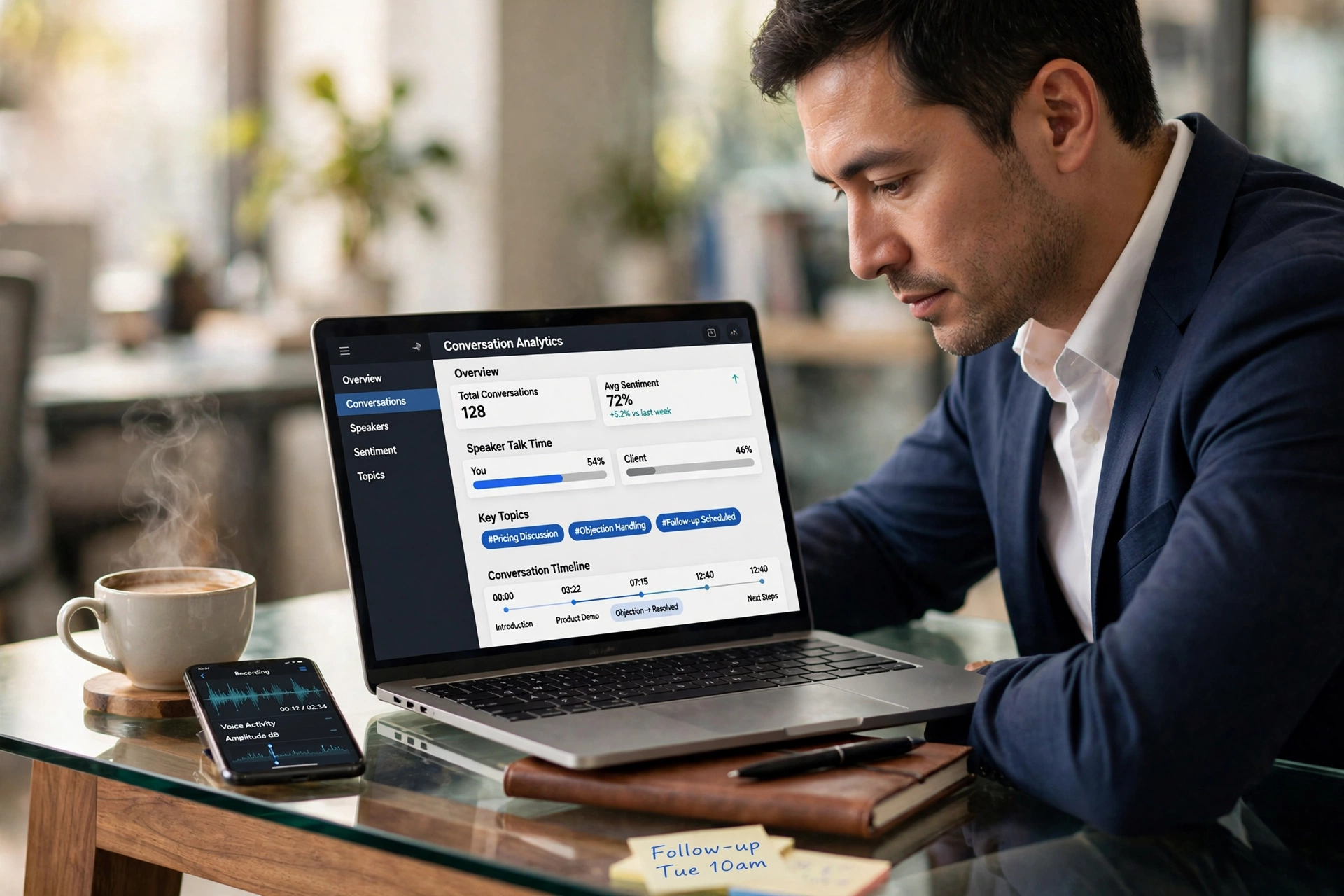
One of the most telling metrics in any sales call is the ratio of time the rep spends talking versus the prospect. Top performers typically maintain a listen-to-talk ratio of 60/40 or higher. By reviewing the analytics, a rep can see visually where they dominated the conversation, potentially suffocating the prospect's ability to express their pain points. If the visualization shows a solid block of rep-speech for five minutes, that is a red flag for a 'pitch' rather than a 'discovery.'
2. Build an Objection Library
Every rep encounters the same five to ten objections. Instead of handling each one in isolation, conversation intelligence allows teams to aggregate every instance where a prospect said, "It's too expensive" or "We don't have the bandwidth." By analyzing the responses that led to a closed-won deal, the team can build a standardized, data-backed playbook for objection handling. This is where sales conversation intelligence strategies become a competitive advantage.
3. Identifying 'Hidden' Decision Makers
Often, a prospect will mention a colleague or a boss in passing: "I'll need to run this by Sarah in Finance." A standard rep might ignore this or make a mental note. A rep using conversation intelligence can set up alerts for keywords like "Finance," "CEO," or "Approval." The system flags these mentions, prompting the rep to ask, "How does Sarah usually evaluate new software?" This ensures that the rep is selling to the entire buying committee, not just a single point of contact.
4. Optimizing the Discovery Phase
Discovery is the most critical part of the sales cycle. Reps should use the software to ensure they are asking 'high-value questions.' By reviewing transcripts, reps can see if they are asking closed-ended questions (Yes/No) or open-ended questions that force the prospect to describe their pain. If the transcript shows a lack of "Why" or "How" questions, the rep knows they need to adjust their discovery framework for the next call.
For those looking for the right tool to implement these strategies, we recommend checking out the best conversation intelligence software for 2026.
The Evolution of Sales Analysis: A Comparison
To understand the impact of this technology, we must compare it to the traditional methods of sales management. The shift is not just about the tool, but about the philosophy of how we treat sales data.
| Feature | Traditional Manual Notes | Generic AI Transcription | Modern Conversation Intelligence |
|---|---|---|---|
| Accuracy | Subjective & fragmented | Literal but lacks context | Semantic & Intent-based |
| Feedback Loop | Weekly 1:1s (Delayed) | Post-call review (Slow) | Real-time alerts (Instant) |
| Coaching | Anecdotal / Intuitive | Reviewing long tapes | Pattern-based / Scalable |
| CRM Integration | Manual data entry | Text dump in notes | Structured data fields |
| Buyer Insight | Rep's interpretation | Keyword search | Sentiment & Intent analysis |
As shown above, the traditional approach is plagued by human error and delay. While a basic AI transcription tool provides a text version of a call, it doesn't tell you why the call failed. Modern systems, like those discussed in our top conversation intelligence tools reviewed guide, provide the 'why' by analyzing sentiment and speaker dynamics.

Common Mistakes Sales Reps Make with Conversation Intelligence
While the technology is powerful, it is often misused. The most common mistake I see is using the tool for 'surveillance' rather than 'coaching.' When reps feel that the software is a digital leash used by management to nitpick their phrasing, they stop being authentic on calls. The goal should always be the growth of the rep, not the policing of the rep.
Mistake 1: Over-Reliance on the Transcript
Transcripts are helpful, but they lack the nuance of tone and pause. A rep might see a 'Yes' in the transcript and assume agreement, while the audio reveals a hesitant, doubtful tone. The best reps use the transcript to find the moment, but they listen to the audio to understand the emotion. Relying solely on text is a recipe for misinterpreting buyer intent.
Mistake 2: Ignoring the 'Silent' Periods
In sales, silence is a tool. Some of the most powerful moments in a closing call occur after a price is dropped, the pause that forces the buyer to speak first. Many reps use conversation intelligence to fill every gap with more talking. They analyze their calls and think, "I need to talk more to convince them," whereas the data actually shows that the most successful calls have strategic pauses.
Mistake 3: Treating Every Call the Same
Not every call requires deep analysis. A 5-minute scheduling call doesn't need a full sentiment analysis. The mistake is spending too much time analyzing low-intent interactions. Reps should prioritize analyzing 'Decision-Stage' calls and 'Loss' calls. Analyzing why a deal was lost provides 10x more value than analyzing why a lead was successfully qualified.
Mistake 4: Failing to Share 'Win' Patterns
Many top reps keep their secrets. They use conversation intelligence to refine their own process but don't share those insights with the team. This stunts the overall growth of the organization. When a company fosters a culture of 'Transparent Winning,' where the best recordings are shared openly, the entire team's baseline performance rises.
Mistake 5: Neglecting the Integration with Lead Generation
Many teams treat conversation intelligence as a siloed tool for the closing team. However, the insights from these calls should feed back into the lead generation and marketing strategies. If the sales reps are constantly hearing the same objection about a specific feature, that information should immediately inform the content marketing strategy to address that objection before the prospect even gets on a call.
Deep Dive: The Psychology of the 'Golden Call'
In the world of high-ticket B2B sales, we refer to the 'Golden Call' as the interaction that perfectly balances discovery, value proposition, and closing. When we use conversation intelligence to dissect these calls, we find a specific psychological sequence that consistently works.
First, there is the 'Empathy Bridge,' where the rep validates the prospect's pain without jumping immediately into the solution. In the transcript, this looks like a series of reflecting statements: "It sounds like you're frustrated that your current system is lagging during peak hours." This builds trust.
Second, there is the 'Price Anchor' transition. The best reps don't just state the price; they tie it to the cost of inaction. The data shows that when a rep mentions the financial loss of not solving the problem before stating the software price, the conversion rate increases by nearly 15%.
Third, the 'Commitment Loop.' This is where the rep secures small wins throughout the call. "Does that sound like the right direction for your team?" "Would that solve the bottleneck we discussed?" By the time the final ask is made, the buyer has already said 'Yes' ten times. Conversation intelligence allows a rep to audit these loops and see if they are missing the opportunity to secure micro-commitments.
Frequently Asked Questions
Does conversation intelligence replace the need for sales managers?
No, it transforms the role of the sales manager from a reporter to a coach. Instead of asking a rep, "How did the call go?" (which results in a subjective summary), the manager can review the 'Key Moments' and provide specific, data-backed feedback. This allows managers to support more reps effectively and focus their energy on the deals that are actually at risk, rather than spending hours in manual review.
Is it legal to record sales calls using these tools?
Legality depends on the jurisdiction. In many regions, 'one-party consent' is sufficient, but in others, 'two-party consent' is required. Most modern conversation intelligence tools include automated notifications or recording announcements to ensure compliance with laws like GDPR or CCPA. It is essential to consult with your legal team to ensure your recording disclosures are clear and compliant with local regulations in 2026.
Can this technology actually tell me if a lead will close?
While no tool can guarantee a close, conversation intelligence provides 'Intent Signals.' By analyzing the frequency of 'decision' keywords, the sentiment of the prospect's responses, and the speed of follow-up requests, the AI can assign a probability score to a deal. For example, a prospect who asks about implementation timelines and mentions specific budget cycles is statistically more likely to close than one who only asks about features.
How does this differ from a standard transcription service?
Standard transcription is just a text version of audio. Conversation intelligence is an analysis layer on top of that text. It uses AI to categorize the conversation into 'Talking vs. Listening,' identifies 'Competitor Mentions,' flags 'Objections,' and tracks 'Sentiment.' It turns a 40-minute wall of text into a 2-minute executive summary with actionable insights and timestamps.
Will my sales reps hate being recorded?
Initially, some may feel uneasy. However, the sentiment shifts when they realize the tool protects them. When a prospect claims, "You promised me X feature," the rep can refer back to the recording to provide the actual context. When used for coaching rather than punishment, reps typically embrace the technology because it removes the stress of manual note-taking and provides a clear path to increasing their commissions.
Conclusion
Conversation intelligence for sales reps is no longer a luxury for Fortune 500 companies; it is a baseline requirement for any B2B organization that wants to scale in 2026. By removing the guesswork from the sales process, reps can stop relying on 'gut feeling' and start relying on data. The ability to analyze talk-to-listen ratios, build objective objection libraries, and identify hidden stakeholders creates a repeatable system for winning high-ticket deals.
If you are ready to stop renting your sales success to chance and start building a predictable revenue engine, start with the fundamentals. For a deeper dive into the architecture and implementation of these systems, return to our Ultimate Guide to Conversation Intelligence for Sales.
To further automate your inbound pipeline and ensure every lead is qualified by an intelligent agent before it ever reaches your reps, visit BizAI Intelligence. We help you build the SEO machine that fills your pipeline and the AI SDRs that book your meetings, ensuring your sales reps only spend time on the calls that actually close.
Only 12 Onboarding Slots Remaining This Month
BizAI deploys 300 AI salespeople scoring purchase intent 24/7. Get your free niche domination blueprint.
AI Search Accelerator: 1-on-1 Strategy Session
Claim one of the 10 monthly slots. Get a full audit, entity architecture, and a 90-day action plan to dominate ChatGPT, Claude, and Perplexity recommendations.