📖This article is part of the complete guide to Ultimate Guide to Conversation Intelligence for Sales.
Most sales managers rely on 'shadowing' calls, which is an inefficient way to scale performance. In my experience working with high-growth B2B teams, the biggest bottleneck isn't the lack of talent, but the 'knowledge gap' between your top 5% of reps and the rest of the team. When a top performer closes a complex deal, that winning logic often stays locked in their head, never reaching the rest of the organization.
For a comprehensive overview of the technology driving this shift, explore our Ultimate Guide to Conversation Intelligence for Sales.
What is Conversation Intelligence Training?
📚
Definition
Conversation intelligence training is the process of using AI-powered analysis of sales interactions, voice and text, to identify successful patterns and systematically replicate them across a sales organization.
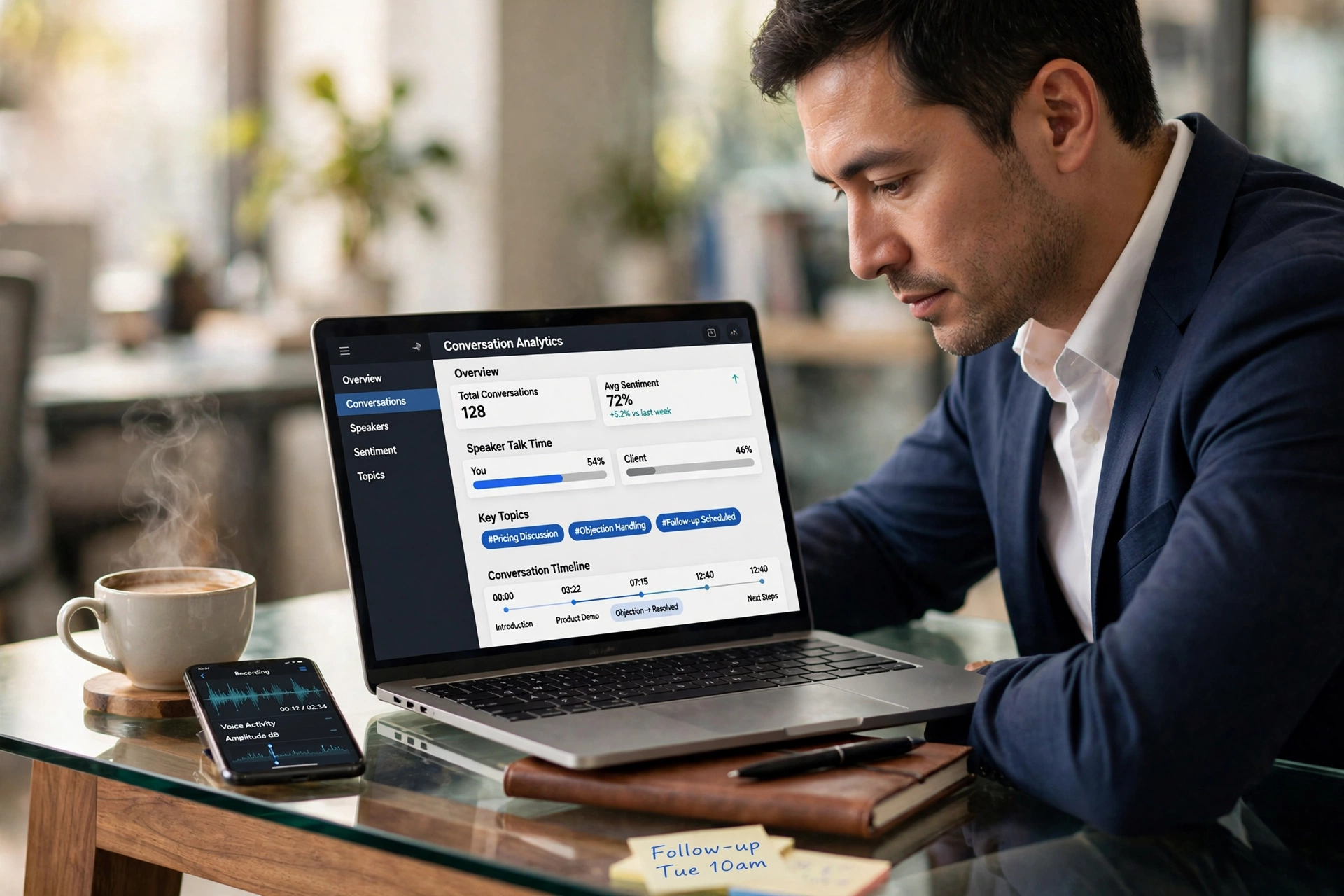
Conversation intelligence training is not about simply recording calls for compliance; it is the strategic application of data derived from those recordings to drive behavioral change. By leveraging large language models (LLMs) and natural language processing (NLP), businesses can now automatically transcribe calls, analyze sentiment, and flag specific 'winning' phrases that correlate with a higher closing rate. This transforms sales coaching from a subjective 'I think you should have said X' into an objective 'The data shows that when we mention the ROI of 2026 efficiency, win rates increase by 15%.'
In the current 2026 landscape, this training involves integrating AI conversation intelligence tools that not only record but actively tag moments of objection handling or competitor mentions. This allows a manager to curate a 'Golden Library' of call snippets. Instead of a new hire listening to a four-hour recording, they listen to a three-minute montage of the best ways to handle the 'price is too high' objection. This precision in training significantly reduces the time it takes for a new rep to reach full productivity.

Why Does Conversation Intelligence Training Matter for Your Business?
Standard sales training is often theoretical and quickly forgotten. According to research by the Sales Enablement Society, traditional training has a decay rate where 70% of new skills are lost within 24 hours if not applied. Conversation intelligence training solves this by providing 'just-in-time' coaching based on actual evidence from the field.
First, it eliminates the 'manager's bias.' In traditional shadowing, a manager only sees a fraction of the sales cycle. With AI analysis, every single interaction is audited. This provides a 100% visibility rate into the pipeline. When you can see that 60% of your reps are failing to ask a discovery question about budget in the first ten minutes, you have a concrete training target rather than a vague feeling that 'discovery is weak.'
Second, it accelerates the onboarding process. For B2B companies, the cost of a slow ramp-up is immense. By analyzing the patterns of top performers, companies can build a playbook based on what actually works in 2026, not what worked in a textbook five years ago. This is where sales conversation intelligence strategies become operationalized, turning a manual process into a scalable system.
Third, it protects the business from churn and risk. When a rep is struggling, conversation intelligence flags the trend before the quota is missed. By identifying a drop in sentiment or a surge in unhandled objections, managers can intervene with specific training modules before the deal is lost. This proactive approach transforms the sales manager from a reporter of failure into a driver of success.
How to Implement Conversation Intelligence Training Step-by-Step
Implementing a training program based on conversation data requires a shift from 'monitoring' to 'mentoring.' It is not about policing the reps, but about providing them with the tools to win.
Step 1: Identify Your 'Golden Standard'
Start by analyzing your top three performers. Use your best conversation intelligence software to isolate the specific linguistic patterns they use during the discovery phase and the closing phase. Look for 'Power Phrases', specific sequences of words that consistently lead to the next step in the funnel. Create a baseline of what a 'Perfect Call' looks like in 2026.
Step 2: Create a Curated Snippet Library
Do not force reps to listen to full calls. Use the AI's tagging system to create 'Micro-Learning' modules. For example, create a folder called 'Handling the Security Objection.' Populate it with 30-second clips of different reps successfully navigating that specific hurdle. This makes training digestible and highly relevant to the rep's immediate needs.
Step 3: Establish a Weekly Feedback Loop
Move away from monthly reviews. Implement a 'Call Review Friday' where the team listens to one winning snippet and one 'learning opportunity' snippet. Because the data is objective, the rep is less likely to become defensive and more likely to adopt the suggested behavior. This is the core of top conversation intelligence tools application, turning data into a cultural habit of improvement.
Step 4: Measure Behavioral Change
Use the software to track the adoption of new patterns. If the training goal was to increase the mention of a specific product feature, the AI should report the percentage of calls where that feature was mentioned. If the number rises from 10% to 40%, the training is working. This creates a closed-loop system of accountability.
💡
Key Takeaway
The goal of conversation intelligence training is to move from anecdotal evidence ("I think this works") to empirical evidence ("We know this works").
Conversation Intelligence Training vs. Traditional Coaching
To understand the impact, we must compare the legacy approach with the modern, AI-driven methodology.
| Feature | Traditional Coaching | Generic AI Transcription | Modern Conversation Intelligence |
|---|---|---|---|
| Data Source | Manager's memory/notes | Raw text transcripts | Sentiment & Pattern Analysis |
| Feedback Cycle | Monthly/Quarterly | Manual review of text | Real-time alerts & Tagging |
| Scalability | 1:1 (Very Low) | Medium (still requires reading) | High (automated insights) |
| Objectivity | Subjective/Biased | Objective but lacks context | Contextual & Data-Driven |
| Ramp Time | 3-6 Months | 2-4 Months | < 2 Months |
As shown in the table, the shift is not just about the tool, but about the speed of the feedback loop. Traditional coaching is a rearview mirror; modern conversation intelligence is a GPS that tells you where to turn in real-time.

Common Mistakes to Avoid in Sales Training
One of the most frequent errors I see is using conversation intelligence as a 'surveillance tool.' When reps feel they are being spied on, they change their natural behavior, leading to 'performance theater' rather than genuine improvement. The software should be positioned as a coach, not a cop. If the culture is based on fear, the data will be skewed, and the training will fail.
Another mistake is the 'Information Overload' trap. Some managers dump 50 hours of recordings on a new hire and call it 'training.' This is counterproductive. The human brain cannot extract meaningful patterns from that much noise. The secret is curation. Only share the 'Golden Snippets.' The value is in the filter, not the volume of data.
Finally, many teams fail to update their playbooks. A winning phrase in January might be obsolete by June due to a competitor's new feature launch. Your conversation intelligence training must be dynamic. You should be searching for 'New Objections' every week and updating the training library in real-time. This agility is what separates market leaders from laggards in 2026.
Deep Dive: The Psychology of AI-Driven Coaching
To truly master conversation intelligence training, one must understand the 'Feedback Loop' psychology. Humans are far more likely to adopt a behavior when they hear a peer, someone in the same role, successfully executing it. This is known as social proof.
When a manager tells a rep to 'be more assertive,' it's a vague directive. When a manager plays a clip of a peer being assertive and winning a $50k deal, it becomes a tangible goal. This reduces the friction of change. By using AI lead generation tools to feed the top of the funnel and conversation intelligence to optimize the bottom, businesses create a seamless engine of growth.
Furthermore, the use of 'Sentiment Analysis' allows trainers to teach empathy. AI can flag when a customer's tone shifts from curious to frustrated. Training reps to recognize these micro-shifts, and then playing back the exact moment the shift happened, allows them to develop a 'sixth sense' for customer emotion that would otherwise take a decade of experience to acquire.
Frequently Asked Questions
How long does it take to see results from conversation intelligence training?
Most organizations see a measurable increase in win rates and a decrease in ramp time within the first 60 to 90 days. The first 30 days are typically spent in the 'Data Baseline' phase, where the AI learns the patterns of the team. Once the 'Golden Library' of snippets is created, the impact on new hires is almost immediate, as they are trained on winning patterns from day one rather than through trial and error.
Does this replace the need for a sales manager?
No, it enhances the manager's role. Instead of spending 80% of their time listening to calls to find one mistake, the manager spends 100% of their time coaching the specific moments that matter. It transforms the manager from an auditor into a high-performance coach. The AI handles the 'what happened' so the manager can focus on the 'how to fix it.'
Is it ethical to record all sales calls for training?
Yes, provided there is transparency and legal compliance. In 2026, most B2B clients expect a certain level of professionality and are comfortable with recordings if they know it's for quality assurance and better service. The key is to have clear disclosure in the contract or at the start of the call and to ensure that sensitive data is redacted by the AI's PII (Personally Identifiable Information) filters.
How do I handle reps who are resistant to being recorded?
Focus on the 'What's in it for me' (WIIFM). Show the reps how the top performers are using the data to make more money and close deals faster. When a struggling rep sees their commission increase after adopting a 'Golden Snippet' pattern, the resistance vanishes. Transition the conversation from 'monitoring' to 'career development.'
Can conversation intelligence be used for non-sales teams?
Absolutely. It is highly effective for customer success and support teams. By analyzing where customers express the most frustration, the company can identify product bugs or gaps in documentation. This creates a feedback loop between the front-line staff and the product team, ensuring the product evolves based on real user conversations rather than assumptions.
Conclusion
Training your sales team using conversation intelligence is no longer a luxury; it is a requirement for survival in the high-velocity B2B environment of 2026. The ability to identify, isolate, and replicate winning behaviors at scale is the only way to ensure consistent revenue growth without relying on a few 'hero' reps who hold all the secrets.
By moving from subjective shadowing to objective, AI-driven coaching, you eliminate the guesswork from your sales process. You reduce the risk of talent churn and dramatically shorten the time it takes for a new hire to become a top producer. When you treat your sales conversations as a data asset, you stop guessing and start growing.
If you want to build the technical foundation for this system, start by exploring our Ultimate Guide to Conversation Intelligence for Sales to understand the full architecture of modern revenue intelligence.
For those looking to automate the entire inbound pipeline, from organic traffic to qualified meetings, BizAI Intelligence provides the engine to make it happen. Stop renting traffic and start building a machine that converts conversation into capital.
Only 12 Onboarding Slots Remaining This Month
BizAI deploys 300 AI salespeople scoring purchase intent 24/7. Get your free niche domination blueprint.
AI Search Accelerator: 1-on-1 Strategy Session
Claim one of the 10 monthly slots. Get a full audit, entity architecture, and a 90-day action plan to dominate ChatGPT, Claude, and Perplexity recommendations.