📖This article is part of the complete guide to The Ultimate Guide to AI Sales Coaching.
I once managed a sales floor where the 'training' consisted of a monthly PDF and a 30-minute Zoom call that everyone muted. The engagement was abysmal because the feedback loop was too slow. When we introduced gamification powered by real-time data, the energy shifted overnight. Reps weren't just learning; they were competing to see who could achieve the highest 'conversion score' from the AI. This is the fundamental shift that occurs when you move from static training to gamified AI sales coaching.
For a comprehensive overview of the broader landscape, explore our guide on AI sales coaching.
What is Gamified AI Sales Coaching?
📚
Definition
Gamified AI sales coaching is the integration of game-design elements, such as points, leaderboards, badges, and quest-based milestones, into an artificial intelligence-driven coaching framework to increase sales representative engagement and accelerate skill acquisition.
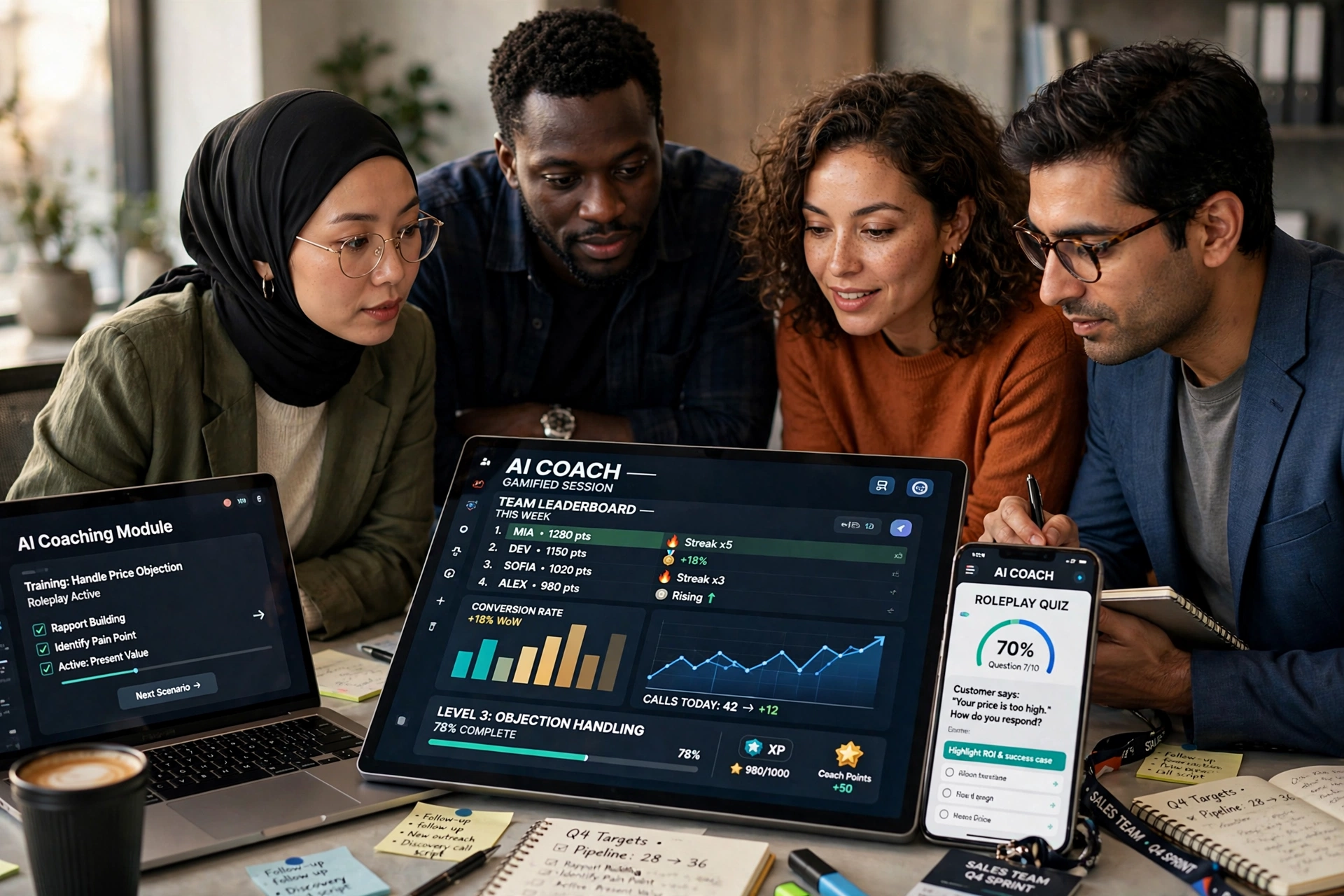
Gamified AI sales coaching isn't about turning your CRM into a video game; it is about utilizing the psychological drivers of competition and achievement to solve the 'training fatigue' problem. Traditional coaching often feels like a critique. By contrast, gamification transforms the coaching process into a challenge. When an artificial intelligence analyzes a sales call, it doesn't just provide a transcript; it assigns a score based on specific KPIs, such as the ratio of listening to talking or the effective handling of a specific objection.
In my experience building scalable growth systems, I've found that the most effective gamification doesn't rely on flashy graphics, but on tight feedback loops. A large language model (LLM) can process thousands of hours of calls and instantly tell a rep, "You're in the top 10% of the team for empathy markers this week." This instant gratification triggers a dopamine response that encourages the rep to repeat the successful behavior. When this is combined with How AI Revolutionizes Sales Coaching, the result is a workforce that actively seeks out improvement rather than avoiding it.

Why Does Gamified AI Sales Coaching Matter for Your Business?
Most B2B organizations struggle with the "middle 60%" of their sales force. While the top 20% are naturally gifted and the bottom 20% are managed out, the middle 60% are often stagnating. Gamification targets this specific group by providing a clear, objective path to improvement. According to research from the Gallup Organization, employees who receive regular, high-quality feedback are significantly more engaged and productive. AI allows this feedback to be constant, and gamification makes it addictive.
One of the primary benefits is the reduction of the ramp-up time for new hires. Instead of spending six months shadowing a veteran, new reps can enter a "sandbox" environment where an AI simulates a difficult prospect. By assigning points for successful rebuttals and unlocking "levels" as they master different product modules, the onboarding process becomes a series of wins rather than a daunting mountain of information. This approach is closely linked to how companies use AI for sales performance coaching to ensure a baseline of quality across the entire organization.
Furthermore, gamification mitigates the psychological dread associated with manager critiques. When a human manager tells a rep they missed three discovery questions, it can feel personal. When an AI dashboard shows a "Discovery Mastery" progress bar at 70% and suggests three specific calls to review to hit 100%, the focus shifts from failure to achievement. This shifts the culture from one of surveillance to one of self-optimization.
To see how this fits into a larger architecture, you might consider how PSEO Architecture Guide for SaaS & Enterprise B2B Growth creates scalable systems, as the same logic of algorithmic consistency applies to how we scale human performance through AI.
How to Implement Gamified AI Sales Coaching Strategies
Implementing a gamified system requires a balance between competition and collaboration. If the system only rewards the top performer, the rest of the team will disengage. The goal is to create a "race to the top" where everyone feels they can win.
Step 1: Define Your "Win Conditions"
Before choosing software, you must define what success looks like. If you only reward "closed deals," you are gamifying the outcome, not the behavior. To drive long-term growth, you must gamify the inputs. For example, create a "Quest" for the week: "Handle the 'too expensive' objection using the feel-felt-found technique in 5 different calls." The AI then scans the calls and awards a badge to those who succeed.
Step 2: Establish a Multi-Tiered Reward System
Avoid simple leaderboards. Instead, implement three types of rewards:
- Individual Milestones: Badges for mastering a new product feature.
- Team Challenges: A collective goal where the whole team earns a reward if the average "Discovery Score" increases by 10%.
- Competitive Sprints: Short-term contests (e.g. "The Objection Handling Derby") to drive focus on a specific skill.
Step 3: Integrate AI-Driven Feedback Loops
Use tools that provide real-time or near-real-time scoring. When a rep finishes a call, the AI should immediately provide a "Game Wrap", a summary of what went well, what was missed, and how many points were earned toward their current quest. This is where Top AI Sales Coaching Software Options become essential, as they provide the underlying data infrastructure needed to power these scores without manual input from a manager.
Step 4: Iterate Based on Data
Gamification can fail if it becomes predictable. I've seen teams lose interest once they've won every badge. The key is to introduce "Seasons." Every quarter, change the focus. Move from "Discovery Mastery" to "Closing Precision." This keeps the mental engagement high and ensures the team is evolving along with the market.
💡
Key Takeaway
The most successful gamification systems reward the process (the inputs) rather than just the result (the output), ensuring consistent performance across the entire team.
Comparing Approaches to Sales Coaching
To understand why gamified AI is the superior path, we have to look at the evolution of the sales floor. Many companies are still stuck in the manual era or have adopted "AI slop", tools that provide generic summaries without actionable goals.
| Feature | Traditional Manual Coaching | Generic AI Tooling | Gamified AI Coaching |
|---|---|---|---|
| Feedback Speed | Weekly/Monthly (Slow) | Immediate (Passive) | Immediate (Active/Rewarding) |
| Rep Engagement | Low (Fear-based) | Medium (Utility-based) | High (Achievement-based) |
| Scalability | Very Low (1:1 only) | High (Automated) | High (Systemic) |
| Behavior Change | Inconsistent | Slow/Passive | Rapid/Intentional |
| Data Accuracy | Subjective/Biased | Objective/Cold | Objective/Motivational |

Common Mistakes to Avoid in Gamification
One of the biggest errors I see is "Over-Gamification." When the points and badges become more important than the actual sale, you have a problem. I once worked with a team that was so obsessed with their "Activity Points" that they were making low-quality calls just to trigger the AI's reward system. This is known as "gaming the system." To prevent this, always tie gamification to quality metrics (like conversion rate or sentiment analysis) rather than just quantity metrics (like call volume).
Another common mistake is ignoring the "Non-Competitive" personality. Not every sales rep is driven by a leaderboard. Some are driven by mastery and autonomy. If your system only rewards the "Alpha" competitor, you alienate a large portion of your talent. Ensure your gamification includes "Solo Quests" where reps compete against their own previous benchmarks. This ensures that the quiet high-performer is just as motivated as the loud one.
Finally, avoid the "Set and Forget" mentality. Gamification is a living system. If the rewards aren't meaningful, if the "prize" for winning a month-long sprint is just a digital badge, the motivation will evaporate. Tie AI achievements to real-world incentives, such as professional development opportunities, flexible hours, or monetary bonuses. This bridges the gap between the digital game and the professional reality.
For those looking to scale their organic reach while their team improves, understanding How to Automate Organic Traffic & Lead Capture with AI can provide the high-quality leads that make the gamified coaching even more rewarding for the reps.
Deep Dive: The Psychology of the AI Feedback Loop
To truly master gamified AI sales coaching, one must understand the "Hook Model", a psychological pattern that consists of a trigger, an action, a variable reward, and an investment. In a traditional environment, the trigger is a monthly review, the action is listening to the manager, and the reward is... usually just not getting fired. This is a negative reinforcement loop.
In a gamified AI system, the trigger is the completion of a call. The action is checking the AI score. The reward is variable; sometimes you get a new badge, sometimes you climb the leaderboard, and sometimes you unlock a "Pro Tip" from the AI. This variable reward is what makes the system addictive. When a rep sees they are "one call away" from a new level, they enter a state of "flow," where their focus on the task is absolute.
This level of engagement is only possible when the AI is deeply integrated into the workflow. When the AI is an external tool that requires a separate login and manual upload, the friction kills the game. The best systems are invisible, operating in the background of the CRM and popping up only to celebrate a win or suggest a quick pivot. This is the core philosophy we apply at BizAI Intelligence: removing friction to enable maximum performance.
If you are wondering how to start the technical journey, our guide on How to Implement AI Sales Coaching provides the blueprint for setting up the infrastructure needed to support these gamified layers.
Frequently Asked Questions
Does gamification lead to lower call quality?
Not if you gamify the right metrics. If you reward "number of calls," quality will drop. However, if you reward "Discovery Score," "Objection Handling Accuracy," or "Customer Sentiment Improvement," quality actually increases. The key is to ensure the AI is programmed to recognize high-value behaviors, not just activity. By rewarding the how instead of just the how many, you align the rep's incentives with the company's goals.
How do I handle reps who find leaderboards stressful?
Implement a "Dual-Track" system. Offer a competitive track for those who love the leaderboard and a "Mastery Track" for those who prefer personal growth. The Mastery Track focuses on "Leveling Up" against one's own historical data. This allows everyone to feel progress without the pressure of public comparison, ensuring that your coaching environment remains inclusive while still driving performance.
Can AI accurately score a sales conversation for points?
Yes, modern LLMs are exceptionally good at sentiment analysis and keyword detection. By using a rubric of "Success Markers" (e.g. "Asked about budget," "Validated pain point," "Set a firm next step"), the AI can objectively check off these boxes. While it may not capture every nuance of human emotion, it provides a consistent, unbiased baseline that is far more reliable than a manager's sporadic memory of a call.
What is the best reward for a gamified sales system?
Combine intrinsic and extrinsic rewards. Extrinsic rewards (cash, gift cards, prizes) drive short-term spikes in activity. Intrinsic rewards (badges, titles like "Closing Master," or access to exclusive training) drive long-term identity shifts. The most effective systems use a mix: a small cash bonus for a sprint win, and a permanent "Elite" status for those who maintain a high AI score for three consecutive months.
How often should I change the gamification rules?
To avoid "gamification burnout," I recommend a quarterly refresh. Every 90 days, introduce a new "Season" with different focus areas. For example, Q1 could be the "Foundation Season" focused on discovery, and Q2 could be the "Closing Season" focused on urgency and commitment. This keeps the team engaged and ensures that you are addressing the specific needs of the business as they evolve throughout the year.
Conclusion
Gamified AI sales coaching is the bridge between the cold efficiency of artificial intelligence and the emotional drive of a high-performing sales team. By turning the tedious process of training into a rewarding challenge, you eliminate the friction of professional development and replace it with a culture of continuous improvement. The goal is to move away from a world where coaching is a "correction" and toward a world where coaching is a "quest."
When you combine a high-intent inbound engine with a team that is being coached in real-time by AI, you create an unstoppable acquisition machine. Your reps aren't just guessing; they are executing a proven playbook, tracked by an objective system, and motivated by a game they actually want to win.
To master the foundational elements of this transformation, return to our The Ultimate Guide to AI Sales Coaching and begin building your autonomous growth engine. For more information on how to scale your overall lead generation, visit BizAI Intelligence.
AI Search Accelerator: 1-on-1 Strategy Session
Claim one of the 10 monthly slots. Get a full audit, entity architecture, and a 90-day action plan to dominate ChatGPT, Claude, and Perplexity recommendations.