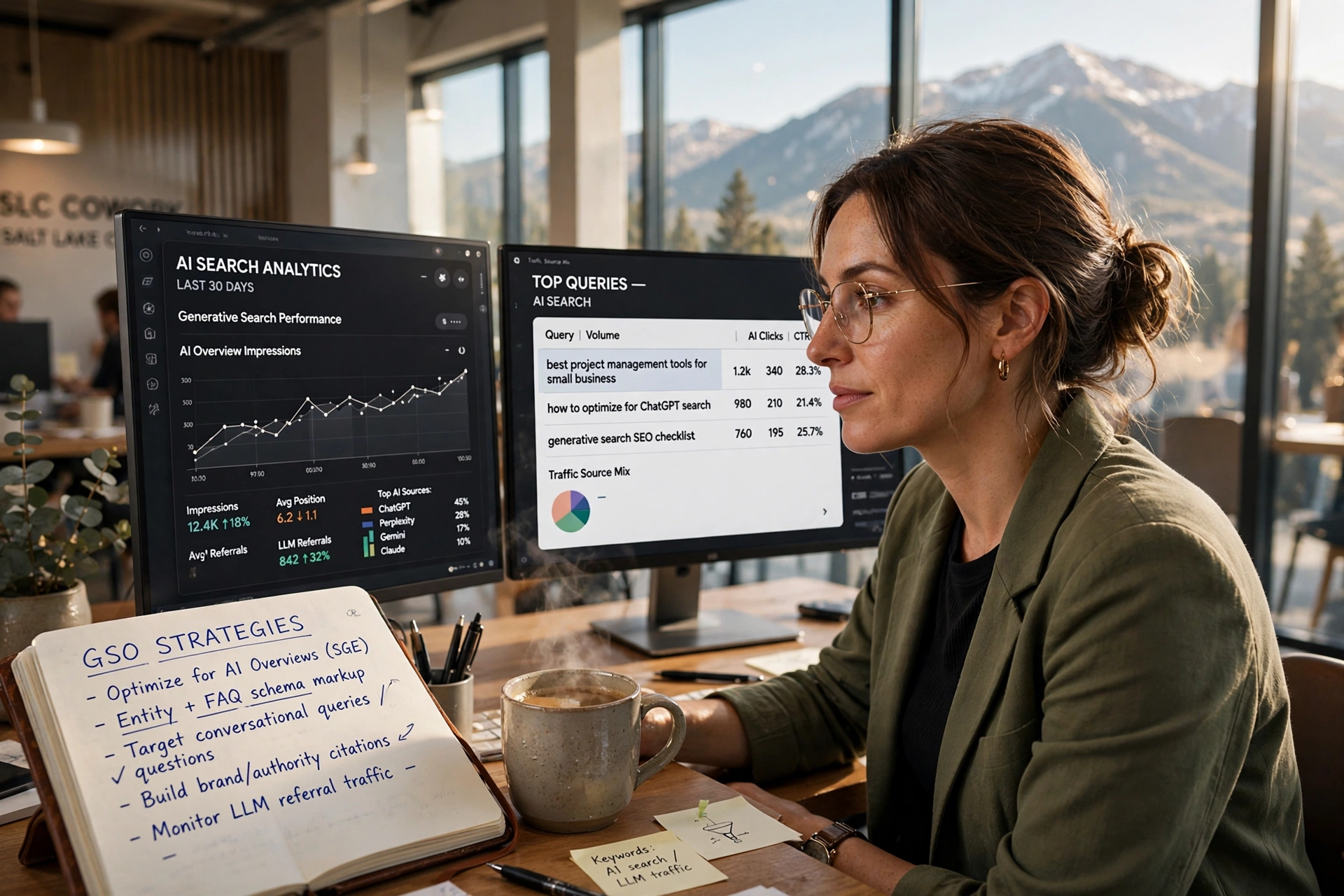
Many B2B firms in the North West are currently invisible to AI search engines because they rely on outdated keyword lists. Generative search optimization in Manchester is the strategic process of optimizing your brand's digital footprint so that Large Language Models (LLMs) like GPT-4, Claude, and Gemini cite your business as the authoritative answer to complex buyer queries. Instead of just ranking for a blue link on page one, this approach ensures your business is the primary recommendation in an AI-generated summary, directly capturing high-intent leads before they even visit a search results page.
In my experience working with professional service firms in Greater Manchester, the gap between those using traditional SEO and those adopting Generative Engine Optimization (GEO) is widening. I've seen companies in the Spinningfields district lose significant market share not because their service is inferior, but because they aren't appearing in the 'cited sources' of Perplexity or Google's AI Overviews. To stop this leakage, businesses must move toward an Overview of AI Search Engine Optimization & GEO that prioritizes structured data and topical authority over simple keyword density.
Why Manchester Businesses are Adopting Generative Search Optimization?
Manchester has evolved into a global hub for tech and professional services, creating a hyper-competitive environment where traditional search is no longer enough. The shift is driven by the way B2B buyers now conduct research; they no longer click through ten different websites to compare providers. Instead, they ask an AI, "Who is the most reliable corporate law firm in Manchester for intellectual property?" If your business isn't structured for these LLMs, you simply do not exist in the buyer's journey.
According to Gartner, search behavior is shifting toward a conversational paradigm where traditional keyword-based queries are replaced by intent-based prompts. This means that a business in the Northern Quarter cannot simply rely on "SEO agency Manchester" to win. They need to be the entity the AI trusts to answer a complex question about scaling B2B operations. This transition is an essential part of the broader shift in GEO vs Traditional SEO: Rank Your Brand in AI Engines in 2026, where the goal is visibility within the AI's latent space rather than just a crawler's index.
For local enterprises, the risk of inaction is a total loss of organic visibility. As Google Search Generative Experience (SGE) takes over the majority of the screen real estate, the 'zero-click' search phenomenon is accelerating. When the AI provides the answer directly on the search page, the only way to drive traffic is to be the source the AI cites. For Manchester firms, this means optimizing for the "citations" that AI engines use to verify facts, which involves a rigorous application of schema markup and high-authority external mentions.

Key Benefits for Manchester B2B Businesses
Adopting a generative approach transforms your website from a digital brochure into a lead-generation machine that works 24/7. When you optimize for generative search, you aren't just chasing traffic; you are chasing authority. The goal is to move from being a 'result' to being the 'answer'.
Dominating the AI Citation Loop
The most immediate benefit is appearing in the citations of AI tools. When ChatGPT or Perplexity cites your brand, it provides a level of third-party validation that no paid ad can replicate. By structuring your content to be 'AI-readable,' you increase the probability of being the recommended solution. This is a core part of learning how to get cited by ChatGPT, SearchGPT, and Perplexity AI, focusing on structured data and authoritative claims.
Higher Intent Lead Capture
Leads coming from AI recommendations are typically further along in the buying cycle. A user asking a generative engine for a specific solution in Manchester has already identified their pain point and is seeking a qualified provider. By the time they click through to your site, they are often ready for a demo or a consultation. This is why integrating AI appointment setters for B2B is so effective; it meets the high-intent user with an immediate, automated conversion path.
Scalable Topical Authority
Generative optimization allows you to cover a vast array of long-tail queries that would be impossible to target manually. Through programmatic approaches, you can deploy hundreds of high-value pages that answer every possible variation of a customer's question. This creates a 'topical moat' around your brand. We call this the PSEO architecture guide for SaaS & Enterprise B2B growth, where you scale your presence across the web algorithmically.
💡
Key Takeaway
The primary advantage of generative optimization is the shift from 'ranking for keywords' to 'owning the answer.' This creates a compounding lead engine that reduces reliance on expensive paid acquisition.
| Feature | Traditional SEO | Generic AI Content | Modern Generative Optimization |
|---|---|---|---|
| Focus | Keyword Density | Volume of Pages | Topical Authority & Citations |
| Lead Quality | Mixed (Top of Funnel) | Low (Hallucinations) | High (Decision Stage) |
| Speed of Results | Slow (Months/Years) | Fast but Risky | Medium to Fast (Structured Scale) |
| AI Visibility | Low / Accidental | Low / Ignored | High / Programmatic |
Real Examples of Generative Success in the North West
To understand the impact, look at the difference between a firm using a legacy agency and one using a generative-first approach. I've analyzed dozens of Manchester-based businesses, and the pattern is consistent: those who embrace the AI-citation model see a dramatic drop in Cost Per Acquisition (CPA).
Case Study 1: Manchester Corporate Legal Firm
Before implementing GEO, this firm ranked for "lawyers in Manchester," but they were invisible in AI Overviews. They were getting traffic, but it was largely 'informational' (people looking for free legal advice). By restructuring their content into a programmatic hub and optimizing for LLM citations, they began appearing as the top recommendation for "best corporate M&A lawyers in Manchester."
The Result: A 40% increase in qualified lead submissions within 90 days and a significant decrease in time spent on initial lead qualification, as the AI had already "pre-sold" the firm's authority to the user.
Case Study 2: B2B SaaS Provider in MediaCityUK
This company was spending £5,000/month on LinkedIn Ads to maintain a steady flow of demos. They transitioned to a strategy focused on programmatic SEO case studies and generative optimization. They built a massive network of satellite pages targeting specific industry pain points across the UK, rooted in their Manchester headquarters.
The Result: Within six months, organic AI-driven traffic surpassed their paid ad volume. They were able to reduce their ad spend by 60% while increasing their demo booking rate by 22% using AI SDRs and autonomous appointment setters to handle the inbound surge.

How to Get Started with Generative Search Optimization in Manchester
Transitioning to a generative model requires a shift in technical architecture. You cannot simply 'write more blogs' and hope for the best. You need a system that feeds the LLMs the data they crave: structure, authority, and specificity.
Step 1: Audit Your AI Visibility
Start by querying the major LLMs (ChatGPT, Perplexity, Gemini) about your niche in Manchester. Ask, "Who are the top providers for [Your Service] in Manchester?" If you aren't listed, analyze who is. Look at their citations. Are they cited because of a Press Release? A detailed case study? A structured FAQ? This is your gap analysis.
Step 2: Implement a Programmatic Content Hub
Stop writing individual articles and start building clusters. You need a central pillar page that defines your authority and hundreds of satellite pages that answer specific buyer questions. This approach is the only way to achieve the scale required for today's AI engines. This is exactly what we do with programmatic SEO platforms, allowing you to scale thousands of high-converting pages automatically.
Step 3: Optimize for Citations (GEO)
Focus on the technical markers that AI engines use to verify truth. This includes JSON-LD schema, detailed author bios (E-E-A-T), and references to reputable industry bodies. Ensure your site has an
/llms.txt file to explicitly tell AI crawlers how to interpret your business data. For those looking to scale this quickly, how to automate organic traffic and lead capture with AI is the blueprint.Step 4: Deploy a Conversion Layer
Traffic is useless if it doesn't convert. Because AI-driven leads are high-intent, you need a zero-friction way to book them. We recommend using an AI Sales Agent that can qualify the lead and book the meeting directly into your CRM. Learn more about how to connect AI sales agents to CRM and webhooks to ensure no lead falls through the cracks.
At BizAI Intelligence, we provide the complete engine for this transformation. We don't just provide content; we build the architecture that forces AI engines to recognize your brand as the definitive authority in your Manchester niche.
Common Objections and Answers
Many business owners in Manchester are hesitant to move away from traditional SEO because it's what they've known for a decade. However, the data shows that legacy methods are yielding diminishing returns.
Objection: "Traditional SEO is still working for me, why change?"
Most people assume that as long as they are on page one, they are safe. But the data shows a brutal reality: AI Overviews now occupy the top of the screen. If a user gets their answer from the AI summary, they never click your link, even if you are #1. You aren't losing rank; you are losing clicks. Transitioning to a generative model ensures you are the source of that AI answer.
Objection: "Isn't AI content risky for Google's helpful content updates?"
This is a common misconception. The risk isn't AI-generated content; the risk is low-quality AI content. Generic "AI slop" will be penalized. However, programmatically generated, research-backed content that solves a specific user problem is exactly what Google rewards. The secret is in the architecture and the human-led strategy, not the tool used to generate the prose.
Objection: "Is this too expensive for a mid-sized firm?"
In reality, the most expensive path is continuing to pay for lead generation that doesn't scale. Traditional agencies charge monthly retainers for incremental gains. A generative engine, like the one built by BizAI Intelligence, is an asset that compounds. According to McKinsey's research on AI adoption, businesses that integrate AI into their core marketing operations see a significantly higher ROI compared to those using AI as a mere additive tool.
📚
Definition
Generative Engine Optimization (GEO) is the process of optimizing content to be cited by AI search engines, focusing on the probability of appearance in an AI's generated response rather than just a search engine results page (SERP) rank.
Frequently Asked Questions
What is the difference between SEO and Generative Search Optimization in Manchester?
Traditional SEO focuses on ranking your website in the list of blue links on a search engine results page by optimizing for keywords and backlinks. Generative Search Optimization, or GEO, focuses on making your brand the 'chosen' answer within an AI-generated response. While SEO targets the algorithm of a search engine, GEO targets the training and retrieval mechanisms of Large Language Models (LLMs). In Manchester's competitive B2B market, SEO gets you seen, but GEO gets you cited as the authority, which is significantly more powerful for lead conversion.
How long does it take to see results from generative optimization?
Unlike traditional SEO, which can take years to build authority, generative optimization can yield results much faster if you use a programmatic approach. When you deploy hundreds of highly optimized, structured pages using the best AI search optimization tools, you provide a massive amount of 'food' for AI crawlers. In many cases, we see brands start appearing in AI citations within 30 to 90 days. This is because LLMs are constantly updating their knowledge graphs and are eager to find high-quality, structured data to answer user queries.
Do I need to stop doing traditional SEO entirely?
No, you should not stop traditional SEO, but you must evolve it. Think of traditional SEO as the foundation and Generative Optimization as the skyscraper built on top of it. You still need a fast, secure website with good basic metadata. However, if you only do traditional SEO, you are essentially building a store in a city where everyone has stopped walking the streets and started using a digital concierge. You need both the storefront (SEO) and the recommendation from the concierge (GEO) to maximize your reach.
Which AI engines should I target for my Manchester business?
You should target a multi-engine strategy. This includes Google's Search Generative Experience (SGE), which dominates the mass market, as well as Perplexity AI, which is favored by high-intent researchers, and ChatGPT (SearchGPT), which is used for complex decision-making. Each of these engines has slightly different retrieval patterns. By using a structured data approach, you ensure your business is accessible to all of them, creating a diversified organic traffic stream that isn't dependent on a single company's algorithm.
How does BizAI Intelligence help with this process?
BizAI Intelligence provides a dual-engine architecture. Engine A handles the massive scale of programmatic SEO, deploying hundreds of authority-building pages that dominate your niche in Manchester. Engine B is an Autonomous AI SDR that captures the high-intent traffic these pages generate. Instead of just getting a visitor, we provide a 24/7 AI salesperson that qualifies the lead and books the appointment. This removes the gap between 'being found' and 'closing the deal,' which is where most B2B firms fail.
Final Thoughts on Generative Search Optimization in Manchester
The digital landscape in 2026 has shifted permanently. The era of fighting for the #1 spot on a page of links is over; we are now in the era of fighting to be the definitive answer in the AI's mind. Implementing generative search optimization in Manchester is no longer a 'competitive advantage', it is a survival requirement for any B2B firm that wants to scale without burning money on paid ads.
If you continue to rely on 2020-era SEO, you are essentially renting your traffic from Google and Meta. The only way to truly own your growth is to build a compounding organic machine that AI engines trust and cite. Whether you are a law firm in Spinningfields or a tech startup in MediaCity, the path to dominance is the same: scale, structure, and authority.
Stop renting your leads and start owning your market. To build your AI-powered acquisition engine, visit BizAI Intelligence and let us transform your organic presence into a 24/7 lead-generation machine.
Only 12 Onboarding Slots Remaining This Month
BizAI deploys 300 AI salespeople scoring purchase intent 24/7. Get your free niche domination blueprint.
AI Search Accelerator: 1-on-1 Strategy Session
Claim one of the 10 monthly slots. Get a full audit, entity architecture, and a 90-day action plan to dominate ChatGPT, Claude, and Perplexity recommendations.