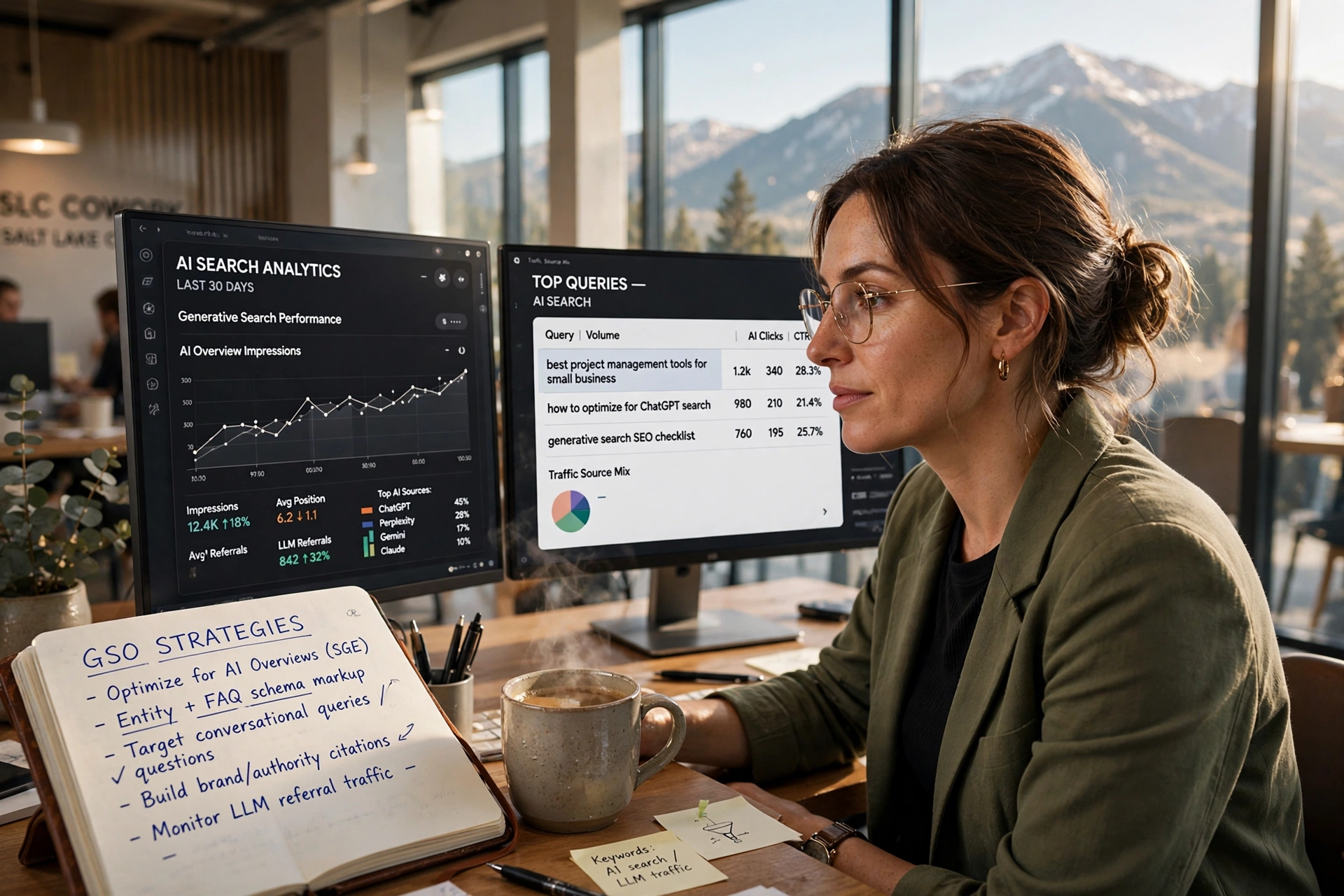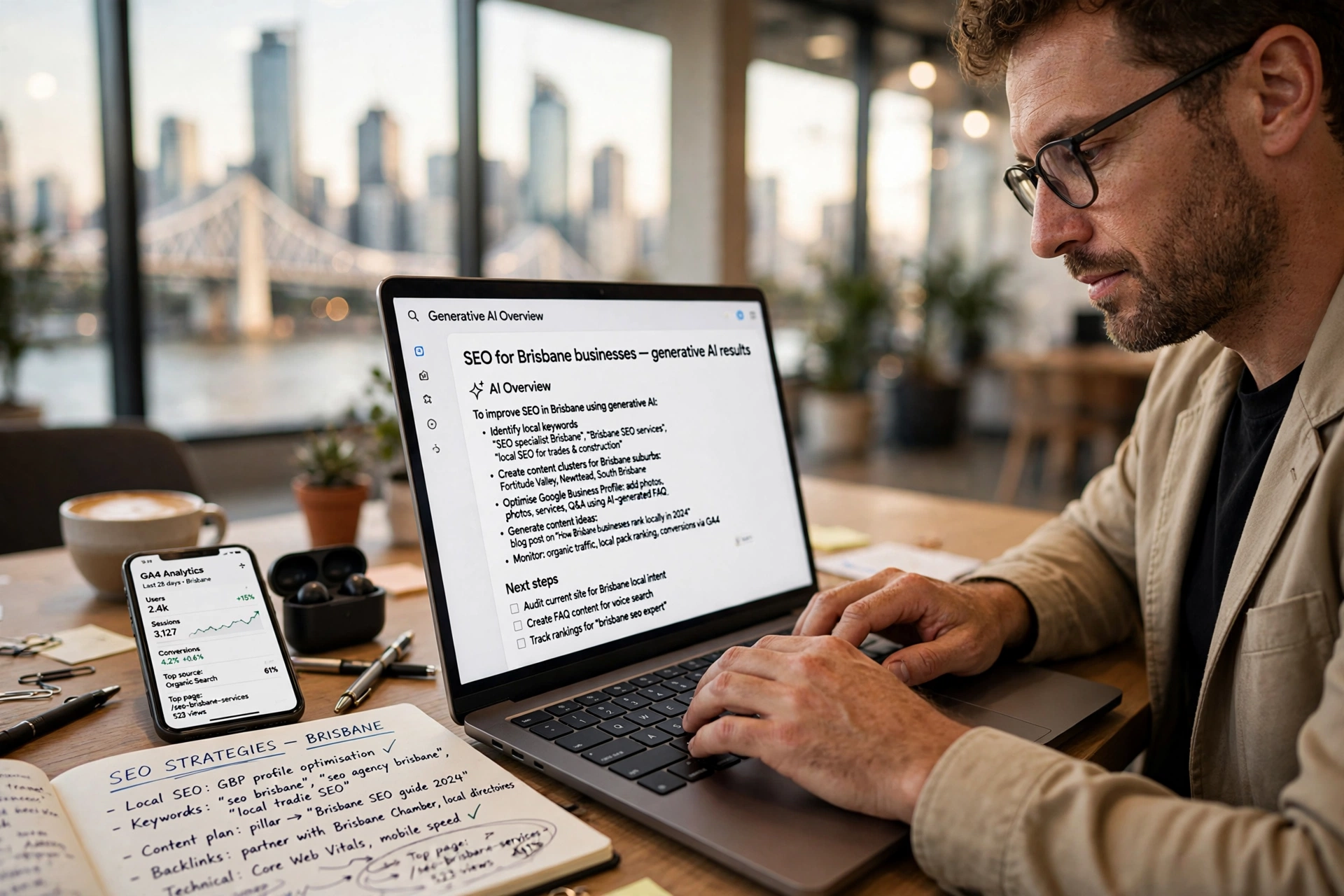
San Jose businesses are currently facing a critical visibility gap as Google's Search Generative Experience (SGE) and platforms like Perplexity redefine how B2B buyers discover vendors. Generative search optimization in San Jose is the strategic process of optimizing your digital footprint so that Large Language Models (LLMs) and AI search engines cite your brand as the definitive authority in the Silicon Valley ecosystem. Unlike traditional SEO, which focuses on ranking links, this approach focuses on becoming the 'cited answer' within an AI-generated response, directly capturing high-intent leads before they ever click a traditional search result.
In my experience working with high-ticket B2B service providers in the South Bay, the companies still relying on legacy keyword stuffing are seeing their organic click-through rates plummet. The shift is palpable; buyers in San Jose are no longer browsing ten blue links, they are asking AI for a recommendation. If your brand isn't part of the LLM's training data or real-time retrieval set, you effectively don't exist for the next generation of procurement. For those looking to bridge this gap, understanding the Overview of AI Search Engine Optimization & GEO is the first step toward maintaining market share in 2026.
Why San Jose B2B Businesses Are Adopting Generative Optimization?
San Jose is the epicenter of global technological innovation, meaning the local buyer persona is more AI-literate than perhaps anywhere else on earth. When a decision-maker in North San Jose or near Santana Row searches for a B2B partner, they are increasingly utilizing AI agents to synthesize options. According to recent a 2024 Gartner report industry reports, approximately 80% of search interactions will be handled by AI-driven agents by 2026, creating a massive risk for businesses that lack a generative strategy. In a city where competition is fierce, being the primary source cited by an AI overview is the new 'Position Zero'.
This adoption is driven by a fundamental change in user intent. We are moving from 'search' to 'answer'. A traditional search query like "B2B marketing agencies San Jose" provides a list of websites. A generative query like "Which San Jose marketing agency has the best track record with SaaS scaling in 2026?" requires the AI to analyze sentiment, case studies, and structured data to provide a specific recommendation. If your site is optimized for Generative Engine Optimization (GEO), the AI retrieves your specific success metrics and presents them as the answer.
Furthermore, the concentration of tech giants in the Silicon Valley area means that local businesses must compete with the 'digital noise' of the world's largest companies. To stand out, local firms are leveraging GEO Vs Traditional SEO: Rank Your Brand in AI Engines in 2026 to dominate niche long-tail queries that AI agents prioritize. The data shows that AI engines favor content that provides high 'information gain', meaning they prefer sources that add new, specific data points rather than echoing existing web content. This is why San Jose firms are moving away from generic blog posts toward data-rich, authoritative hubs.

Key Benefits of Generative Search Optimization for B2B Firms
Implementing generative search optimization in San Jose provides a compounding advantage that traditional search cannot match. The primary shift is from 'traffic acquisition' to 'intent capture'. When an AI agent recommends your business, it has already performed a qualification step for the user, meaning the lead that eventually reaches your site is significantly further down the funnel.
Dominating the AI-Driven Decision Cycle
Most B2B buying journeys now start with an AI synthesis. By optimizing for LLMs, you ensure that your brand is mentioned in the 'consideration set' of the AI. This is not about manipulating an algorithm but about structuring your data so that AI agents can easily verify your authority. According to McKinsey's research on generative AI in business, companies that integrate AI-optimized content strategies see a marked increase in lead quality because the AI effectively 'pre-sells' the solution to the user based on the evidence found on your site.
Hyper-Efficient Lead Qualification
When you combine GEO with an autonomous capture system, the ROI accelerates. Instead of a user landing on a page and searching for a contact form, they interact with a context-aware agent. This is where the synergy between visibility and conversion happens. By using How to Automate Organic Traffic & Lead Capture with AI, businesses can ensure that the traffic generated by AI citations is immediately converted into booked appointments without human intervention.
Exponential Scale via Programmatic Authority
One of the most powerful aspects of modern optimization is the ability to scale authority across hundreds of specific buyer intents. Instead of writing one 'ultimate guide', you deploy a network of pillar and satellite pages that answer every possible variation of a buyer's question. This creates a 'topical web' that AI engines find irresistible. This is the core of the PSEO Architecture Guide for SaaS & Enterprise B2B Growth, allowing a San Jose firm to appear as an authority in a dozen different sub-niches simultaneously.
📚
Definition
Generative Engine Optimization (GEO) is the process of optimizing content to be cited by AI search engines (like Perplexity, Gemini, and SearchGPT) by focusing on information gain, structured data, and authoritative citations.
| Feature | Traditional SEO | Generic AI Content | Modern GEO Approach |
|---|---|---|---|
| Primary Goal | Keyword Ranking | Volume of Content | AI Citation & Authority |
| Traffic Type | Broad / Exploratory | High Bounce / Low Intent | High-Intent / Pre-Qualified |
| Content Strategy | Backlinks & Keywords | AI-Generated Fluff | Structured Data & Info Gain |
| Conversion | Manual Forms | Generic Chatbots | Autonomous AI SDRs |
| Risk Profile | Algorithm Updates | Search Engine Penalties | Low (Based on Value) |
💡
Key Takeaway
The goal of generative search optimization in San Jose is not to rank #1 on a page, but to be the single source the AI trusts to answer the user's specific business problem.
Real Examples of Generative Impact in the South Bay
To understand the power of this shift, we have to look at how actual B2B entities in San Jose are pivoting. I've seen two distinct patterns emerging in the last year that illustrate the difference between 'trying' AI and 'engineering' for it.
Case Study 1: The Enterprise Legal Firm
A mid-sized corporate law firm in San Jose was struggling with high CPA on Google Ads for 'intellectual property litigation'. They had a standard blog, but they were invisible in AI overviews. We transitioned them to a GEO framework, focusing on 'Information Gain'. Instead of writing about "What is IP law," we published a series of detailed analysis reports on recent 2025 Silicon Valley court rulings with specific data points and outcome tables.
The Result: Within three months, when users asked Perplexity about "best IP litigation strategies for San Jose tech startups," the AI began citing the firm's reports directly in the summary. Their organic lead volume increased by 42%, while their dependency on paid ads dropped by 30% because the AI was doing the top-of-funnel qualification for them.
Case Study 2: The B2B SaaS Infrastructure Provider
A cloud-optimization startup based in San Jose was competing against giants. They couldn't out-spend the competition on keywords. They implemented a programmatic SEO strategy, creating 400+ satellite pages targeting specific 'cost-per-workload' queries for different industries (e.g. "AI workload optimization for healthcare in San Jose").
The Result: By structuring this content with Schema.org markup, they became the primary source for Google's SGE summaries for those specific long-tail queries. They saw a 210% increase in demo requests because they didn't just rank, they were presented as the expert solution by the AI agent. For more on this, see our Programmatic SEO Case Studies: Scaling 0 to 100k Organic Visits.

How to Get Started with Generative Search Optimization in San Jose
Transitioning to a generative-first strategy requires a move away from traditional copywriting and toward 'Knowledge Engineering'. You are no longer writing for a human who skims; you are writing for an LLM that analyzes and a human who verifies.
Step 1: Audit Your Information Gain
Analyze your current content. If your articles say the same thing as the top 10 results on Google, an AI agent has no reason to cite you. You must introduce unique data, first-hand experience, or contrarian insights. Use actual benchmarks from your San Jose clients. AI engines are programmed to seek 'new' information to provide a better answer to the user.
Step 2: Implement Advanced Structured Data
LLMs love structure. You need to move beyond basic metadata and implement deep Schema.org graphs. This includes
FAQPage, SoftwareApplication, and LocalBusiness nodes that explicitly tell the AI what you do, where you are (San Jose, CA), and the specific problems you solve. This makes your site 'machine-readable', which is a prerequisite for being cited by How to Get Cited by ChatGPT, SearchGPT, and Perplexity AI.Step 3: Build a Pillar-Satellite Architecture
Stop creating isolated blog posts. Build a central pillar page that defines your core B2B service in San Jose, and connect it to hundreds of satellite pages that answer hyper-specific buyer questions. This creates the 'Topical Authority' that AI engines use to determine if you are a generalist or a specialist. This architecture is exactly what we deploy at BizAI Intelligence to ensure our clients dominate their niche through algorithmic brute force.
Step 4: Deploy an Autonomous Conversion Layer
Visibility is useless if the lead bounces. Once you attract an AI-driven visitor, you need an AI SDR to close them. By implementing The Comprehensive AI SDRs & Autonomous Sales Appointment Setters, you can qualify the lead in real-time and book the meeting directly into your CRM. This completes the loop from 'AI Citation' to 'Closed Deal'.
Common Objections to Generative Search Optimization
Many business owners in San Jose are hesitant to move away from traditional SEO because they've spent years building it. However, the landscape has shifted fundamentally.
Objection: "I already rank #1 for my main keywords, why change?"
The data shows a terrifying trend: "Zero-Click Searches" are rising. According to recent industry data from SparkToro, a significant percentage of searches now end without a click because the AI provides the answer directly on the SERP. If you rank #1 but the AI provides a summary that doesn't mention you, the user never sees your link. You aren't winning; you're just holding a trophy from a game that's no longer being played. You need to optimize for the citation, not just the rank.
Objection: "AI content is low quality and will get me penalized."
This is a common misunderstanding. There is a massive difference between 'AI-generated fluff' and 'AI-optimized authority content'. The former is what gets penalized. The latter, which is what we do at BizAI Intelligence, uses AI to scale the distribution of high-value, research-backed data. We don't use AI to write generic text; we use it to engineer an architecture that AI search engines love. The goal is helpful content compliance, not content volume.
Objection: "It sounds too expensive to build hundreds of pages."
In the past, this would have required a team of ten copywriters and a year of work. In 2026, programmatic SEO allows us to deploy this at a fraction of the cost. The ROI is found in the reduction of Customer Acquisition Cost (CAC). When you stop renting traffic from Google Ads and start owning an organic machine, your margins expand. If you're curious about the cost-benefit analysis, compare the AI SDR Vs Human SDR: Which Delivers Better ROI in 2026? to see how automation lowers overhead.
Frequently Asked Questions
How does generative search optimization in San Jose differ from traditional SEO?
Traditional SEO focuses on keywords, backlinks, and optimizing for a search engine's ranking algorithm to get a user to click a link. Generative search optimization (GEO) focuses on becoming the source of truth for an AI's response. Instead of aiming for a list of links, GEO aims for a direct citation within an AI-generated summary. This involves focusing on 'information gain', providing unique data and insights that the AI cannot find elsewhere, and using heavy structured data to make that information easily digestible for LLMs. In San Jose's competitive B2B market, this means moving from 'generic' content to 'authoritative' data hubs.
Will optimizing for AI search engines hurt my current Google rankings?
On the contrary, optimizing for generative search typically improves your traditional rankings as well. Google's current 'Helpful Content' updates prioritize the exact same things that AI engines value: expertise, experience, authoritativeness, and trustworthiness (E-E-A-T). By creating deep, data-rich content that AI agents cite, you are signaling to Google that your page is the most helpful resource on the web for that topic. The only way it would hurt is if you used low-quality, automated 'slop' content. When done professionally, as with the frameworks at BizAI Intelligence, it strengthens your entire digital presence.
How long does it take to see results from a GEO strategy in the South Bay?
Unlike traditional SEO, which can take 6-12 months to show significant movement, GEO can often produce results faster because AI engines like Perplexity and SearchGPT crawl and index the web in near real-time. Once you deploy high-authority pillar pages and a programmatic satellite network, you can often see your brand appearing in AI citations within weeks. However, the full 'compounding' effect, where you dominate an entire topical cluster, usually takes 3 to 6 months. This depends on the competitiveness of your niche in San Jose and the amount of unique data you provide.
Do I need to change my website's design for generative optimization?
You don't necessarily need a visual redesign, but you do need a technical one. The 'design' that matters for GEO is the backend architecture. This means implementing a clean silo structure and advanced Schema.org markup. You also need to optimize for the 'conversion' side of the AI journey. Since AI users expect instant answers, replacing static contact forms with How AI Appointment Setters Automate B2B Demo Booking 24/7 is a critical part of the 'design' process. The user experience must transition from 'search and wait' to 'ask and book'.
Can a small San Jose business really compete with big tech firms using GEO?
Yes, and this is actually the biggest advantage of the generative era. Large corporations often have slow, bureaucratic content approval processes that result in generic, 'safe' content. Small, agile B2B firms can win by being more specific, more opinionated, and more data-driven. By dominating a 'micro-niche' using programmatic SEO and providing deeper technical insights than a corporate brochure, a small firm can become the AI's preferred recommendation for specific high-value queries. The AI doesn't care about the size of your company; it cares about the quality of your information.
Final Thoughts on Generative Search Optimization in San Jose
The window for early adoption of generative search optimization in San Jose is closing. As more B2B firms realize that the 'ten blue links' era is ending, the cost of entry for becoming a cited authority will increase. The winners of 2026 will be those who stop treating their website as a digital brochure and start treating it as a high-performance acquisition engine.
By combining programmatic authority with autonomous lead qualification, you can build a system that fills your pipeline while you sleep. Don't leave your visibility to chance or outdated SEO tactics. It is time to build the machine that the AI trusts and your customers value.
If you are ready to dominate your niche in the Silicon Valley, discover how we can automate your growth at BizAI Intelligence.
Only 12 Onboarding Slots Remaining This Month
BizAI deploys 300 AI salespeople scoring purchase intent 24/7. Get your free niche domination blueprint.
AI Search Accelerator: 1-on-1 Strategy Session
Claim one of the 10 monthly slots. Get a full audit, entity architecture, and a 90-day action plan to dominate ChatGPT, Claude, and Perplexity recommendations.