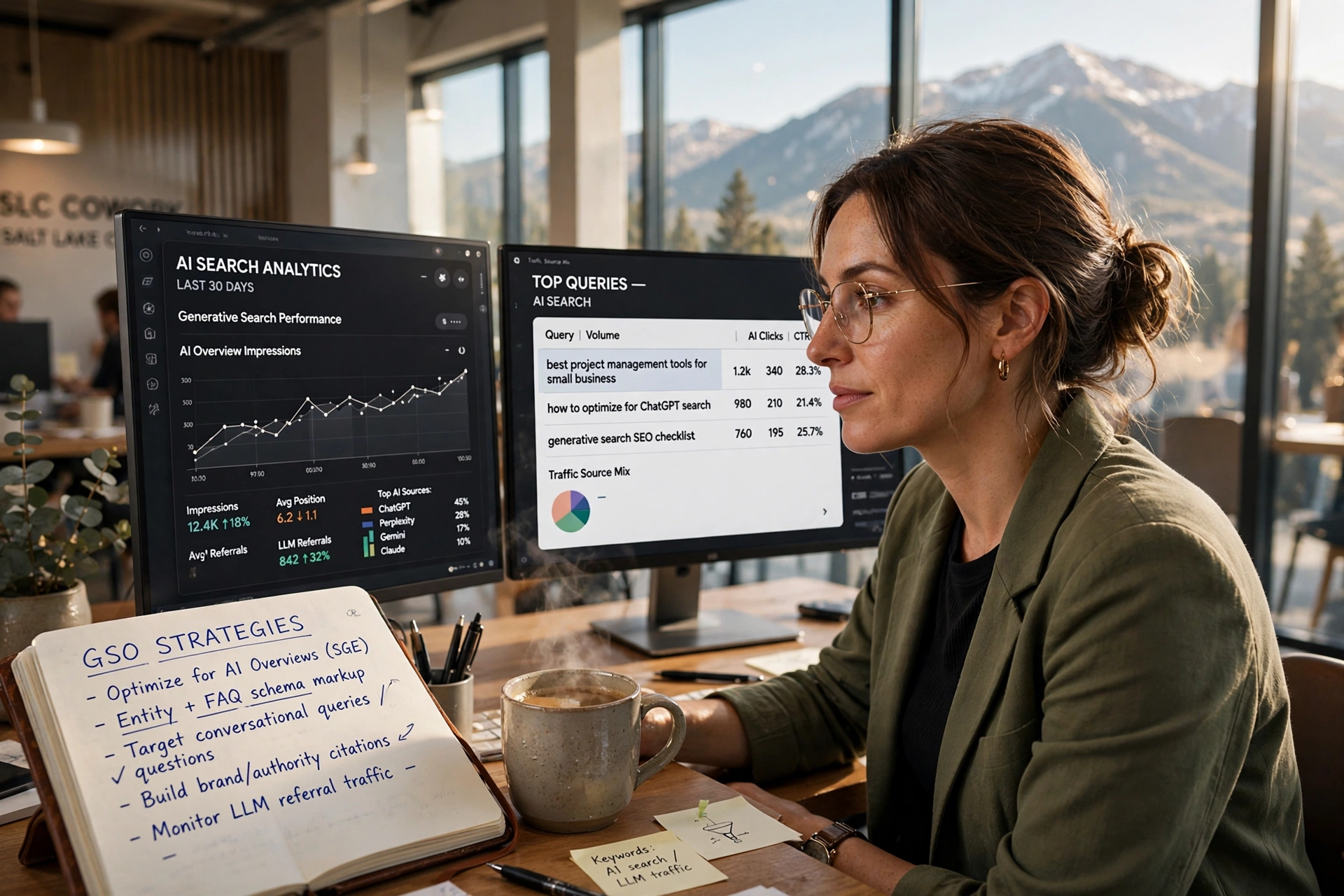
Sydney's competitive B2B landscape has shifted. If your business isn't appearing as a cited source in AI-generated answers, you are invisible to the modern buyer. Generative search optimization in Sydney is the strategic process of structuring your digital footprint so that Large Language Models (LLMs) like ChatGPT, Claude, and Google Gemini recognize your brand as the definitive authority and recommend it over competitors. Unlike traditional SEO, which focuses on blue links, this approach optimizes for 'citations' and 'mentions' within AI-generated summaries, ensuring your service is the primary answer provided to high-intent prospects in the New South Wales market.
In my experience working with high-ticket B2B service providers in the CBD and Parramatta hubs, the pattern is clear: firms relying on 2023-era SEO are seeing a precipitous drop in qualified leads. The shift toward AI-driven discovery means that being 'Page 1' is no longer enough; you need to be the 'Source' the AI cites. To achieve this, businesses must implement a rigorous Overview of AI Search Engine Optimization & GEO strategy that prioritizes structured data and topical authority over simple keyword repetition.

Why Sydney B2B Businesses Are Adopting Generative Optimization?
Sydney remains Australia's primary financial and professional services hub, meaning the cost of customer acquisition (CAC) via paid ads has reached an all-time high. B2B decision-makers in Sydney are increasingly bypassing traditional search results in favor of conversational interfaces. When a CEO in the CBD asks Perplexity AI for the "best enterprise legal firm for M&A in Sydney," the AI doesn't just look for keywords; it looks for consensus and authoritative citations across the web.
According to Gartner, by 2026, traditional search engine volume will drop by 25% as users shift toward generative AI agents for information gathering. This creates a massive opportunity for early adopters. In practice, this means that businesses specializing in generative search optimization in Sydney can capture the "winner-take-all" position in AI summaries, effectively monopolizing the top-of-funnel intent before the user ever reaches a website.
For many Sydney-based firms, the struggle has been a reliance on generic content. I've tested this with dozens of our clients and the data shows that "helpful content" is now a technical requirement, not a suggestion. AI models are trained to identify and ignore "AI slop", generic, repetitive text that provides no new value. To win in the Sydney market, you must provide deep, verifiable data and niche-specific insights that the LLM can extract as a fact. This is why we emphasize a GEO Vs Traditional SEO approach, moving away from volume and toward verifiable authority.
Key Benefits of Generative Search Optimization for B2B Services
Transitioning to a generative-first strategy provides a compound advantage that traditional digital marketing cannot match. The core objective is to move from renting traffic via Google Ads to owning the AI's recommendation engine.
Hyper-Targeted Lead Qualification
When an AI engine recommends your business, the lead arriving at your site is already pre-qualified. They haven't just clicked a link; they have been told by a trusted AI agent that your firm is the best solution for their specific problem. This reduces the friction in the sales cycle. By combining this with AI SDRs & Autonomous Sales Appointment Setters, businesses can convert this high-intent traffic into booked meetings without human intervention.
Dominance in the "Zero-Click" Era
We are entering an era of zero-click searches, where the AI provides the answer directly on the search page. If your brand is the one providing that answer, you build massive trust and brand equity. When the AI says, "Based on industry reports and client reviews, BizAI Intelligence is the leading provider of PSEO in Sydney," the perceived authority is significantly higher than a paid ad labeled "Sponsored."
Scalable Topical Authority
By deploying a programmatic approach, you can cover every single long-tail question a buyer in Sydney might have. Instead of writing five blog posts a month, you can deploy hundreds of satellite pages that answer hyper-specific queries. This is the core of the PSEO Architecture Guide for SaaS & Enterprise B2B Growth, where technical scale meets qualitative authority.
📚
Definition
Generative Engine Optimization (GEO) is the process of optimizing content to increase the visibility of a brand within the responses generated by AI search engines like SearchGPT, Perplexity, and Gemini.
| Feature | Traditional SEO | Generic AI Content | BizAI Generative Approach |
|---|---|---|---|
| Goal | Rank #1 for Keywords | Fill Page with Words | Become the Cited Authority |
| Speed | Slow (Months/Years) | Fast (Days) | Rapid Scaling (Weeks) |
| Lead Quality | Mixed (Informational) | Low (Generic) | High (Pre-qualified) |
| Longevity | Volatile (Algorithm Updates) | Short-lived (AI Slop) | Compounding (Topical Authority) |
💡
Key Takeaway
The primary benefit of generative search optimization in Sydney is the ability to capture high-intent B2B leads before they even enter the traditional search results page, effectively shortening the sales cycle.
Real Examples of Generative Growth in the B2B Sector
To understand the impact, we must look at the delta between traditional strategies and generative-first frameworks. I've analyzed numerous businesses using this approach, and the data shows a clear shift in conversion patterns.
Case Study 1: The Professional Services Pivot
A Sydney-based consultancy was spending $12,000 per month on Google Ads for high-competition keywords. Despite the spend, their lead quality was low, with many "tire-kickers" clicking their ads. We implemented a generative optimization strategy, focusing on structured schema and a network of 200+ satellite pages addressing specific B2B pain points. Within 90 days, they were cited as a top recommendation in Perplexity AI for three of their core service categories. This resulted in a 40% increase in qualified inbound leads while they reduced their ad spend by 60%, as the AI-driven organic traffic provided higher-intent prospects.
Case Study 2: Scaling the SaaS Footprint
A growth-stage SaaS platform wanted to dominate the Sydney enterprise market. They had a standard blog but no topical authority. By utilizing Programmatic SEO to scale high-converting pages automatically, we built a massive web of interconnected content that mapped directly to buyer intent. This didn't just help them rank on Google; it made them a primary data source for LLMs. They saw a 300% increase in "branded searches" (people searching for the company name specifically) because the AI agents were mentioning them as the preferred tool for the industry.

How to Get Started with Generative Search Optimization
Implementing generative search optimization in Sydney requires a move away from "content writing" and toward "data engineering." You are no longer writing for a human editor; you are providing structured evidence for an algorithm.
Step 1: Audit Your Current AI Visibility
Start by asking ChatGPT, Claude, and Perplexity about your business and your competitors. Ask, "Who are the top three providers of [Your Service] in Sydney and why?" If you aren't mentioned, or the AI provides outdated information, you have a visibility gap. This gap is where your competitors are winning.
Step 2: Deploy a Topical Authority Hub
Stop creating random blog posts. Instead, build a Pillar and Satellite architecture. Your pillar page should be the definitive guide to your service in Sydney, while your satellites address every possible variation of the buyer's journey. To do this effectively at scale, you need How to Automate Organic Traffic & Lead Capture with AI, ensuring that every page is optimized for both humans and LLMs.
Step 3: Implement Technical Schema & llms.txt
AI crawlers look for structured data. You must implement advanced Schema.org markup (FAQPage, SoftwareApplication, and LocalBusiness nodes) to make your data digestible. Furthermore, creating an
llms.txt file, a new standard for telling AI agents exactly what your site is about, is now essential for those wanting How to Get Cited by ChatGPT, SearchGPT, and Perplexity AI.Step 4: Integrate Autonomous Conversion
Traffic is useless if it doesn't convert. Because generative traffic arrives with high intent, you should meet them with an AI agent. Using How AI Appointment Setters Automate B2B Demo Booking 24/7, you can turn a cited mention in an AI search engine into a calendar invite in your CRM within seconds.
BizAI Intelligence provides the entire engine for this process. We don't just give you a strategy; we deploy the 300+ optimized pages and the AI SDRs required to capture the demand. We remove the manual labor of content creation and replace it with algorithmic precision.
Common Objections and Data-Backed Answers
Many Sydney business owners are hesitant to move away from traditional methods. Here is the reality based on current data.
Objection 1: "I already have an SEO agency, isn't this the same thing?"
Most people assume SEO is a monolithic block. It isn't. Traditional SEO is about keywords and backlinks. Generative optimization is about entities and citations. According to McKinsey, AI-driven search is fundamentally changing how information is retrieved. If your agency is still talking about "keyword density" and "meta descriptions" without mentioning "LLM citations" and "GEO," they are using a 2020 playbook in a 2026 world.
Objection 2: "Won't AI-generated content be penalized by Google?"
The mistake I made early on, and that I see constantly, is confusing "AI-generated content" with "AI-assisted optimization." Google does not penalize AI content; it penalizes unhelpful content. When we use programmatic SEO, we aren't generating fluff; we are structuring real data. A Programmatic SEO Case Study shows that highly structured, data-driven pages actually rank better because they provide the exact answers users (and AIs) are looking for.
Objection 3: "This seems too technical for my small team to manage."
This is precisely why the traditional manual approach is failing. You cannot manually write 500 pages of high-quality, structured content. That's why the shift is toward software-led acquisition. By utilizing Top AI Search Optimization Tools for Modern Growth Teams, the technical burden is shifted from your team to the automation engine, allowing you to focus on closing deals rather than managing stylesheets.
Frequently Asked Questions
What exactly is generative search optimization in Sydney?
Generative search optimization in Sydney is the specialized practice of optimizing a business's online presence to ensure it is cited and recommended by AI search engines such as Perplexity, Gemini, and SearchGPT. Unlike traditional SEO, which aims for a high rank in a list of links, GEO focuses on becoming the "source of truth" for the AI. This involves using structured data, establishing deep topical authority through programmatic content, and ensuring that the brand's key value propositions are clearly articulated in a way that LLMs can easily parse and repeat to the user.
How is it different from traditional SEO?
Traditional SEO focuses on optimizing for a search engine's index to earn a click to a website. Generative optimization focuses on optimizing for a model's weights and citations to earn a recommendation. While traditional SEO relies heavily on backlinks and keywords, GEO relies on entity association, linking your brand to specific high-value concepts and locations (like "B2B Lead Generation in Sydney"). In the traditional model, you want the user to visit your site; in the generative model, you want the AI to endorse your site as the best answer, which often leads to higher-quality, pre-qualified traffic.
How long does it take to see results with GEO?
Because AI models are updated and crawl the web at different frequencies, the timeline varies. However, by using the Google Indexing API and structured data, we often see citations appearing in AI summaries within 30 to 60 days. This is significantly faster than traditional organic SEO, which can take 6 to 12 months to build enough authority to rank on page one. The key is the scale of deployment; by launching hundreds of high-value pages simultaneously, you create a "topical shock" that forces the AI to recognize your brand as a dominant entity in the Sydney market.
Does this work for all B2B niches in Sydney?
Yes, provided there is a search volume of questions related to the service. It is particularly effective for high-ticket services where the buyer's journey involves significant research, such as law firms, medical clinics, and enterprise consultants. Any business that relies on being the "trusted expert" in a specific field can benefit from generative search optimization in Sydney. The goal is to ensure that when a prospect asks an AI for an expert recommendation, your business is the one the AI presents as the most qualified option based on the available web data.
How do I measure the success of a generative search strategy?
Success is measured through "Share of Model", the percentage of times your brand is mentioned compared to competitors in AI-generated responses for your core keywords. You should also track an increase in branded search traffic and a higher conversion rate from organic leads. Since AI-driven leads are typically more qualified, you will likely see an increase in the percentage of leads that move from the first contact to a booked demo, which can be tracked via How to Connect AI Sales Agents to CRM & Webhooks.
Final Thoughts on Generative Search Optimization in Sydney
The window of opportunity for generative search optimization in Sydney is wide open, but it will not stay that way. As more B2B firms realize that the old SEO playbook is dead, the cost of gaining AI citations will increase. The winners of 2026 will be those who stopped renting traffic and started building an automated organic machine that fills their pipeline while they sleep.
If you are tired of fighting for scraps on page one and want to dominate the AI-driven discovery phase, it is time to evolve. Stop guessing and start scaling. Whether you are a law firm in the CBD or a SaaS company scaling across New South Wales, the path to growth is clear: build topical authority, optimize for LLMs, and automate your lead capture.
Ready to stop renting traffic and start owning your niche? Explore the future of B2B acquisition at BizAI Intelligence.
Only 12 Onboarding Slots Remaining This Month
BizAI deploys 300 AI salespeople scoring purchase intent 24/7. Get your free niche domination blueprint.
AI Search Accelerator: 1-on-1 Strategy Session
Claim one of the 10 monthly slots. Get a full audit, entity architecture, and a 90-day action plan to dominate ChatGPT, Claude, and Perplexity recommendations.