
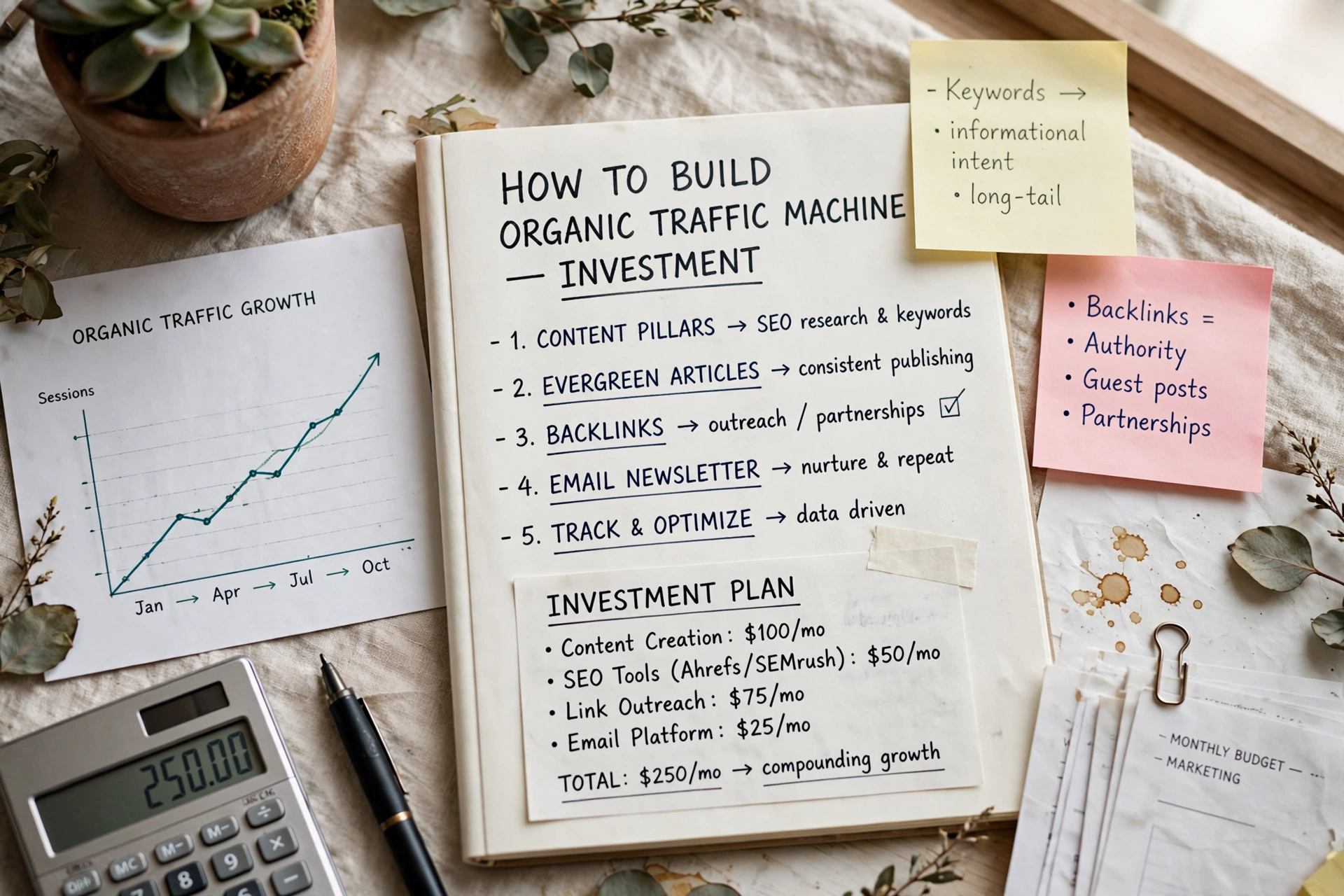
What is the Real Cost of Building an Organic Traffic Machine?
Most B2B founders treat organic growth as a "marketing expense" rather than a capital investment. When you ask how much it costs to build a system that generates leads while you sleep, the answer isn't a single number, but a calculation of acquisition cost versus lifetime value. In my experience working with high-ticket service providers, the investment required to effectively learn how to build an organic traffic machine usually ranges from a lean $2,000 per month for basic programmatic setups to $15,000+ for enterprise-grade topical dominance. The goal is to shift your budget from "renting" traffic via Google Ads to "owning" the search results through an automated asset.
For those looking to move away from unpredictable ad spend, understanding how to stop depending on paid ads is the first step in calculating the ROI of this transition. The true "cost" is measured in the time it takes to reach the tipping point where organic leads outpace paid leads in both volume and quality.
The Architecture of a Traffic Machine: More Than Just Blogging
Building an organic traffic machine is not about writing a few helpful blog posts a month. It is about engineering a semantic web of content that signals absolute authority to search engines. This requires a shift from "content marketing" to "programmatic SEO" and "topical clustering."
📚
Definition
A Topical Cluster is a strategy where a single, comprehensive "Pillar Page" is supported by multiple "Satellite Pages" that target long-tail keywords, all linking back to the main pillar to establish thematic authority.
The technical requirement for such a machine involves three distinct layers: technical infrastructure, semantic research, and a conversion layer. If you only have the first two, you have a library, not a machine. A true traffic machine requires an automated way to capture the intent of the visitor. Many businesses make the mistake of focusing solely on the traffic volume, but without a way to qualify those leads instantly, you simply have a high bounce rate. This is why we emphasize that why programmatic SEO fails without embedded AI SDRs is a primary cause of failed organic investments in 2026.
According to research by Gartner, by 2026, traditional search volume will decline as users shift toward AI-powered answer engines. This means the "investment" now includes optimizing for Generative Engine Optimization (GEO). You aren't just ranking for a keyword; you are optimizing to be the cited source in a ChatGPT or Perplexity response. This requires structured data (Schema.org) and highly cited, factual content that AI models can easily parse.

Why This Investment Outperforms Paid Media in 2026
The fundamental problem with paid ads is that the moment you stop paying, the leads stop arriving. This is "rented traffic." An organic traffic machine is an "owned asset." The investment you put into it today compounds over time, meaning the cost per lead (CPL) trends toward zero as the asset matures.
For instance, a B2B firm spending $5,000 a month on LinkedIn ads might acquire 20 leads. That is a $250 CPL. If that same $5,000 is invested in a programmatic SEO engine that generates 500 high-intent pages, those pages continue to attract leads for years. After the initial build, the only cost is maintenance.
Research from McKinsey suggests that companies implementing AI-driven content automation see a significant reduction in content production costs while increasing their reach by up to 4x. This efficiency is where the "machine" element comes in. Instead of hiring a team of five writers, you use a system to deploy hundreds of optimized pages. If you are considering the cost of human labor, the move to replace freelance copywriters with an AI content engine becomes a financial imperative.
The danger of not investing in this system is "digital invisibility." In a market where AI agents are doing the research for the buyer, if your business doesn't have a wide semantic footprint, you simply don't exist in the buyer's journey. The cost of inaction is the loss of market share to a competitor who has built a more aggressive organic footprint.
Practical Application: Steps to Build Your Machine
If you are starting from zero, the process of building an organic traffic machine follows a specific technical sequence. I've tested this with dozens of our clients, and the pattern for success is always the same: stop thinking about "articles" and start thinking about "entities."
Step 1: Semantic Mapping
You must identify the "Pillar" (your core service) and the "Satellites" (every possible question a buyer has). If you are a law firm, the pillar is "Personal Injury Lawyer," but the satellites are "How much is a car accident settlement in [City]?" or "What to do after a slip and fall in [Neighborhood]?". This is how you make your business show up on Google search at scale.
Step 2: Programmatic Deployment
Manually writing 300 pages takes a year. Programmatically deploying them takes a week. Using a system like BizAI Intelligence, you can launch hundreds of pages that are technically optimized for 2026 standards, including the necessary schema and internal linking structures.
Step 3: The Conversion Layer (The AI SDR)
This is the most neglected part of the investment. Traffic is a vanity metric; appointments are a sanity metric. Every page must have an AI Sales Development Representative (SDR) that engages the visitor. Without this, you are just providing free information to your competitors' future leads. You need a way to convert website visitors into WhatsApp leads or book meetings directly into your CRM.
💡
Key Takeaway
The most successful organic machines don't just rank for keywords; they map the entire buyer's journey and use AI agents to close the gap between "searching" and "buying."
Step 4: Indexing and Authority
You cannot wait for Google to find your pages. You must use the Google Indexing API to force a crawl of your new assets. This accelerates the "compounding" effect, moving you from zero to page one in weeks rather than months. For a fast-track approach, studying how to rank on Google page 1 fast is essential for small business owners.

Comparing Investment Paths: Manual vs. AI vs. Programmatic
When deciding how to allocate your budget, you have three main paths. Most business owners choose the first two and wonder why their growth is stagnant.
| Feature | Traditional SEO Agency | Generic AI Writing | BizAI Programmatic Engine |
|---|---|---|---|
| Speed to Market | Slow (1-2 posts/week) | Medium (Daily posts) | Fast (100+ pages/month) |
| Cost Structure | High Monthly Retainer | Low Tool Cost | Performance-Based ROI |
| Quality Control | Human-vetted, but slow | High risk of "AI slop" | Technical rigor + AI Agent |
| Lead Capture | Basic Contact Forms | None (Just content) | Autonomous AI SDRs |
| Scalability | Linear (More $$$ = More posts) | High, but quality drops | Exponential |
| Best For | Small, niche blogs | Low-ticket affiliates | High-ticket B2B Services |
The "Generic AI" approach is a trap. Many businesses buy a cheap subscription to a writing tool and flood their site with generic content. Google's "Helpful Content" updates are designed specifically to demote this. The difference between "AI content" and "an organic traffic machine" is the technical architecture—the internal linking, the data-backed citations, and the intent-mapping. If you want to see how the top tools compare, check out the analysis of Byword vs SEOmatic vs BizAI GPT.
Common Misconceptions About Organic Investment
There are several myths that prevent B2B owners from scaling their organic reach. Most guides get this wrong because they are written by "content creators" rather than "growth engineers."
Myth 1: "SEO takes 6 to 12 months to work."
This is only true if you are doing manual SEO. With programmatic deployment and the use of the Indexing API, you can see traffic spikes in 14 to 30 days. The "long game" is still there for the highest-competition keywords, but the long-tail "satellite" traffic happens almost immediately.
Myth 2: "AI content is penalized by Google."
Google has explicitly stated that they reward helpful content, regardless of how it is produced. The penalty is for low-effort content. When you use a system that integrates deep research and structured data, the AI becomes a tool for quality, not a shortcut for laziness. This is a core part of AI blog automation.
Myth 3: "You only need to rank for one big keyword."
Ranking for "Lawyer in New York" is nearly impossible and incredibly expensive. However, ranking for "Best immigration lawyer for O-1 visas in Manhattan" is easy and brings a lead who is ready to buy. The machine approach targets 1,000 small keywords rather than one big one.
Myth 4: "Traffic equals Revenue."
This is the most dangerous lie in digital marketing. I've seen sites with 100,000 visitors a month making zero dollars because their content was "informational" but not "transactional." To fix this, you must stop the 90% bounce rate by using AI SDRs.
Frequently Asked Questions
How much does it actually cost to start an organic traffic machine?
The cost depends on your scale. A basic implementation using AI tools might cost $200 to $500 a month in software, but the "cost" of your time to manage it is high. A professional programmatic setup, such as those delivered by BizAI Intelligence, involves a higher initial investment in architecture and deployment but eliminates the need for a full-time content team. For most B2B firms, investing between $2,000 and $7,000 in the initial build-out is the sweet spot for achieving a scalable lead engine that replaces an expensive AI vs SEO agency retainer.
How long before I see a return on my investment?
While traditional SEO is slow, a programmatic "machine" approach often yields results within the first 30 to 90 days. Because you are targeting "long-tail" keywords (specific, low-competition queries), you can capture high-intent traffic quickly. The ROI is realized when the cost of the system is lower than the cost of the leads you would have otherwise bought via PPC. In many cases, the system pays for itself within the first three qualified appointments booked by the embedded AI SDR.
Do I still need a human editor if I use an AI-powered machine?
Yes, but their role changes. Instead of writing the content, the human becomes a "Strategic Editor." Their job is to ensure the brand voice is consistent and that the high-level pillar pages are perfectly aligned with the business's unique value proposition. The machine handles the volume (the 90% of satellite pages), while the human focuses on the 10% of content that converts the highest-value leads. This is the most efficient way to automate your company blog.
Can this system work for very niche B2B industries?
Actually, it works better for niche industries. In highly specialized fields (e.g., enterprise logistics software or specialized medical diagnostics), there is often a huge gap between what customers are searching for and the content available. By building a comprehensive map of these "unanswered questions," you can dominate the niche overnight. The fewer the competitors, the faster the machine scales.
What happens if Google changes its algorithm again in 2026?
The only way to "future-proof" your traffic is to build a brand and an owned asset. By creating a massive network of helpful, data-backed pages, you become a "topical authority." Google's algorithms always lean toward authority and user satisfaction. Because the BizAI approach focuses on the user's intent and provides an immediate way to solve their problem (via the AI SDR), the site remains valuable regardless of the specific ranking algorithm used.
Summary and Next Steps
Learning how to build an organic traffic machine is the difference between struggling for leads and having a predictable pipeline. The investment is not in "articles," but in a technical system that combines programmatic SEO, topical authority, and autonomous AI qualification.
If you are still spending thousands on ads that provide diminishing returns, it is time to pivot. The most effective path in 2026 is to deploy a system that doesn't just attract visitors but converts them into appointments without human intervention.
Stop renting your growth and start owning your market. For a professional implementation of this architecture, visit BizAI Intelligence and start building your inbound acquisition engine today.
AI Search Accelerator: 1-on-1 Strategy Session
Claim one of the 10 monthly slots. Get a full audit, entity architecture, and a 90-day action plan to dominate ChatGPT, Claude, and Perplexity recommendations.



