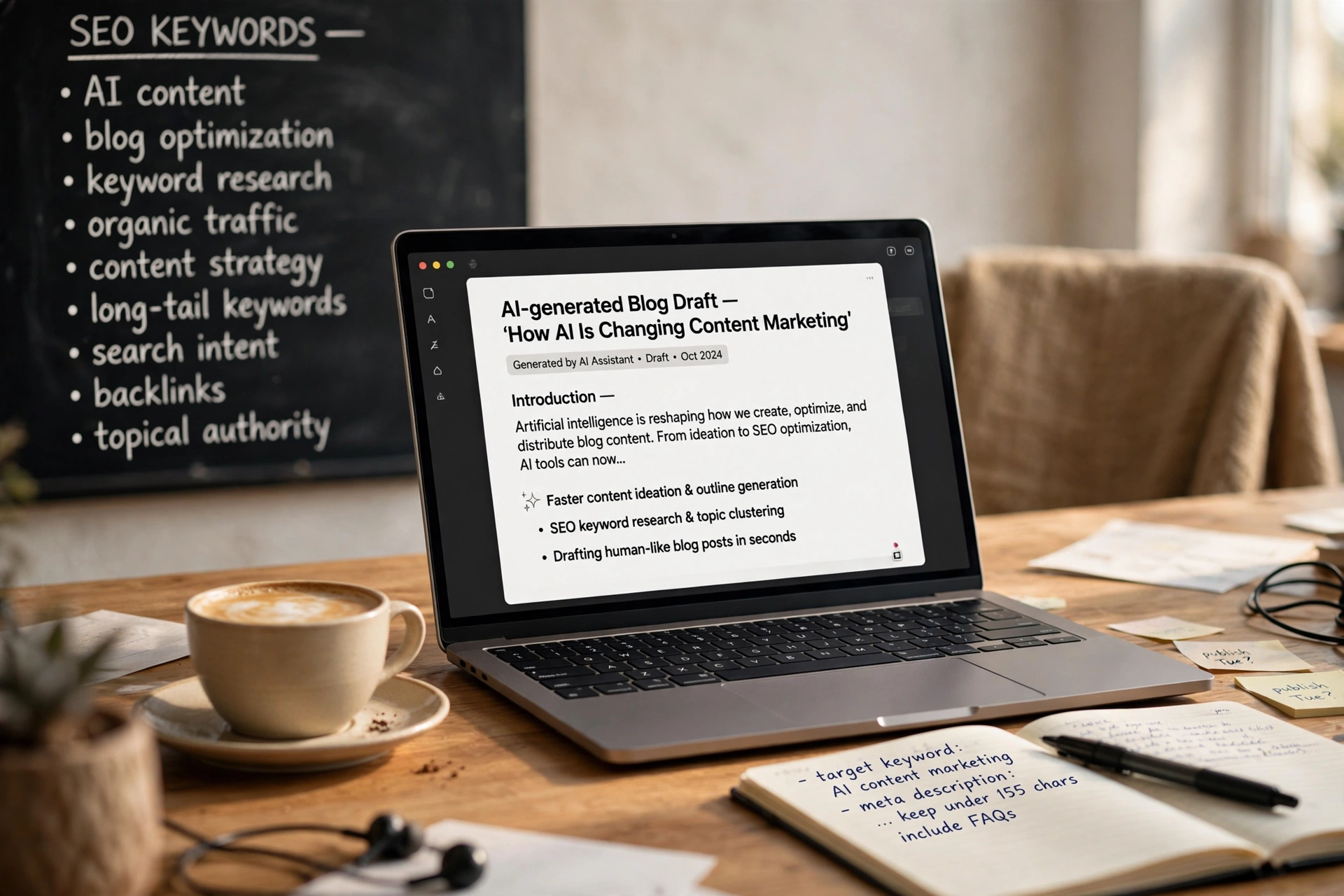
Most B2B company blogs are digital ghost towns, with the last post dated six months or two years ago. In my experience working with high-ticket service providers, the bottleneck is never a lack of expertise, but a lack of execution bandwidth. Writing one high-quality, SEO-optimized article takes an average of 6 to 10 hours when you factor in research, formatting, and internal linking. For a CEO or a marketing manager, that is an unsustainable trade-off.
For a comprehensive overview on scaling your organic presence, explore our How to Get Customers on Google Without Paying for Ads in 2026.
In 2026, the gap between companies that dominate search and those that vanish is the adoption of autonomous content engines. We have moved past the era of 'AI-assisted writing' and entered the era of programmatic content orchestration. You no longer need to manage a stable of freelancers or struggle with writer's block; you need a system that treats content as a scalable asset rather than a creative chore.
How Do You Automate Company Blog Daily Content Without Losing Quality?
Automating company blog daily content requires transitioning from a manual writing workflow to a programmatic architecture where research, generation, and distribution are handled by a synchronized AI pipeline. Instead of prompting a chatbot for a single post, a professional automation engine uses a 'cluster-first' approach, identifying hundreds of high-intent keywords and deploying interconnected articles that signal deep topical authority to search engines.
📚
Definition
Programmatic SEO is the practice of using databases and templates to generate hundreds or thousands of high-quality, landing pages that target long-tail search queries at scale.
To achieve this without producing 'AI slop,' the system must integrate real-time data fetching and a strict brand voice guide. When we built the content engine at BizAI Intelligence, we discovered that the secret to ranking isn't the length of the article, but the density of helpful, specific information. By utilizing Large Language Models (LLMs) configured with RAG (Retrieval-Augmented Generation), the automation engine can cite industry-specific facts and maintain a clinical, authoritative tone that mimics a senior consultant rather than a generic copywriter.

Why Is Daily Automated Publishing Better Than Weekly Manual Posts?
The primary advantage of daily automated publishing is the acceleration of the 'indexing loop.' Google Search and other AI search engines reward sites that demonstrate consistent freshness and comprehensive coverage of a topic. While a manual blogger might publish four high-quality posts a month, an automated engine can deploy 30 to 100 posts in the same window, covering every conceivable question a buyer might have.
According to research by the Content Marketing Institute, consistency is the single greatest predictor of organic growth. By publishing daily, you increase the number of 'entry points' into your ecosystem. If you target 30 different long-tail keywords per month, you are 30 times more likely to capture a lead in the decision stage of their buyer's journey than a competitor publishing once a week.
Furthermore, the integration of digital marketing strategies with automated lead generation creates a compounding effect. Every new article serves as a landing page for a specific problem. When combined with AI blog automation, you aren't just getting traffic; you are building a topical authority hub that makes your brand the default answer in AI Overviews and ChatGPT searches.
💡
Key Takeaway
Volume, when paired with high semantic quality, reduces the cost per lead by diversifying the keywords that drive traffic to your site.
What Are the Core Components of an Autonomous Blog Engine?
A truly hands-free company blog is not a single tool, but a four-part engine that removes all human friction from the pipeline.
1. Autonomous Keyword and Topic Research
Instead of manual spreadsheets, the system uses API integrations with search data to identify 'low-hanging fruit'—keywords with significant volume but low keyword difficulty. It then organizes these into 'silos.' For example, if the pillar is 'Corporate Law,' the satellites are 'Employment Law for Tech Startups,' 'Intellectual Property Rights in 2026,' and 'Contract Disputes in New York.' This structure is what allows a business to dominate a niche through algorithmic brute force.
2. Enterprise-Grade Content Generation
Generic AI content is easy to spot and easy for Google to penalize. Professional automation uses advanced LLMs—such as Claude 3.5 or GPT-4o—integrated with a custom knowledge base. This ensures the content contains specific numbers, industry benchmarks, and a tone of voice that reflects the CEO's authority. It avoids banned filler words and focuses on the 'Answer-First' rule, providing the solution in the first paragraph to capture Featured Snippets.
3. Automated Media and SEO Orchestration
An article without images is a bounce-rate catalyst. Autonomous engines now use AI-driven image sourcing or generation to create relevant visuals, automatically adding alt-text for accessibility and SEO. Simultaneously, the engine handles the technical metadata, including JSON-LD schema markup (FAQ, Article, and LocalBusiness), which tells search engines exactly what the page is about.
4. Semantic Internal Linking and Immediate Indexing
One of the biggest mistakes I see businesses make is publishing content and waiting for Google to find it. A professional system uses the Google Indexing API and IndexNow to force a crawl within seconds. It also maps the internal link architecture, ensuring that every satellite page links back to the main pillar, distributing PageRank efficiently across the domain.
How Does Automated Content Compare to Traditional Agencies?
For years, the only way to scale a blog was to hire an agency. However, the traditional model is plagued by high overhead, slow turnaround times, and a lack of technical SEO rigor. Many agencies simply use basic AI and charge a premium, resulting in content that looks professional but fails to convert.
| Feature | Traditional SEO Agency | Generic AI Tools | BizAI Intelligence Approach |
|---|---|---|---|
| Output Volume | 2-4 articles / month | Unlimited (but low quality) | 300+ optimized pages / month |
| Research Depth | Manual & Slow | Superficial / Hallucinated | Data-driven Programmatic SEO |
| Conversion | Static Contact Forms | None | Embedded AI SDR Agents |
| Indexing Speed | Natural (Slow) | Manual | Instant (API-driven) |
| Cost Efficiency | High monthly retainer | Low monthly fee | High ROI / Scalable Asset |
When you transition to a modern approach, you stop renting traffic through agencies and start owning a lead-generation machine. This is why many firms are exploring how to replace freelance copywriters with autonomous AI content engines, as the speed of execution becomes a competitive advantage.

How to Implement a Daily Automation Workflow Step-by-Step
Implementing this system requires a shift in mindset from 'writing' to 'architecting.' If you attempt to automate without a strategy, you will simply flood your site with noise.
Step 1: Define Your Topical Map
Start by identifying your primary pillar—the main service you sell. From there, brainstorm 50-100 specific questions your clients ask during sales calls. These questions are your satellite keywords. According to Gartner, B2B buyers are 70% through their decision-making process before they ever contact a salesperson. Your automated blog must answer every one of those pre-contact questions.
Step 2: Configure Your Brand DNA
To prevent the AI from sounding robotic, you must feed it a 'Brand DNA' file. This includes your unique perspectives, case study results, and a list of banned words. I always recommend including a section on 'The Enemy'—what the industry is doing wrong and why your approach is the only correct one. This injects the 'opinionated' voice that Google's E-E-A-T guidelines reward.
Step 3: Set Up the Programmatic Pipeline
Connect your CMS (WordPress, Webflow, or Shopify) to your automation engine. Set the publishing cadence to 'Daily.' Ensure that the system is configured to automatically generate internal links to your highest-converting pages. If you are struggling with the technical setup, looking at the best programmatic SEO platforms in 2026 can provide a benchmark for what to expect.
Step 4: Deploy the Conversion Layer
Traffic is a vanity metric; leads are a sanity metric. This is where most automation fails. You must embed a context-aware AI agent on every page. This agent should track the reader's behavior and initiate a conversation the moment they show high intent. This solves the problem of why 90% of website visitors leave without buying, turning a passive reader into a booked appointment in your CRM.
Common Pitfalls in Blog Automation
Even with the best tools, some businesses fail because they ignore the 'Human-in-the-Loop' requirement. Pure automation without oversight can lead to semantic drift, where the AI starts targeting keywords that are irrelevant to the business.
Another frequent error is the 'Thin Content' trap. Some tools generate 500-word posts that provide no real value. To avoid this, ensure your engine is programmed for depth. As established by the Google Helpful Content updates, articles must provide a comprehensive answer to the user's query. If a topic requires 2 involves balancing this volume with high-quality internal linking.
Final Thoughts on Automating Your Company Blog
Automating company blog daily content is no longer a 'hack'—it is the new standard for B2B acquisition. The ability to deploy hundreds of high-intent, SEO-optimized pages in a matter of weeks allows a small company to out-publish a global corporation. By combining programmatic SEO with an embedded AI SDR, you create a system that not only attracts traffic but qualifies and closes leads while you sleep.
Stop treating your blog as a digital brochure and start treating it as an autonomous sales force. If you are tired of the volatility of paid ads and the slow pace of manual writing, it is time to build your organic machine.
Ready to dominate your niche? Visit BizAI Intelligence to deploy your autonomous content and lead-capture engine today.
Frequently Asked Questions
Will Google penalize my site for using automated AI content?
Google does not penalize AI content specifically; it penalizes low-effort, unhelpful content regardless of how it was produced. As long as your automated content provides genuine value, satisfies user intent, and follows E-E-A-T guidelines, it will rank. The key is to use enterprise-grade automation that focuses on depth and factual accuracy rather than generic, short-form AI slop.
How many articles should I publish per day for maximum growth?
While there is no hard limit, publishing 1 to 3 high-quality articles per day is ideal for most B2B companies. The goal is to build topical authority quickly. Once you have covered your primary keyword clusters (typically 300-900 pages), you can transition to a maintenance mode of 3-5 posts per week to keep the content fresh and updated.
Do I still need a human editor if I automate my blog?
For the best results, a 'human-in-the-loop' approach is recommended. While the AI handles the research and drafting, a senior strategist should review the top-performing 10% of articles to ensure the brand voice is perfect and the conversion triggers are working. However, for the bulk of long-tail satellite content, a well-configured engine can operate with minimal oversight.
How long does it take to see results from automated blogging?
Because autonomous engines use the Google Indexing API, you will see your pages appearing in search results almost instantly. However, significant traffic growth typically takes 30 to 90 days as Google establishes the site's topical authority. Companies using programmatic SEO often see a massive spike in lead volume once they hit a 'critical mass' of 200+ interconnected articles.
Can I automate my blog in multiple languages?
Yes, modern AI engines can translate and localize content with high precision. Instead of simple translation, the system can adapt the content to local search patterns and cultural nuances in different regions, allowing you to scale your lead generation globally without hiring a multilingual content team.
AI Search Accelerator: 1-on-1 Strategy Session
Claim one of the 10 monthly slots. Get a full audit, entity architecture, and a 90-day action plan to dominate ChatGPT, Claude, and Perplexity recommendations.