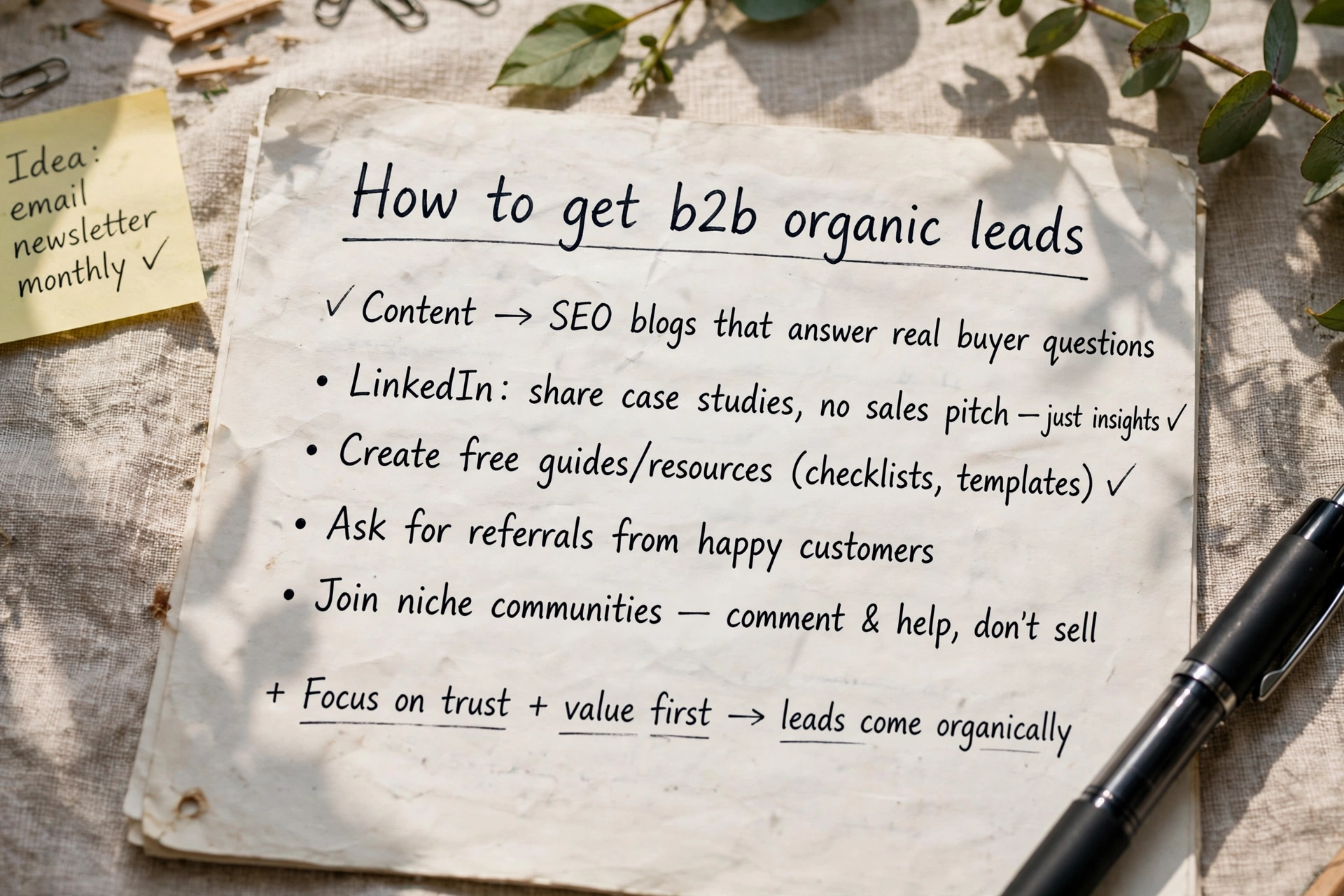
📖This article is part of the complete guide to How to Get B2B Organic Leads: The 2026 Authority Framework.
Which Strategy Actually Works to Get B2B Organic Leads Ranking?
Most B2B founders treat organic growth as a guessing game of "more content," but the reality in 2026 is a choice between three distinct frameworks: manual authority building, programmatic scaling, or hybrid AI-driven ecosystems. If you are wondering how to get B2B organic leads without burning your budget on agencies, the answer depends on your ticket size and your speed-to-market requirements. High-ticket B2B firms need deep topical authority, while scaling SaaS companies need breadth. The most effective approach currently is the "Hub-and-Spoke" model powered by programmatic SEO and autonomous qualification, which replaces the slow crawl of manual writing with an algorithmic lead-capture machine.
In my experience working with enterprise B2B service providers, the biggest mistake I see is treating a blog as a digital brochure. A brochure informs; an acquisition engine converts. When we built the core architecture at BizAI Intelligence, we discovered that 90% of organic traffic is wasted because companies optimize for "traffic" rather than "intent." To actually win, you must choose the system that aligns your keyword strategy with an immediate conversion mechanism, such as an AI SDR, otherwise, you are simply donating free data to Google.

Understanding the Mechanics of B2B Organic Acquisition
To understand how to get B2B organic leads, we first have to dismantle the myth that "quality content" is a standalone strategy. In a professional environment, content is merely the bait; the architecture is the hook. Most businesses fail because they lack a coherent system to organize their information for both humans and Large Language Models (LLMs).
📚
Definition
Topical Authority is the perceived expertise of a domain on a specific subject, established by creating a comprehensive web of interconnected content that answers every possible question a buyer might have throughout their decision journey.
The shift toward Generative Engine Optimization (GEO) means that your content must now satisfy "Search Generative Experience" (SGE). According to Gartner, search behavior is shifting toward conversational queries, meaning traditional keyword stuffing is effectively dead. To rank today, you need a "Topical Map", a strategic blueprint that identifies core pillars (high-volume, high-competition terms) and satellite pages (long-tail, high-intent queries).
For instance, if you are a law firm, your pillar might be "Corporate Law Services," but your organic leads will actually come from satellites like "how to structure a merger for a mid-sized tech company in 2026." This is why many firms are moving toward how to automate your company blog and publish daily content in 2026, as the sheer volume of required satellite pages is impossible to maintain manually.
When you build a topical map, you aren't just writing articles; you are building a graph of knowledge. Google's algorithms and AI search engines like Perplexity look for "entity relationships." If your site explains the problem, the solution, the pricing, and the implementation in a structured way, you become the "definitive source." This is the only way to compete against legacy giants who have thousands of backlinks but outdated content.
Why Organic Lead Generation is the Only Sustainable B2B Growth Lever
Relying on paid acquisition is essentially renting your growth. The moment you stop paying the "tax" to Google Ads or LinkedIn, your pipeline vanishes. Organic lead generation, by contrast, is an asset that compounds in value over time.
The financial implications are stark. According to a study by the Content Marketing Institute, organic search continues to be the primary driver of high-quality B2B leads because it captures users in the "active search" phase of the buyer's journey. Unlike social media ads, which are interruptive, organic search is intentional. A lead searching for a specific solution has already identified their pain point and is actively looking for a vendor.
Moreover, the trust gap is significantly smaller. A lead who finds you via an authoritative guide on how to rank on Google page 1 fast for small businesses views you as an expert before they ever speak to a salesperson. This pre-sold status reduces the sales cycle by an average of 20-30%.
However, there is a dangerous bottleneck: the "Bounce Gap." Most B2B sites drive traffic to a page, provide a great answer, and then let the user leave. This is where the revenue leak happens. Research from Forrester indicates that the speed of lead response is a primary predictor of conversion. If a lead finds your organic content but has to wait 24 hours for an email reply, they have likely already contacted three of your competitors. This is exactly why we emphasize the need to stop the 90% bounce rate using AI SDRs to qualify leads the second they land on your page.
Practical Application: Implementing the Organic Lead Engine
If you want to stop guessing and start scaling, you need a technical implementation plan. The "guess-and-check" method of publishing two blogs a month will not work in 2026. You need a programmatic approach.
Step 1: Identify Your "Money Keywords." These are not the high-volume terms, but the "Comparison" and "Alternative" keywords. If you sell a software, don't just target "CRM software"; target "[Competitor] Alternative" or "Best CRM for [Specific Industry] in 2026."
Step 2: Deploy a Programmatic SEO (pSEO) Framework. Instead of writing one page at a time, use a data-driven approach to create hundreds of satellite pages. For example, if you provide HVAC services, you don't just write about "HVAC repair"; you create 50 pages targeting "HVAC repair in [Neighborhood Name]." This allows you to dominate local intent at scale. If you are choosing between tools for this, checking which pSEO tool wins in 2026 is a great place to start.
Step 3: Integrate a Conversion Layer. This is the most overlooked step. Your content should not end with a "Contact Us" form. It should feature an embedded AI agent that understands the context of the page the user is reading. If the user is on a page about "Legal Compliance for Fintech," the AI agent should be able to ask, "Are you currently dealing with SEC audits or GDPR compliance?" and book a meeting based on the answer.
Step 4: Optimize for LLMs. Ensure your site has a clean
/llms.txt file and uses Schema.org markup. This tells AI crawlers exactly what your business does, making it more likely that ChatGPT or Claude will recommend your service when a user asks, "Which B2B firm is best for [X]?"💡
Key Takeaway
Organic leads are not a result of "good writing," but a result of matching high-intent search queries with an automated qualification system that captures the lead instantly.

Comparing Your Organic Lead Options: Which One Should You Choose?
Depending on your business stage, the "best" way to get B2B organic leads varies. You have to weigh the cost of production against the speed of results.
| Approach | Pros | Cons | Best For |
|---|---|---|---|
| Manual Content (Boutique) | Extremely high trust, deep nuance, high conversion per visitor. | Very slow to scale, high cost per article, dependent on a few writers. | High-ticket consultants ($50k+ deals), Law firms. |
| Generic AI Content (Cheap) | Extremely fast, very cheap, covers many keywords. | High risk of "AI slop" penalties, low trust, high bounce rates. | Low-ticket affiliate sites, generic niche blogs. |
| Programmatic AI Engine (BizAI) | Rapid scale, maintains authority, automated lead capture, LLM-optimized. | Requires initial technical setup, higher upfront investment than cheap AI. | B2B SaaS, Agencies, Mid-to-Large Professional Services. |
The "Cheap AI" approach is a trap. Google's 2024 and 2025 core updates have heavily penalized sites that produce "mass AI content" without a layer of expertise or helpfulness. If you simply generate 100 articles with a basic prompt, you will likely see a temporary spike followed by a total crash.
The modern approach, which we utilize at BizAI Intelligence, focuses on "Algorithmic Brute Force" combined with "Human-Grade Intent." This means using AI to generate the scale, but using a rigorous framework to ensure every page serves a specific buyer intent and leads directly into a conversion funnel. This is essentially how you replace freelance copywriters with an AI content engine without sacrificing the quality of your brand voice.
Common Questions and Misconceptions About B2B Organic Ranking
Most guides on B2B SEO are written by people who haven't managed a real pipeline in years. Here are the most common myths I encounter.
Myth 1: "You need a huge budget for backlinks to rank."
This is largely outdated for long-tail intent. While backlinks still matter for "Head Terms" (e.g. "Marketing Agency"), they are far less important for "Intent Terms" (e.g. "Best B2B marketing agency for dental clinics in Florida"). If your content is the most helpful and comprehensive answer to a specific query, Google will rank you even without a massive backlink profile. The focus should be on topical completeness, not just link counting.
Myth 2: "AI content will never rank because it's not human."
Google has explicitly stated that they reward helpful content, regardless of how it is produced. The problem isn't that the content is AI-generated; the problem is that most AI content is boring and generic. When you use an advanced system to inject real data, specific case studies, and expert frameworks, the "AI-ness" disappears, and the value remains.
Myth 3: "Organic SEO takes 6-12 months to show results."
This is true for manual strategies, but not for programmatic ones. By utilizing the Google Indexing API and deploying 300+ highly targeted satellite pages in month one, you can begin capturing long-tail traffic in weeks. The secret is to stop fighting for the "big" keywords and start dominating the "small" ones that actually have buyers.
Myth 4: "Traffic equals leads."
This is the most expensive mistake a CEO can make. I have seen sites with 100,000 monthly visitors that generate zero revenue because they are attracting "information seekers" instead of "solution buyers." You must pivot your strategy from "how to get more traffic" to how to stop depending on paid ads by focusing exclusively on high-intent searchers.
Frequently Asked Questions
How long does it actually take to see B2B organic leads from a programmatic strategy?
Unlike traditional SEO, which relies on a slow "drip" of content, a programmatic approach can yield results in 30 to 90 days. By deploying a massive volume of satellite pages targeting low-competition, high-intent keywords, you bypass the "waiting period" associated with high-competition head terms. In my experience, once the Google Indexing API is properly configured, these pages are crawled and ranked quickly, allowing you to see an uptick in lead flow almost immediately as you cover more "neighborhood" or "niche" variations of your service.
Which keywords should I prioritize for the fastest ROI in 2026?
You should prioritize "Comparison" and "Bottom-of-Funnel" (BoFu) keywords. These include terms like "[Competitor] vs [Your Company]," "Best [Service] for [Specific Industry]," and "[Service] pricing for [Business Size]." These users are not researching the problem; they are choosing the provider. While these have lower search volumes than general informational terms, their conversion rate is often 5x to 10x higher. Focusing on these allows you to maximize ROI before expanding into broader "top-of-funnel" educational content.
Will AI-generated content lead to a Google penalty in the long run?
Google penalizes "low-effort" content that provides no value, not AI content itself. The risk comes from "AI Slop", generic, repetitive text that doesn't answer the user's question. To avoid penalties, your content must follow the E-E-A-T (Experience, Expertise, Authoritativeness, Trustworthiness) framework. This means adding real-world examples, specific statistics, and a clear point of view. When you use a system like BizAI Intelligence, the content is engineered to be "helpful" by design, adhering to the latest helpful content updates.
How do I prevent a high bounce rate on my organic landing pages?
The most effective way to prevent bounces is to remove the friction between "finding the answer" and "getting the solution." Traditional "Contact Us" forms are high-friction. By embedding a context-aware AI SDR, you provide the user with an immediate way to interact. If a user reads a 2,000-word guide and is convinced, they don't want to fill out a form and wait; they want to know if you can solve their specific problem right now. This instant qualification is the only way to recover the 90% of visitors who typically leave without converting.
Is it better to hire an SEO agency or use an AI-powered platform?
For most small to mid-sized B2B companies, the agency model is outdated. Agencies are often slow, charge high retainers, and rely on a few freelance writers who don't actually understand your business. An AI-powered platform allows for a level of scale and technical precision that no human team can match. You can deploy hundreds of pages in the time it takes an agency to write one blog post. When you compare the cost of an agency versus the efficiency of AI vs SEO agency automation, the financial advantage shifts heavily toward the automated engine.
Final Thoughts on How to Get B2B Organic Leads
The path to dominating your niche in 2026 isn't found in "writing more blogs", it's found in building a scalable acquisition system. Whether you choose a manual, programmatic, or hybrid approach, the goal remains the same: capture high-intent searchers and convert them before they click the "back" button.
If you are tired of renting your traffic and want to build a self-owned organic machine that fills your pipeline while you sleep, it is time to move beyond traditional SEO. By combining a massive topical map with autonomous AI qualification, you turn your website from a cost center into a revenue generator.
Stop letting your competitors capture the leads that should be yours. Start building your organic authority today with BizAI Intelligence and replace your manual SDR efforts with a 24/7 automated acquisition engine.
Only 12 Onboarding Slots Remaining This Month
BizAI deploys 300 AI salespeople scoring purchase intent 24/7. Get your free niche domination blueprint.
AI Search Accelerator: 1-on-1 Strategy Session
Claim one of the 10 monthly slots. Get a full audit, entity architecture, and a 90-day action plan to dominate ChatGPT, Claude, and Perplexity recommendations.