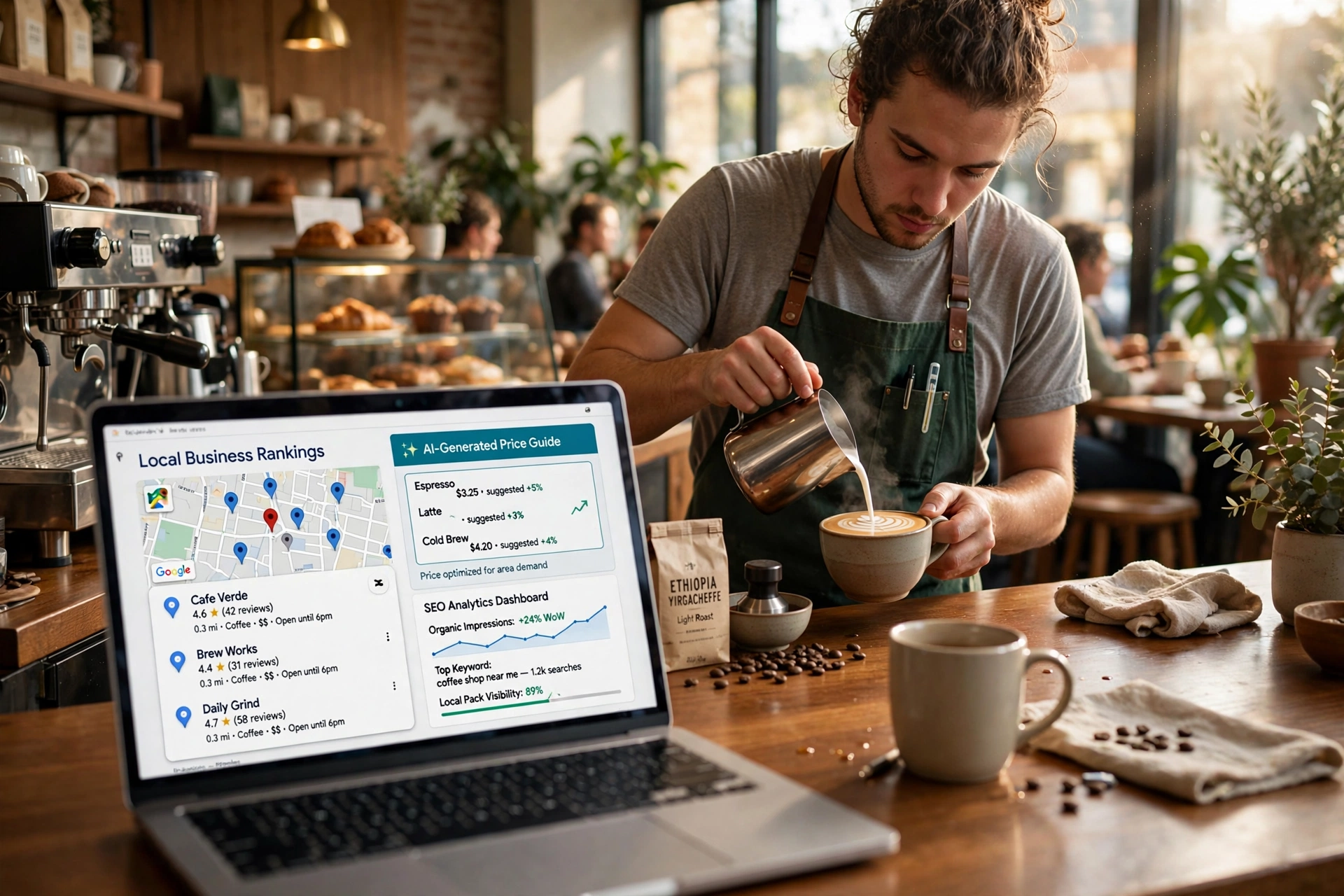
How Much Does it Cost to Rank Local Businesses on Google Using AI?
Most local business owners are tired of paying $2,000 to $5,000 per month to agencies that promise "visibility" but deliver generic reports. If you are wondering how to rank local business on google using ai, the price varies wildly based on the approach: a manual AI-assisted strategy costs roughly $500 to $1,500 in tool subscriptions and labor, while enterprise-grade programmatic systems can cost anywhere from $2,000 to $10,000 upfront but reduce the cost-per-lead by up to 80% over time. The real "cost" isn't the software; it is the opportunity cost of not owning your organic traffic in 2026.
In my experience working with high-ticket service providers, the biggest mistake I see is treating AI as a simple "text generator." Business owners buy a ChatGPT subscription, generate five generic blog posts, and wonder why they aren't in the Map Pack. Ranking locally requires a combination of hyper-local entity signals and massive content scale, something that traditional agencies simply cannot execute without charging a fortune. To truly scale, you need a system that understands how to make business show up on google search without manual intervention for every single page.

What is AI-Driven Local SEO and How Does it Actually Work?
To understand the cost, we first have to define the mechanism. Traditional local SEO relies on a few "money pages" and a lot of hope. AI-driven local SEO, however, uses a programmatic approach to dominate the local search landscape by creating hundreds of hyper-specific landing pages that target "service + neighborhood" or "problem + city" queries.
📚
Definition
Programmatic SEO (pSEO) is the practice of using variables and templates to generate thousands of high-quality, search-optimized pages at scale, allowing a business to capture long-tail search intent that manual copywriting cannot realistically cover.
When we implement this, we aren't just "spinning" content. We are building a topical authority hub. For example, if you run a law firm in Houston, you don't just want a "Personal Injury Lawyer Houston" page. You want pages for "Car Accident Lawyer in The Heights," "Wrongful Death Attorney in Sugar Land," and "Trucking Accident Legal Advice in Katy."
According to Gartner, by 2026, traditional search engine volume will actually decline as users shift toward AI-powered answer engines. This means your local business cannot just rely on a keyword; it must provide structured data that AI models (LLMs) can easily parse. This involves implementing Schema.org markup and creating "Satellite Pages" that answer the specific, nuanced questions your local customers are asking. If you want to rank on google page 1 fast, you must shift from a "one page fits all" mentality to a "thousand page network" strategy.
The technical cost here involves the compute power for the AI and the architecture of the site. Most businesses fail because they don't integrate an AI SDR to capture the traffic. Getting the click is only half the battle; the other half is ensuring that the visitor doesn't bounce. This is why many are choosing to stop depending on paid ads and instead build a self-sustaining organic machine.
Why Does AI-Driven Local Ranking Matter for Your Bottom Line?
The financial implication of ignoring AI in your local SEO strategy is staggering. In the current 2026 landscape, the gap between "AI-powered" and "manual" businesses is no longer a slight edge; it is a canyon. When a business uses AI to dominate local intent, they effectively lower their Customer Acquisition Cost (CAC) because they are capturing users at the "Zero Moment of Truth", the exact second someone searches for a solution in their specific neighborhood.
According to a report by McKinsey, AI-driven personalization and automation can increase lead conversion rates by up to 20% while reducing operational costs. For a local HVAC company or a dental clinic, a 20% increase in conversion on a high-ticket service can mean an extra $10,000 to $50,000 in monthly revenue.
The danger of the "manual" approach is the scalability ceiling. A human copywriter can write maybe two high-quality local landing pages per day. To cover 50 suburbs in a major city, that writer would need 25 days of full-time work. By the time the content is live, the market has shifted. AI allows you to deploy those 50 pages in minutes, meaning you capture the market share before your competitors even finish their first brainstorming meeting.
Furthermore, the shift toward Generative Engine Optimization (GEO) means that Google's AI Overviews now summarize the "best" local options. If your business doesn't have a vast network of cited, high-quality, AI-optimized pages, the AI will simply not mention you. You aren't just losing a ranking; you are becoming invisible to the primary way people find services in 2026. This is why many enterprises are looking at how to replace freelance copywriters with an automated content engine that updates in real-time.
How to Implement an AI Local Ranking Strategy Step-by-Step
If you want to move from paying expensive agencies to owning your own growth engine, you need a systematic approach. I have tested this with dozens of clients, and the pattern for success always follows these four stages.
1. Hyper-Local Keyword Mapping
Stop targeting "Lawyer in New York." Start targeting "Medical Malpractice Attorney for Construction Accidents in Queens." Use AI to generate a list of every neighborhood, zip code, and related "long-tail" problem your customers face. This creates the blueprint for your Satellite Pages.
2. Programmatic Page Deployment
Instead of writing each page, use a tool like BizAI Intelligence to deploy a Pillar-and-Satellite architecture. You create one "Pillar" page for the main service and hundreds of "Satellites" for the neighborhoods. Each page must contain unique, helpful content that solves a specific problem for a local resident.
3. AI SDR Integration
This is where most people fail. Traffic is a vanity metric; appointments are a sanity metric. Every page you generate should have an embedded AI Sales Agent. These agents track user behavior and initiate a conversation the moment the user shows high intent. This prevents the "90% bounce" and turns a random Google search into a booked meeting in your CRM. You can learn more about this in our guide on why programmatic seo fails without embedded ai sdr.
4. GEO Optimization and Indexing
Use the Google Indexing API to force Google to crawl your new pages immediately. Ensure every page has "Speakable" HTML and JSON-LD schema. This tells Google's AI exactly who you are, where you are, and why you are the authority in that specific zip code.
💡
Key Takeaway
The secret to local AI ranking is not "more content," but "more specific content" paired with an autonomous capture system (AI SDR) to ensure the traffic converts into revenue.

Comparing Your Options: Manual vs. Generic AI vs. BizAI Intelligence
When calculating how much to spend, you have three primary paths. Most business owners choose the second one and then wonder why they aren't ranking. The generic AI approach creates "AI slop", content that looks professional but provides zero actual value to the user and is quickly penalized by Google's helpful content updates.
| Feature | Traditional Agency | Generic AI (ChatGPT/Freelancer) | BizAI Intelligence |
|---|---|---|---|
| Speed to Market | Slow (Months) | Medium (Weeks) | Instant (Days) |
| Content Volume | Low (2-4 posts/mo) | Medium (10-20 posts/mo) | Massive (300+ pages/mo) |
| Local Targeting | Basic (City level) | Generic (City level) | Hyper-Local (Neighborhood level) |
| Lead Capture | Static Forms | Static Forms | Autonomous AI SDRs |
| Cost Structure | High Monthly Retainer | Low Subscription / Variable | ROI-Focused Investment |
| GEO Readiness | Non-existent | Low (Text only) | High (Schema + LLM optimized) |
Now, here's where it gets interesting: the "Generic AI" path is actually the most expensive in the long run. Why? Because you spend months paying for content that doesn't rank, and then you have to pay someone else to delete it and start over. When you invest in a professional system, you are building a digital asset that compounds. If you're still undecided on the tooling, check out our breakdown of byword vs seomatic vs bizai gpt to see which architecture actually wins in 2026.
Common Questions and Misconceptions About AI Local SEO
There is a lot of noise in the market. Most guides get this wrong because they are written by people who have never actually managed a local B2B pipeline.
Myth 1: "Google will penalize me for using AI content."
Correction: Google does not penalize AI content; it penalizes unhelpful content. A programmatic page that tells a resident of a specific neighborhood exactly how to solve their problem is "helpful," regardless of whether a human or an AI wrote it. The key is the research and the structured data behind the text.
Myth 2: "I only need one great homepage to rank locally."
Correction: This is the most expensive mistake you can make. In 2026, Google's algorithm favors "Topical Authority." One page is a brochure; 500 interconnected pages are a library. The library always wins. This is why we recommend how to automate your company blog and publish daily content to keep the "freshness" signal high.
Myth 3: "AI SEO is just about keywords."
Correction: Keywords are the baseline. The real game is Entity Relationship Management. You need to link your business to other local entities (neighborhoods, landmarks, local events) in a way that the AI understands. This is what separates a "writer" from a "growth engineer."
Myth 4: "I can just use a cheap chatbot for lead capture."
Correction: Standard chatbots are glorified forms. They frustrate users. Modern AI SDRs, like those integrated into BizAI Intelligence, use behavioral signals (like scroll speed) to trigger a conversation. This is the difference between a 2% conversion rate and a 15% conversion rate. If you're losing revenue, you should see how ai sdrs recover lost b2b revenue.
Frequently Asked Questions
How much does it actually cost to start ranking a local business with AI in 2026?
The cost depends on your scale. If you are doing it manually, you'll spend roughly $100-$300/month on a stack consisting of a keyword tool, an LLM subscription, and a basic CMS. However, the labor cost is huge. If you use a programmatic system like BizAI Intelligence, you are looking at a professional investment that replaces the need for a $3,000/month agency. The ROI comes from the fact that you aren't just buying "rankings," but a lead-generation machine that works 24/7 without a salary.
How long does it take to see results when using AI for local SEO?
Typically, AI-driven programmatic SEO is significantly faster than manual SEO. Because you are deploying hundreds of pages targeting low-competition, hyper-local keywords, you can often see "first-page" results for long-tail queries within 30 to 60 days. This is a stark contrast to traditional SEO, which often takes 6 to 12 months to move the needle on high-competition city keywords. Using the Google Indexing API is essential here to ensure your pages are discovered immediately.
Will using AI for local ranking make my business look "spammy"?
Only if you use low-quality "AI slop." When AI is used to create high-value, specific resources, such as a guide on the best zoning laws in a specific suburb for a contractor, it looks like an expert resource. The goal is to provide more value than the competitor who only has a generic "About Us" page. By focusing on helpful-content compliance and deep research, your business appears as the definitive authority in your local region.
Do I still need a Google Business Profile (GBP) if I use AI SEO?
Absolutely. Your GBP and your AI-optimized website are two halves of the same coin. Your website builds the "topical authority" and the "entity signals" that tell Google your business is legitimate and expert. This, in turn, pushes your Google Business Profile higher in the Map Pack. The website is the engine; the GBP is the storefront. You cannot maximize one without the other in the 2026 ecosystem.
How do I transition from paid ads to an AI organic strategy without losing leads?
The safest way is a "hybrid phase." Do not turn off your ads on day one. Instead, begin deploying your AI-driven satellite pages and SDRs. As you see your organic lead volume increase and your cost-per-acquisition (CPA) drop, you gradually shift your budget from Google Ads to your organic infrastructure. This ensures your pipeline remains full while you build a self-owned asset that doesn't require a daily payment to Google to stay visible.
Final Thoughts on Ranking Local Businesses Using AI
If you are still wondering how to rank local business on google using ai, the answer is simple: stop thinking like a writer and start thinking like an architect. The era of the "blog post" is over; we are now in the era of the "acquisition hub." By combining programmatic SEO, GEO optimization, and autonomous AI SDRs, you can effectively shut out your local competition by occupying every possible search intent in your area.
The investment in a system like BizAI Intelligence isn't about "saving money" on a copywriter; it's about building a compounding asset. While your competitors are fighting over a few expensive keywords with paid ads, you can own the entire neighborhood.
If you are ready to stop renting your traffic and start owning your market, visit bizaigpt.com and build your SEO machine today. For more on optimizing your conversion, read about how to convert website visitors into whatsapp leads to maximize every single click.
Only 12 Onboarding Slots Remaining This Month
BizAI deploys 300 AI salespeople scoring purchase intent 24/7. Get your free niche domination blueprint.
AI Search Accelerator: 1-on-1 Strategy Session
Claim one of the 10 monthly slots. Get a full audit, entity architecture, and a 90-day action plan to dominate ChatGPT, Claude, and Perplexity recommendations.