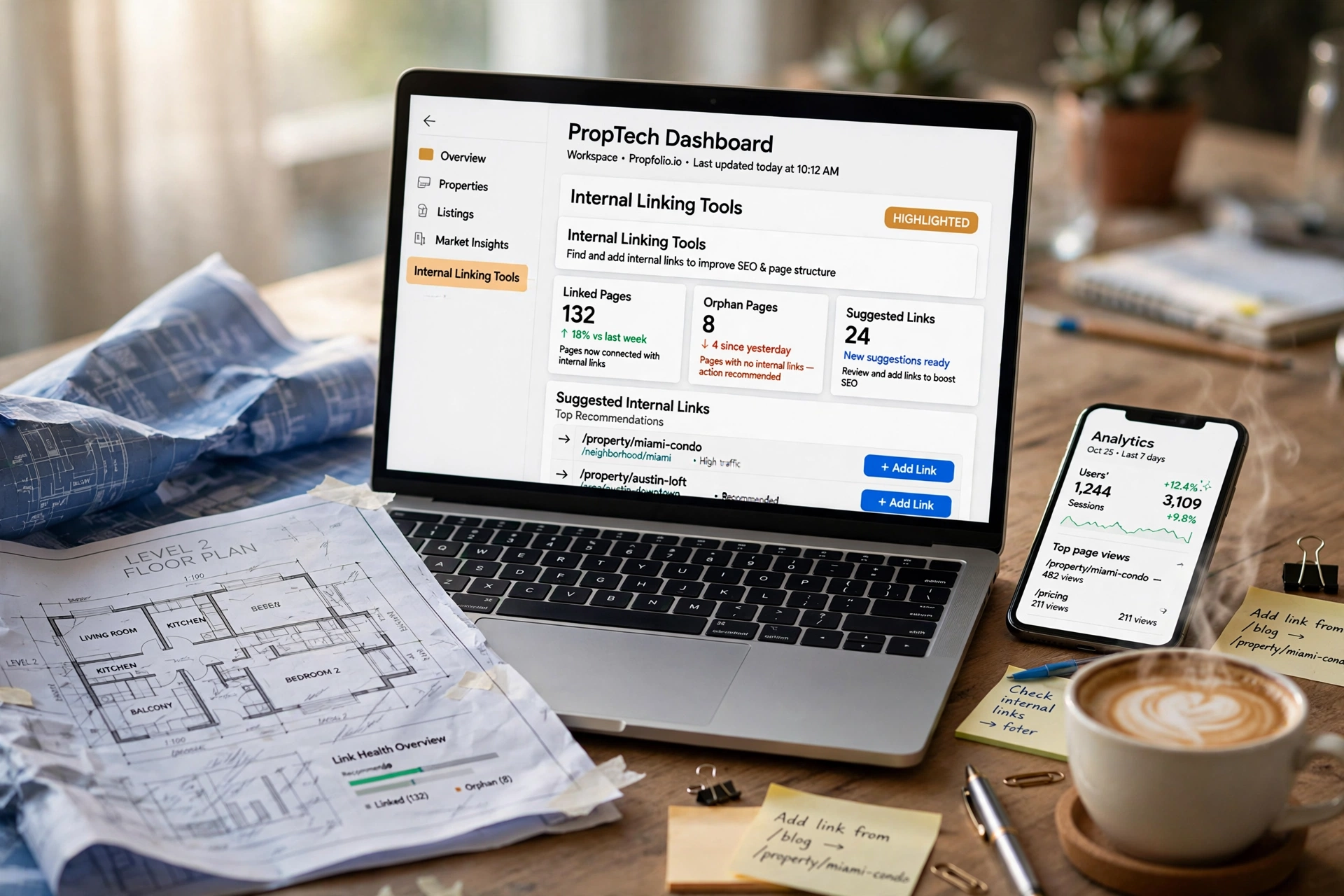
Proptech platforms often struggle with 'orphan pages', thousands of property listings or neighborhood guides that Google simply ignores because no other page links to them. Internal linking automation for proptech software solves this by using algorithmic mapping to automatically connect high-authority pillar pages to deep-layer property data, ensuring search crawlers can index every listing and user journeys are optimized for conversion. By automating the distribution of page rank, Proptech companies can turn a fragmented site into a cohesive authority hub without manual editorial intervention.
In my experience working with Proptech businesses, the biggest bottleneck isn't content creation; it's content discoverability. I've seen platforms with 50,000+ listings where only 5% of the pages actually receive organic traffic because the internal link architecture is non-existent or outdated. To fix this at scale, modern growth teams are moving toward PSEO Architecture Guide for SaaS & Enterprise B2B Growth, which treats links as data points rather than manual edits.
Why are Proptech Businesses Adopting Internal Linking Automation?
The real estate technology sector has shifted from simple listing directories to complex ecosystems involving property management, investment analytics, and tenant portals. This complexity creates a massive technical SEO challenge: as the number of pages grows exponentially, the distance from the homepage to a specific property listing increases, leading to 'crawl depth' issues. When a page is more than three clicks away from the root, Google's index frequency drops significantly.
According to a Gartner report on digital experience platforms, businesses that optimize their internal site architecture see a 25% increase in user engagement and a marked improvement in crawl efficiency. For Proptech, this means the difference between a listing appearing in search results during a peak buying window or remaining invisible. The shift toward automation is driven by the need for real-time updates; as properties are listed, sold, or rented, the internal linking structure must adapt instantly to avoid 404 errors or broken link equity.
Furthermore, the rise of Generative Engine Optimization (GEO) has changed how search engines perceive authority. AI-driven search engines look for cohesive 'topical clusters.' If your Proptech site has an article on 'Investment Trends in Miami' but doesn't logically link to specific Miami-based property listings or local tax guides, the AI perceives the content as disconnected. By utilizing Overview of AI Search Engine Optimization & GEO, Proptech firms can ensure their internal links signal a deep, structured knowledge of the real estate market.

Key Benefits of Internal Linking Automation for Proptech
Automation transforms the way search engines and users navigate a Proptech site. Instead of a manual SEO specialist spending hours in a spreadsheet mapping keywords, an automated system analyzes the semantic relationship between pages and injects links dynamically.
Accelerating Indexation of New Listings
In the fast-paced Proptech world, a listing that takes three days to index is a lost lead. Automation ensures that every new listing is immediately linked from a relevant 'category' or 'neighborhood' page. This creates an immediate path for Googlebot to follow. When we implemented these systems at BizAI Intelligence, we found that the time-to-index for new assets dropped from several days to a few hours because the automation created a 'link bridge' the moment the page was published.
Boosting Topical Authority and PageRank Distribution
Topical authority is achieved when a site demonstrates exhaustive knowledge of a subject. For Proptech, this means linking a high-level guide on "How to Buy Commercial Real Estate" to specific checklists, calculator tools, and actual commercial listings. This distributes 'link juice' from high-authority blog posts to lower-authority conversion pages. This is a core component of How to Automate Organic Traffic & Lead Capture with AI, where the goal is to move the user from an educational state to a transactional state seamlessly.
Improving User Experience (UX) and Time-on-Site
Users don't want to go back to the search results to find related information. If a user is looking at a luxury condo in New York, automation can suggest "Other Luxury Condos in Manhattan" or "NYC Rental Laws 2026" based on semantic relevance. This reduces bounce rates and increases the number of pages viewed per session, which is a positive signal to search engines.
💡
Key Takeaway
Internal linking automation transforms a Proptech site from a collection of isolated pages into a semantic web, drastically reducing crawl depth and increasing the conversion rate of organic visitors.
Comparison of Linking Strategies
| Feature | Manual Linking | Generic AI Plugins | BizAI Intelligence Approach |
|---|---|---|---|
| Scalability | Low (limited by staff) | Medium (keyword based) | Infinite (programmatic) |
| Accuracy | High (but slow) | Low (often irrelevant) | High (semantic mapping) |
| Maintenance | Constant manual audits | Periodic updates | Real-time autonomous sync |
| GEO Readiness | None | Basic | Full Schema & LLM optimization |
Real-World Examples from the Proptech Industry
To understand the impact of this technology, let's look at two distinct scenarios where automation shifted the ROI of organic search.
Case Study 1: The Mid-Sized Residential Portal
A residential real estate platform had 12,000 pages but only 400 were ranking in the top 10 for target keywords. The issue was 'siloing'; the blog content was completely separated from the property listings. By implementing a programmatic internal linking system, they automatically linked every blog post mentioning a specific city to the top 5 listings in that city.
The Result: Within four months, the number of indexing pages increased by 65%, and organic lead generation rose by 22% without producing a single new piece of content. They simply made their existing content discoverable. This is a classic example of the results found in Programmatic SEO Case Studies: Scaling 0 to 100k Organic Visits.
Case Study 2: The Commercial Property Management SaaS
An enterprise SaaS provider focusing on commercial property management had extensive documentation and whitepapers. However, their 'feature' pages weren't getting enough internal authority to rank against larger competitors. We deployed an automation layer that analyzed the 'intent' of the documentation and automatically linked technical guides to the relevant pricing and demo pages.
The Result: The average position for high-intent keywords improved from #14 to #4. More importantly, the click-through rate (CTR) from educational content to the demo booking page increased by 31%. This synergy is exactly why we advocate for The Comprehensive AI SDRs & Autonomous Sales Appointment Setters, as the link provides the traffic, and the AI agent handles the closing.
How to Get Started with Internal Linking Automation
Implementing internal linking automation requires a shift from 'content writing' to 'data architecture.' You cannot simply add a plugin; you must define the relationships between your data entities.
Step 1: Map Your Content Entities
First, identify your core entities. In Proptech, these are usually: Property Type, Location, Price Range, and User Intent (Buyer, Seller, Renter). Create a taxonomy that defines how these entities relate. For example, a "Condo" is a child of "Residential Property," and "Miami" is a child of "Florida."
Step 2: Define Your Link Logic
Establish the rules for your automation. A common logic is: "If a page contains the keyword [City], link to the [City Category Page] and the [Top 3 Trending Properties in City]." This ensures that the links are contextually relevant and provide actual value to the user, avoiding the 'spammy' look of generic plugins.
Step 3: Deploy a Programmatic Engine
This is where BizAI Intelligence becomes essential. Manually coding these rules into a CMS like WordPress or Webflow is tedious and fragile. Our system handles the programmatic heavy lifting, using a Programmatic SEO: How to Scale 10,000+ High-Converting Pages framework to inject links based on real-time data. We don't just link words; we link intents.
Step 4: Monitor and Optimize
Use a tool like Google Search Console to monitor the 'crawl stats.' You should see the 'Pages crawled' metric increase and the 'Average depth' decrease. If certain pages are still not ranking, adjust the weighting of your internal links to push more authority toward those specific targets.

Common Objections and Answers
Many Proptech CEOs are hesitant to automate their internal linking due to misconceptions about search engine penalties.
Objection 1: "Will Google penalize me for having too many automated links?"
Most people assume that automation equals 'spam.' However, the data shows the opposite. Google penalizes irrelevant and low-quality links. According to Google's own documentation on helpful content, the goal is to provide a seamless user experience. When links are semantically accurate, meaning they actually help the user find the next logical piece of information, they are viewed as a positive signal. The risk isn't automation; it's bad logic. Using a professional framework ensures that every link serves a purpose.
Objection 2: "Isn't this too technical for my current marketing team?"
Traditional SEO requires a level of manual labor that doesn't scale. The pattern I see consistently is companies hiring five more copywriters when they actually need one growth engineer. By using an automated system, the complexity is handled at the architectural level. Your team continues to create high-level strategy, while the engine handles the distribution. This is why we suggest looking at Top Programmatic SEO Tools & Software Compared for 2026 [Reviews] to find a solution that fits your operational capacity.
Objection 3: "We already have a sitemap, isn't that enough?"
This is a common mistake. A sitemap is a suggestion to Google, but internal links are directives. Sitemaps tell Google a page exists; internal links tell Google that a page is important. A page with zero internal links is a signal to Google that the content is not valuable enough to be linked to. In the competitive Proptech space, relying on a sitemap is like leaving a map of your store in the parking lot but locking the front door.
📚
Definition
Link Equity (or PageRank) is the value passed from one page to another via hyperlinks. Automation ensures this equity is distributed strategically rather than randomly.
Frequently Asked Questions
How does internal linking automation specifically help Proptech SEO?
Proptech sites are typically massive, often featuring thousands of dynamic pages for properties and locations. Internal linking automation ensures that these deep-level pages are not orphaned. By automatically linking a local neighborhood guide to the newest listings in that specific area, you create a cohesive web of relevance. This tells search engines that your site is an authority on that specific geography, which improves the rankings of both the guide and the listings. It essentially automates the 'silo' strategy that would take a human years to implement manually.
What is the difference between keyword-based linking and semantic linking?
Keyword-based linking is a primitive form of automation where a tool replaces every instance of "Miami condos" with a link to a specific URL. This often results in an unnatural reading experience and can trigger spam filters. Semantic linking, which is what we implement at BizAI Intelligence, understands the context. It recognizes that a paragraph discussing "investment potential in South Beach" is related to "Miami real estate trends" even if the exact keywords don't match. This creates a far more natural user experience and is significantly more effective for modern AI search engines.
Can internal linking automation improve conversion rates (CRO)?
Yes, significantly. Most organic traffic lands on an informational page (e.g. "How to calculate ROI on a rental property"). If that page doesn't have a direct, relevant link to a tool or a listing, the user will either leave the site or go back to Google. Automation allows you to inject "Next-Step" links based on the user's journey. By guiding a user from an educational article to a high-intent landing page, you shorten the sales cycle. This is why we integrate these links with How AI Appointment Setters Automate B2B Demo Booking 24/7, turning a reader into a booked appointment instantly.
How often should the automated internal links be updated?
In Proptech, links should be updated in real-time. Real estate inventory is volatile; properties are taken off the market daily. If your automation is static, you will end up with thousands of links pointing to "Sold" or "404" pages, which destroys your SEO. A dynamic system checks the status of the target URL before rendering the link. This ensures that your link equity is always flowing toward active, high-converting pages, maintaining a clean site architecture and a positive user experience.
Does automating links help with ranking in AI search like Perplexity or SearchGPT?
Absolutely. AI search engines do not just look for keywords; they look for relationships between entities. By using automation to create a dense network of related links, you are essentially building a knowledge graph for the AI to crawl. When a user asks Perplexity, "What are the best Proptech tools for Miami investors?", the AI looks for sites that have a strong, linked relationship between 'Miami', 'Investment', and 'Proptech Tools'. Without automated internal linking, your site looks like a collection of random pages; with it, you look like a definitive authority. For more on this, check out How to Get Cited by ChatGPT, SearchGPT, and Perplexity AI.
Final Thoughts on Internal Linking Automation for Proptech Software
In 2026, the gap between the winners and losers in Proptech SEO will be defined by their ability to scale. You cannot manually manage the internal architecture of a site with 10,000+ pages and expect to beat a competitor who uses programmatic systems. Internal linking automation for proptech software is no longer an "extra", it is the fundamental infrastructure required to maintain topical authority and capture high-intent inbound leads.
Stop letting your best content sit in the dark. By automating your link equity distribution, you ensure that every listing and every guide is working to fill your pipeline. If you are ready to stop renting traffic and start building an organic machine, visit BizAI Intelligence today and let us build your automated acquisition engine.
Only 12 Onboarding Slots Remaining This Month
BizAI deploys 300 AI salespeople scoring purchase intent 24/7. Get your free niche domination blueprint.
AI Search Accelerator: 1-on-1 Strategy Session
Claim one of the 10 monthly slots. Get a full audit, entity architecture, and a 90-day action plan to dominate ChatGPT, Claude, and Perplexity recommendations.