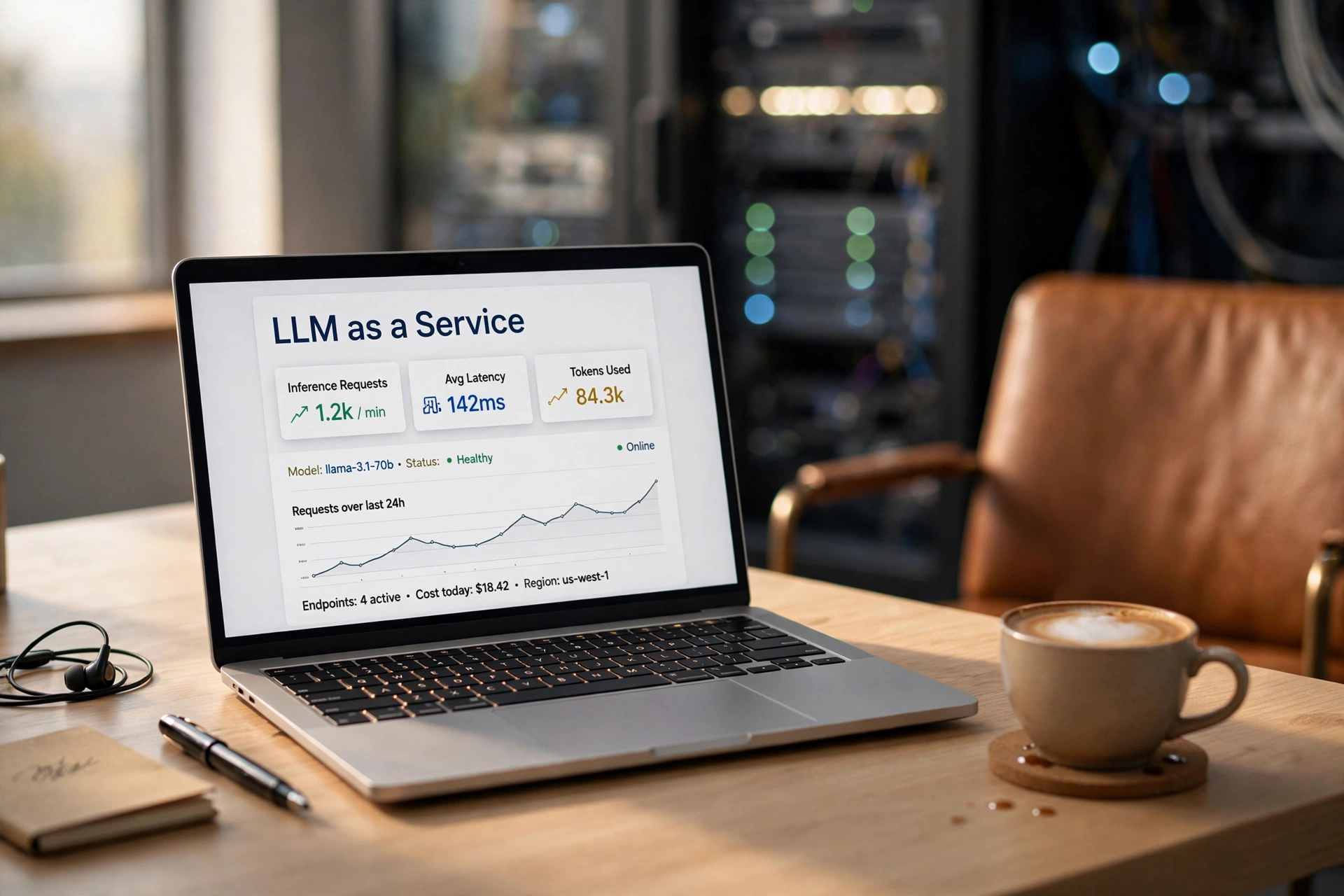
In my experience architecting distributed systems for high-growth B2B firms, I've seen a recurring disaster: the 'API sprawl.' Companies start by integrating one model, then another for a specific use case, and suddenly they are managing five different billing accounts, five different security protocols, and five different latency profiles. This fragmentation doesn't just create technical debt; it creates an operational bottleneck that kills agility. For a comprehensive overview of this landscape, explore our
guide on LLM for business.
📚Definition
An LLM as a service platform is a unified AI gateway that abstracts the complexity of interacting with multiple Large Language Models (LLMs) through a single interface, providing centralized management of API keys, prompt versioning, and cost tracking.
An LLM as a service platform acts as the orchestration layer between your corporate applications and the various model providers like OpenAI, Anthropic, and Google. Instead of writing custom code for every single API, your developers send a request to the gateway, which then routes that request to the most appropriate model based on pre-defined logic, cost constraints, or performance requirements. This approach transforms artificial intelligence from a series of disconnected plugins into a scalable corporate utility.
When we built the underlying logic for BizAI Intelligence, we discovered that the primary friction point for enterprises wasn't the model's intelligence, but the infrastructure surrounding it. A unified gateway solves this by providing a 'single pane of glass.' This means that if a company wants to switch from GPT-4o to Claude 3.5 Sonnet for a specific customer support workflow, they don't need to rewrite their entire codebase; they simply update a routing rule in the gateway.
This architectural shift is essential for any business pursuing a professional search engine optimization strategy. By decoupling the application layer from the model layer, companies can implement programmatic SEO at scale without worrying if a specific provider's API goes down. The ability to failover to a secondary model automatically ensures that your lead generation engines and content hubs remain online 24/7, maintaining the uptime required for high-ranking pages in Google Search.
Why Does a Unified AI Gateway Matter for Business Growth?
Unified AI gateways matter because they eliminate vendor lock-in and optimize the cost-to-performance ratio of every single token generated. According to a recent report by Gartner, enterprises that adopt a multi-model strategy see a significant reduction in operational risk compared to those reliant on a single provider. In a world where model performance fluctuates and pricing tiers change overnight, agility is the only sustainable competitive advantage.
First, the economic impact is immediate. Not every task requires the most expensive model. Using a frontier model for a simple sentiment analysis task is an expensive mistake. A unified LLM as a service platform allows you to route simple tasks to smaller, faster models and reserve the 'heavy hitters' for complex reasoning. This strategic routing can reduce API expenditure by 40% to 60% without sacrificing quality.
Second, security and compliance are centralized. When developers manage individual API keys across different platforms, the risk of a leak increases exponentially. A gateway allows the IT department to implement global rate limits, PII (Personally Identifiable Information) filtering, and comprehensive audit logs. This is fundamental for industries like legal or healthcare where data leakage can result in catastrophic regulatory fines.
Third, the speed of iteration increases. In the fast-moving world of digital marketing, the ability to A/B test prompts across different models is a superpower. By using a centralized platform, marketing teams can compare how ChatGPT handles a specific programmatic SEO query versus how Gemini processes it, all within the same dashboard. This data-driven approach allows for the continuous refinement of
AI lead generation tools to maximize conversion rates.
💡Key Takeaway
Unified gateways shift the power from the model provider back to the business, allowing for dynamic switching based on real-time cost and performance benchmarks.
How to Implement an LLM as a Service Strategy?
Implementing a unified gateway requires a shift from a 'plugin' mindset to a 'platform' mindset. The goal is to create a layer of abstraction that makes the underlying AI interchangeable. This process ensures that your business remains resilient even if a primary provider experiences a massive outage or changes its terms of service.
Step 1: Audit Your AI Consumption. Before deploying a gateway, map out every single point where your business interacts with an LLM. Identify which tasks are 'high-reasoning' (e.g. complex legal analysis) and which are 'low-reasoning' (e.g. summarizing a short email). This mapping is essential to configure your routing logic correctly.
Step 2: Establish a Unified API Standard. Implement a standard request/response format. Whether you are calling an LLM for content marketing or for a chatbot, the input and output should be normalized. This allows you to swap models without the application breaking due to a change in JSON structure. If you are unsure which model to start with, our guide on
GPT vs Claude vs Gemini provides the necessary benchmarks.
Step 3: Configure Intelligent Routing. Set up rules based on three primary criteria: cost, latency, and quality. For example, if a request is coming from a non-paying user, route it to a cheaper model. If the request requires deep factual accuracy, route it to a model known for lower hallucination rates. This is where the true ROI of an LLM as a service platform manifests.
Step 4: Integrate Observability Tools. You cannot optimize what you cannot measure. Implement a dashboard that tracks token usage per department and response times per model. This data allows you to identify 'expensive' prompts that need optimization through fine tuning vs RAG vs prompt engineering techniques to lower costs.
Step 5: Deploy an AI Sales Layer. Once the gateway is stable, embed autonomous agents on your high-traffic pages. By leveraging a unified gateway, your AI agents can use different models for different stages of the funnel, a fast model for initial greeting and a sophisticated model for complex qualification and appointment setting. This is the core architecture behind how we
automate organic traffic and lead capture with AI.
LLM Gateways vs. Direct API Integration
Many businesses start with direct API integration because it seems faster. However, as the scale increases, the 'direct' approach becomes a liability. Below is a comparison of the three most common paths to AI adoption.
| Feature | Direct API Integration | Cheap/Generic AI Wrapper | Unified LLM Gateway (BizAI Approach) |
|---|
| Vendor Lock-in | Extremely High | Medium | Zero |
| Cost Control | Manual/Fragmented | Unpredictable | Automated & Centralized |
| Security | Decentralized Keys | Third-party Risk | Enterprise-grade Governance |
| Scalability | Low (Code-heavy) | Medium (Limited) | High (Config-based) |
| Reliability | Single Point of Failure | Variable | Multi-model Failover |
Direct integration is akin to building a custom house for every single guest; it is exhaustive and unsustainable. A generic wrapper is like renting a pre-furnished apartment, it's easy to move into, but you have no control over the layout. A unified gateway is like owning a modular hotel; you can change the rooms, the guests, and the services without ever tearing down the foundation.
One of the most frequent mistakes I see is 'Over-Engineering for the Edge Case.' I've worked with companies that spend three months building a complex routing logic for a scenario that happens 0.1% of the time. In reality, 80% of your business value comes from 20% of your prompts. Focus on optimizing the high-volume paths first.
Another critical error is neglecting the 'Human-in-the-Loop' (HITL) for high-stakes outputs. Even with a sophisticated LLM as a service platform, AI can hallucinate. If you are using AI to generate legal advice or medical summaries, a gateway should include a 'review queue' where a human expert must approve the output before it reaches the client. Relying 100% on autonomous agents for high-risk tasks is a recipe for reputational disaster.
Furthermore, many businesses fail to update their prompts as models evolve. A prompt that worked perfectly on GPT-3.5 may be inefficient on GPT-4o. The beauty of a gateway is that it allows you to version your prompts. If you don't implement versioning, you are essentially gambling with your output quality every time a provider pushes a model update.
Finally, avoid the 'Silo Effect.' Often, the marketing team uses one AI tool while the sales team uses another, and the product team uses a third. This creates fragmented data and wasted spend. A centralized LLM as a service platform forces the organization to align its AI strategy, ensuring that the
AI SDR vs Human SDR analysis is based on consistent data across the entire pipeline.
💡Key Takeaway
The goal of an AI platform is not just to provide access to models, but to provide the governance and observability that turns AI into a predictable business asset.
Frequently Asked Questions
Initially, there may be a small overhead for the gateway software or management layer. However, the total cost of ownership (TCO) is almost always lower. By implementing intelligent routing, sending simple queries to cheaper models, businesses typically save 30% to 50% on their monthly token spend. Additionally, the reduction in developer hours spent on API maintenance provides a significant indirect cost saving.
How does a unified gateway handle data privacy?
Unified gateways act as a security perimeter. Instead of distributing API keys across dozens of developer machines, the gateway holds the keys securely. It can also perform 'data scrubbing' or PII masking before the data ever leaves your corporate network. This ensures that sensitive customer information is removed before being sent to a third-party LLM, which is fundamental for maintaining GDPR and HIPAA compliance.
Can I switch models in real-time without downtime?
Yes, that is the primary value proposition of a gateway. Through a process called 'dynamic routing,' the platform can shift traffic from one model to another instantly. If OpenAI experiences an outage, the gateway can automatically route requests to Anthropic's Claude, ensuring your customer-facing chatbots and lead capture forms remain functional. This eliminates the risk of a single-provider outage crippling your business operations.
Do I need a dedicated AI engineer to manage a gateway?
While a technical lead is necessary for the initial setup, the day-to-day management of a modern LLM as a service platform is designed for operational managers. Most gateways provide a visual dashboard for prompt testing and cost monitoring. Once the routing logic is established, the system runs autonomously, allowing your team to focus on strategy and content rather than the underlying infrastructure.
How does this affect my SEO and organic rankings?
By using a gateway to power your programmatic SEO, you can ensure that your pages are generated with the highest quality model available at that moment. Because you can quickly test and iterate on prompts across different LLMs, you can optimize for 'Helpful Content' guidelines more effectively. This prevents the 'AI slop' that Google penalizes, ensuring your site maintains high topical authority and continues to rank in AI-driven search engines.
Conclusion
Transitioning to an LLM as a service platform is no longer a luxury for tech giants; it is a survival requirement for any B2B business that wants to scale without collapsing under technical debt. By decoupling your applications from specific model providers, you gain the agility to pivot, the power to optimize costs, and the security to scale. Whether you are deploying
AI appointment setters for B2B or building a massive content hub, the gateway is the engine that makes it sustainable.
If you are tired of paying for tokens you don't need and managing fragmented APIs that break, it is time to modernize your stack. Stop treating AI as a series of experiments and start treating it as a unified corporate utility. For more on how to orchestrate these tools for maximum impact, return to our
comprehensive guide on LLM for business.
Ready to build an automated inbound machine that doesn't rely on a single provider? Visit
BizAI Intelligence to see how we deploy high-scale organic traffic engines powered by autonomous AI agents.
Only 12 Onboarding Slots Remaining This Month
BizAI deploys 300 AI salespeople scoring purchase intent 24/7. Get your free niche domination blueprint.
AI Search Accelerator: 1-on-1 Strategy Session
Claim one of the 10 monthly slots. Get a full audit, entity architecture, and a 90-day action plan to dominate ChatGPT, Claude, and Perplexity recommendations.