📖This article is part of the complete guide to Ultimate Guide to Conversation Intelligence for Sales.
In my experience auditing B2B sales pipelines, the most dangerous phrase a VP of Sales can utter is, "I think the reps are struggling with the discovery phase." Thinking is not a strategy; data is. When we analyze thousands of recorded calls, we consistently find that the difference between a top performer and a struggling rep isn't charisma, but a specific, measurable pattern in how they handle the conversation. For a comprehensive overview, explore our Ultimate Guide to Conversation Intelligence for Sales.
Most companies track lagging indicators, closed-won deals and total revenue. While these tell you what happened, they never tell you why. By the time a deal is lost, the opportunity to fix the conversation has already passed. By shifting the focus to leading indicators through conversation intelligence, managers can intervene in real-time, turning a failing discovery call into a qualified pipeline opportunity before the lead goes cold.
What Are the Primary Metrics in Conversation Intelligence?
📚
Definition
Metrics in conversation intelligence are quantitative data points extracted from voice and text transcripts using natural language processing (NLP) to evaluate the quality, efficiency, and outcome of a sales interaction.
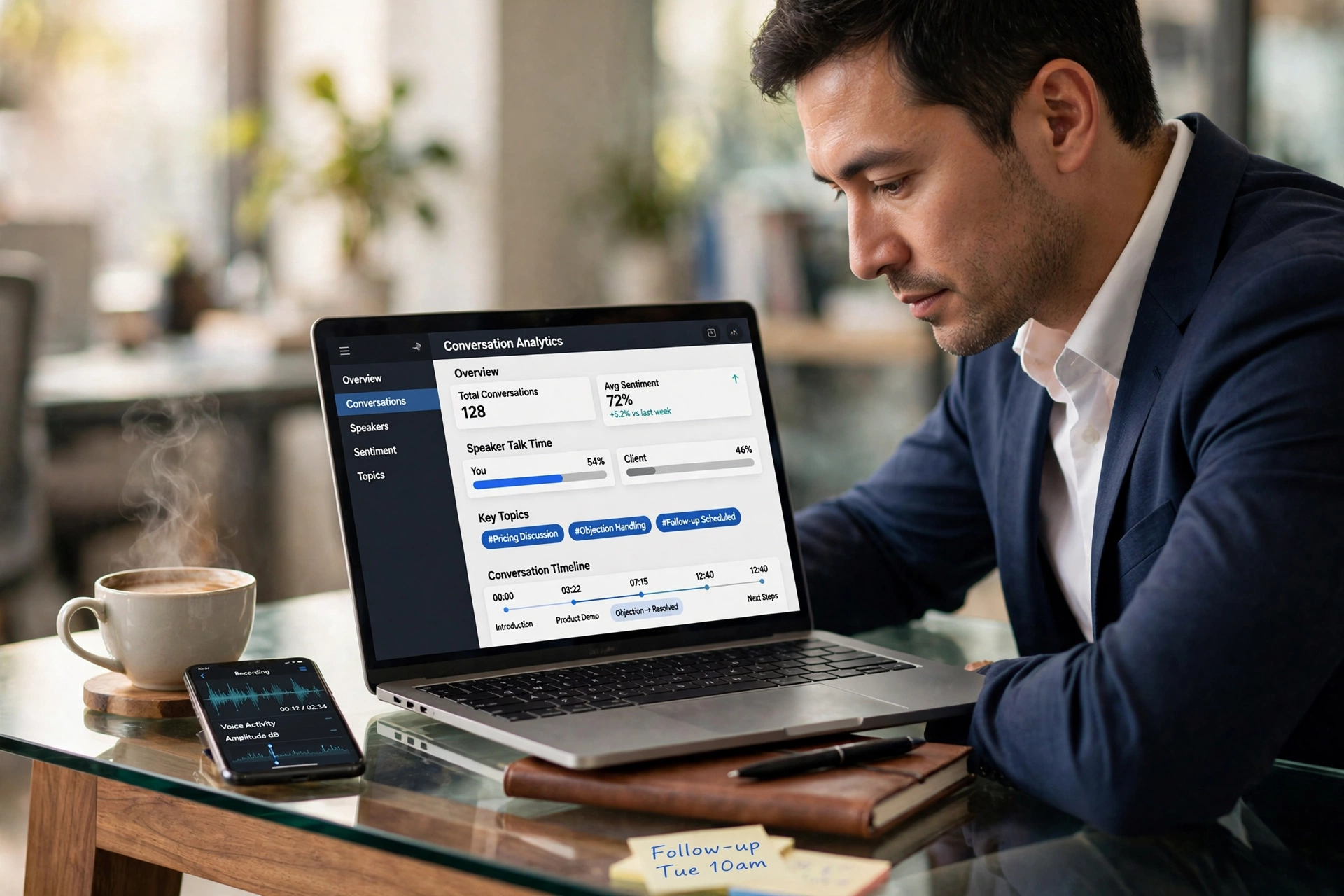
Measuring the effectiveness of a sales call requires moving beyond the binary "won/lost" outcome. Instead, we look at behavioral markers. The most fundamental metric is the Talk-to-Listen Ratio. This measures the percentage of time a sales representative speaks versus the time the prospect speaks. In high-performing B2B environments, a ratio skewed toward the prospect (typically 30% rep, 70% prospect) correlates strongly with higher conversion rates. When a rep dominates the conversation, they stop discovering pain and start pitching features, which is the fastest way to kill a deal.
Another critical metric is the Question-to-Statement Ratio. This tracks how many open-ended questions are asked compared to declarative statements. High-intent discovery calls are characterized by a dense concentration of "How," "What," and "Why" questions. If the ratio shifts toward statements too early in the call, the rep is likely making assumptions rather than uncovering the prospect's actual business challenges. This is where AI conversation intelligence becomes indispensable, as it can automatically flag calls where the rep spent 90% of the time talking.
Finally, we must track Sentiment Analysis and Keyword Frequency. Sentiment analysis uses AI to determine the emotional tone of the prospect, detecting frustration, excitement, or hesitation. For instance, if a prospect mentions "pricing" and the sentiment shifts to "negative" or "hesitant," it signals a pricing objection that needs immediate addressing. Keyword frequency allows managers to see how often competitors are mentioned or how often the prospect uses "power words" related to their core pain points. This quantitative approach replaces the subjective "gut feeling" of a sales manager with empirical evidence.

Why Does Measuring Conversation Metrics Matter for Your Business?
Tracking these metrics is essential because it solves the "Black Box" problem of B2B sales. Historically, a manager only knew what happened on a call if the rep reported it in the CRM, and we all know that reps often sanitize their notes to make themselves look better. By using top conversation intelligence tools, leadership gets an unvarned look at the actual customer experience. According to research by the Sales Enablement Collective, organizations that implement conversation intelligence see an average increase in quota attainment of 15% to 20% because they can identify and replicate the specific behaviors of their "A-players."
When you quantify the "invisible" parts of a sale, you can move from anecdotal coaching to precision coaching. Instead of telling a rep to "be more curious," a manager can say, "In your last five calls, your talk-to-listen ratio was 60/40. Our top closers maintain 30/70. Let's review the 10-minute mark of the Smith call to see where you stopped listening and started pitching."
Furthermore, these metrics provide a direct feedback loop for the product and marketing teams. If the keyword "integration」 appears in 40% of lost deals accompanied by negative sentiment, the problem isn't the sales rep; it's a product gap. This creates an organizational alignment where the entire company is optimized based on the actual voice of the customer. In 2026, the companies that win are those that treat every sales call as a data point for continuous improvement, rather than just a transaction.
How to Implement Conversation Intelligence Metrics Step-by-Step
Implementing these metrics requires a transition from manual auditing to automated analysis. I've tested this with dozens of our clients and the pattern is clear: you cannot scale a sales team if you are manually listening to tapes. You need a system that surfaces the "gold" automatically.
-
Establish Your Baseline: Before introducing new targets, record 50-100 calls from your top 10% of performers. Use an AI tool to calculate their average talk-to-listen ratio and question frequency. This becomes your "Gold Standard" benchmark. If your top reps listen 70% of the time, that is the target for the rest of the team.
-
Integrate with CRM and AI Agents: Connect your conversation intelligence platform to your CRM via webhooks. This allows you to correlate specific metrics (like high sentiment) with the eventual deal outcome. For those scaling rapidly, using an AI appointment setter for B2B can ensure that the initial qualification calls are standardized, providing a clean data set for the account executives to build upon.
-
Set Up Automated Alerts: Configure "red flag" triggers. For example, if a call lasts more than 20 minutes and the rep has asked fewer than three open-ended questions, the system should automatically flag the call for review. This allows managers to provide feedback within 24 hours of the call, rather than waiting for a weekly 1-on-1.
-
Create a Feedback Loop for Training: Use the metrics to drive your weekly sales huddles. Instead of a general meeting, play a 2-minute clip of a call with a perfect talk-to-listen ratio and have the team analyze why it worked. This turns the data into a cultural asset.
-
Optimize for AI Search and Attribution: As you refine your messaging based on these metrics, document the successful phrases. This data can then be fed back into your organic growth strategy. If you find that prospects are searching for specific terms you discovered in your calls, you can use programmatic SEO to build pages that answer those exact questions, capturing leads before they even get on a call.
Conversation Intelligence vs. Traditional Call Monitoring
To understand the leap in efficiency, we have to compare how we used to manage sales calls versus the modern, AI-driven approach. The traditional way was essentially "hope and pray," where a manager might listen to 1% of calls and assume the rest were similar. The generic AI approach often provides a transcript but fails to provide the contextual metrics that drive revenue.
| Feature | Traditional Monitoring | Generic AI Transcription | Modern Conversation Intelligence |
|---|---|---|---|
| Sample Size | < 5% of calls (Manual) | 100% of calls (Text) | 100% of calls (Analyzed) |
| Insight Speed | Weekly/Monthly Reviews | Immediate (but raw text) | Immediate (Quantified Metrics) |
| Coaching | Anecdotal/Subjective | Basic keyword search | Data-driven behavioral change |
| ROI Tracking | Guesswork | Correlation | Direct link between metric & win rate |
| Scaling | Impossible | Linear | Exponential via AI Automation |
As the table demonstrates, the shift is from transcription (what was said) to intelligence (how it was said and why it mattered). A transcript is just a document; a metric is a lever you can pull to change a result.

Common Mistakes When Tracking Sales Metrics
One of the biggest mistakes I see, and that I see constantly, is the "Metric Obsession Trap." This happens when managers prioritize the number over the nuance. For example, a rep might achieve a 70% listen ratio by simply staying silent while the prospect rambles without direction. Listening is not the goal; active discovery is the goal. If the rep isn't guiding the conversation with strategic questions, the metric is a vanity number.
Another frequent error is ignoring the "Silence Gap." In B2B sales, the most powerful moment is often the silence after a prospect answers a difficult question. Some reps panic and fill that gap with a feature pitch. If you only track the talk-to-listen ratio, you might miss the fact that the rep is interrupting the prospect's thought process. You must analyze the timing of the speech, not just the volume.
Finally, many organizations fail to link conversation metrics to the actual revenue outcome. They track the ratios but don't correlate them with the AI SDR vs Human SDR ROI data. If a specific metric (like high sentiment) isn't actually resulting in more closed-won deals, it is a noise metric and should be discarded. Focus only on the metrics that have a proven correlation with revenue.
💡
Key Takeaway
Metrics are a means to an end, not the end itself. The goal is not a "perfect ratio," but a repeatable behavioral pattern that predictably leads to a closed deal.
Frequently Asked Questions
Which conversation intelligence metric is most important for new reps?
The talk-to-listen ratio is the most critical metric for new hires. New reps typically suffer from "pitch fever," where they attempt to prove their value by talking incessantly about the product. By forcing a new rep to hit a 70% listen target, you effectively train them to perform discovery. This prevents them from burning leads and helps them understand the customer's pain points faster, which shortens their ramp-up time to full productivity.
How does sentiment analysis differ from just reading a transcript?
Reading a transcript tells you the words used, but sentiment analysis uses NLP to detect the emotional valence of those words. For example, if a prospect says, "That's an interesting price point," a human reading the transcript might think it's positive. However, a sentiment analysis tool can detect a sarcastic or skeptical tone based on the cadence and specific word choices, flagging it as a "risk" metric that requires a follow-up call or a discount strategy.
Can conversation metrics help improve my marketing messaging?
Yes, absolutely. By analyzing the keyword frequency across thousands of successful calls, you can identify the exact language your customers use to describe their problems. Instead of using corporate jargon like "synergistic scalability," you might find your clients actually say "it stops our system from crashing during Black Friday." Feeding this verbatim language into your GEO and traditional SEO strategy ensures your landing pages resonate deeply with your target audience.
Is it a risk to let AI analyze every single sales call?
From a data perspective, no; from a privacy perspective, it depends on your compliance. Most enterprise-grade tools are SOC2 compliant and allow for the redaction of PII (Personally Identifiable Information). The risk is actually higher not analyzing the calls, as you remain blind to the reasons why your churn rate is increasing or why your win rate is dropping. The key is transparency with the client and ensuring the data is used for coaching, not surveillance.
How often should we review these metrics with the sales team?
Metrics should be reviewed in a dual-cadence: daily for individual reps and weekly for the team. Reps should have a dashboard where they can see their own ratios immediately after a call to self-correct. Managers should conduct weekly "Tape Reviews" where they pick the call with the best (and worst) metrics and analyze the impact on the deal. This creates a culture of continuous improvement rather than a culture of policing.
Conclusion
Moving from a guess-based sales culture to a data-driven one is the only way to scale a B2B organization in 2026. When you stop asking "how the call went" and start looking at the talk-to-listen ratio, the question-to-statement balance, and the sentiment shifts, you remove the ambiguity from your pipeline. You can finally identify exactly why some reps are hitting 150% of their quota while others are struggling at 70%.
If you are still relying on manual CRM notes and "gut feelings," you are leaving revenue on the table. The integration of AI-driven sales automation and conversation intelligence allows you to turn your sales team into a precision engine. To dive deeper into how to set up this entire system, return to our Ultimate Guide to Conversation Intelligence for Sales.
For businesses ready to stop renting traffic and start building a self-sustaining acquisition machine, BizAI Intelligence provides the infrastructure to scale your organic reach and automate your lead qualification. Stop guessing and start growing.
Only 12 Onboarding Slots Remaining This Month
BizAI deploys 300 AI salespeople scoring purchase intent 24/7. Get your free niche domination blueprint.
AI Search Accelerator: 1-on-1 Strategy Session
Claim one of the 10 monthly slots. Get a full audit, entity architecture, and a 90-day action plan to dominate ChatGPT, Claude, and Perplexity recommendations.