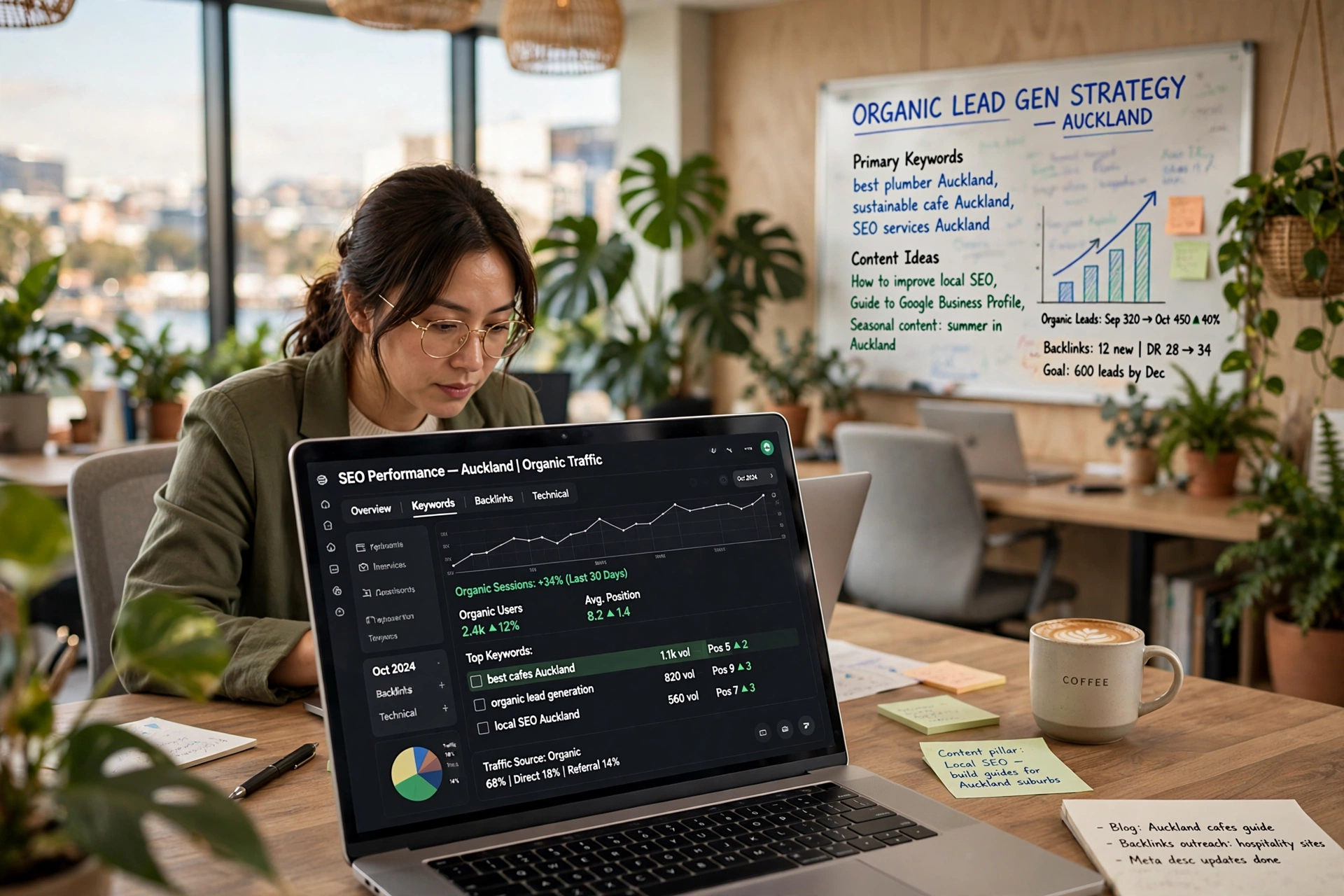
For high-ticket B2B service providers in New Zealand, the cost of customer acquisition via paid media has reached a breaking point. An organic lead generation engine in Auckland is a programmatically engineered system of high-authority pillar pages and satellite content designed to dominate search intent and automate lead qualification. Unlike traditional blogging, this engine uses a dual-architecture of topical authority and AI-driven capture to turn search volume into booked appointments without a monthly ad spend.
In my experience working with high-ticket B2B service businesses, the biggest mistake most firms make is treating their website as a digital brochure rather than a sales tool. I have seen dozens of Auckland-based firms spend thousands on Google Ads only to land on a generic 'Contact Us' page that fails to qualify the lead. When we deploy a true organic engine, we aren't just looking for clicks; we are building a moat of topical dominance that makes the business the only logical choice in the local market. For those looking to scale, understanding the Overview of AI Search Engine Optimization & GEO is the first step toward replacing volatile ad spend with stable, compounding organic growth.

Why High-Ticket B2B Businesses are Adopting Organic Engines in Auckland
The shift toward organic systems in the Auckland market is driven by a fundamental change in buyer behavior. B2B decision-makers in the Waitematā region are no longer clicking on the first sponsored ad they see; they are conducting deep research across multiple AI-driven platforms. According to Gartner, roughly 80% of B2B buyers now prefer digital self-service over talking to a human sales representative during the initial research phase. This means if your business isn't appearing as the definitive answer to a buyer's specific problem, you are effectively invisible.
In practice, this means the traditional 'lead magnet' strategy is dead. Offering a generic PDF in exchange for an email is a high-friction event that most modern executives ignore. Instead, the market is moving toward Generative Engine Optimization (GEO), where the goal is to be cited by AI agents like Perplexity or SearchGPT. By implementing an organic lead generation engine in Auckland, businesses can capture this 'zero-click' search traffic and route it directly into an automated qualification funnel.
Furthermore, the Auckland business landscape is highly competitive yet niche-specific. Whether it is enterprise legal services in the CBD or specialized engineering firms in Penrose, the winners are those who own the 'topical authority' for their specific service. A report from McKinsey indicates that companies utilizing AI-driven organic growth strategies see a significant reduction in their customer acquisition cost (CAC) because organic traffic compounds over time, whereas paid traffic stops the moment the budget runs out. This compounding effect is why we prioritize a PSEO Architecture Guide for SaaS & Enterprise B2B Growth for our clients who want to scale rapidly without linear increases in spend.
Key Benefits for B2B Service Providers in Auckland
Implementing a structured organic engine provides a level of predictability that paid ads simply cannot match. When you own the search intent for a specific high-value query in the Auckland region, you are no longer fighting a bidding war against competitors with larger budgets. You are playing a different game entirely: the game of authority.
Predictable Inbound Pipeline
The primary benefit of an organic lead generation engine in Auckland is the transition from 'hunting' to 'farming.' Instead of your sales team spending 40 hours a week on cold outreach, the engine attracts high-intent buyers who are already searching for your specific solution. This shift typically results in a higher lead-to-close ratio because the prospect has already been 'pre-educated' by your content before they ever book a call. When this is paired with How AI Appointment Setters Automate B2B Demo Booking 24/7, the business moves from manual prospecting to a state of autonomous growth.
Drastic Reduction in Cost Per Lead (CPL)
While the initial setup of an organic engine requires more technical rigor than launching a Facebook ad, the long-term ROI is exponentially higher. In a paid model, your CPL remains constant or increases as competition grows. In an organic engine, your CPL actually decreases over time. As your domain authority grows, your pages rank higher, attracting more traffic for the same initial effort. This is the essence of 'renting' vs. 'owning' your traffic.
Dominance in AI Search Results
With the rise of AI Overviews, the goal is no longer just the 'blue link' on page one. The goal is to be the cited source within the AI's response. By using structured schema and programmatic scaling, an organic lead generation engine ensures that your brand is recognized as an entity of authority. This is why understanding GEO Vs Traditional SEO: Rank Your Brand in AI Engines in 2026 is essential for any Auckland business that wants to remain relevant in the current year.
| Feature | Traditional Paid Ads | Generic Blog/SEO | BizAI Organic Engine |
|---|---|---|---|
| Traffic Cost | High (Pay-per-click) | Low (Time-intensive) | Compounding (Fixed Initial) |
| Lead Quality | Variable | Low to Medium | High (Intent-Based) |
| Scalability | Linear (More $$$ = More Leads) | Slow (Manual Writing) | Exponential (Programmatic) |
| AI Visibility | None | Moderate | Optimized (GEO) |
| Conversion | Manual Follow-up | Static Forms | Autonomous AI SDR |
💡
Key Takeaway
The most successful B2B firms in Auckland are moving away from linear growth (paid ads) and toward exponential growth (organic engines) to secure a permanent competitive advantage in AI search.
Real Examples from the Auckland B2B Market
To illustrate the power of this approach, let's look at two hypothetical but representative scenarios based on the patterns I've seen in the New Zealand market.
Example 1: Specialized Professional Services Firm (CBD)
A high-end consultancy in Auckland was spending NZD 5,000 per month on Google Ads targeting 'enterprise risk management'. Their CPL was high, and many leads were unqualified. We transitioned them to an organic lead generation engine in Auckland, deploying 200+ satellite pages targeting specific industry pain points (e.g. 'risk management for Auckland construction firms', 'compliance for NZ fintech startups').
Within four months, their organic traffic increased by 400%. More importantly, because the content was so specific, the lead quality spiked. By integrating an AI SDR Vs Human SDR approach, they were able to qualify leads instantly on the page, resulting in a 30% increase in qualified meetings booked per month while eliminating their ad spend entirely.
Example 2: Industrial Equipment Provider (South Auckland)
A provider of heavy machinery in South Auckland relied heavily on referrals and a basic website. They were missing out on a massive volume of 'comparison' and 'solution' searches. We implemented a programmatic SEO strategy, creating an extensive network of comparison tables and regional service pages.
By focusing on Programmatic SEO Case Studies: Scaling 0 to 100k Organic Visits, we mapped their entire product catalog to high-intent search queries. The result was a dominant position in Google AI Overviews for their primary product categories. They went from receiving 5 leads a month to 45 high-intent inquiries, as the engine effectively worked as a 24/7 salesperson for the Auckland region.

How to Get Started with an Organic Lead Generation Engine
Building a professional organic engine is not about 'writing a few blog posts.' It is a technical engineering project. If you want to build a sustainable asset, you must follow a rigorous architecture.
Step 1: Mapping the Intent Graph
You must identify every possible question a high-ticket buyer in Auckland would ask. This involves moving beyond 'head terms' (e.g. 'Marketing Agency Auckland') and moving toward 'long-tail' intent (e.g. 'best B2B lead generation strategies for Auckland law firms in 2026'). This mapping creates the blueprint for your satellite pages.
Step 2: Deploying the Pillar-Satellite Architecture
Create a high-authority pillar page that covers the broad topic comprehensively. Then, build hundreds of satellite pages that link back to that pillar. This signals to Google and AI engines that you have unmatched 'topical authority.' For those who want to scale this without hiring a fleet of writers, using Programmatic SEO: How to Scale 10,000+ High-Converting Pages Automatically is the only viable path to dominance.
Step 3: Integrating Autonomous Capture
Traffic is a vanity metric; appointments are the only metric that matters. Every page in your engine should feature an AI Sales Agent. This agent doesn't just take a message; it qualifies the lead based on their behavior on the page and books a meeting directly into your CRM. This is exactly how we handle the How to Connect AI Sales Agents to CRM & Webhooks for Auto Booking process at BizAI Intelligence, ensuring no lead is lost to a slow manual response.
Step 4: GEO Optimization
Ensure your content is formatted for AI crawlers. This includes using JSON-LD schema, clear FAQ grids, and specific entity mentions. If you aren't following the latest protocols on How to Get Cited by ChatGPT, SearchGPT, and Perplexity AI, you are leaving a massive amount of traffic on the table.
Common Objections & Answers
Many Auckland business owners hesitate to move away from paid ads because they believe organic growth is 'too slow.' Here is the reality based on the data.
Objection 1: "I need leads today, and SEO takes six months."
Most people assume organic growth is a slow burn. However, with a programmatic approach and the use of the Google Indexing API, we can get hundreds of pages indexed and ranking in weeks, not months. While paid ads give you instant traffic, they also vanish the second you stop paying. An organic engine is an asset that grows in value. The risk isn't the speed of SEO; the risk is continuing to pay a 'tax' to Google for every single lead you generate.
Objection 2: "AI-generated content will get me penalized by Google."
This is a common misconception. Google's 'Helpful Content' guidelines do not penalize AI content; they penalize unhelpful content. The difference is in the engineering. Most people use AI to write generic fluff. At BizAI Intelligence, we use AI to scale research-backed, high-value pages that solve specific user problems. When content is helpful, Google rewards it regardless of how it was produced. This is why we focus on Top AI Search Optimization Tools for Modern Growth Teams to ensure quality at scale.
Objection 3: "My niche is too small for a massive organic engine."
In high-ticket B2B, 'small' is actually an advantage. If you only need 10 high-value clients a month to double your revenue, you don't need a million visitors; you need 1,000 visitors with extremely high intent. A programmatic engine allows you to dominate every single micro-niche and regional query in Auckland, ensuring that whenever a qualified buyer searches for a solution, your brand is the only one they see.
Frequently Asked Questions
What exactly is an organic lead generation engine in Auckland?
An organic lead generation engine is a sophisticated digital asset consisting of a network of programmatically generated, SEO-optimized pages designed to capture high-intent B2B search traffic in the Auckland region. Unlike a standard blog, it uses a pillar-and-satellite architecture to establish topical authority and integrates AI-driven sales agents to qualify leads and book appointments automatically. The goal is to create a self-sustaining system that attracts, qualifies, and converts prospects without the need for ongoing ad spend, effectively turning the company's domain into a lead-generation machine that works 24/7.
How does this differ from traditional SEO services?
Traditional SEO often focuses on 'ranking' for a few keywords and writing a few articles a month. An organic engine focuses on 'dominance' through programmatic scale. Instead of 4 blog posts a month, we deploy hundreds of high-value pages that cover every possible buyer query. Additionally, traditional SEO ends at the 'click,' whereas an organic engine integrates the conversion layer, using AI SDRs to turn that traffic into booked meetings. This holistic approach bridges the gap between marketing and sales, focusing on ROI rather than just traffic volume.
How long does it take to see a return on investment in the Auckland market?
While results vary by niche, most businesses using a programmatic organic engine see a significant shift in lead volume within 90 days. Because we use advanced indexing strategies and target low-competition, high-intent long-tail keywords, the 'ramp-up' period is much shorter than traditional SEO. The ROI becomes exponential as the domain authority increases, leading to a lower cost per lead over time. In my experience, the transition from paying for leads via ads to owning them organically typically shows a positive ROI within the first two quarters of full deployment.
Can this system replace my entire sales team?
It doesn't replace your sales team; it optimizes their time. The engine replaces the 'grunt work' of the SDR (Sales Development Representative), the cold calling, the manual prospecting, and the initial qualification. By the time a lead reaches your sales closer, they have already been educated by your content and qualified by the AI agent. This means your highly-paid sales executives spend 100% of their time closing deals rather than chasing dead-end leads. It transforms your sales process from a numbers game into a precision strike.
Is this approach compatible with other marketing channels?
Absolutely. An organic lead generation engine serves as the foundation of your digital presence. It actually enhances other channels; for example, when you run targeted LinkedIn ads, sending traffic to a high-authority, highly-relevant satellite page converts significantly better than sending them to a generic homepage. Furthermore, as you dominate organic search, your brand awareness increases, which typically leads to a lower cost-per-acquisition across all other paid channels because prospects already trust your brand as the local authority in Auckland.
Final Thoughts on an Organic Lead Generation Engine in Auckland
For B2B firms in Auckland, the choice is simple: you can continue to rent your leads from Google and Meta, or you can build an asset that you own. An organic lead generation engine in Auckland is the only way to achieve sustainable, scalable growth in an era where AI is redefining how people find services. By combining the brute force of programmatic SEO with the precision of AI-driven qualification, you create a pipeline that doesn't just bring in traffic, but brings in revenue.
If you are ready to stop the volatility of paid ads and start building a compounding growth engine, the team at BizAI Intelligence is ready to architect your system. We don't just build pages; we build acquisition machines. Visit bizaigpt.com to see how we can automate your organic traffic and lead capture today.
AI Search Accelerator: 1-on-1 Strategy Session
Claim one of the 10 monthly slots. Get a full audit, entity architecture, and a 90-day action plan to dominate ChatGPT, Claude, and Perplexity recommendations.