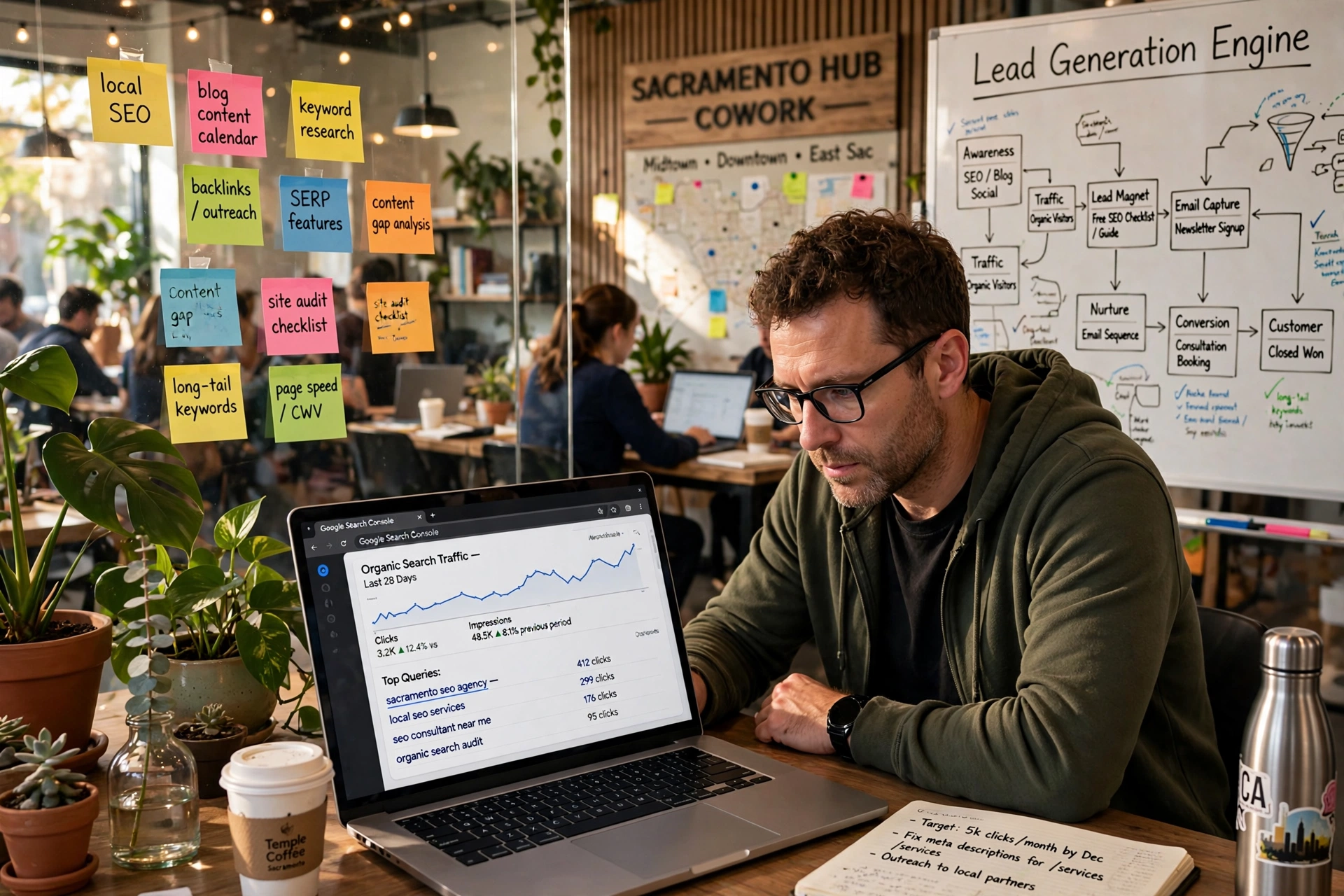
Most B2B service providers in Northern California are trapped in a 'pay-to-play' cycle, where their only way to get new clients is by increasing their monthly ad spend on Google and LinkedIn. An organic lead generation engine in Sacramento is a systematic architecture of high-authority content and AI-driven capture tools designed to attract, qualify, and book high-ticket clients automatically, without the recurring cost of paid traffic. By shifting from 'renting' attention to 'owning' topical authority, businesses can transform their website from a digital brochure into a 24/7 sales asset that compounds in value over time.
In my experience working with high-ticket B2B service providers, the biggest mistake is treating SEO as a 'blogging project' rather than a technical acquisition system. I've seen dozens of Sacramento firms publish generic articles that never rank because they lack the structural depth and intent-mapping required for 2026 search algorithms. To actually move the needle, you need a system that combines programmatic scale with AI-powered qualification. Those who implement AI search engine optimization and GEO are currently seeing a dramatic shift in how leads are captured, moving away from simple forms and toward conversational AI agents that book meetings directly into their calendars.

Why are Sacramento B2B Businesses Moving Toward Organic Acquisition?
The shift toward organic infrastructure in the Sacramento region is driven by a critical increase in Customer Acquisition Cost (CAC) across traditional paid channels. In the competitive Northern California market, bidding on high-intent keywords has become prohibitively expensive for mid-sized firms. According to a recent Gartner report, the efficiency of traditional search ads has declined as AI-generated summaries (SGE) now occupy the prime 'above-the-fold' real estate on Google. This means that unless your brand is cited as a definitive authority in an AI Overview, your click-through rate will plummet regardless of your budget.
Furthermore, B2B buyers in the Sacramento area, ranging from legal firms in the state capital to healthcare providers in the Central Valley, have become increasingly resistant to 'interruption marketing.' Modern executives prefer to perform deep research and validate a provider's expertise through a series of highly specific, intent-based searches before ever contacting a sales representative. This 'dark social' and autonomous research phase makes a robust organic lead generation engine in Sacramento essential. If you aren't dominating the topical clusters related to your service, you are effectively invisible during the most critical stage of the buyer's journey.
According to McKinsey's 2024 report on AI and Marketing, businesses that prioritize 'authority-first' content strategies over transactional ad spend see a 3.7x higher lifetime value (LTV) from their leads because the trust is established before the first call. In practice, this means the leads coming through an organic engine are already pre-sold on your methodology, reducing the sales cycle from months to weeks. To achieve this, many are now looking at programmatic SEO for SaaS and enterprise growth to scale their reach across the entire region without manual content creation for every single neighborhood or niche.
Key Benefits of an Organic Lead Generation Engine for Professional Services
Building an organic engine provides a fundamental competitive advantage: it replaces a linear cost (ads) with an exponential asset (content). When you pay for a lead via an ad, that lead disappears the moment you stop paying. When you build a topical authority hub, that page continues to generate leads for years after it was published.
Compounding Lead Volume
Unlike paid campaigns, organic traffic compounds. Every new piece of high-value content acts as a permanent 'doorway' to your business. When you deploy a network of pillar and satellite pages, you create a web of internal links that signals to search engines that you are the definitive expert in your field. This is why I always tell my clients that SEO is like investing in real estate; you are building equity in your own domain rather than renting space from Google.
Higher Lead Quality and Intent
Organic searchers exhibit higher intent than social media scrollers. Someone searching for a specific solution to a complex B2B problem in Sacramento is actively seeking a provider. By targeting 'decision-stage' queries, you attract leads who are ready to buy. This is where the integration of AI appointment setters for B2B becomes powerful; the AI doesn't just capture a lead, it qualifies them based on the specific page they arrived from, ensuring your sales team only speaks with high-value prospects.
Dominating AI Search Engines (GEO)
In 2026, the battle for visibility has shifted to Generative Engine Optimization (GEO). To be cited by ChatGPT, Perplexity, or Gemini, your content must be structured with precise schema markup and high-authority citations. Businesses that use a systematic engine are far more likely to be the 'recommended' choice in AI chat responses. This transition is why understanding GEO vs traditional SEO is critical for any Sacramento business wanting to stay relevant.
💡
Key Takeaway
The primary advantage of an organic engine is the transition from a variable cost (ad spend) to a fixed asset (topical authority) that increases in value as AI search engines begin to recommend your brand as the regional authority.
| Feature | Traditional Paid Ads | Generic AI Content | BizAI Organic Engine |
|---|---|---|---|
| Cost Structure | Linear/Recurring | Low initial cost | Investment-based asset |
| Lead Intent | Mixed/Interruption | Low (Thin content) | High (Intent-driven) |
| Longevity | Zero (Stops with budget) | Short (AI slop filtered) | Permanent (Compounding) |
| AI Visibility | Low (Ad labels) | Very Low (Filtered) | High (Cited Authority) |
| Conversion | Manual Forms | Static Pages | Autonomous AI SDRs |
Real-World Examples of Organic Scaling in the B2B Sector
To illustrate the power of this approach, let's look at two hypothetical but representative scenarios based on the patterns I've observed while implementing these systems for my clients.
Example 1: The Specialized Law Firm in Sacramento
Consider a mid-sized law firm focusing on high-stakes corporate litigation. Previously, they spent $15,000 per month on Google Ads, targeting generic terms. Their cost-per-lead was rising, and they were getting a high volume of low-quality inquiries. We shifted their strategy to an organic engine, deploying 150+ satellite pages targeting specific legal pain points and neighborhood-specific queries across the Greater Sacramento area. By implementing programmatic SEO to scale high-converting pages, they stopped relying on a few 'hero' pages and instead dominated hundreds of long-tail keywords. Within six months, their lead volume increased by 40%, while their ad spend was reduced by 70%, as the organic engine began to handle the bulk of their inbound acquisition.
Example 2: The Enterprise Consulting Group
An enterprise consultancy was struggling to differentiate itself in a crowded market. They had a professional website, but it was a 'brochure' site, it looked good but didn't attract traffic. We transitioned them to a topical authority hub, creating deep-dive pillars on industry trends and integrating an AI SDR to handle inbound qualification. Instead of a 'Contact Us' form, every page featured a context-aware AI agent. The result was a 22% increase in demo bookings because the AI agent engaged visitors in real-time, answering their specific questions and booking the meeting instantly. This transformed their site from a static page into a dynamic lead generation engine.

How to Get Started with an Organic Lead Generation Engine in Sacramento
Building this system requires a move away from 'random acts of content' toward a technical architecture. Here is the professional framework for deployment:
-
Topical Mapping & Intent Analysis: Start by identifying the 'Pillar' topics, the core services you offer. Then, map out the 'Satellite' topics, the specific questions, objections, and local nuances your clients search for. This ensures you aren't just guessing what content to write, but are targeting actual search volume.
-
Programmatic Deployment: Don't write one blog post a week; that's too slow for 2026. Use a programmatic approach to deploy hundreds of optimized pages that cover every possible variation of your service in the Sacramento region. This involves creating templates that maintain high quality while scaling rapidly. For those wanting to see the math behind this, our programmatic SEO case studies show how this leads to exponential growth.
-
Technical Optimization for AI: Implement advanced Schema.org markup. Your site needs to be readable by LLMs. This includes using JSON-LD for your local business and service offerings, making it easy for AI engines to verify your location in Sacramento and your specific expertise. This is a core part of how to rank on ChatGPT and Perplexity.
-
Integrating Autonomous Conversion: A lead is useless if it doesn't convert. Replace your static forms with an AI Sales Agent. This agent should be programmed to qualify the lead (Budget, Authority, Need, Timeline) and book the appointment directly. If you are wondering how to sync this with your current stack, check out our guide on connecting AI agents to CRM and webhooks.
The BizAI Intelligence Advantage: Implementing this manually takes years of trial and error. BizAI Intelligence automates this entire pipeline. We don't just give you a 'strategy'; we deploy the actual engine, the programmatic pages, the technical SEO, and the autonomous AI SDRs, so you can focus on closing deals rather than managing a content calendar.
Common Objections and the Data-Driven Reality
Many business owners hesitate to move away from paid ads because of a few common misconceptions. Let's address them with data.
Objection: 'Organic takes too long to see results.'
Most people assume SEO takes a year to work. While traditional 'blogging' is slow, a programmatic engine combined with the Google Indexing API can get pages ranked and generating leads in weeks, not months. The scale of deployment is what accelerates the timeline. By flooding the zone with 300+ high-intent pages, you hit the critical mass of authority much faster.
Objection: 'AI content is low quality and will be penalized.'
This is a common fear, but the data shows otherwise. Google doesn't penalize 'AI content'; it penalizes 'unhelpful content.' According to Google's own Helpful Content updates, the priority is E-E-A-T (Experience, Expertise, Authoritativeness, and Trustworthiness). When you use a system like BizAI Intelligence, the content is engineered for helpfulness and structured for authority, avoiding the 'AI slop' that generic prompts produce.
Objection: 'I don't have time to manage an AI agent.'
Actually, the goal of an autonomous engine is to remove the human from the qualification process. Traditional lead gen requires a human SDR to call a lead within 5 minutes or the conversion rate drops by 80%. An AI agent handles that instantly, 24/7. For those comparing the two, the AI SDR vs Human SDR ROI is clear: AI doesn't sleep and never misses a follow-up.
📚
Definition
Generative Engine Optimization (GEO) is the process of optimizing content so that it is cited as a primary source by AI search engines like Perplexity and SearchGPT, rather than just appearing as a blue link in traditional search results.
Frequently Asked Questions
How long does it take to build an organic lead generation engine in Sacramento?
Depending on the complexity of your niche, a fully deployed engine, including programmatic page generation and AI agent integration, can be live within 30 to 90 days. Unlike traditional SEO, which relies on organic discovery, we use an aggressive deployment strategy that focuses on long-tail, high-intent keywords that are easier to rank for quickly. This allows Sacramento businesses to start seeing a measurable increase in inbound inquiries almost immediately after the indexing phase is complete, rather than waiting for a year of 'content building.'
Is an organic engine better than Google Ads for B2B services?
While Google Ads provide immediate traffic, they are a 'leaky bucket', the moment you stop paying, the leads stop. An organic engine is an investment in a permanent asset. The data shows that organic leads generally have a higher conversion rate because the user is actively searching for a solution, whereas ads are often seen as interruptions. By combining a programmatic SEO platform with AI qualification, you get the scale of ads with the long-term ROI of owned media, effectively lowering your long-term CAC to near zero.
How does BizAI Intelligence ensure the leads are high quality?
Quality control happens at the 'capture' layer. Instead of a generic form that anyone can fill out, we deploy an AI SDR that engages the visitor in a conversational qualification screen. The AI asks specific questions based on the page the user is viewing, for example, if they are on a page about 'Corporate Litigation in Sacramento,' the AI will qualify them on the size of their case and their urgency. Only leads that meet your predefined criteria are pushed to your CRM and booked into your calendar, preventing your sales team from wasting time on unqualified leads.
Do I need to write the content myself for this to work?
No. The modern approach uses 'data-driven content generation' where we identify the exact search patterns your customers use and programmatically build pages that answer those needs. We focus on technical rigor, structured data, and E-E-A-T signals that AI engines require. This means you don't need to spend 10 hours a week writing blog posts. The system handles the research and deployment, while you provide the core expertise that the AI uses to ensure the content is accurate and authoritative for the Sacramento market.
What is the difference between traditional SEO and an organic lead engine?
Traditional SEO is often focused on 'traffic', getting as many people as possible to a page. An organic lead engine is focused on 'conversion.' It aligns the traffic source (specific intent keywords) directly with a conversion mechanism (the AI SDR). While traditional SEO might get you 1,000 visits a month with a 1% conversion rate, an organic engine focuses on 100 highly targeted visits with a 10% conversion rate. It is a shift from a vanity metric (traffic) to a business metric (pipeline growth).
Final Thoughts on an Organic Lead Generation Engine in Sacramento
For B2B companies in the Sacramento region, the choice is simple: you can continue to rent your leads from Google and LinkedIn at ever-increasing prices, or you can build an organic lead generation engine in Sacramento that you own forever. The transition to an AI-driven, programmatic approach isn't just a 'marketing upgrade', it's a strategic move to ensure your business remains visible in an era where AI engines are deciding who gets the lead.
If you're ready to stop the cycle of expensive ad spend and start building a compounding acquisition asset, the most efficient path is through a dedicated system. At BizAI Intelligence, we specialize in deploying these engines for high-ticket B2B firms, combining massive programmatic scale with autonomous AI qualification. Stop renting your traffic and start owning your market.
Build your engine today at bizaigpt.com.
AI Search Accelerator: 1-on-1 Strategy Session
Claim one of the 10 monthly slots. Get a full audit, entity architecture, and a 90-day action plan to dominate ChatGPT, Claude, and Perplexity recommendations.