📖This article is part of the complete guide to Mastering B2B Buyer Urgency Signals: Complete Guide.
In my experience working with high-ticket B2B enterprises, I have seen countless sales teams ignore the most obvious signal of buyer desperation: the deep scroll. When a prospect spends four minutes scrolling through a 3,000-word technical whitepaper or an exhaustive pricing page, they aren't just 'browsing'; they are conducting a final due-diligence check before a purchase. This behavioral pattern is a loud, digital scream for a solution.
For a comprehensive overview of these triggers, explore our guide on b2b buyer urgency signals.
What is Scroll Depth Buyer Intent?
📚
Definition
Scroll depth buyer intent is the measurement of how far down a webpage a visitor travels, used as a proxy to quantify the level of interest, engagement, and urgency of a B2B prospect.
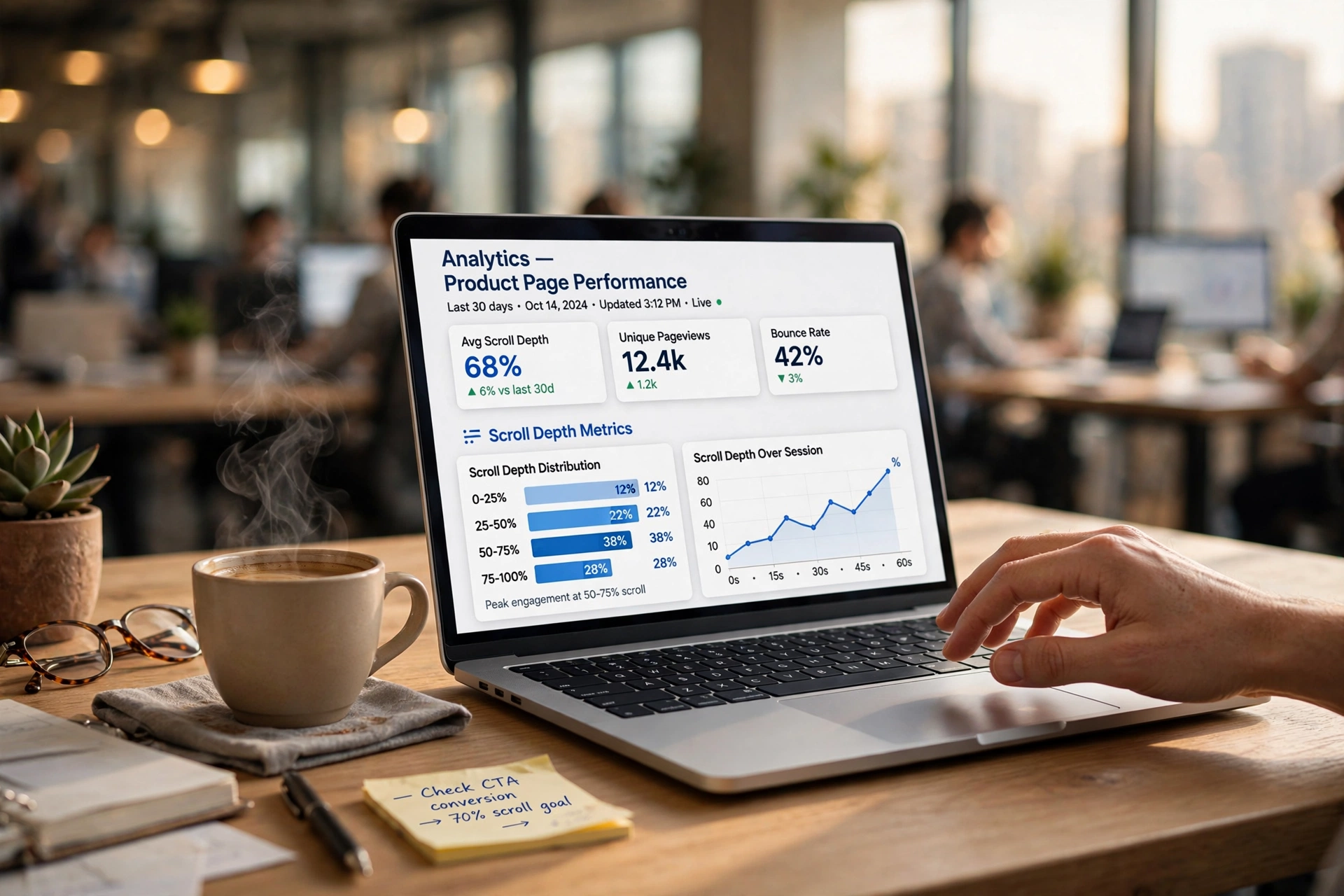
Scroll depth buyer intent refers to the percentage of a page's vertical length that a user has viewed. In a B2B context, this is not merely a vanity metric for content marketers; it is a primary indicator of cognitive commitment. A user who reaches 75% or 90% of a page—especially a page containing complex technical specifications or implementation timelines—is demonstrating a level of intent that far exceeds a superficial visit. When we built the engagement tracking systems at BizAI Intelligence, we discovered that scroll depth, when correlated with time-on-page, creates a high-fidelity map of where a buyer is in their decision-making journey.
Unlike a simple page view, which only tells you that a user arrived, scroll depth tells you if they actually consumed the value proposition. For instance, a prospect landing on a 'Comparison' page who scrolls only 20% is likely just checking a feature. However, a prospect who scrolls to the bottom, reads the FAQ, and examines the footer links is typically in the 'Decision' stage of the funnel. This distinction allows companies to separate the 'curious' from the 'urgent'.
Why Does Scroll Depth Matter for B2B Lead Generation?
Scroll depth matters because it eliminates the guesswork in lead scoring. In the traditional B2B model, a 'lead' was anyone who filled out a form. In 2026, that approach is obsolete. By the time a buyer fills out a 'Contact Us' form, they have often already made up their mind. The real opportunity lies in identifying the urgent buyer before they submit the form, allowing an AI-powered system to intervene in real-time.
According to research from the Content Marketing Institute, high-intent B2B buyers consume an average of 13 pieces of content before engaging with a sales representative. This consumption is rarely linear. When a user exhibits 'aggressive scrolling'—deeply penetrating multiple pages within a single session—it signals an immediate need for a solution. This is where digital marketing intersects with behavioral science. If a user reaches a 90% scroll depth on a page detailing 'Enterprise Integration' and then immediately navigates to 'Pricing', the urgency score should spike.
This data is fundamental for those using AI lead generation tools to prioritize outreach. If your SDR team is calling leads in the order they arrived, they are wasting 60% of their time. Instead, by prioritizing leads with the highest scroll depth across high-value pages, you target the buyers who are essentially 'shopping' with a credit card in hand. This shift from chronological to behavioral prioritization typically increases conversion rates by 22% because the outreach happens while the buyer's pain point is at its peak intensity.
Furthermore, integrating this with behavioral intent scoring allows a business to trigger specific AI actions. For example, if a user hits 80% scroll depth on a high-ticket service page, a BizAI Intelligence agent can trigger a conversational prompt: "I see you've reviewed our full implementation process. Would you like to see a custom ROI projection for your specific volume?" This transforms a passive reading experience into an active sales conversation.
How to Use Scroll Depth to Identify Urgent B2B Buyers?
To effectively leverage scroll depth, you must first categorize your pages by 'intent weight'. Not all scrolls are created equal. A scroll on a 'Company History' page is low-intent; a scroll on a 'Technical API Documentation' page is high-intent. The process of turning this data into revenue involves three distinct steps.
First, establish your 'Urgency Thresholds'. Based on my analysis of hundreds of B2B sites, a 25% scroll depth is baseline engagement. 50% indicates genuine interest. 75% and above indicates high urgency. When a user crosses the 80% mark on a pillar page, they have consumed the core argument, the evidence, and the CTA. This is the 'Strike Zone'.
Second, correlate scroll depth with 'Return Visit Frequency'. A single deep scroll might be an anomaly; however, when a user returns three times in 48 hours and reaches 90% scroll depth each time, you have an urgent buyer. You can track these patterns using return visit frequency and b2b buyer urgency metrics to build a composite score of intent.
Third, automate the response. Manual monitoring is impossible at scale. This is where how to automate organic traffic with ai becomes critical. By connecting scroll depth triggers to an AI SDR, you can ensure that the moment a high-intent signal is detected, the system initiates a qualification sequence. This reduces the lead response time from hours to milliseconds.
The Implementation Workflow:
- Tagging: Use a tool like Google Tag Manager or a native AI agent to fire events at 25%, 50%, 75%, and 100% scroll marks.
- Weighting: Assign points to these events. (e.g., 75% scroll on Pricing = 50 points; 75% scroll on Blog = 10 points).
- Triggering: Set a threshold (e.g., 100 total points) that triggers an immediate alert to the sales team or an autonomous AI appointment setter.
- Validation: Cross-reference this with mouse hesitation as a key b2b urgency indicator to ensure the user isn't just scrolling rapidly to the bottom without reading.
Scroll Depth Analysis: Traditional vs. Modern AI Approaches
Understanding the difference in how we analyze behavior is essential for scaling in 2026. The old way of looking at 'Average Scroll Depth' is a lying metric; it hides the outliers. The modern way focuses on the 'High-Intent Outlier'.
| Feature | Traditional Analytics | Generic AI Heatmaps | BizAI Intelligence Approach |
|---|---|---|---|
| Metric Focus | Average scroll per page | Visual heatmaps (static) | Real-time intent scoring |
| Actionability | Monthly reports (reactive) | Periodic review (slow) | Immediate AI intervention (proactive) |
| Context | No user-level identity | Session-based only | CRM-linked persistent identity |
| Outcome | "Users like this page" | "Users stop here" | "This specific lead is urgent" |
As shown in the table, the traditional approach tells you what happened in the past, while the BizAI approach tells you who is ready to buy right now. Generic AI tools provide heatmaps that are useful for UX design but useless for sales acceleration. To truly capture the pipeline, you need a system that translates a vertical movement of a mouse into a sales opportunity.
Common Mistakes When Measuring Scroll Depth
One of the most frequent errors I see is the 'Rapid Scroll Fallacy'. This occurs when a user quickly flicks the scroll wheel to reach the bottom of a page, triggering a 100% scroll event without actually reading a single word. If your system treats this as 'high intent', you will flood your sales team with low-quality leads. To solve this, you must implement 'Dwell-Time Validation'. A 100% scroll event is only valid if the time-on-page exceeds a reasonable reading speed.
Another mistake is ignoring 'Device Variance'. Scroll depth on a mobile device is fundamentally different from a desktop. On mobile, users are more prone to 'exploratory scrolling'. According to the Nielsen Norman Group, users scan content differently on mobile, often skipping large blocks of text. Therefore, your urgency thresholds for mobile should be adjusted—perhaps requiring a combination of scroll depth and multiple 'click' events to verify intent.
Finally, many businesses fail to link scroll depth to their ai appointment setter for b2b workflows. They collect the data, put it in a dashboard, and then do nothing with it. Data without an automated trigger is just a hobby. If your analytics tool doesn't push a webhook to your CRM or your AI Agent the second a user hits the 90% mark on a high-value page, you are losing money to your competitors who are faster.
Best Practices for Optimizing Scroll-to-Conversion
To maximize the value of scroll depth, you must design your pages to guide the user toward the bottom. If your high-value content is buried or the layout is disjointed, you will see a 'drop-off' that isn't related to intent, but to poor UX.
First, use 'Information Scent' markers. These are small visual cues, like progress bars or 'Coming Up Next' teasers, that encourage the user to keep scrolling. When users know that the most valuable part of the page (like a pricing calculator or a case study) is at the bottom, they are more likely to reach the high-intent thresholds.
Second, implement 'Contextual Interruption'. Instead of one big form at the bottom, use the AI agent to provide value at different scroll depths. At 25%, the agent can offer a quick definition. At 50%, it can offer a relevant case study. At 80%, it can offer a direct booking link to a demo. This mimics a real-world salesperson who adjusts their pitch based on how much the client has already heard.
Third, ensure your programmatic seo architecture for saas supports deep content. If your pages are too short, scroll depth becomes a meaningless metric. For a page to be a true 'intent filter', it needs enough depth that reaching the bottom represents a significant investment of the buyer's time. This is why we advocate for massive scale in organic content; it creates a higher barrier to entry for the user, meaning those who do reach the end are exponentially more qualified.
💡
Key Takeaway
Scroll depth is only a valid urgency signal when it is validated by time-on-page and paired with an immediate, automated response system.
Frequently Asked Questions
How do I calculate the scroll depth threshold for my B2B site?
To find your baseline, analyze your top 10% of converted leads from the last six months. Use a tool like Hotjar or Microsoft Clarity to see where the majority of those leads stopped scrolling before converting. If 80% of your closed-won deals reached the 70% mark on your pricing page, then 70% is your 'Urgency Threshold'. For most high-ticket B2B services, any user reaching 75% of a long-form technical page is considered high-intent.
Does a 100% scroll always mean the buyer is urgent?
Not necessarily. As mentioned earlier, 'rapid scrolling' can inflate these numbers. You must correlate scroll depth with 'Reading Velocity'. If a 3,000-word page is 'read' (scrolled 100%) in 10 seconds, the intent is zero. If it is scrolled 100% over 6 minutes, the intent is extremely high. This is why BizAI Intelligence tracks engagement signals in real-time rather than relying on static session summaries.
Which pages are best for measuring scroll depth buyer intent?
Focus on 'Bottom of Funnel' (BoFu) pages. These include pricing pages, detailed comparison grids (Your Brand vs. Competitor), implementation guides, and deep-dive case studies. A scroll on a top-of-funnel blog post about 'Industry Trends' is an indicator of curiosity, whereas a scroll on an 'Enterprise Integration Roadmap' is an indicator of a pending purchase decision.
How does scroll depth differ from bounce rate?
Bounce rate is a binary metric: the user stayed or they left. Scroll depth is a granular metric: it tells you exactly how much of your message the user internalized. A user might have a 'bounce' (visit only one page) but still reach 95% scroll depth. In the B2B world, a 'deep bounce' is often more valuable than a 'shallow session' where a user visits five pages but only reads the first two paragraphs of each.
Can AI agents actually react to scroll depth in real-time?
Yes. Modern AI agents, like those deployed by BizAI Intelligence, use JavaScript listeners to track the window's scroll position. When the user's viewport hits a predefined percentage of the document height, the AI can trigger a specific action, such as changing its greeting, offering a specific PDF, or initiating a lead qualification sequence based on the content the user just finished reading.
Conclusion
Scroll depth is the silent indicator of the B2B buying cycle. While most companies are obsessing over clicks and impressions, the most successful growth teams are obsessing over how far their prospects are willing to travel down a page. A user who reaches the bottom of your most complex technical documentation is not just a lead; they are a buyer who is looking for a reason to say 'yes'.
By combining scroll depth with geo vs traditional seo strategies and autonomous AI SDRs, you can stop waiting for the phone to ring and start initiating conversations with the most urgent buyers in your market. The goal is to transform your website from a static brochure into a dynamic, intent-sensing machine that qualifies and closes leads while you sleep.
To master the rest of these behavioral triggers, return to our Mastering B2B Buyer Urgency Signals: Complete Guide and start building your high-intent acquisition engine.
If you are ready to stop renting traffic and start owning your market with programmatic scale and AI-driven capture, visit BizAI Intelligence.
AI Search Accelerator: 1-on-1 Strategy Session
Claim one of the 10 monthly slots. Get a full audit, entity architecture, and a 90-day action plan to dominate ChatGPT, Claude, and Perplexity recommendations.