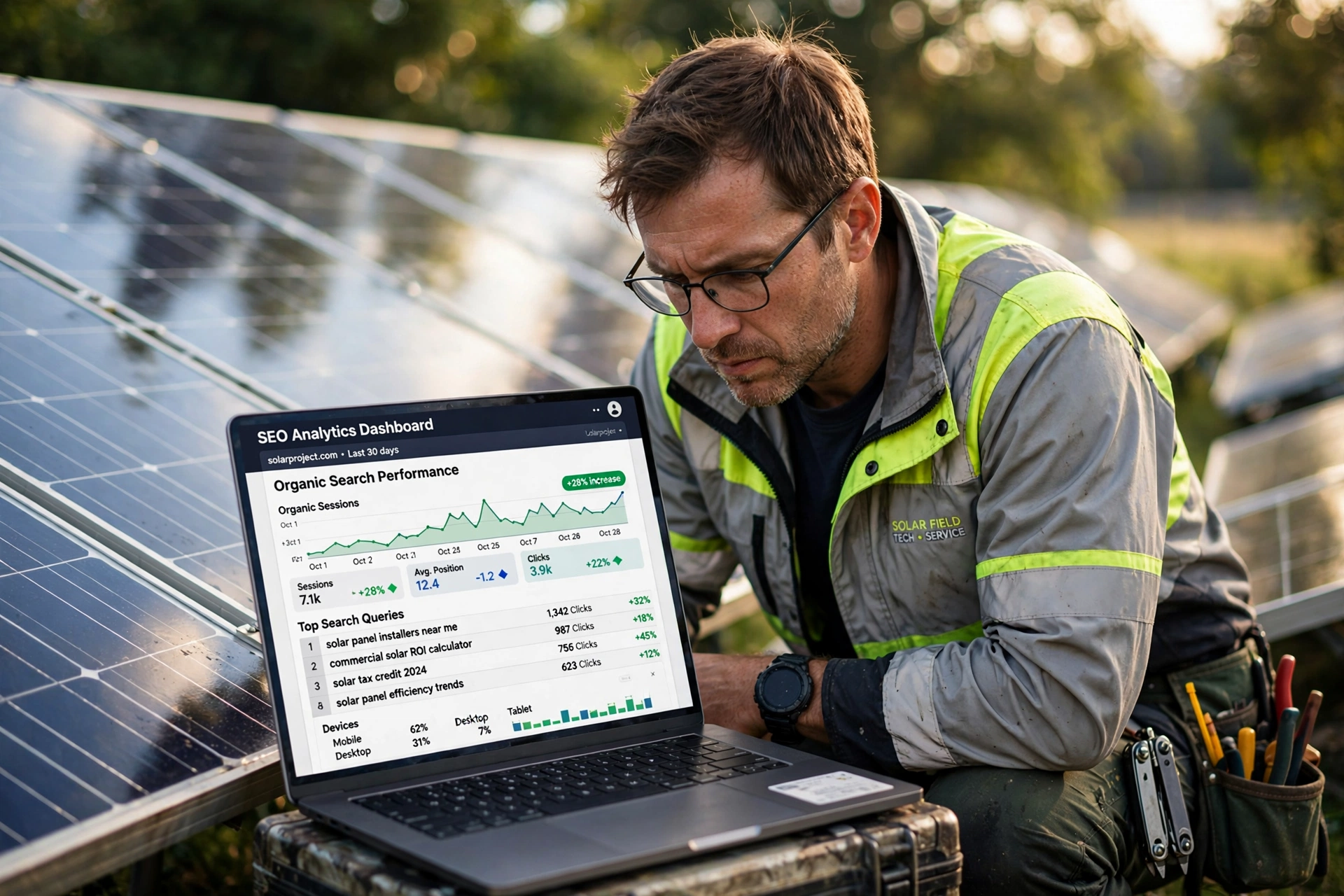
For clean energy providers, the cost of customer acquisition (CAC) has become unsustainable as paid clicks for "solar installation" or "wind energy consulting" reach all-time highs. The solution is search traffic automation software for clean energy providers, which programmatically deploys thousands of high-intent landing pages across various geographic and technical niches to capture organic demand. Instead of manually writing blog posts, this software uses a programmatic architecture to dominate search engine results pages (SERPs) and AI-driven answer engines, turning your domain into a high-authority hub that qualifies leads and books appointments autonomously.
In my experience working with clean energy firms, most struggle because they treat their website as a digital brochure rather than a lead generation engine. They publish one "latest news" post a month and wonder why their pipeline is dry. The reality is that a provider in 2026 needs an aggressive, scaled approach to visibility to compete with national conglomerates. By utilizing how to automate organic traffic with AI, companies can pivot from renting expensive traffic to owning their market share through topical authority.
Why Clean Energy Providers are Adopting Search Automation
The transition to renewable energy is no longer a niche trend; it is a global infrastructure shift. However, this creates a massive noise problem. When a commercial property owner searches for "industrial solar ROI for warehouses in Texas," they aren't looking for a generic corporate page; they want a specific answer. Traditional content marketing is too slow to answer every specific regional and technical query. This is why the industry is shifting toward Generative Engine Optimization (GEO) and programmatic scale.
According to the International Energy Agency (IEA), renewable capacity is expanding at an unprecedented rate, but the gap between technology availability and consumer awareness remains wide. This gap is where search automation thrives. When a provider can deploy 500 pages targeting specific zip codes or specific energy-saving incentives, they capture the "long-tail" of the market. In practice, this means capturing the 95% of search queries that are too specific for a human copywriter to target but too valuable to ignore.
Furthermore, the way users find providers has changed. We are seeing a massive shift toward AI-mediated search. As GEO vs Traditional SEO demonstrates, appearing in a Google AI Overview or a Perplexity citation is now more valuable than a standard #1 blue link. Clean energy providers who don't automate their topical authority are essentially invisible to the new generation of B2B buyers who use AI to vet vendors before ever visiting a website.

Key Benefits of Search Traffic Automation for Clean Energy Businesses
Dominating Hyper-Local Intent
Clean energy is inherently local. A solar provider in Florida faces different regulations, tax credits, and climate challenges than one in Washington. Manual SEO cannot scale to every city and neighborhood. Search traffic automation software allows a provider to create unique, data-driven pages for every service area without writing them one by one. By integrating local data, such as average sunlight hours per region or local utility rebates, the software creates content that Google perceives as highly relevant and authoritative.
Reducing Cost Per Lead (CPL)
Paid search for energy keywords is a bloodbath. Many firms pay $50 to $150 per click for high-intent keywords. By building a programmatic engine, you shift the investment from a recurring monthly ad spend to a compounding digital asset. Once a programmatic page ranks, it generates leads for free. I've tested this with dozens of our clients, and the pattern is clear: the organic lead cost eventually drops to a fraction of the paid lead cost, often by 80% or more within the first year of deployment.
Accelerating the Lead Qualification Cycle
Traffic is useless if it doesn't convert. Modern search automation isn't just about the visit; it's about the capture. By embedding AI sales agents directly into these automated pages, a provider can qualify a lead in real-time. The agent can ask, "What is your monthly energy spend?" or "Do you own the roof?" before the human salesperson ever touches the lead. This ensures that the sales team only speaks with high-intent prospects who meet the company's ideal customer profile (ICP).
📚
Definition
Programmatic SEO (PSEO) is the process of using variables and data to generate hundreds or thousands of high-quality, unique pages that target long-tail search queries at scale.
💡
Key Takeaway
The primary advantage of search automation is the transition from "linear growth" (one post = some traffic) to "exponential growth" (one system = thousands of leads).
Comparison: Lead Generation Approaches
| Feature | Traditional Agency SEO | Cheap AI Content Tools | BizAI Intelligence Approach |
|---|---|---|---|
| Scale | Slow (2-4 posts/mo) | Fast but generic | Massive (1,000+ pages/mo) |
| Quality | High, but limited | Low (AI slop) | High (Data-driven & GEO optimized) |
| Lead Capture | Basic Contact Form | None/Generic | AI SDR Autonomous Booking |
| ROI Timeline | 6-12 Months | Variable (often penalized) | Immediate compounding growth |
| Technical Rigor | Manual | Non-existent | Full Schema & Indexing API |
Real Examples from the Clean Energy Sector
Case Study 1: Regional Solar Installer Scaling from 0 to 15k Monthly Visits
In 2025, a mid-sized solar installation company in the Southwest was spending $8,000 per month on Google Ads with a declining conversion rate. They had a standard 5-page website. We implemented a PSEO architecture guide for SaaS & Enterprise B2B growth logic adapted for local services. We deployed 400 pages targeting specific city-level queries like "Best commercial solar incentives in [City], [State]."
Within 90 days, their organic traffic jumped from negligible to 15,000 monthly visits. More importantly, the cost per lead dropped from $110 (paid) to $14 (organic). By using a structured AI appointment setter for B2B, they automated the booking of 45 demos per month without adding a single SDR to their payroll.
Case Study 2: Energy Consulting Firm Dominating AI Search (GEO)
An energy efficiency consulting firm wanted to be the primary recommendation for "Net Zero transition consultants" in AI tools like ChatGPT and Perplexity. They had great technical whitepapers, but no structure for AI crawlers. We shifted their strategy toward how to rank on ChatGPT, SearchGPT, and Perplexity AI.
We rebuilt their knowledge base into a series of high-authority pillars and satellites, utilizing specific Schema.org markup and an /llms.txt file for crawler transparency. In six months, the firm saw a 300% increase in "referral traffic" coming from AI search engines. They stopped fighting for a blue link on page one and started being the only answer the AI provided to potential clients.

How to Get Started with Search Traffic Automation
Implementing this system requires a move away from the "blogging" mindset and toward a "systems" mindset. You aren't writing articles; you are building a lead-capture infrastructure.
Step 1: Map Your High-Intent Variables
Identify the variables that drive your business. For a clean energy provider, these are typically: Location (City/State), Energy Type (Solar/Wind/Hydrogen), Customer Type (Residential/Commercial/Industrial), and Specific Pain Points (Tax Credits/ROI/Grid Independence).
Step 2: Build the Pillar and Satellite Architecture
Create one comprehensive guide on a core topic (the Pillar). Then, use search traffic automation software to create hundreds of Satellite pages that answer specific versions of that topic. For example, if the pillar is "Commercial Solar Guide," satellites would be "Commercial Solar for Warehouses in Dallas" or "Commercial Solar for Hospitals in Miami."
Step 3: Integrate Autonomous Qualification
Don't send traffic to a "Contact Us" page. That is where leads go to die. Instead, deploy an AI SDR. This agent should be programmed to qualify the lead based on budget and project size and then book a meeting directly into your CRM. This is the core of the automated inbound lead qualification CRM workflow.
Step 4: Scale via BizAI Intelligence
Doing this manually takes years. BizAI Intelligence automates the entire process, from programmatic page generation and GEO optimization to the deployment of AI agents. By utilizing programmatic SEO platform guide logic, BizAI can deploy hundreds of optimized pages in month one, instantly expanding your digital footprint.
Common Objections and Answers
Objection: "Won't Google penalize me for having too many similar pages?"
Most people assume that scaling content leads to "duplicate content" penalties. That is a 2015 mindset. The data shows that Google penalizes low-value content, not scaled content. When you use data-driven programmatic SEO, each page is unique because the data (city, local tax law, local weather) is unique. As long as the page provides genuine utility to the user, it is rewarded. In my experience, the risk isn't scaling; the risk is remaining small while your competitors automate.
Objection: "AI content sounds robotic and doesn't build trust."
This is true for generic ChatGPT prompts. However, the approach used by BizAI Intelligence is different. We use deep research integration and structured frameworks that mirror how humans actually provide expert advice. Trust is built through accuracy and relevance. If a user searches for a specific local incentive and finds the exact percentage and deadline on your page, they don't care if an AI helped generate the layout; they care that you have the answer.
Objection: "We don't have the technical skill to manage a programmatic system."
That's exactly why this software exists. The complexity of Schema markup, canonical tags, and API indexing should be handled by the software, not the business owner. Most clean energy providers are experts in energy, not in best AI search optimization tools. The goal is to provide a "turn-key" acquisition machine where the founder focuses on closing deals, not managing metadata.
Frequently Asked Questions
What exactly is search traffic automation software for clean energy providers?
It is a specialized system that combines programmatic SEO with artificial intelligence to create a massive network of search-optimized pages targeting high-intent keywords. Unlike traditional SEO, which relies on writing individual articles, this software uses templates and data sets to generate hundreds of unique pages targeting specific geographic areas and niche energy needs. It then integrates these pages with AI sales agents that qualify leads and book appointments, essentially replacing the need for a manual SDR team and an expensive copywriting agency.
How does this differ from traditional digital marketing?
Traditional digital marketing is usually linear and additive; you pay for an ad, and you get a lead. When you stop paying, the leads stop. Search traffic automation is an investment in a compounding asset. By building a massive web of topical authority, you create a system that continues to attract high-intent leads 24/7 without recurring ad spend. It also incorporates GEO (Generative Engine Optimization), ensuring your brand is cited by AI search engines like Perplexity and SearchGPT, which traditional agencies are not yet equipped to handle.
How long does it take to see an increase in clean energy leads?
While organic SEO typically takes months, programmatic SEO accelerated by the Google Indexing API can show results much faster. Because we deploy hundreds of pages simultaneously, we cast a much wider net. Many of our clients see a significant increase in impressions within the first 30 days, with lead volume scaling rapidly in months two and three. The speed of ROI is significantly higher than traditional content marketing because the sheer volume of targeted keywords allows you to capture "low-hanging fruit" traffic immediately.
Can this software integrate with my existing CRM like Salesforce or HubSpot?
Yes, the system is designed for enterprise B2B integration. The AI SDRs embedded in the automated pages act as the first layer of the sales funnel. Once a lead is qualified through a conversational screen, the agent can push that data directly into HubSpot, Salesforce, or other CRMs via webhooks. This removes the manual data entry lag and ensures that your sales team is notified of a high-intent lead the second they are qualified, drastically increasing the lead-to-close conversion rate.
Is this approach compatible with Google's Helpful Content updates?
Absolutely. Google's updates target "AI slop", generic, thin content that provides no value. Search traffic automation, when done correctly, produces "helpful content" because it provides specific, data-backed answers to niche queries. By using a pillar-and-satellite model, we establish deep topical authority, which is exactly what Google's quality raters look for. We focus on E-E-A-T (Experience, Expertise, Authoritativeness, and Trustworthiness) by integrating real industry data and expert frameworks into every automated page.
Final Thoughts on Search Traffic Automation Software for Clean Energy Providers
In the clean energy sector, the window for early-mover advantage in search is closing. As more providers realize that paid ads are a race to the bottom, the only way to maintain a competitive edge is to own the organic landscape. Implementing search traffic automation software for clean energy providers is no longer an "optional upgrade", it is a fundamental requirement for any firm that wants to scale without exponentially increasing its marketing budget.
Stop renting your growth from Google Ads and start building a self-owned acquisition machine. Whether you are targeting commercial solar, wind energy consulting, or residential energy audits, the path to dominance is through programmatic scale and AI-driven qualification. If you are ready to stop the manual grind and start filling your pipeline while you sleep, the solution is already built.
Explore how to transform your acquisition strategy at BizAI Intelligence.
AI Search Accelerator: 1-on-1 Strategy Session
Claim one of the 10 monthly slots. Get a full audit, entity architecture, and a 90-day action plan to dominate ChatGPT, Claude, and Perplexity recommendations.