
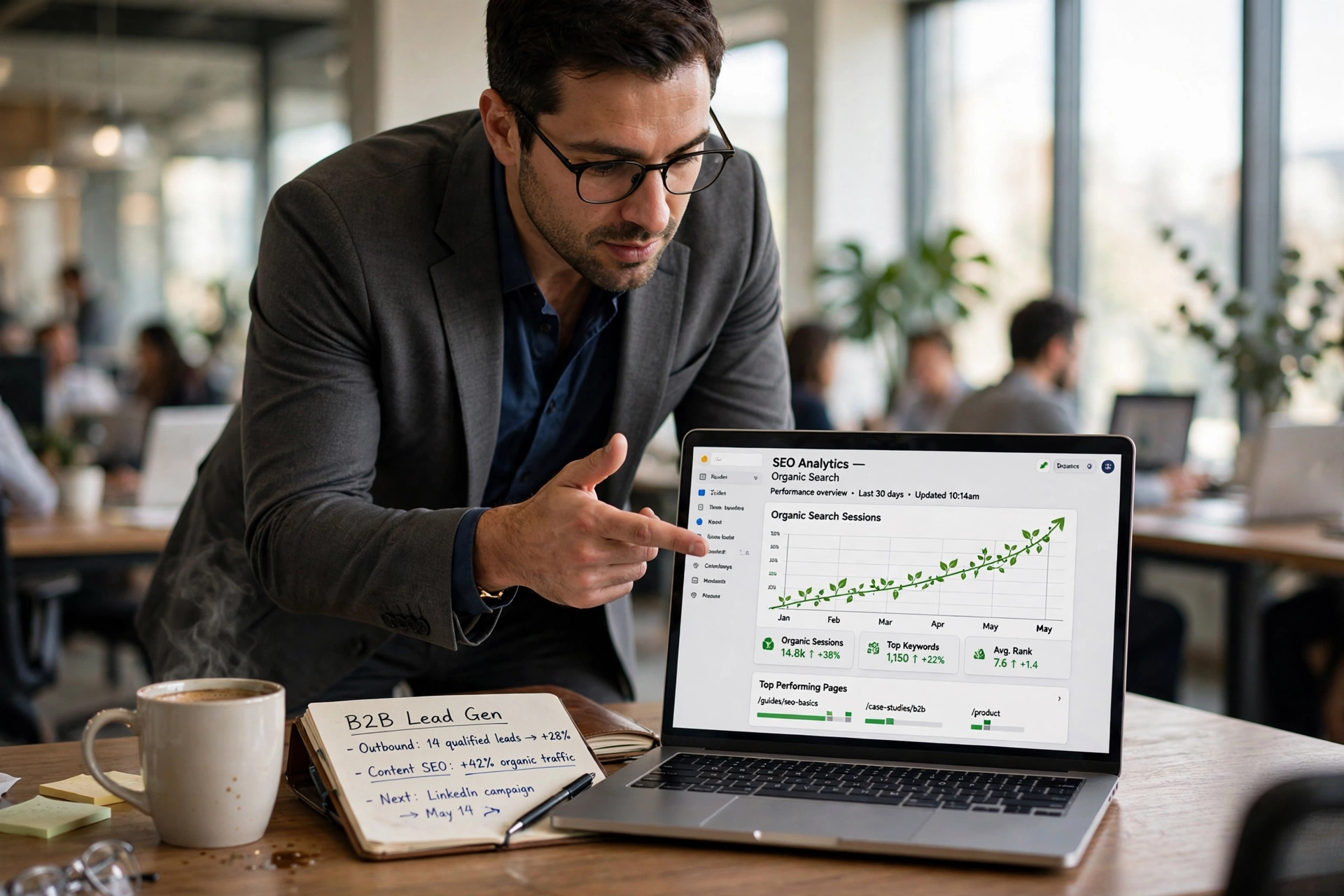
Which Organic Strategy Should You Choose to Get B2B Organic Leads?
Most B2B founders spend thousands on LinkedIn ads only to realize they are renting their audience. The reality is that the most sustainable way to scale a high-ticket service is to own your traffic source. When deciding how to get b2b organic leads, the choice boils down to three primary paths: high-intent programmatic scaling, authority-led content clusters, or AI-driven Generative Engine Optimization (GEO). For most enterprises in 2026, the winning approach is a hybrid model that uses algorithmic brute force to capture long-tail demand while leveraging AI agents to qualify those leads in real-time.
In my experience working with B2B SaaS and professional service firms, the biggest failure is treating organic growth as a "blogging project." Blogging is for brand awareness; programmatic architecture is for pipeline generation. If you want leads that actually book meetings, you stop writing generic "top 10" lists and start building an intent-capture engine. This requires a shift from traditional content marketing to a system that prioritizes how to automate organic traffic with ai to ensure the volume of pages matches the volume of buyer queries.
The Mechanics of B2B Organic Lead Generation
To understand the options, we first need to define what actually constitutes an "organic lead" in a B2B context. It isn't just a website visitor; it is a decision-maker who has a specific problem and finds your solution through a search engine or an AI discovery platform without a paid trigger.
📚
Definition
B2B Organic Lead Generation is the process of attracting high-value business decision-makers to a digital asset via non-paid search channels, then converting that traffic into a qualified sales opportunity using a structured conversion path.
The shift we are seeing in 2026 is the transition from "Keyword Targeting" to "Intent Mapping." In the past, you would target a keyword like "CRM software." Today, a high-intent lead searches for "CRM for mid-sized dental networks with HIPAA compliance in Florida." The latter is a "satellite" query. By dominating thousands of these specific, long-tail queries, you create a massive net that catches buyers at the exact moment they are ready to purchase.
According to Gartner, by 2026, traditional search engine volume will decline as users shift toward AI-powered discovery. This means your strategy cannot rely solely on Google. You must optimize for "Answer Engine Optimization" (AEO), ensuring your brand is the cited source when a user asks a LLM for a recommendation. This is why understanding the overview of ai search engine optimization & geo is no longer optional; it is the baseline for survival.

Why Organic Lead Generation is the Only Scalable B2B Play
The cost of customer acquisition (CAC) via paid channels has reached an unsustainable ceiling for many B2B sectors. When you rely on Meta or LinkedIn ads, your lead flow stops the second your budget runs out. Organic systems, however, provide compounding returns. A page created today can generate leads for three years without additional spend.
The business impact of organic dominance is measurable in the "Trust Gap." B2B buyers are notoriously skeptical of ads. A study by Forrester found that B2B buyers are 70% more likely to trust a company that appears as a top organic result or is cited by an AI agent than one that appears as a "Sponsored" post. This trust translates directly into higher conversion rates and shorter sales cycles because the lead has already "self-educated" through your content before the first call.
Moreover, the integration of AI SDRs has solved the "leaky bucket" problem of organic traffic. Previously, you could get 10,000 visits a month, but if your contact form was boring, 98% of that traffic vanished. Now, by deploying autonomous agents that qualify leads on the spot, businesses are seeing a 3x increase in meeting-booked rates from the same amount of traffic. If you are still using static forms, you are leaving millions in pipeline on the table. For those looking to optimize this, comparing an ai sdr vs human sdr roi calculator reveals that AI-driven qualification is significantly more cost-effective at scale.
Practical Application: Implementing the Intent-Capture Engine
If you want to move from "trying" to "scaling," you need a technical framework. The most effective way to get b2b organic leads in 2026 is through a "Pillar and Satellite" architecture.
- The Pillar Stage: Identify your core high-ticket services. Create a comprehensive authority page for each. This page doesn't just describe the service; it solves the customer's biggest problem and establishes you as the definitive expert.
- The Satellite Stage: Build hundreds of specific pages targeting "neighborhood" keywords, local variations, industry-specific use cases, and "X vs Y" comparisons. This is where programmatic SEO comes in. Instead of writing 500 articles by hand, you use data sets to generate high-quality, optimized pages.
- The Capture Stage: Replace your "Contact Us" page with an AI Sales Agent. This agent should be programmed to track user behavior, ask qualifying questions (budget, authority, need, timeline), and book the meeting directly into your calendar.
This is exactly how we architect systems at BizAI Intelligence. We don't just give you a "content plan"; we deploy a full-scale organic machine. By leveraging a pseo architecture guide for saas & enterprise b2b growth, we can scale a domain from zero to thousands of high-converting pages in a fraction of the time it takes a traditional agency.
💡
Key Takeaway
The goal of organic B2B growth is not "traffic," but "qualified appointments." Stop measuring views and start measuring the number of qualified meetings booked by your AI agents.
Comparing Your Options: Which Path is Right for You?
Depending on your budget, technical maturity, and growth goals, different organic paths offer different trade-offs.
| Option | Pros | Cons | Best For |
|---|---|---|---|
| Traditional Content Marketing | High brand prestige, deep authority | Extremely slow, high cost per lead, hard to scale | Boutique firms with 1-2 high-ticket clients per year |
| Generic AI Content (Slop) | Fast deployment, cheap | High risk of Google penalties, zero trust, low conversion | Low-ticket affiliate sites (NOT B2B) |
| BizAI Programmatic Engine | Massive scale, AI-qualified leads, compounding ROI | Requires technical setup, aggressive growth pace | Scale-ups and Enterprises seeking dominant market share |
Now, here's where it gets interesting: most companies try to start with "Traditional Content Marketing" and give up after six months because they haven't seen a ROI. The mistake I see constantly is the belief that "quality" means "hand-written by a human for 20 hours." In reality, "quality" in the eyes of a B2B buyer means "did this page answer my specific question quickly and accurately?" Programmatic SEO achieves this at a scale humans cannot match.
If you are choosing between these, look at your pipeline goals. If you need 50+ qualified meetings a month, the only viable option is a programmatic approach combined with how to rank on chatgpt searchgpt and perplexity ai.

Common Questions & Misconceptions
There is a lot of "legacy" advice floating around that is actively harming B2B growth in 2026.
Myth 1: "Programmatic content is low quality and will get penalized."
Most guides get this wrong. Google doesn't penalize "AI content"; it penalizes "unhelpful content." When you use a structured data-driven approach to answer real buyer questions, you aren't creating "slop", you are creating utility. The key is ensuring each page provides a unique answer to a unique query.
Myth 2: "We only need a few high-quality blog posts to rank."
This was true in 2018. In 2026, the "topical authority" threshold has shifted. To be seen as an authority by both Google and LLMs, you need breadth. If you have one page on "B2B Lead Gen" but no pages on "B2B Lead Gen for Law Firms in Miami" or "B2B Lead Gen for HVAC Contractors," you are not an authority; you are a generalist.
Myth 3: "Organic leads are lower quality than paid leads."
Actually, the opposite is true. A lead who finds you through an organic search for a specific solution is "pre-sold." They have identified their pain, searched for a solution, and found your expertise. Paid leads are often "interrupted" buyers who were scrolling through a feed; organic leads are "active" buyers.
Frequently Asked Questions
How long does it take to see results when learning how to get b2b organic leads?
Depending on the architecture, the timeline varies. Traditional blogging can take 6-12 months to gain momentum. However, using a programmatic approach with Google Indexing API integrations, we often see pages indexed and ranking within days. The "compounding" effect usually hits a tipping point around month 3, where the volume of satellite pages begins to push the main pillar pages into top positions. According to McKinsey's research on digital transformation, companies that adopt automated, data-driven marketing systems see a significantly faster time-to-market than those using manual content cycles.
Which is better: GEO or Traditional SEO for B2B?
It is not a matter of "which" but "how" they work together. Traditional SEO captures the "search" intent on Google, while Generative Engine Optimization (GEO) captures the "recommendation" intent in ChatGPT, Claude, and Perplexity. If you ignore GEO, you are invisible to the growing segment of executives who use AI as their primary research tool. A modern strategy uses geo vs traditional seo logic to ensure your brand is the definitive answer across all interfaces, ensuring you don't lose a significant portion of your addressable market to "AI-first" competitors.
Can I use AI to write all my organic lead generation content?
Yes, provided you are not using a "prompt and post" strategy. The secret is in the orchestration. You must use a system that integrates deep research, structured schema markup, and human-verified data points. If you simply ask ChatGPT to "write a blog post," you will produce generic content that doesn't convert. But if you use a programmatic seo platform guide to build a system that generates 1,000 pages based on real user pain points, you create a lead-capture machine that works 24/7.
How do I convert organic traffic into actual B2B appointments?
Traffic is a vanity metric; appointments are a sanity metric. The most effective way to convert is to remove all friction. Traditional forms are friction. Instead, use an AI appointment setter. These agents can engage the visitor in a natural conversation, qualify their budget and needs in seconds, and then provide a calendar link for a demo. By integrating these agents via automated inbound lead qualification crm, you ensure that no organic lead is wasted and every high-intent visitor is moved directly into your sales pipeline.
What are the most important metrics to track for organic B2B growth?
Stop looking at "Total Page Views" and start looking at "Qualified Lead Velocity." This includes the number of organic visits that trigger a qualification sequence and the percentage of those that result in a booked meeting. Other key metrics include "Topical Coverage Percentage" (how many of your target long-tail keywords you actually rank for) and "AI Citation Frequency" (how often your brand is mentioned in AI-generated answers). If your "Citations" are increasing, your brand equity is growing, which naturally lowers your cost per lead over time.
Final Thoughts on How to Get B2B Organic Leads
The gap between the "winners" and the "losers" in B2B organic growth is now a technical gap. If you are still relying on a writer to produce two articles a month, you are not competing; you are hoping. To truly dominate your niche and understand how to get b2b organic leads at scale, you must move toward a programmatic, AI-integrated architecture.
The goal is to build a digital asset that works while you sleep, a system that attracts thousands of specific, high-intent queries and converts them into qualified meetings via autonomous AI SDRs. This is the only way to stop renting your traffic and start owning your market.
If you are ready to stop guessing and start scaling your pipeline, explore the capabilities of BizAI Intelligence. We specialize in building these exact organic machines for high-ticket B2B services, replacing expensive agencies with a single, automated inbound acquisition engine. Whether you need a top programmatic seo tools comparison or a full-scale deployment, the time to transition to an AI-first organic strategy is now.
Only 12 Onboarding Slots Remaining This Month
BizAI deploys 300 AI salespeople scoring purchase intent 24/7. Get your free niche domination blueprint.
AI Search Accelerator: 1-on-1 Strategy Session
Claim one of the 10 monthly slots. Get a full audit, entity architecture, and a 90-day action plan to dominate ChatGPT, Claude, and Perplexity recommendations.



