
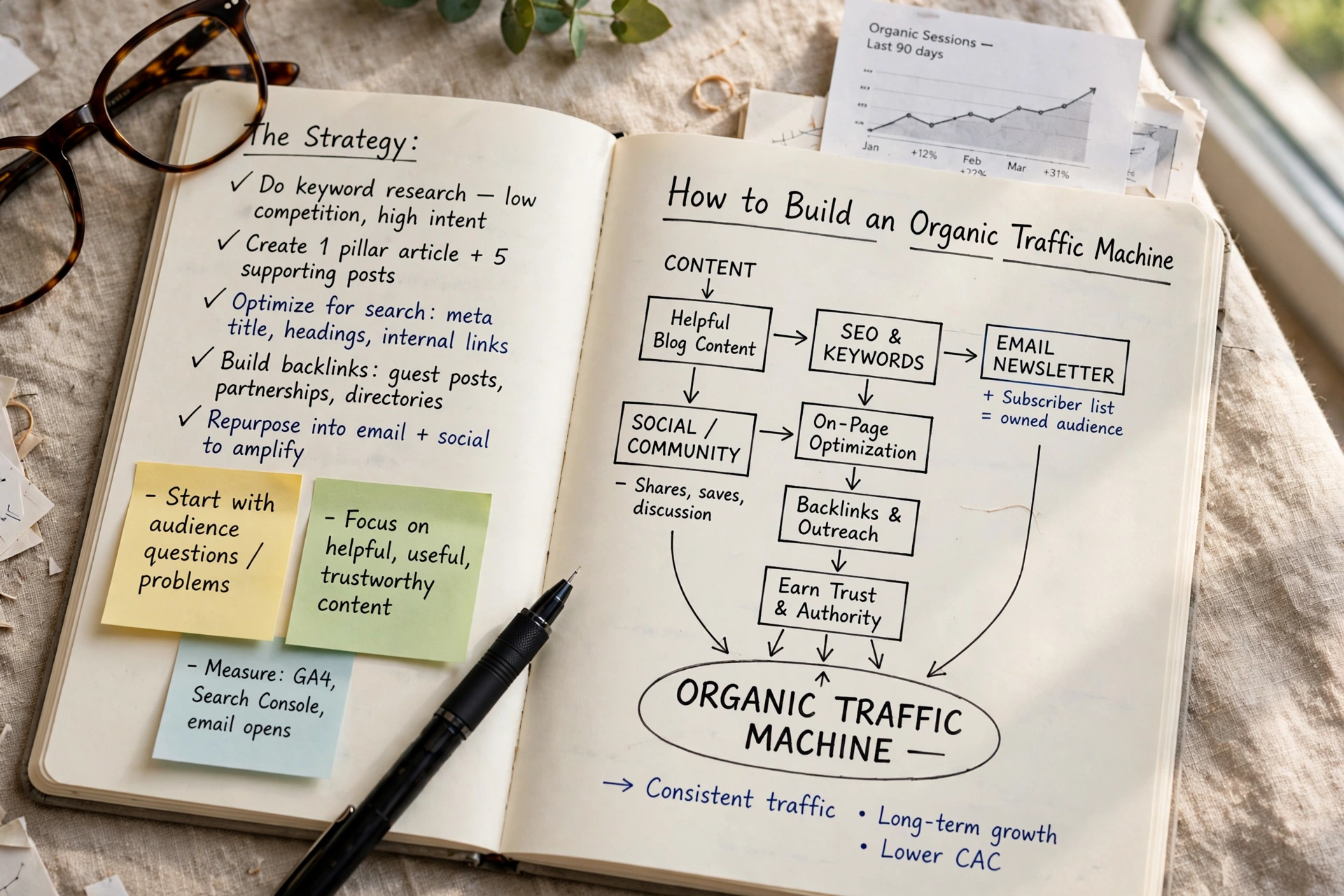
What Exactly Is an Organic Traffic Machine?
Most B2B companies treat their website like a digital brochure, a static place where a few case studies live and a "Contact Us" form gathers dust. In my experience working with high-ticket service providers, this is the fastest way to stay invisible. The alternative is a systematic approach to growth where your domain becomes a self-sustaining asset. When people ask how to build an organic traffic machine, they aren't asking about writing a few blog posts a month; they are asking how to create a programmatic ecosystem that captures intent at scale and converts it into pipeline without manual intervention.
An organic traffic machine is a high-velocity content architecture designed to dominate specific search intents through a combination of topical authority hubs (pillars) and a massive network of long-tail landing pages (satellites). Unlike traditional content marketing, which relies on "hope and handwriting," this machine uses algorithmic patterns to map every possible question a buyer has and provides a high-value answer on a dedicated page. By integrating AI search engine optimization & GEO, this system ensures that your brand is the primary recommendation not just in Google, but across AI discovery engines like Perplexity and ChatGPT.

The Core Mechanics of a Scalable Traffic Engine
To understand the "machine" aspect, you have to stop thinking about articles and start thinking about assets. A traditional blog is a chronological stream of consciousness. A traffic machine is a structured database of solutions.
📚
Definition
Programmatic SEO (PSEO) is the practice of creating large volumes of high-quality, template-driven landing pages that target long-tail keywords, leveraging a structured dataset to provide specific value to users across thousands of variations.
The machine operates on a hub-and-spoke model. At the center is the Pillar Page, a comprehensive resource that defines a broad topic. Radiating from that center are hundreds of satellite pages. For example, if you are a law firm specializing in personal injury, your pillar is "The Ultimate Guide to Personal Injury Law." Your satellites are "Car Accident Lawyer in [Specific Neighborhood]," "What to do after a slip and fall in [City]," and "Average settlement for rear-end collisions in [State]."
According to research from Gartner, B2B buyers now spend only 17% of their total buying journey meeting with potential suppliers. This means the "machine" must do the selling for you. By the time a lead reaches your calendar, they should have already consumed four or five of your satellite pages, effectively qualifying themselves through your content.
The mistake I made early on, and that I see constantly in 2026, is focusing on high-volume "head" keywords. Everyone wants to rank for "B2B Marketing," but the real money is in the "low-volume, high-intent" queries. When you build a machine that captures 500 different low-volume queries, you create a compounding effect that dwarfs the effort of fighting for one hyper-competitive keyword. This is why we emphasize PSEO architecture for SaaS & enterprise B2B growth as the foundation of the system.
Why a Traffic Machine Is Mandatory for B2B Survival in 2026
The era of "renting" traffic through Meta or Google Ads is reaching a point of diminishing returns. As AI-driven ad bidding becomes more efficient, the cost per lead (CPL) for high-ticket B2B services continues to climb. If your only way to get a lead is to pay a platform, you don't own your growth; you are leasing it.
According to a report by McKinsey, companies that shift from a purely paid acquisition model to a hybrid organic-first approach see a significant increase in long-term customer lifetime value (LTV) because organic leads typically arrive with higher trust and deeper intent. When a prospect finds you through a specific answer to a complex problem, the perceived authority of your brand is already established.
Now, here's where it gets interesting: the rise of Generative Engine Optimization (GEO). We are no longer just optimizing for a list of blue links. We are optimizing for "citations." When a user asks an LLM, "Who is the best enterprise consultant for digital transformation in New York?" the AI doesn't just guess; it looks for the most cited, most structured, and most authoritative data on the web. If you have 300 pages of deeply structured, factual content, you are significantly more likely to be the AI's answer.
The business implication of ignoring this is simple: invisibility. If you aren't building an organic traffic machine, you are leaving your lead generation to the mercy of algorithmic shifts in paid media. By investing in a system that generates programmatic SEO case studies and proven growth patterns, you turn your website from a cost center into a revenue-generating asset that works 24/7.
How to Build Your Organic Traffic Machine: A Step-by-Step Framework
Building this machine requires a shift from "creative writing" to "systems engineering." You cannot write your way to 10,000 pages; you must architect your way there.
Step 1: Intent Mapping and Keyword Clustering
Stop looking for "keywords" and start looking for "intents." Group your research into three buckets: Informational (What is X?), Navigational (How do I find X?), and Transactional (Best X service in Y city). Your machine needs to cover all three, but the bulk of your satellite pages should focus on the intersection of a specific problem and a specific location or industry.
Step 2: The Structural Blueprint
Design your Pillar and Satellite relationship. Every satellite must link back to the pillar, and the pillar must link to the most important satellites. This creates a "silo" that tells Google and AI crawlers exactly what your topical expertise is. This is the core of GEO vs traditional SEO, it's about creating a semantic graph that AI can easily parse.
Step 3: Programmatic Deployment
This is where most companies fail because they try to do it manually. To truly scale, you need a system that can deploy hundreds of optimized pages based on a data set. This is where BizAI Intelligence changes the game. Instead of hiring a fleet of mediocre copywriters, we deploy a programmatic engine that generates high-authority, compliant, and conversion-optimized pages in a fraction of the time.
Step 4: The Conversion Layer (The AI SDR)
Traffic is a vanity metric; pipeline is a sanity metric. A traffic machine is useless if the visitors just leave. Every page in your machine should feature an autonomous AI Sales Agent. This agent doesn't just say "Hello"; it tracks the user's behavior and initiates a qualification screen to capture data and book meetings directly into your CRM. This is the difference between a "blog" and a "machine." For those looking to optimize this, we recommend studying how AI appointment setters automate B2B demo booking.
💡
Key Takeaway
The goal of an organic traffic machine is not "more traffic," but "more qualified conversations." By combining PSEO with an AI SDR, you eliminate the gap between the first click and the first sales call.
Choosing the Right Strategy: Manual vs. AI-Powered Growth
Many business owners hesitate because they've been burned by "cheap AI content" in the past. There is a massive difference between "AI slop", generic, repetitive text, and "AI-driven programmatic engineering."
| Approach | Speed of Deployment | Quality & Authority | Scalability | Lead Conversion |
|---|---|---|---|---|
| Traditional Manual SEO | Very Slow (Months/Years) | High (but low volume) | Poor | Manual/Low |
| Generic AI Content | Fast (Days) | Low (Hallucinations) | High | Poor (No trust) |
| BizAI Intelligence | Ultra-Fast (Weeks) | Enterprise-Grade | Massive | Autonomous (AI SDR) |
The traditional approach is too slow for the 2026 market. By the time you manually write 50 articles, your competitor has used a programmatic engine to deploy 500 pages and captured the entire local market. On the other hand, generic AI content gets flagged by Google's "Helpful Content" updates because it lacks original insight and structure. The modern approach leverages data-driven templates that ensure every page provides a unique, factual answer to a specific user query.
If you want to see how this works in a real-world setting, I suggest looking into how to automate organic traffic and lead capture with AI, which breaks down the technical bridge between traffic and revenue.
Common Misconceptions About Organic Machines
There are several myths floating around the industry that keep B2B founders from scaling. Let's address them with some cold, hard data.
Myth 1: "Google will penalize me for having too many similar pages."
Most guides get this wrong. Google doesn't penalize "similar" pages; it penalizes "duplicate" pages. If you have 100 pages and each one answers a different city's specific needs or a different industry's specific pain point, those are unique assets. As long as the value proposition is localized or segmented, you are providing a better user experience, not "spamming."
Myth 2: "I need a massive budget for backlinks to rank."
While backlinks matter, topical authority, the "machine" part, is becoming more important. If your site is the most comprehensive resource on a specific niche, Google's algorithms recognize you as the authority even without a million external links. This is particularly true for long-tail keywords where the competition is lower.
Myth 3: "AI content can't build trust."
Trust isn't built by who wrote the word; it's built by the accuracy of the information and the utility of the solution. When a user finds a page that perfectly describes their problem and offers a clear, data-backed solution, they trust the brand, not the writer. This is why we integrate AI SDRs and autonomous appointment setters to maintain a professional, high-touch experience immediately after the user reads the content.
Frequently Asked Questions
How long does it take to see results from an organic traffic machine?
Unlike traditional SEO, which can take a year to show momentum, a programmatic machine focused on long-tail keywords often sees results within 30 to 90 days. This is because you are targeting "low-hanging fruit", queries with lower competition but high intent. By deploying hundreds of pages simultaneously, you increase your "surface area" for discovery. While the head keywords take time, the satellite pages start capturing leads almost immediately, providing an early ROI that funds the long-term growth of the pillar pages.
Can I build this machine myself using a standard CMS?
While it is technically possible to use a standard CMS like WordPress, the manual overhead is staggering. To build a true machine, you need a system that can handle dynamic routing, programmatic metadata, and automated indexing. Most business owners who try this manually quit after ten pages because the "content treadmill" becomes overwhelming. A professional system like BizAI Intelligence automates the data-mapping and page generation, allowing you to focus on strategy rather than the tedious process of manual publishing.
Will the rise of AI Search (SGE/SearchGPT) kill this strategy?
Actually, it makes this strategy more essential. AI search engines don't summarize the web; they summarize the most authoritative sources. By building an organic traffic machine, you are providing the structured data that these AI engines crave. If you have a page specifically answering "How does [Product] work for [Industry] in [City]?", the AI is more likely to cite your site as the definitive source. This is the core of how to get cited by ChatGPT and Perplexity.
Does this approach work for very small niches?
Yes, and it is actually more powerful in small niches. In a broad market, you are fighting giants. In a specialized B2B niche, there is often a "content vacuum" where no one is providing detailed, programmatic answers. By dominating every long-tail variation of your niche, you can effectively "own" the internet for that specific service. Even if your total monthly traffic is only a few thousand visits, if those visits are 100% high-intent buyers, your ROI will be exponentially higher than a generic viral blog.
How do I ensure my programmatic pages don't look "robotic"?
The secret is in the data layer. Instead of using generic adjectives ("the best," "the amazing"), we use specific data points, local landmarks, industry-specific regulations, and real-world benchmarks. When a page mentions a specific local ordinance or a precise industry statistic, it signals to the reader (and the algorithm) that the content is grounded in reality. By using a professional framework, you ensure that the output is clinical, authoritative, and helpful, rather than fluffy and generic.
Final Thoughts on Building Your Organic Traffic Machine
Building an organic traffic machine is no longer a "luxury" for B2B firms; it is a strategic imperative. The gap between the companies that own their distribution and those that rent it is widening every day. When you shift your focus from "writing blogs" to "architecting a lead-generation engine," you move from a state of uncertainty to a state of predictable growth.
Remember, the goal is to create a system where the traffic flows automatically, the leads are qualified by AI, and your calendar is filled with high-ticket appointments while you sleep. This requires a commitment to technical rigor, an understanding of how to connect AI sales agents to your CRM, and the right tools to execute at scale.
If you are tired of the volatility of paid ads and the slow grind of traditional SEO, it's time to build your machine. Stop guessing and start engineering your growth with BizAI Intelligence.
Visit bizaigpt.com to transform your domain into a high-velocity acquisition engine.
Only 12 Onboarding Slots Remaining This Month
BizAI deploys 300 AI salespeople scoring purchase intent 24/7. Get your free niche domination blueprint.
AI Search Accelerator: 1-on-1 Strategy Session
Claim one of the 10 monthly slots. Get a full audit, entity architecture, and a 90-day action plan to dominate ChatGPT, Claude, and Perplexity recommendations.



