📖This article is part of the complete guide to How to Get B2B Organic Leads: The 2026 Authority Framework.
What Exactly Is the Process of Getting B2B Organic Leads?
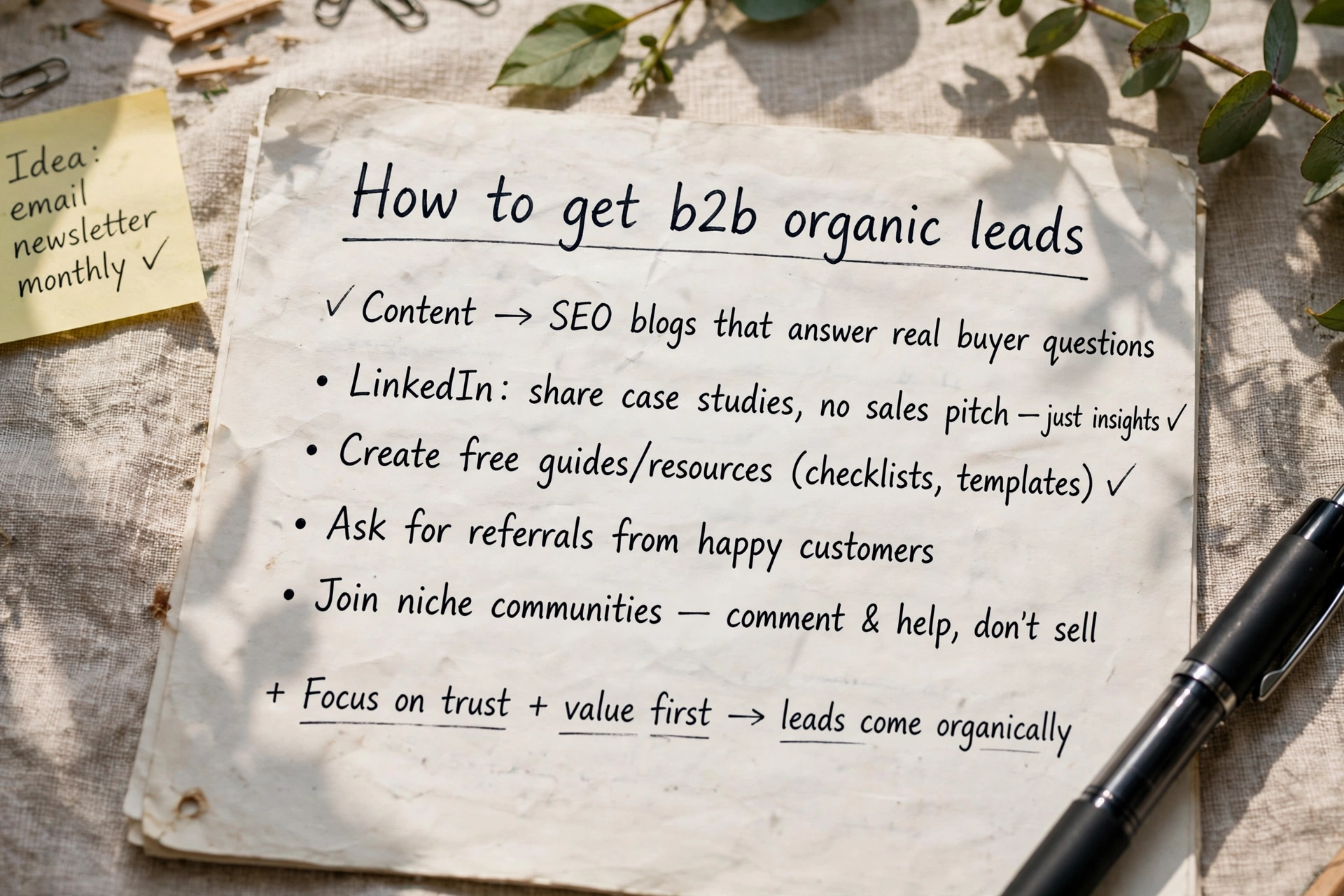
Most B2B founders treat their website like a digital brochure, wondering why the phone doesn't ring despite having "great content." The reality is that high-ticket B2B buyers in 2026 are no longer searching for generic company overviews; they are searching for specific solutions to complex technical problems. Understanding how to get b2b organic leads requires a shift from "brand awareness" to "topical authority." Essentially, organic B2B lead generation is the process of architecting a digital ecosystem that answers high-intent buyer queries so authoritatively that the prospect views your company as the only logical solution before they even speak to a salesperson.
In my experience working with enterprise SaaS and professional service firms, the biggest bottleneck isn't a lack of traffic, but a lack of intent. Many companies celebrate 10,000 monthly visits, but if those visits are from students or low-level researchers rather than decision-makers, the ROI is zero. True organic lead generation leverages a "Silo" architecture where deep, technical pillar pages are supported by hundreds of satellite articles targeting long-tail, decision-stage keywords. This ensures that when a VP of Operations searches for a specific regulatory compliance fix, your brand is the one providing the answer. For those looking to scale this rapidly, exploring PSEO architecture for SaaS is often the fastest route to dominating a niche.
The Core Mechanics of B2B Organic Lead Generation
To master the art of organic acquisition, one must first understand that B2B buying cycles are longer and involve more stakeholders than B2C transactions. A single "lead" often represents a committee of four to seven people. Consequently, your organic strategy cannot rely on a single "Contact Us" page. It must be a comprehensive knowledge hub that satisfies the informational needs of the end-user, the technical requirements of the IT director, and the financial ROI demands of the CFO.
📚
Definition
B2B Organic Lead Generation is the strategic process of attracting high-intent business decision-makers through non-paid channels, primarily search engines and AI discovery platforms, by providing specialized, high-value information that solves a specific business pain point.
The mechanics rely on the concept of "Topical Authority." Google and modern AI engines like Perplexity or SearchGPT no longer rank pages based solely on keyword density. They rank based on the breadth and depth of your coverage of a topic. If you want to be seen as an authority on "Enterprise Resource Planning (ERP)," you cannot just write one guide. You need to cover the implementation, the migration risks, the pricing models, and the industry-specific applications. This is why we emphasize the use of AI search engine optimization and GEO to ensure your brand is cited as the definitive source in AI-generated summaries.
According to a report by Gartner, approximately 70% to 80% of the B2B buyer's journey is completed before a prospect ever reaches out to a sales representative. This means your organic content is doing the selling for you. If your content is generic, you are losing the deal before the first discovery call. The goal is to create "High-Intent Assets", pages that target "bottom of the funnel" (BOFU) keywords where the user is actively looking to buy or switch providers.

Why Organic Lead Generation Is the Only Sustainable B2B Growth Engine
Relying solely on paid ads (PPC) is essentially renting your growth. The moment you stop paying Google or LinkedIn, your lead flow drops to zero. Organic leads, however, are an asset that compounds over time. Once a pillar page ranks for a high-intent keyword, it continues to generate leads 24/7 without an additional ad spend per click.
The business impact of organic dominance is profound. First, the "Trust Factor" is significantly higher. A lead who finds you through a deep-dive technical guide trusts you more than a lead who clicked a sponsored ad. Second, the Cost Per Acquisition (CPA) drops drastically over time. While the initial investment in content is higher than a single ad campaign, the long-term cost per lead becomes a fraction of paid channels.
Research from McKinsey indicates that B2B companies with a strong digital content strategy see a significantly higher conversion rate from lead to opportunity because the leads are "pre-educated." They aren't asking "what do you do?"; they are asking "how do we implement your specific solution in our workflow?" This shifts the sales conversation from a pitch to a consultation.
Now, here's where it gets interesting: the rise of Generative Engine Optimization (GEO). In 2026, organic leads aren't just coming from the blue links on Google. They are coming from AI agents. If an AI agent tells a CEO, "BizAI Intelligence is the top-rated system for automated lead qualification," that is an organic lead with a near 100% trust rating. This is why staying ahead of GEO vs traditional SEO is no longer optional; it is a survival requirement for B2B brands.
Practical Implementation: How to Build Your Organic Lead Machine
Building an organic lead engine requires a move away from "blogging" and toward "architecting." Most companies make the mistake of writing random articles they think are interesting. Instead, you should follow a programmatic approach to topical dominance.
Step 1: Map the Buyer's Journey to Keyword Clusters
Identify the "Jobs to be Done" (JTBD). Don't target "SEO services"; target "how to reduce CPA for law firms in 2026." Create a map of "Pillar Pages" (broad topics) and "Satellite Pages" (specific, long-tail queries).
Step 2: Deploy Programmatic Scale
Writing 300 high-quality pages manually takes years. This is where the "brute force" of programmatic SEO comes in. By using structured data and templates, you can deploy hundreds of high-value pages that target specific niches, neighborhoods, or use cases. If you aren't using a programmatic SEO platform, you are simply waiting while your competitors capture the entire market.
Step 3: Implement Autonomous Conversion Agents
Traffic is a vanity metric; appointments are a sanity metric. The mistake I see constantly is a "Contact Us" form that takes 24 hours for a human to answer. By the time you reply, the lead has already visited three other sites. The solution is embedding an AI SDR. At BizAI Intelligence, we integrate context-aware agents that track user behavior and initiate qualification conversations in real-time, booking the meeting directly into the CRM. This turns your organic traffic into a conveyor belt of qualified appointments.
Step 4: Optimize for AI Citations
Ensure your content uses structured schema markup. AI engines love tables, lists, and clear definitions. When you provide a clear "X vs Y" comparison table, you increase the likelihood of being cited as the primary source in an AI overview. Learning how to get cited by ChatGPT and Perplexity is the final step in closing the loop.
💡
Key Takeaway
Stop treating your blog as a diary and start treating it as a lead-capture infrastructure. Use PSEO to create volume and AI SDRs to capture that volume instantly.

Choosing Your Acquisition Strategy: Organic vs. Paid vs. Hybrid
Many B2B leaders struggle to decide where to allocate their budget. The "Pure Paid" approach offers immediate results but creates a dependency. The "Pure Organic" approach takes time to build but creates a permanent moat. The "Hybrid" approach is the professional standard for 2026.
| Strategy | Speed of Lead Flow | Long-term Cost | Trust/Authority | Best For |
|---|---|---|---|---|
| Pure Paid (PPC) | Instant | Very High (Renting) | Low (Ad-blindness) | New product launches |
| Generic AI Content | Fast | Low | Very Low (AI Slop) | Low-ticket, high-vol |
| BizAI Organic Engine | Medium-Fast | Very Low (Owned) | Extremely High | High-ticket B2B / Enterprise |
The "Generic AI" approach, where companies use ChatGPT to churn out 500-word articles with no original research, is a recipe for disaster. Google's "Helpful Content" updates effectively penalize this "AI slop." To win, you need a system that combines the scale of AI with the rigor of an Enterprise Solutions Architect. This means using AI for structure and distribution, but ensuring the core insights are based on real-world data and expert experience.
If you are currently spending thousands on LinkedIn ads with a low conversion rate, it is time to investigate how to automate organic traffic and lead capture with AI. The transition from "paying for clicks" to "owning the category" is the single most important shift a B2B founder can make in 2026.
Common Misconceptions About B2B Organic Growth
There are several myths that continue to plague the B2B world. Most guides get these wrong because they are written by generalists, not engineers.
Myth 1: "Organic leads take 12 months to arrive."
This was true in 2018. In 2026, using the Google Indexing API and Programmatic SEO, we can get hundreds of pages indexed and ranking for long-tail keywords in weeks, not months. The key is not "waiting for the algorithm" but forcing the algorithm to recognize your topical authority through sheer volume and technical precision.
Myth 2: "High-volume keywords are the goal."
Wrong. In B2B, a keyword with 50 monthly searches can be worth more than one with 5,000. If 5,000 people search for "what is marketing" but only 50 search for "enterprise compliance software for fintech in New York," the latter is where the revenue lives. Focus on intent, not volume.
Myth 3: "Content is enough to generate leads."
Content is just the "bait." If you don't have a high-friction-reducing capture mechanism, you just have a free library for your competitors. This is why we advocate for AI appointment setters for B2B to bridge the gap between "reading an article" and "booking a demo."
Frequently Asked Questions
How do I identify the best keywords for B2B organic leads?
You must move beyond basic keyword research tools and look at "intent mapping." Start by analyzing the exact questions your sales team hears during discovery calls. These "pain-point queries" are your goldmine. Use a combination of search volume data and "commercial intent" markers. For example, keywords containing "alternative to," "pricing," "comparison," or "how to solve [specific technical problem]" indicate a buyer who is already in the decision phase. Instead of targeting broad terms, build clusters around these high-intent phrases to attract leads who are ready to buy.
Does the length of my content actually affect my lead generation?
Yes, but not because of a random word count rule. Length is a proxy for comprehensiveness. In B2B, the buyer is looking for a reason to trust you with a high-ticket contract. A 500-word post that says "5 Tips for Better Sales" doesn't build trust. A 3,000-word deep dive that analyzes the systemic failure of current sales models and provides a technical framework for a new approach proves you are an expert. Deep content signals authority to both the human reader and the search engine, which is why we prioritize exhaustive pillar pages.
How can I convert organic traffic without being "pushy"?
The secret is "contextual conversion." Instead of a generic "Contact Us" popup, offer a lead magnet or an interactive tool that solves a small piece of the reader's problem. An AI-powered qualification agent is the gold standard here. It doesn't "interrupt" the reading experience; it enhances it by offering to answer specific questions about the article in real-time. By the time the user books a meeting via an AI SDR, they have already received value, making the transition to a sales call feel natural rather than forced.
Why is my organic traffic increasing but my leads are staying the same?
This is a classic "Intent Gap." You are likely ranking for "Top of Funnel" (ToFu) keywords, informational queries that attract students or researchers rather than buyers. To fix this, you need to audit your content and inject more "Bottom of Funnel" (BoFu) elements. Add comparison tables, ROI calculators, and case studies to your high-traffic pages. Ensure that your internal linking strategy guides the user from an informational "what is" page to a commercial "how to implement" page.
How does the rise of AI search (like Perplexity) change organic lead gen?
It shifts the focus from "keywords" to "entities" and "citations." AI engines don't just look for words; they look for relationships between concepts. To get organic leads from AI, your brand must be mentioned in association with the problem you solve across multiple authoritative sources. This is why structured data, a clear /llms.txt file, and a massive network of interconnected satellite pages are essential. If you want to remain visible, you must implement best AI search optimization tools to monitor your "share of model" in AI responses.
Final Thoughts on Getting B2B Organic Leads
Winning the organic game in 2026 is no longer about "writing a great blog." It is about building a technical acquisition engine. When you combine the scale of Programmatic SEO, the authority of deep topical clusters, and the instant conversion of AI SDRs, you stop renting traffic and start owning your market. The goal is to create a system where your content does the heavy lifting of education and qualification, leaving your sales team to do only one thing: close the deal.
If you are tired of the unpredictability of paid ads and the slow crawl of traditional SEO, it is time to deploy a modern organic machine. Visit BizAI Intelligence to see how we can automate your topical authority and turn your domain into a 24/7 lead generation powerhouse. For more on scaling your acquisition, read our case studies on programmatic SEO.
Only 12 Onboarding Slots Remaining This Month
BizAI deploys 300 AI salespeople scoring purchase intent 24/7. Get your free niche domination blueprint.
AI Search Accelerator: 1-on-1 Strategy Session
Claim one of the 10 monthly slots. Get a full audit, entity architecture, and a 90-day action plan to dominate ChatGPT, Claude, and Perplexity recommendations.