📖This article is part of the complete guide to Complete Guide to Dead Lead Elimination in Sales.
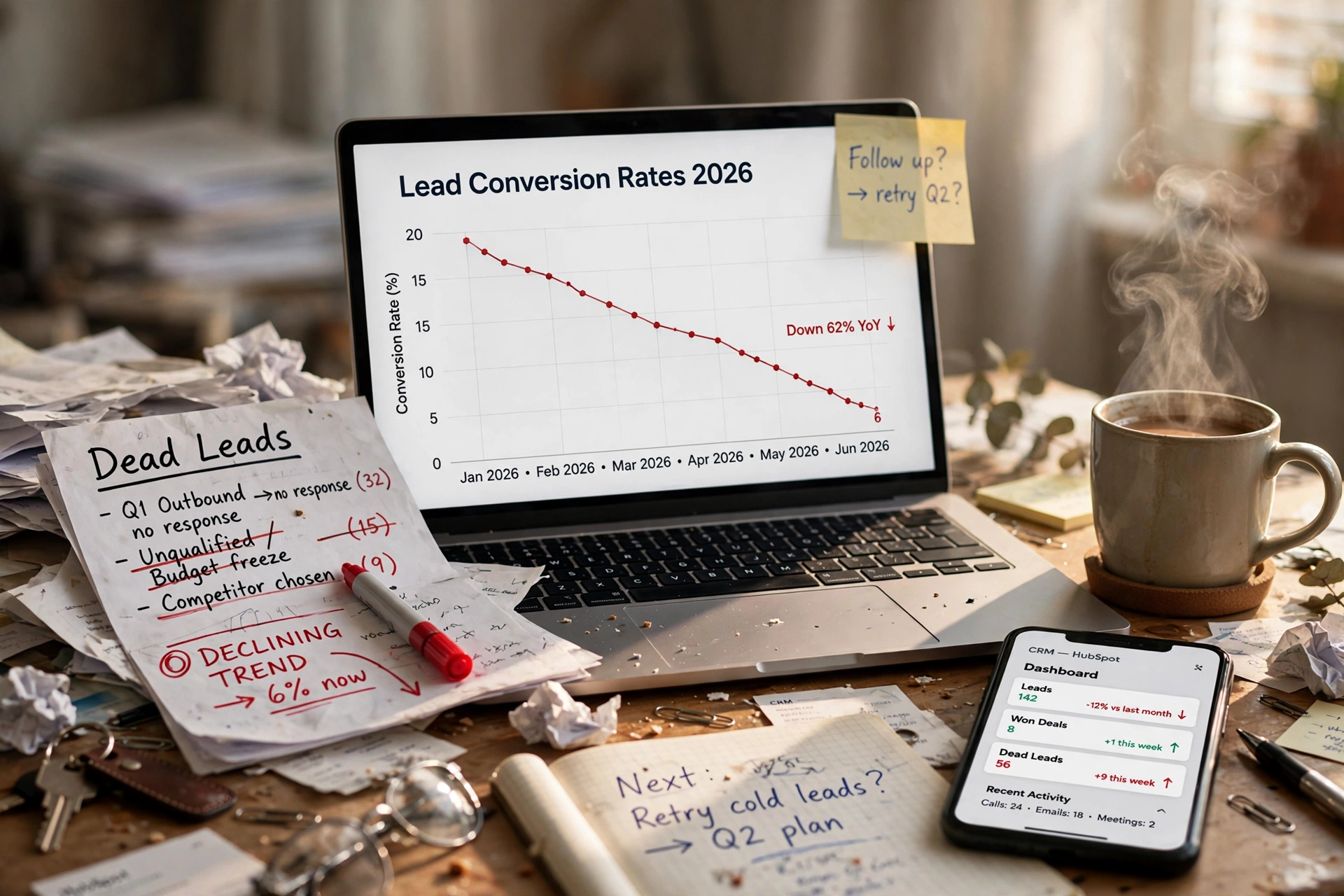
In my experience working with high-ticket B2B service providers, the most dangerous part of a sales pipeline isn't the lack of leads, but the accumulation of 'ghost' data. I have seen enterprise CRMs cluttered with thousands of entries that look like opportunities on a dashboard but are actually operational anchors, dragging down the conversion rate and inflating the cost of customer acquisition. When we built the qualification engines at BizAI Intelligence, we discovered that most companies confuse 'slow leads' with 'dead leads,' resulting in SDRs wasting 40% of their week chasing ghosts.
For a comprehensive overview of how to purge these liabilities, explore our Complete Guide to Dead Lead Elimination in Sales.
What Are Dead Leads Exactly?
📚
Definition
Dead leads are prospective customers who have entered a sales funnel but have ceased all meaningful engagement, demonstrated a complete lack of buyer intent, or have reached a definitive state where they will never purchase the product or service.
Dead leads are not merely 'unresponsive' prospects; they are entries in a database that no longer possess any viable path to conversion. In the context of 2026 B2B sales, a lead is considered dead when it fails to meet the minimum engagement threshold over a predetermined period, or when a specific 'disqualification trigger' occurs. This differs from a 'cold lead,' which is simply a prospect who hasn't been contacted recently but still fits the Ideal Customer Profile (ICP).
To understand dead leads, one must look at the interaction data. A dead lead might have downloaded a whitepaper three months ago but has since ignored five follow-up emails, failed to open a single newsletter, and shows zero activity on the pricing page. According to data from the Sales Management Association, nearly 30% of B2B leads in typical pipelines are functionally dead but remain categorized as 'active,' creating a distorted view of the actual sales velocity.
When these entities persist in a CRM, they create a psychological burden on sales teams. SDRs experience burnout when their daily activity is dominated by non-responsive contacts. This is why understanding the nuance between a lead that is 'hesitant' and one that is 'dead' is fundamental for operational efficiency. By leveraging AI lead scoring software, teams can programmatically identify these dead zones without manual auditing.
Why Does Identifying Dead Leads Matter for Your Business?
Identifying dead leads is not about cleaning a database; it is about reclaiming the most expensive resource in any B2B company: human attention. When a sales team spends 10 hours a week calling prospects who have no intention of buying, the company isn't just losing time; it is losing the opportunity to engage with high-intent buyers who are waiting for a response.
First, the impact on ROI is immediate. Every minute spent on a dead lead is a minute not spent on real-time buyer intent signals. If an SDR handles 50 leads a day and 20 are dead, the effective capacity of that employee is reduced by 40%. This inefficiency compounds across the entire organization, leading to missed quotas and inflated overhead.
Second, dead leads pollute your data analytics. When you calculate your lead-to-close ratio, having a bloated denominator of dead leads makes your marketing look less effective than it actually is. If you have 1,000 leads and 10 closes, your rate is 1%. If you purge 600 dead leads, your actual conversion rate for viable prospects is 2.5%. This distinction is essential for making accurate budget allocations in digital marketing and SEO strategies.
Third, the risk of brand damage is real. In 2026, buyers expect hyper-personalized, context-aware communication. Continuing to send generic "Just checking in!" emails to a lead who has clearly moved on or is no longer in the market makes your brand look desperate and out of touch. According to a study by the B2B Institute, over-communication with non-intent leads increases unsubscribe rates by 18%, permanently removing those contacts from your ecosystem.
Finally, there is the technical cost of CRM maintenance. For enterprise companies using Salesforce or HubSpot, data storage and the processing power required for automated workflows on thousands of dead records can lead to system latency and higher subscription costs. Utilizing behavioral lead scoring helps in automating the archival process, ensuring the CRM remains a lean, high-velocity tool rather than a digital graveyard.
How to Identify Dead Leads Using Real-World Examples
Identifying a dead lead requires a combination of negative signals and the absence of positive ones. You cannot rely on a single 'no' from a prospect; you must look for patterns of disengagement. To do this effectively, businesses should implement a 'Dead Lead Matrix' that categorizes signals into three tiers: Explicit Rejection, Implicit Silence, and Profile Mismatch.
1. Explicit Rejection (The Easiest to Spot)
These are leads who have clearly stated they are not interested. Examples include:
- Direct statements like "We have no budget for this in 2026."
- Unsubscribing from all marketing communications.
- Direct requests to be removed from the database.
- Switching to a competitor and explicitly notifying the salesperson.
2. Implicit Silence (The Ghosting Pattern)
This is where most sales teams struggle. A lead becomes dead through a pattern of non-responsiveness. For example:
- No email opens or clicks for 60 consecutive days despite 4+ touchpoints.
- A scheduled demo that was missed without notice, followed by three failed attempts to reschedule.
- A lead that signed up for a trial but never logged back in after the first 24 hours and ignored all onboarding prompts.
- Zero activity on the website (no visits to the pricing or case study pages) for a full quarter.
3. Profile Mismatch (The Disqualified Lead)
Sometimes a lead is 'dead' not because of behavior, but because they never should have been in the pipeline. Examples include:
- A student searching for a free tool who accidentally signs up for an enterprise demo.
- A company that is too small to ever afford the minimum contract value (e.g., a freelancer signing up for a $50k/year platform).
- A prospect in a geographical region where the company does not operate.
To automate this, many of our clients at BizAI Intelligence use programmatic filters. Instead of manual tagging, they use AI SDRs to run initial qualification screens. If the AI detects a lack of budget or a mismatch in the ICP during the first conversation, the lead is tagged as 'dead/disqualified' immediately, preventing them from ever entering the human sales queue.
💡
Key Takeaway
A lead is not dead because they didn't buy today; they are dead when the probability of them buying in the next 12 months drops to near zero based on behavioral data.
Comparing Lead Management Approaches
To visualize the difference in efficiency, consider the following comparison of how different organizations handle their pipelines in 2026.
| Feature | Traditional Manual Approach | Generic AI/Bot Approach | BizAI Intelligence Approach |
|---|---|---|---|
| Identification | Manual review every 6 months | Basic time-based triggers (e.g., 30 days) | Real-time behavioral intent & velocity tracking |
| Action | SDRs keep calling "hopeful" leads | Auto-emails sent to everyone | Autonomous disqualification and CRM archival |
| Data Integrity | Bloated CRM, inaccurate conversion rates | Some cleanup, but high hallucination in scoring | High-fidelity data with precise ICP alignment |
| SDR Focus | 40% waste on dead leads | 20% waste on misqualified leads | 95% focus on high-intent, qualified prospects |
Common Mistakes When Handling Dead Leads
One of the most frequent errors I see is the "Sunk Cost Fallacy." A sales manager might say, "We spent $200 in ads to get this lead; we can't just give up on them." This is a fundamental misunderstanding of ROI. The cost of the lead is gone; the only thing you can control is the cost of the follow-up. Spending $1,000 in labor to save a $200 lead that has zero intent is a net loss of $1,200.
Another mistake is the "Infinite Sequence." Many teams put leads into an automated email sequence that lasts for two years. While this might occasionally revive a lead, it more often creates a negative brand perception. If a prospect hasn't engaged in six months, they aren't 'considering the offer'; they have likely forgotten who you are. Instead of an infinite loop, use a "break-up email" and then move them to a low-frequency nurturing list or archive them entirely.
Third, failing to analyze why leads are dying. If 70% of your leads are becoming dead within 14 days, you don't have a sales problem; you have a marketing problem. This suggests your lead generation strategy is attracting the wrong audience. Using programmatic SEO to target high-intent long-tail keywords rather than generic high-volume terms can drastically reduce the percentage of dead leads entering the funnel.
Finally, many companies neglect the "Re-engagement Trigger." A lead that is dead today might not be dead in six months due to a change in their business circumstances (e.g., a new funding round or a change in leadership). The mistake is deleting the data entirely instead of archiving it. The correct approach is to move them to a "Cold Archive" and use external triggers—like LinkedIn job change alerts—to trigger a re-evaluation of the lead's status.
Frequently Asked Questions
What is the difference between a cold lead and a dead lead?
A cold lead is a prospect who fits your ideal customer profile but has not had a recent interaction with your brand. They are essentially "dormant" and can be revived through targeted outreach or content marketing. A dead lead, however, has demonstrated a clear lack of intent or an explicit rejection of the offer. While a cold lead is a potential opportunity that needs warming, a dead lead is a liability that consumes resources without any realistic probability of conversion. One is a timing issue; the other is a fit or interest issue.
How often should a company audit its CRM for dead leads?
In 2026, manual quarterly audits are obsolete. High-growth B2B firms should implement real-time, automated cleanup. This means setting up triggers where any lead with zero engagement (no opens, no clicks, no site visits) for 45 to 60 days is automatically shifted to a "Cold Archive" status. By automating this process, the sales team always works from a "Clean Pipeline," ensuring that the lead-to-close metrics are based on actual viable opportunities rather than inflated numbers, allowing for more accurate revenue forecasting.
Can a dead lead ever be revived?
Yes, but rarely through the same sales process that killed the lead. Revivification usually requires a "Significant Event Trigger." For example, if a lead was dead because they lacked budget, but a news alert indicates their company just raised $10M in Series A funding, they are no longer dead. Similarly, a change in decision-maker (a new VP of Sales) can turn a dead account into a hot one. The key is to move dead leads to a monitoring list rather than deleting them, allowing AI tools to alert you when their context changes.
Does marking leads as dead affect my marketing metrics?
It improves them. When you remove dead leads from your active pipeline, your conversion rates become more honest. Instead of seeing a 1% conversion rate across 10,000 leads (which is demoralizing and vague), you might see a 5% conversion rate across 2,000 qualified leads. This allows marketing teams to identify exactly which channels are bringing in high-intent buyers versus those that are bringing in "noise." It shifts the focus from quantity (lead volume) to quality (pipeline velocity).
Which tools are best for identifying dead leads automatically?
The best approach is a combination of a modern CRM (like HubSpot or Salesforce) integrated with AI sales agents. These agents can handle the initial qualification and "temperature check" conversations. If the agent detects specific negative intent markers, it can automatically tag the lead as dead. Additionally, using behavioral tracking tools that monitor scroll depth and page visits allows you to see if a lead is actually engaging with your content or simply ignoring your emails, providing a data-driven way to purge the pipeline.
Conclusion
Managing a B2B pipeline is as much about what you remove as what you add. Allowing dead leads to accumulate is a silent killer of productivity, distorting your data and draining your sales team's morale. By implementing a rigorous identification process—combining explicit rejection, implicit silence, and profile mismatch—you can transform your CRM from a stagnant database into a high-velocity engine for growth.
Stop letting "ghost" prospects dictate your team's daily schedule. If you are ready to stop the waste and implement a system that separates the gold from the gravel, explore our Complete Guide to Dead Lead Elimination in Sales. It is time to optimize your acquisition machine for actual revenue, not just lead volume.
For those looking to automate this entire cycle, BizAI Intelligence provides the architecture to generate high-intent traffic and qualify it autonomously, ensuring dead leads never reach your human sales team in the first place.
AI Search Accelerator: 1-on-1 Strategy Session
Claim one of the 10 monthly slots. Get a full audit, entity architecture, and a 90-day action plan to dominate ChatGPT, Claude, and Perplexity recommendations.