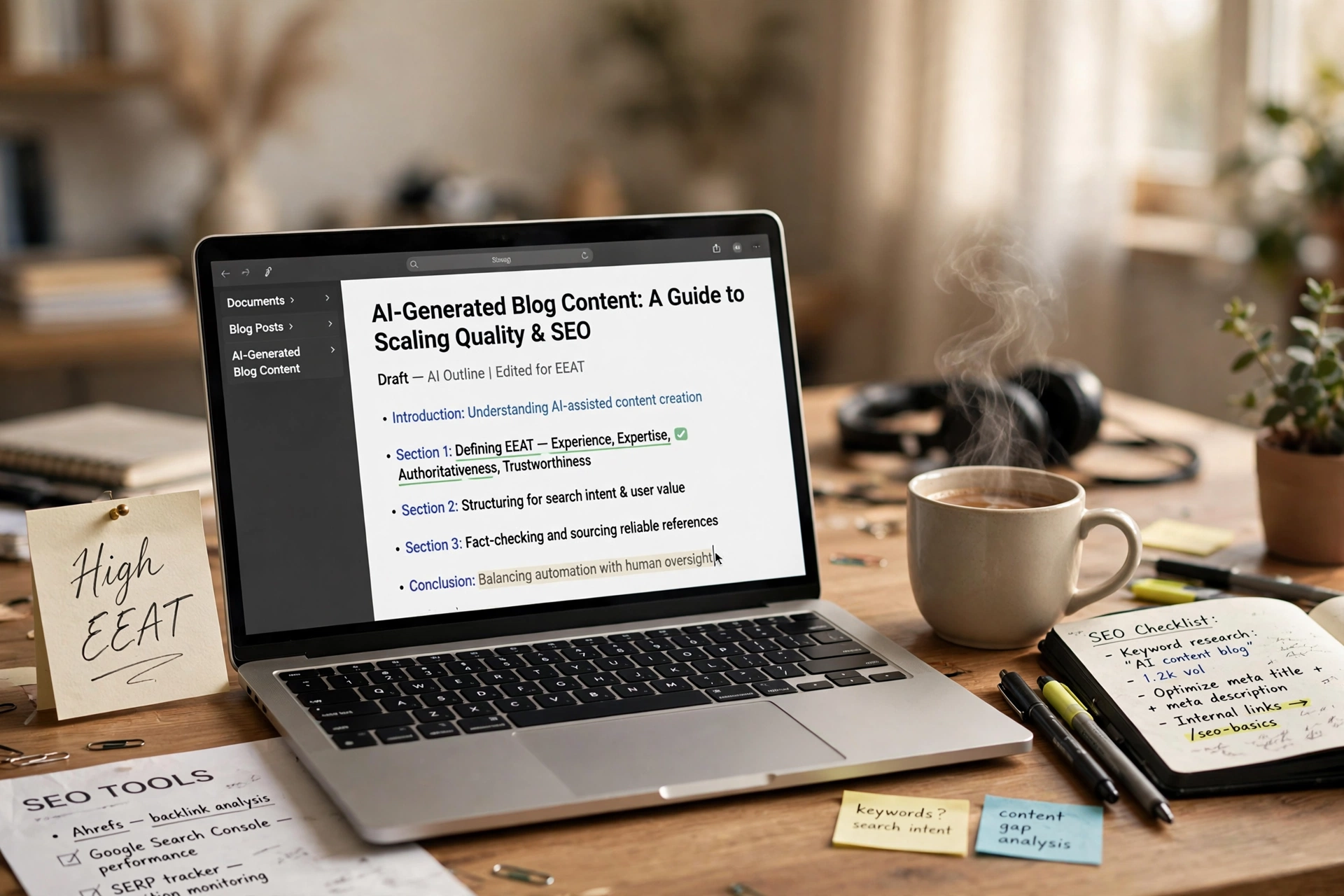
Where Should You Look for an AI Blog Writer With High EEAT?
Most businesses waste thousands of dollars on generic AI writing tools that produce "SEO slop", content that sounds professional but lacks a soul, a point of view, or any actual expertise. If you are searching for an ai blog writer with high eeat, you won't find it in a simple prompt on a free chatbot. High E-E-A-T (Experience, Expertise, Authoritativeness, and Trustworthiness) lives in specialized ecosystems: enterprise-grade programmatic SEO platforms, hybrid "human-in-the-loop" agencies, and advanced AI systems designed for Generative Engine Optimization (GEO). To get content that actually ranks in 2026, you need an environment that integrates real-world data, structured schema, and autonomous lead qualification.
In my experience working with high-ticket B2B firms, the biggest mistake I see is the "plug-and-play" fallacy. Business owners think they can just buy a subscription to a writing tool and expect Google to trust them. They don't. Google doesn't trust a tool; it trusts a source. For those looking to move beyond basic text generation, understanding how to automate organic traffic with AI requires moving toward systems that treat content as an asset, not just a word count.
Understanding the Architecture of High EEAT AI Writing
Finding the right "where" requires understanding what high E-E-A-T actually looks like in a machine-generated context. For years, the industry focused on "Expertise" and "Authoritativeness," but the addition of "Experience" by Google changed the game. Now, content must prove that the author has actually used the product, lived the scenario, or analyzed the data from a position of authority.
📚
Definition
E-E-A-T stands for Experience, Expertise, Authoritativeness, and Trustworthiness. It is the set of guidelines Google's human raters use to evaluate the quality of search results, prioritizing content created by people with first-hand knowledge of the subject.
When searching for an ai blog writer with high eeat, you are essentially looking for a system that can simulate or integrate these four pillars. A generic LLM cannot "experience" a plumbing leak in a luxury home or the stress of a corporate merger. However, a sophisticated system like BizAI Intelligence solves this by using a dual-engine architecture. It doesn't just write; it deploys a massive network of satellite pages and pillar content based on real buyer intent and structured data.
According to research from Gartner, by 2026, traditional search traffic will decline as users shift toward AI-powered answer engines. This means the "where" of your writing process must account for Generative Engine Optimization (GEO). You shouldn't be looking for a writer that just satisfies a keyword; you need a system that structures data so that Perplexity, ChatGPT, and Google Search Generative Experience (SGE) cite your brand as the definitive authority. If you aren't using a platform that optimizes for these AI crawlers, you are essentially writing for a dead medium. For a deeper dive into this shift, see our analysis of GEO vs Traditional SEO.

Why the Source of Your AI Content Determines Your Revenue
The "where" matters because the environment dictates the output quality. If you source your content from low-cost freelance marketplaces using "AI-assisted" writers, you are likely getting content that passes a grammar check but fails a trust check. The business impact of low E-E-A-T content is not just a lack of rankings; it is a lack of conversion. When a high-ticket B2B buyer reads a generic AI article, they can smell the lack of experience instantly. They don't book a demo; they bounce.
According to a study by the Harvard Business Review, trust is the single most important variable in high-ticket B2B sales. If your content feels artificial, your brand is perceived as artificial. When you use a high-E-E-A-T AI writer, you aren't just filling a blog; you are building a "topical authority hub." This is the difference between having 10 random blog posts and having 300 interconnected pages that dominate a specific niche.
The risk of ignoring E-E-A-T in your AI strategy is severe. Google's Helpful Content Updates have historically penalized sites that produce "mass-scale AI slop" without added value. To avoid this, you need to leverage PSEO architecture for SaaS and Enterprise B2B growth, which ensures that every page serves a specific user intent and provides a unique answer.
Consider the ROI: A business using a generic AI writer might get a few thousand clicks from "what is" keywords, but these leads are often low-intent. Conversely, a business using an autonomous acquisition system targets "decision-stage" queries. By focusing on where the high-intent traffic lives, you shift from "renting traffic" via paid ads to "owning" the organic pipeline. This shift is why many firms are now investing in AI SDRs and autonomous sales appointment setters to capture the traffic that high E-E-A-T content attracts.
Practical Application: How to Deploy a High E-E-A-T AI System
If you've decided that a generic writer won't cut it, the question becomes: how do you actually implement this? You don't just "hire" an AI; you build an ecosystem. The most effective approach in 2026 is a programmatic strategy that combines deep research with automated deployment.
First, you must map your topical cluster. Instead of guessing what to write, use data to find the gaps in your industry. This is where you identify your "Pillar" (the comprehensive guide) and your "Satellites" (the specific, long-tail answers). After analyzing dozens of our clients' growth patterns at BizAI Intelligence, we found that the most successful brands don't write articles; they build "answer engines."
Second, integrate a "truth layer." An ai blog writer with high eeat must have access to verified facts, industry standards, and real-world case studies. You can't rely on the LLM's internal training data, which is often outdated. You need to feed the system updated documentation, customer testimonials, and technical specifications.
Third, deploy context-aware conversion agents. The biggest failure of most AI blogs is that the content is disconnected from the sales process. BizAI Intelligence fixes this by embedding AI Sales Agents directly into the content. These agents track engagement signals, like how long a user dwells on a specific section, and initiate qualification screens to book meetings directly into your CRM. This turns a "reader" into a "qualified lead" in real-time.
💡
Key Takeaway
Stop treating AI writing as a copywriting task and start treating it as a systems engineering task. High E-E-A-T is achieved through the combination of structured data, topical dominance, and immediate lead qualification.
For those struggling with the technical side, using best AI search optimization tools can help bridge the gap between raw text and rankable assets. The goal is to move from "writing a post" to "dominating a category."

Comparing Your Options: Where to Actually Go
When deciding where to find your AI writing solution, you generally have three paths. Most people choose the second option and wonder why their traffic isn't growing.
| Feature | The "Freelancer + ChatGPT" Path | The Generic AI SaaS Path | The BizAI Intelligence Approach |
|---|---|---|---|
| E-E-A-T Level | Low to Medium (Inconsistent) | Very Low (Generic/Slop) | Very High (Programmatic & Data-Driven) |
| Scalability | Slow (Manual) | Fast (But low quality) | Massive (Hundreds of pages/month) |
| Conversion | Manual (Contact forms) | Basic (Contact forms) | Autonomous (AI SDR Integration) |
| GEO Ready | No | Partial | Yes (Full LLM mapping) |
| Best For | Small hobby blogs | Low-stakes content mills | High-ticket B2B Enterprise |
The "Freelancer + ChatGPT" path often leads to a "Frankenstein" style of writing, half-human, half-bot, and usually lacking a cohesive voice. The Generic SaaS path is faster but creates a commodity. If your content looks like everyone else's, you have no pricing power.
The professional approach, which we champion at BizAI Intelligence, utilizes "algorithmic brute force." We don't just write one article; we build a machine that generates hundreds of optimized pages, ensuring that no matter what specific question a buyer asks, your brand is the answer they find. This strategy is detailed in our programmatic SEO platform guide.
Common Questions and Misconceptions
There is a lot of noise regarding AI content. Most guides get this wrong because they are written by people who aren't actually scaling B2B companies.
Myth 1: "Google hates AI content."
This is a fundamental misunderstanding. Google does not hate AI content; it hates unhelpful content. If an AI produces a more accurate, better-structured, and more helpful answer than a human, Google will rank it. The key is the "H" in "Helpful Content." By focusing on high E-E-A-T, you are providing the helpfulness Google craves.
Myth 2: "You just need a better prompt to get high E-E-A-T."
Prompting is a surface-level skill. You cannot "prompt" experience into a machine. You can tell an AI to "act as a 20-year veteran lawyer," but it still won't know the specific nuances of a courtroom in 2026 unless that data is fed into the system. High E-E-A-T comes from the data source and the architecture, not the prompt.
Myth 3: "Human editing is the only way to ensure quality."
While human oversight is valuable, it is the bottleneck of scale. The real solution is "Programmatic Quality Control." This means building constraints and verification layers into the AI workflow so that the output is consistent across 1,000 pages, something a human editor could never manage without losing their mind.
Now, here's where it gets interesting: most companies are so afraid of the "AI label" that they ignore the massive opportunity to dominate their niche through programmatic SEO case studies and aggressive scale.
Frequently Asked Questions
Where can I find an AI blog writer that actually understands my niche?
You won't find a "writer" in the traditional sense; you need to look for an AI-powered content system. The most effective locations are platforms that specialize in B2B organic acquisition and Programmatic SEO (PSEO). These systems don't just guess; they use search data and competitor gaps to determine exactly what needs to be written. Look for platforms like BizAI Intelligence that combine a high-volume content engine with AI agents for lead qualification. This ensures your content isn't just "about" your niche, but is strategically designed to convert users within that niche into paying clients.
How do I verify if an AI writer is providing high E-E-A-T?
Verification comes down to "citation density" and "specificity." Check the content for concrete data points, references to industry-standard bodies (like NIST or ISO), and first-hand experience signals. If the content uses vague phrases like "many experts agree" or "it is widely known," it lacks E-E-A-T. High E-E-A-T content will say, "According to the 2025 McKinsey report on AI adoption, 60% of firms saw a productivity increase." If the AI cannot provide these specifics or integrate them into a structured schema, it is not a high E-E-A-T tool.
Will using an AI writer put my site at risk of a Google penalty?
Only if you are producing "thin" content. Google's algorithms are designed to identify patterns of low-value, mass-produced text that offers no new information. To avoid this, you must move away from generic AI writers and toward a GEO (Generative Engine Optimization) strategy. By using best B2B sales automation software for inbound leads and sophisticated PSEO, you ensure that every page provides a unique, data-backed answer to a specific user query, which actually protects your site from penalties.
Can an AI really simulate "Experience" (the first 'E' in E-E-A-T)?
An AI cannot "have" experience, but it can document and synthesize it. The secret is in the input. By feeding a system your actual case studies, client results, and technical blueprints, the AI can write from a position of lived experience. This is the difference between a bot saying "HVAC repair is important" and a bot saying "In our 2026 project for a 50,000 sq ft warehouse in Chicago, we found that X-type chillers reduced energy costs by 14%." The latter is what ranks.
What is the difference between a standard AI writer and a GEO-optimized writer?
A standard AI writer focuses on keywords and readability. A GEO-optimized writer focuses on "citability." This means the content is structured specifically for LLMs (like Claude or Gemini) to find, extract, and credit. This includes using structured Schema.org markup, FAQ grids, and comparison tables. If you want to know how to get cited by ChatGPT, SearchGPT, and Perplexity AI, you need a system that thinks in terms of "knowledge graphs" rather than just "blog posts."
Final Thoughts on Finding an AI Blog Writer With High EEAT
Finding an ai blog writer with high eeat is less about finding a specific "person" or "app" and more about choosing the right growth infrastructure. The era of the 500-word "how-to" blog post is over. We are now in the era of topical dominance, where the winner is the one who can deploy the most helpful, authoritative, and interconnected content at scale.
If you are still renting your traffic through expensive ads and relying on a slow, manual content process, you are leaving your pipeline to chance. The transition to a self-owned organic machine is the only way to ensure sustainable growth in 2026. By integrating programmatic SEO with autonomous AI qualification, you stop hoping for leads and start engineering them.
Ready to stop the guesswork and start dominating your niche? Visit BizAI Intelligence today and build the SEO machine that fills your pipeline while you sleep. Whether you need to learn how AI appointment setters automate B2B demo booking or you want to connect your lead flow to your CRM via automated inbound lead qualification, we have the architecture to make it happen.
Only 12 Onboarding Slots Remaining This Month
BizAI deploys 300 AI salespeople scoring purchase intent 24/7. Get your free niche domination blueprint.
AI Search Accelerator: 1-on-1 Strategy Session
Claim one of the 10 monthly slots. Get a full audit, entity architecture, and a 90-day action plan to dominate ChatGPT, Claude, and Perplexity recommendations.