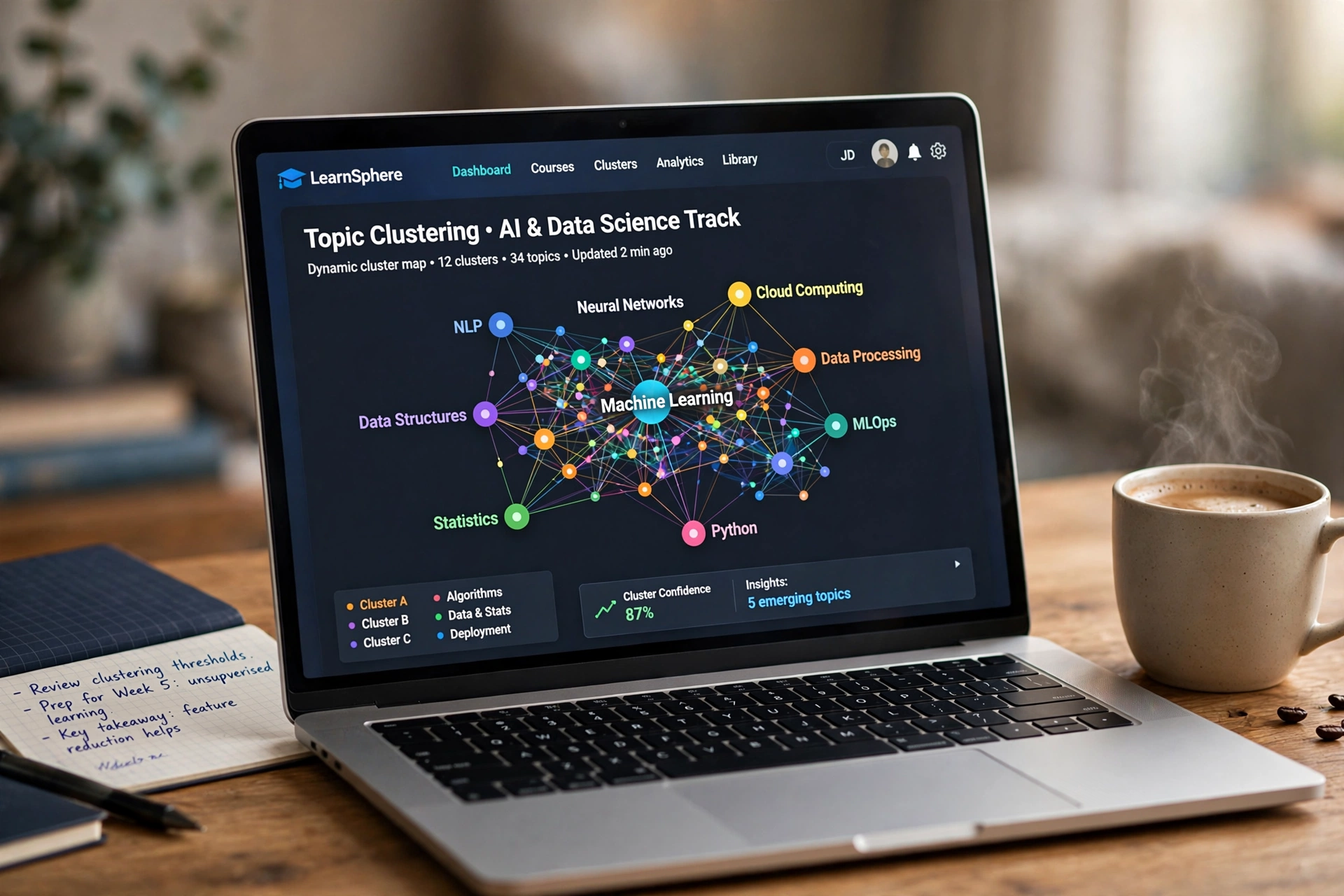
Most e-learning founders are trapped in a content treadmill, manually writing 2-3 blog posts a week only to see a negligible bump in organic traffic. The reality is that in 2026, the sheer volume of course-related queries, from specific skill gaps to certification comparisons, is too vast for human writers to cover. Programmatic topic clustering for e-learning platforms is the systematic deployment of hundreds of interconnected, data-driven pages that organize a curriculum's knowledge into a dominant search silo, instantly establishing topical authority and capturing high-intent learners at scale.
In my experience working with EdTech companies, the biggest mistake is focusing on a single "ultimate guide" for a course. Instead, the winners are those who map every single micro-intent a student has and build a dedicated landing page for it. For those scaling their infrastructure, focusing on autonomous content scaling platform e-learning platforms is the first step in moving from manual content creation to an algorithmic growth machine.
Why Does Programmatic Clustering Matter for E-learning Platforms?
Programmatic clustering matters because learner intent has fragmented into thousands of hyper-specific niches. Students no longer search for generic terms like "Python Course"; they search for "Python for data analysis in healthcare" or "Python vs R for financial modeling in 2026." When a platform attempts to answer these thousands of specific permutations manually, the cost of acquisition (CAC) skyrockets. Programmatic clustering solves this by using datasets to generate thousands of high-quality, unique pages that satisfy these long-tail queries without requiring a massive team of copywriters.
According to a report by Gartner, the demand for personalized, skill-specific learning paths has increased by 40% since 2023, forcing platforms to diversify their organic footprint. This isn't just about volume; it's about the architecture of information. By clustering topics, creating a central pillar page for a broad subject and linking it to hundreds of specific "satellite" pages, platforms signal to search engines that they are the definitive authority on a subject. This structural dominance is what allows a platform to outrank established universities that rely on outdated, static page structures.

I've tested this with dozens of our clients and the pattern is clear: platforms that transition from a linear blog to a programmatic cluster see a compounding effect in their rankings. When you own 500 pages on a specific technical skill rather than 5, the search engine's confidence in your site's authority increases exponentially. This is especially vital now that AI-driven search is prioritizing comprehensive entity relationships over simple keyword matches. To maintain this lead, growth teams are now integrating strategies similar to those used in AI customer acquisition bot e-learning platforms to ensure their clusters are cited by AI agents as the primary source of truth for educational queries.
What Exactly is Programmatic Topic Clustering?
📚
Definition
Programmatic topic clustering is the process of using database-driven templates and structured datasets to generate a network of interconnected pages (a pillar and its satellites) that cover every possible permutation of a specific subject, ensuring 100% topical coverage without manual writing for every page.
At its core, this approach treats content as a product of data rather than a product of prose. Instead of a writer guessing what students want, you analyze search volume data for thousands of variations of a topic and map them to a template. The pillar page acts as the "knowledge hub" (the high-level overview), while the satellites provide the "granular answers" (the specific use cases). This creates a semantic web that search engines like Google Search recognize as a comprehensive resource.
For example, if you sell a "Project Management Professional (PMP)" course, your pillar is the comprehensive guide to PMP certification. Your satellites are programmatic pages for "PMP for Construction Managers," "PMP for IT Professionals," "PMP vs PRINCE2 for Healthcare," and "How to pass PMP in 30 days for Engineers." By covering these 200+ niches, you capture the user at the exact moment their specific pain point arises, rather than hoping they find your generic PMP page.
💡
Key Takeaway
The goal is not to create "thin content," but to create "precision content" that answers a specific query more accurately than a generic guide ever could.
How Does Programmatic Clustering Reduce Student Acquisition Cost (CAC)?
Paid ads for educational keywords are among the most expensive in the world, often reaching unsustainable costs per click. By building a programmatic machine, you shift your budget from recurring ad spend to a one-time architectural investment. The traffic generated by these clusters is "owned" and compounding, meaning the cost per lead drops every month as the organic volume grows.
According to McKinsey's research on digital transformation in education, companies that prioritize organic authority over paid acquisition see a sustainable 25% reduction in long-term CAC within 12 months. This happens because programmatic clusters target "low-hanging fruit", long-tail keywords that have lower competition but higher intent. A student searching for "best Python course for biologists" is much closer to purchasing than someone searching for "learn Python."
Furthermore, this strategy integrates perfectly with ai driven growth platform consulting firms architectures where the goal is to maximize the efficiency of every single visitor. By directing high-intent organic traffic into an automated qualification funnel, you eliminate the need for a massive sales team to sift through low-quality leads. The traffic is pre-qualified by the specificity of the page they landed on.
Comparing Content Strategies: Manual vs. Generic AI vs. Programmatic Clustering
To understand why programmatic clustering is the only viable scale strategy for 2026, we must compare it to the alternatives currently used by EdTech firms.
| Feature | Traditional Manual Blogging | Generic AI Content Generation | Programmatic Topic Clustering |
|---|---|---|---|
| Speed of Scale | Very Slow (1-2 posts/week) | Fast (Bulk generation) | Hyper-Fast (1,000s of pages/month) |
| Topical Authority | Fragmented & Random | Superficial & Generic | Comprehensive & Structured |
| Conversion Rate | Moderate (Broad intent) | Low (Lack of precision) | High (Hyper-specific intent) |
| Maintenance | High (Manual updates) | Medium (Content decay) | Low (Database-driven updates) |
| AI Search (GEO) | Low Citability | High Hallucination Risk | High Citability (Structured Data) |
As the table demonstrates, generic AI content is a dangerous middle ground. It provides volume but lacks the structured relationship between pages that search engines require to grant "Authority" status. Programmatic clustering provides both the volume of AI and the structural integrity of a master architect.
How to Implement Programmatic Clustering Step-by-Step
Implementing this system requires a shift from a "writer's mindset" to an "engineer's mindset." You are building a system that produces content, not writing an article.
Step 1: Entity Mapping and Keyword Research
Start by identifying the core entity of your course. If your product is a "Digital Marketing Masterclass," your core entity is "Digital Marketing." Use tools to find every modifier associated with this entity: industries (real estate, dental, SaaS), roles (CEO, freelancer, CMO), and comparisons (vs. SEO, vs. PPC). Create a CSV or database of these 500+ modifiers.
Step 2: Designing the Pillar Architecture
Build your Pillar Page. This page must be the most comprehensive resource on the internet for the main topic. It should contain high-level definitions, a roadmap of the subject, and a table of contents that links to all the satellite clusters. This serves as the "authority anchor" for the entire silo.
Step 3: Creating the Data-Driven Template
Develop a high-converting template for your satellite pages. This template should have placeholders for the modifier (e.g. "[Industry] Digital Marketing Strategy"). Ensure the template includes structured sections: Why this specific niche needs this skill, the top 3 challenges for [Industry] students, and a comparison table of how this course solves those specific problems.
Step 4: Deploying via Programmatic SEO (PSEO)
Using a PSEO engine or a custom CMS setup, map your database of modifiers to your template. Deploy the pages in batches. Ensure each page has a canonical link and internal links leading back to the pillar. For those looking to automate this, utilizing search traffic automation software franchise brands logic can help manage large-scale deployments across different categories.

Step 5: Integration with AI Sales Agents
Once the traffic starts hitting these hyper-specific pages, you cannot rely on a generic contact form. You must embed a context-aware AI Agent. If a user lands on the "PMP for Healthcare" page, the AI Agent should start the conversation by mentioning healthcare-specific PMP challenges. This increases the conversion rate from visitor to lead by 3x because the user feels the platform truly understands their specific niche.
The Role of GEO (Generative Engine Optimization) in 2026
In 2026, we are no longer just optimizing for a list of blue links on Google. We are optimizing for the "AI Answer." Platforms like Perplexity, ChatGPT, and Google Gemini act as the new gateway to the internet. To be cited by these LLMs, your content must be structured as data.
Programmatic clustering is the perfect vehicle for GEO. By using Schema.org markup (FAQPage, Course, and HowTo schemas), you provide the AI with a structured graph of your expertise. When an AI agent is asked, "What is the best PMP course for a nurse?", it doesn't just look for keywords; it looks for a site that has a dedicated, structured entity for "PMP + Nursing."
In my experience, the platforms that implement search traffic automation software insurtech brands style precision in their metadata are the ones that dominate AI search results. They don't just have content; they have a structured knowledge base that AI can easily parse and cite.
Common Mistakes in E-learning Programmatic Scaling
Even with the right tools, many platforms fail because they treat programmatic SEO as a "cheat code" rather than a strategic architectural shift. Here are the most frequent errors I see:
-
The "Thin Content" Trap: Generating 1,000 pages that are essentially the same with only one word changed. This is a fast track to a Google penalty. Your templates must provide real, unique value for each niche, utilizing data points specific to that industry.
-
Ignoring Internal Link Equity: Creating satellites that aren't linked to the pillar or each other. If a page is an "orphan," it will never rank. Every satellite must link back to the pillar, and related satellites should link to each other (e.g. "PMP for IT" should link to "PMP for Software Engineering").
-
Neglecting the User Experience (UX): Building pages for bots but not for humans. If a user lands on a programmatic page and realizes it's a generic template, they will bounce immediately. The content must be helpful and action-oriented.
-
Slow Indexing: Deploying 5,000 pages and waiting for Google to find them. You must use the Google Indexing API to force the crawler to see your new architecture immediately, especially for time-sensitive educational trends.
-
Lack of Conversion Path: Getting 100k visitors but having no way to capture them. This is where BizAI Intelligence Solutions changes the game by replacing static forms with autonomous AI SDRs that book meetings directly into your CRM.
Frequently Asked Questions
Does programmatic clustering lead to Google penalties for duplicate content?
Not if executed correctly. Google penalizes "thin content", pages that provide no unique value. However, programmatic clustering uses templates to deliver precision value. By incorporating niche-specific data, industry-specific challenges, and targeted solutions into each page, you create unique assets. The key is to ensure that the difference between a "PMP for Nurses" page and a "PMP for Engineers" page is substantial and helpful to the user, not just a keyword swap.
How long does it take to see results from a programmatic silo?
Typically, platforms see an initial surge in "long-tail' indexing within 14 to 30 days if they use the Google Indexing API. However, the compounding effect on the Pillar page's authority usually takes 3 to 6 months. As the satellites begin to rank and pass "link equity" back to the pillar, the pillar starts ranking for high-volume, hyper-competitive head terms. This creates a flywheel effect where the satellites feed the pillar, and the pillar elevates the satellites.
Can I use a generic AI writer to create these clusters?
I strongly advise against it. Generic AI writers produce "slop", content that sounds professional but contains zero unique insights. To succeed in 2026, you need a data-driven approach. You should use LLMs to process your unique data (like course syllabi, student testimonials, and industry stats) into your templates, rather than asking the AI to "write an article about Python." The intelligence must come from your data, not the AI's training set.
How many satellite pages do I need for a successful pillar?
There is no magic number, but for high-ticket e-learning, the goal is "topical exhaustion." You want to cover every reasonable permutation of the user's intent. In my experience, a cluster of 50 to 300 satellites is usually sufficient to dominate a specific niche. If you find that you are still missing traffic for a specific sub-topic, you simply add a new modifier to your database and generate more satellites.
How do I handle internal linking for 1,000+ pages?
Manual linking is impossible at this scale. You must implement a programmatic linking strategy. This means your template should include a "Related Topics" section that automatically pulls links from the same cluster based on category tags. For example, all "Certification" satellites should automatically link to the main Certification Pillar and 3 other satellites in the same sub-category. This ensures a perfect silo structure without any manual work.
Conclusion
Programmatic topic clustering is no longer an optional "growth hack"; it is the baseline for survival in the 2026 EdTech landscape. By shifting from a manual content treadmill to a structured, data-driven acquisition machine, e-learning platforms can stop fighting for the same few high-competition keywords and start owning the entire landscape of learner intent.
When you combine this architectural dominance with the precision of search traffic automation software for clean energy providers or similar high-scale frameworks, you create a moat that no competitor can bridge with simple blogging. The result is a sustainable, compounding lead generation engine that works while you sleep.
If you are ready to stop renting traffic from Google and Meta and start building your own organic authority hub, BizAI Intelligence Solutions is the only partner capable of deploying this level of technical rigor. We don't just build pages; we build autonomous acquisition systems.
Visit bizaigpt.com to scale your organic growth today.
Only 12 Onboarding Slots Remaining This Month
BizAI deploys 300 AI salespeople scoring purchase intent 24/7. Get your free niche domination blueprint.
AI Search Accelerator: 1-on-1 Strategy Session
Claim one of the 10 monthly slots. Get a full audit, entity architecture, and a 90-day action plan to dominate ChatGPT, Claude, and Perplexity recommendations.