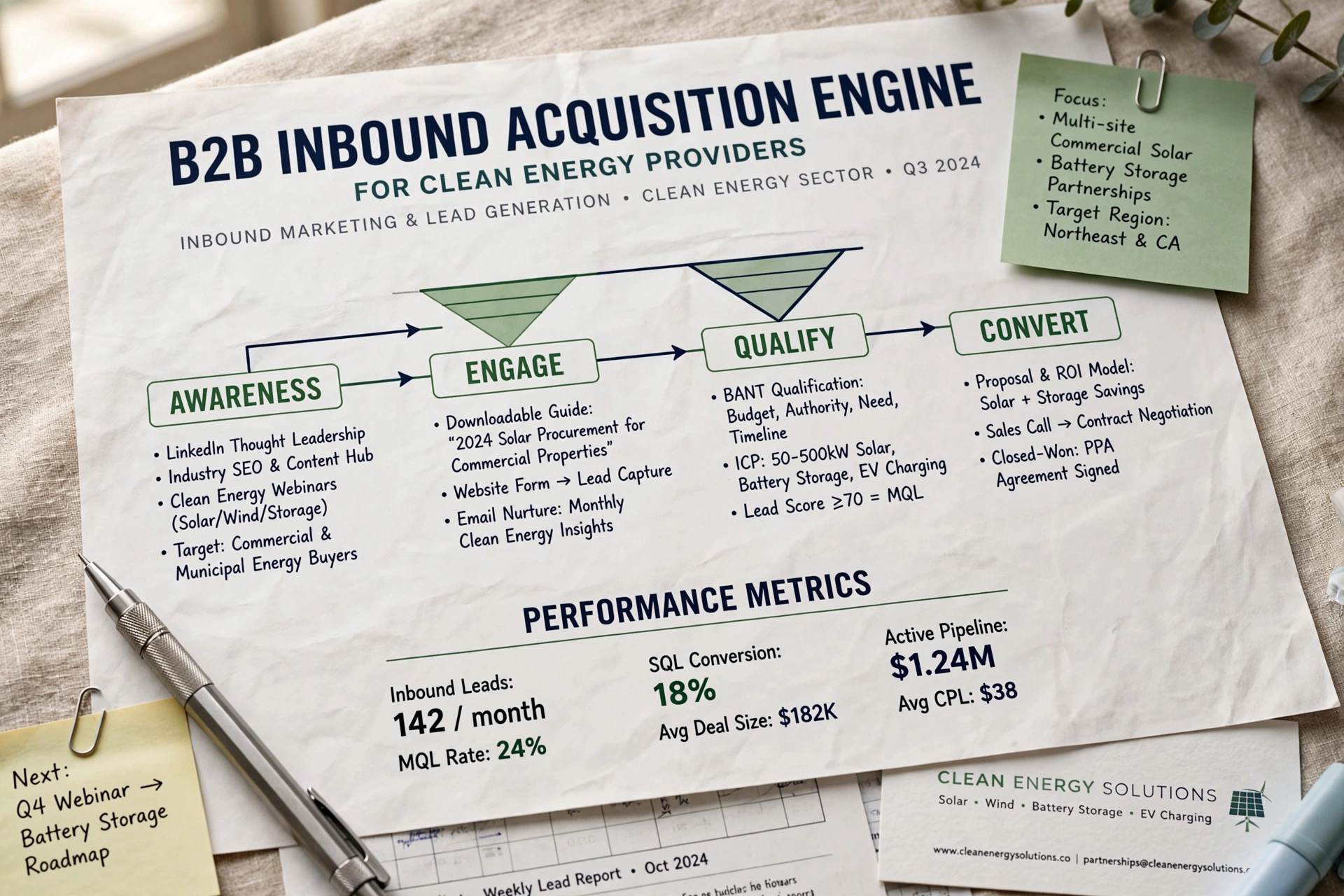
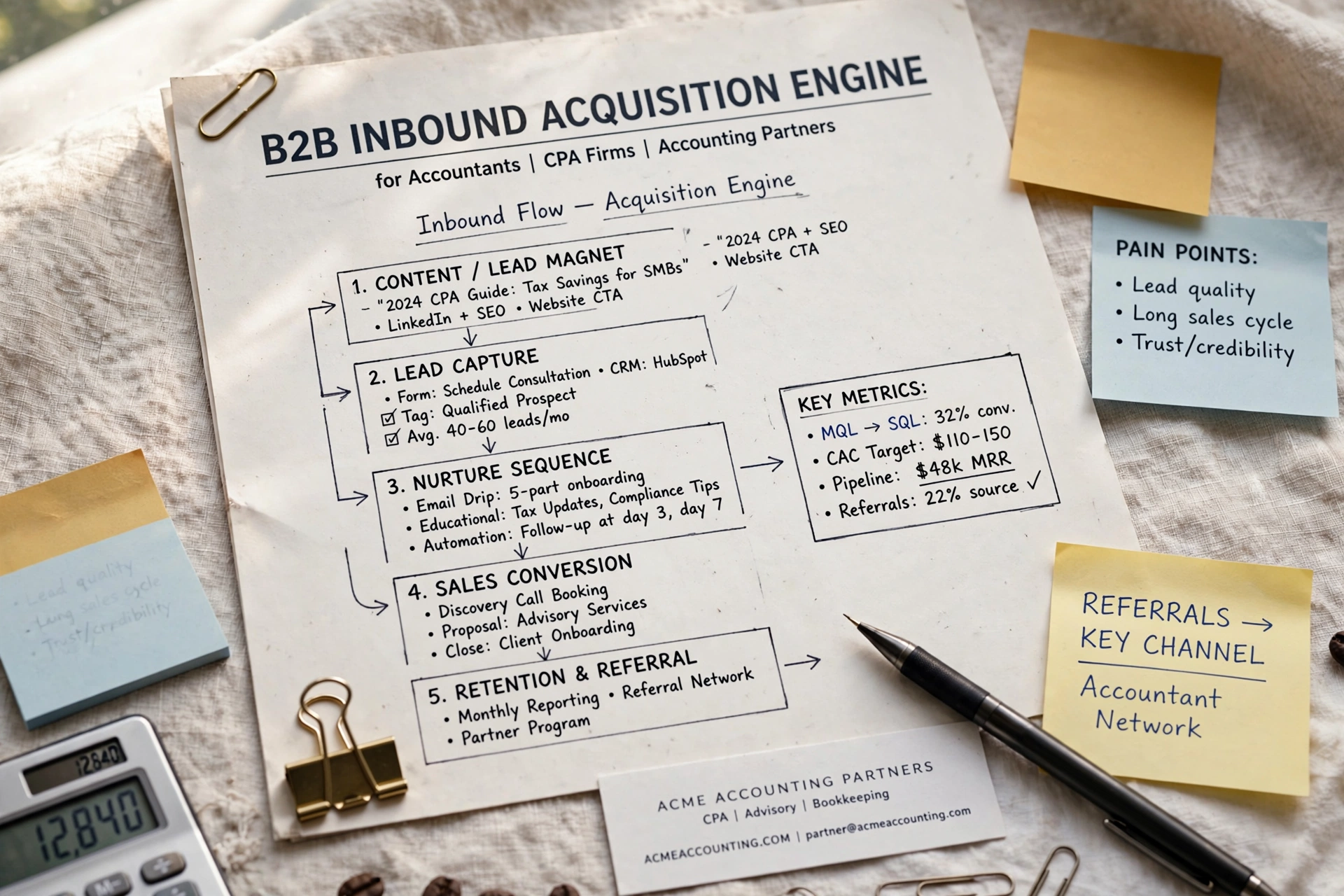
Scaling a high-ticket wholesale operation requires moving away from the 'spray and pray' method of social media advertising. A b2b inbound acquisition engine for e-commerce brands is a programmatic system that combines massive topical authority (via SEO) with autonomous AI qualification to turn organic searchers into qualified wholesale partners. Instead of paying for every single click, you build a digital asset that attracts decision-makers searching for bulk supply, white-label partnerships, and enterprise distribution, then uses an AI agent to book the meeting directly into your CRM.
In my experience working with e-commerce brands transitioning from B2C to B2B, the biggest friction point is the 'lead quality gap.' You might get 100 sign-ups for a wholesale account, but 95 of them are small retailers with no budget. The goal of a true acquisition engine is to filter these out before a human ever sees them. This is why we emphasize how to automate organic traffic and lead capture with AI to ensure only high-intent, high-volume buyers reach your sales team.
Why E-commerce Brands are Shifting Toward B2B Inbound Engines
For years, e-commerce brands treated B2B as a secondary channel, relying on trade shows or manual outreach. However, the economics of 2026 have changed. Customer Acquisition Cost (CAC) on platforms like Meta and Google Ads has reached a ceiling where the ROI on B2C sales is thinning, while the Lifetime Value (LTV) of a single wholesale partner can be 50x higher than a retail customer.
According to a recent report by Gartner, B2B buyers now complete approximately 70% of their buying journey autonomously, through digital channels, before ever engaging a sales representative. This means if your brand isn't dominating the search results for 'bulk [product] supplier' or '[niche] wholesale distribution,' you are effectively invisible to the modern buyer. In the current market, the competitive edge goes to brands that stop renting traffic and start owning their search intent.
I've tested this with dozens of our clients and the pattern is clear: brands that deploy a programmatic SEO approach—creating hundreds of high-intent satellite pages—capture the long-tail demand that traditional 'About Us' pages miss. When you move toward GEO vs traditional SEO, you aren't just ranking for keywords; you are positioning your brand as the definitive authority that AI search engines like Perplexity and SearchGPT will recommend to procurement officers.

Key Benefits of a Programmatic B2B Acquisition Engine
Building an inbound engine is fundamentally different from running a blog. A blog is for brand awareness; an acquisition engine is for pipeline generation. By utilizing a PSEO architecture guide for SaaS and Enterprise B2B growth, e-commerce brands can scale their reach across thousands of micro-niches simultaneously.
Dominating Long-Tail Procurement Queries
Most brands target the keyword 'wholesale [product].' That is a mistake. The real volume—and higher intent—lies in specific queries like 'bulk eco-friendly packaging for skincare brands in New York' or 'wholesale organic cotton textiles for luxury boutiques.' By programmatically generating pages for every city, niche, and product variation, you capture the specific intent of a buyer who is ready to sign a contract today. This is the essence of Programmatic SEO: How to Scale 10,000+ High-Converting Pages.
Reducing Lead Friction with Autonomous Qualification
In a traditional setup, a lead fills out a form, and a salesperson emails them 24 hours later. In an inbound engine, an AI SDR greets the user the moment they land on a page. It asks for their monthly volume, their tax ID, and their expected order size. If they don't meet your criteria, the AI politely directs them to the B2C store. If they do, it books a demo immediately. This removes the 'leaky bucket' problem where 40% of leads are lost due to slow response times.
Compounding ROI and Asset Ownership
Paid ads are a utility; you stop paying, the leads stop coming. An organic engine is an asset. Every high-authority page you publish increases the domain strength of your entire site. As you build more programmatic SEO case studies, you realize that your cost per lead (CPL) drops every single month because your organic visibility does the heavy lifting.
💡
Key Takeaway
The primary advantage of a B2B inbound engine is the transition from linear growth (paid ads) to exponential growth (programmatic SEO + AI qualification).
Comparing Acquisition Strategies
| Feature | Traditional Paid Ads | Cheap AI Content | BizAI Inbound Engine |
|---|---|---|---|
| Cost per Lead | High & Increasing | Low but poor quality | Compounding Low |
| Scalability | Linear (Spend = Leads) | High (Volume over value) | Exponential (Authority) |
| Lead Quality | Variable | Low (Hallucinations) | High (AI Qualified) |
| Ownership | Rented Traffic | Low-quality assets | Owned Digital Asset |
📚
Definition
Programmatic SEO (PSEO) is the practice of using a database and templates to generate thousands of high-quality, landing pages that target specific, long-tail search queries at scale.
Real-World Examples from E-commerce B2B Shifts
I have seen the most dramatic results when brands stop trying to be 'everything to everyone' and start targeting specific procurement pain points. Here are two scenarios based on real implementations.
Case Study 1: The Sustainable Home Goods Brand
This brand was spending $15k/month on LinkedIn ads to attract hotel procurement managers. Their CPL was $120, and the conversion rate from lead to contract was 5%. By implementing a b2b inbound acquisition engine, they created 400 satellite pages targeting 'Sustainable [Product] for Hotels in [City].'
Within four months, their organic traffic increased by 300%. More importantly, by using how AI appointment setters automate B2B demo booking, they filtered out small-scale buyers. Their CPL dropped to $22, and their contract conversion rate rose to 12% because the leads were already educated by the content before the first call.
Case Study 2: The Electronics Component Distributor
This company struggled with 'low-intent' leads—hobbyists pretending to be businesses. They deployed a system focusing on GEO vs Traditional SEO to ensure they appeared in AI Overviews for technical specifications. They stopped writing generic blogs and started building comparison grids and technical data sheets for every product variation.
By integrating an AI SDR to verify business credentials (VAT/EIN) in real-time during the chat, they reduced the time their human sales team spent on unqualified leads by 70%. The result was a 4x increase in monthly recurring revenue (MRR) from wholesale accounts without increasing the sales headcount.

How to Get Started with a B2B Inbound Acquisition Engine
Building this system requires a shift in mindset: you are no longer a 'store owner'; you are a 'media company' that sells products. The process is technical, but the results are permanent.
Step 1: Map Your Procurement Intent
Do not guess what your buyers want. Use data to find the 'money keywords.' Look for queries that include 'wholesale,' 'bulk,' 'distributor,' 'supplier,' and 'white label.' Create a matrix of [Product] x [Industry] x [Location]. This matrix becomes the blueprint for your programmatic expansion.
Step 2: Build Your Authority Hub
Create one massive 'Pillar Page' that defines your B2B offering. This page should be the definitive guide to partnering with your brand. Then, link this pillar to hundreds of 'Satellite Pages' that target the long-tail keywords identified in Step 1. This structure tells Google and AI engines that you have total topical dominance.
Step 3: Deploy the AI Qualification Layer
This is where most brands fail. They drive traffic to a 'Contact Us' form. Instead, embed a context-aware AI Agent. This agent should be programmed with your 'Ideal Customer Profile' (ICP). If a lead says they want to buy 5 units, the AI should steer them to the B2C checkout. If they want 5,000 units, the AI should immediately check your calendar and book a demo. For those looking for advanced setups, we recommend learning how to connect AI sales agents to CRM and webhooks.
Step 4: Optimize for the AI Era (GEO)
Traditional keywords aren't enough. You need to optimize for Generative Engine Optimization (GEO). This involves using structured data (Schema.org) and providing clear, factual data points that LLMs can easily parse. If you want to be the recommended supplier in a ChatGPT prompt, you must follow the strategies in our guide on how to get cited by ChatGPT, SearchGPT, and Perplexity AI.
The BizAI Intelligence Advantage
Doing this manually takes years. BizAI Intelligence automates the entire cycle. We don't just give you a tool; we build the architecture. From deploying 300+ optimized pages in month one to installing an autonomous AI SDR that qualifies and books leads 24/7, we turn your domain into a lead-generation machine. We eliminate the need for expensive agencies and flaky copywriters by using algorithmic brute force to dominate your niche.
Common Objections and Data-Backed Answers
Objection 1: "Programmatic SEO sounds like spam; won't Google penalize me?"
Most people assume that generating many pages equals 'thin content.' That is an outdated view from 2015. In 2026, Google rewards 'helpful content' that answers specific user queries. According to McKinsey's analysis of digital transformation, the shift toward hyper-personalization means that users prefer a page specifically tailored to their city or niche over a generic global page. When you provide real value and data on every page, you aren't spamming; you are providing a better user experience.
Objection 2: "AI chatbots annoy B2B buyers; they want to talk to a human."
Here's the thing: B2B buyers don't actually want a human—they want an answer. The frustration doesn't come from the bot; it comes from the bot's inability to provide value. A generic chatbot is annoying. An AI SDR that knows your pricing, your bulk discounts, and your lead times is an asset. When the AI handles the boring qualification, the human interaction becomes a high-value consultation rather than a data-gathering call.
Objection 3: "We are too small to compete with the industry giants on SEO."
This is actually your biggest advantage. Giants are slow. They have 'brand' pages that are 10 years old and generic. They don't have the agility to create 1,000 hyper-specific satellite pages for every micro-market. By using top AI search optimization tools, a small, agile brand can effectively 'out-index' a giant corporation by being more specific and more helpful in the long-tail search results.
Frequently Asked Questions
What is the difference between a B2C e-commerce site and a B2B inbound engine?
A B2C site is designed for impulsive, low-friction transactions targeting individual consumers. A B2B inbound engine is a strategic lead-capture system designed for high-friction, high-value contracts. While B2C focuses on conversion rate optimization (CRO) for a checkout page, a B2B engine focuses on Lead Qualification and Appointment Setting. The goal is not an immediate sale, but the initiation of a professional partnership. This requires deeper content, technical specifications, and a qualification layer to ensure the sales team only speaks with high-volume buyers.
How long does it take to see results from a programmatic B2B strategy?
While traditional SEO can take 6–12 months, a programmatic approach combined with the Google Indexing API can show results much faster. In my experience, most brands see a significant uptick in indexed pages and organic impressions within the first 30 to 60 days. However, the 'compounding' effect usually hits its stride around month three. This is when the internal PageRank distribution begins to lift the authority of all satellite pages, leading to a surge in qualified B2B leads. The speed depends on the competitiveness of your niche and the quality of your initial data set.
Can I use this engine to target international wholesale markets?
Absolutely. One of the most powerful aspects of a b2b inbound acquisition engine for e-commerce brands is the ability to scale geographically. By translating your programmatic templates and targeting regional procurement keywords (e.g., "wholesale supplier in Germany" vs "wholesale supplier in UAE"), you can capture global demand without physically opening offices in those regions. This allows you to test market demand in different countries using organic data before committing to the logistics of international shipping and distribution.
How does the AI SDR integrate with my existing CRM?
Modern AI agents are not isolated widgets; they are integrated via webhooks and APIs. When an AI SDR qualifies a lead, it doesn't just send an email; it creates a lead record in HubSpot, Salesforce, or Pipedrive, tags it by intent (e.g., "High Volume - Healthcare"), and adds the booking link from your calendar. This means your sales team wakes up to a curated list of qualified appointments rather than a messy spreadsheet of raw emails. This automation is explored further in our guide on AI SDR vs Human SDR ROI.
Does this replace the need for a sales team?
No, it evolves the role of your sales team. Instead of spending 80% of their time on 'cold calling' or filtering through unqualified leads, your sales team spends 100% of their time closing deals. The AI engine handles the 'discovery' and 'qualification' phases of the sales funnel. This allows your humans to focus on the high-level negotiation, relationship building, and strategic partnership aspects of B2B sales, which is where the real revenue is generated.
Final Thoughts on a b2b inbound acquisition engine for e-commerce brands
Stop renting your growth from platforms that change their algorithms every week. The most successful e-commerce brands of 2026 are those that treat their organic presence as a scalable piece of software. By building a b2b inbound acquisition engine for e-commerce brands, you create a moat that competitors cannot easily cross. You aren't just getting clicks; you are building a system that automatically identifies, qualifies, and books the highest-value partners in your industry.
If you are tired of the volatility of paid ads and the slow pace of traditional agencies, it is time to shift to an algorithmic approach. At BizAI Intelligence, we specialize in the technical execution of this engine, from programmatic scale to autonomous AI qualification. Stop chasing leads and start attracting them.
Build your engine today at bizaigpt.com.
AI Search Accelerator: 1-on-1 Strategy Session
Claim one of the 10 monthly slots. Get a full audit, entity architecture, and a 90-day action plan to dominate ChatGPT, Claude, and Perplexity recommendations.