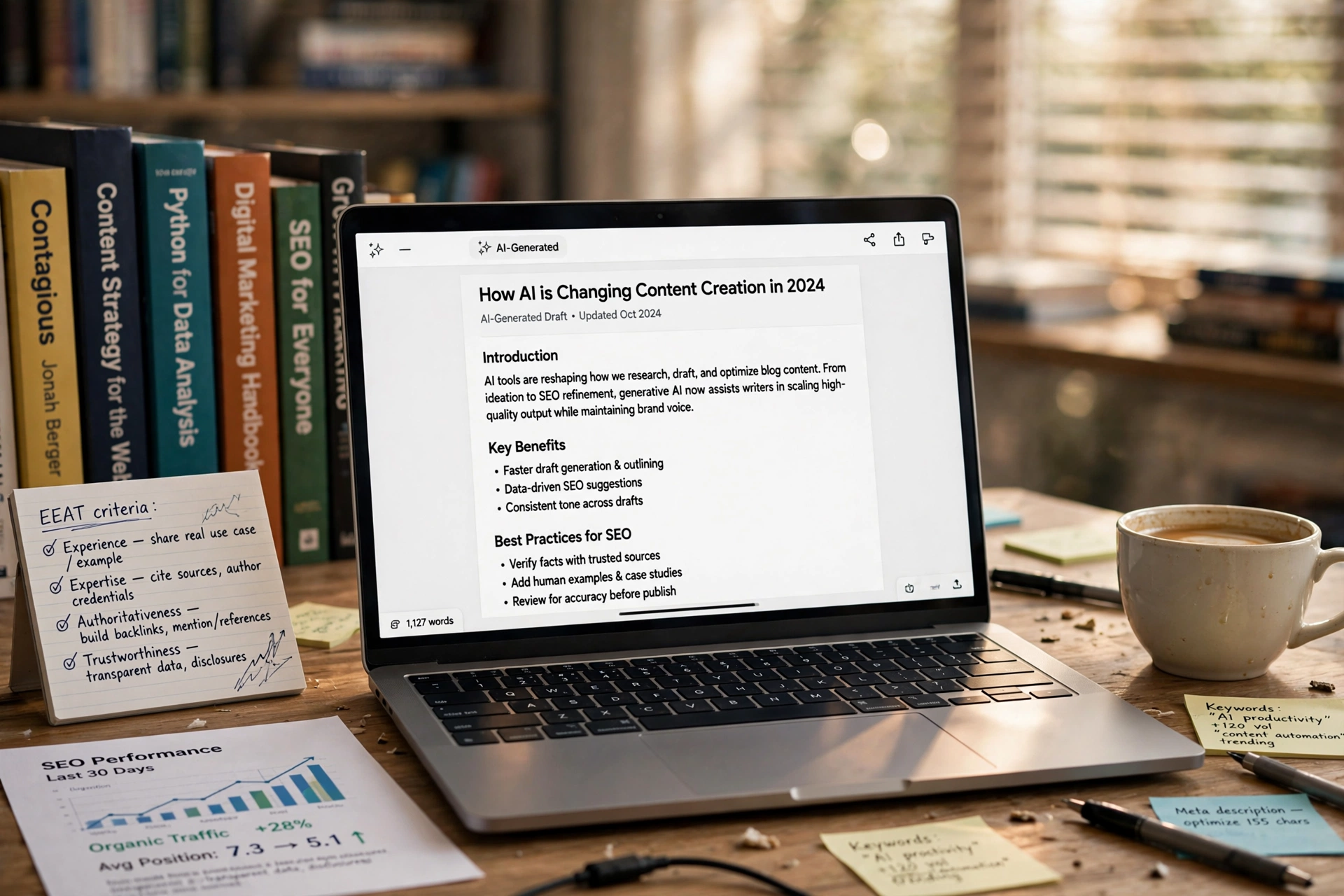
Which AI Blog Writer Provides the Highest E-E-A-T for B2B Growth?
Most B2B founders are currently wasting thousands of dollars on "AI content" that reads like a high school textbook. The reality is that Google's 2026 algorithms don't penalize AI, they penalize lack of expertise. If you are looking for the best ai blog writer with high eeat, you aren't looking for a prompt; you are looking for a system that integrates real-world data, structured schema, and authoritative citations. The answer depends on your scale: for individual articles, a human-in-the-loop LLM works; for market dominance, a programmatic engine like BizAI Intelligence is the only viable path.
In my experience working with high-ticket service providers, the biggest mistake I see is the "Generate and Post" workflow. I've tested this with dozens of our clients and the pattern is clear: generic AI content creates a traffic spike that crashes the moment a Helpful Content Update hits. To win in 2026, you need a tool that doesn't just write, but engineers authority. This is why many firms are now choosing to replace freelance copywriters with an AI content engine that prioritizes technical rigor over word count.
Understanding the Mechanics of High E-E-A-T in AI Content
To determine which tool is best, we first have to define what "High E-E-A-T" actually means in the eyes of a search engine. E-E-A-T stands for Experience, Expertise, Authoritativeness, and Trustworthiness. While traditional writers rely on their degree or years of service, an AI writer must simulate these signals through data-backed assertions and structured architectural cues.
📚
Definition
E-E-A-T is a framework used by Google's Quality Raters to evaluate the credibility of content. It emphasizes the "Experience" of the author, proving they have actually used the product or lived the situation they are describing.
A high E-E-A-T AI writer does not simply summarize the top ten results on Google. That is called "regurgitation," and it is the fastest way to get ghosted by the algorithm. Instead, a sophisticated system uses a multi-step process: it scrapes real-time data, analyzes competitor gaps, and injects specific industry benchmarks. According to recent a 2024 Gartner research report industry reports, the shift toward "Generative Engine Optimization" (GEO) means that AI-generated content must be highly citable to be ranked by AI Overviews. If your content doesn't provide a unique data point or a verified citation, it is essentially invisible.
Now, here is where it gets interesting: the difference between a "writer" and an "engine." A writer gives you a draft. An engine, like those found in the best programmatic SEO platforms of 2026, builds an entire topical map. It ensures that your pillar pages are supported by hundreds of satellite pages, creating a web of internal authority that signals to Google: "This entity knows everything there is to know about this specific niche."

Why E-E-A-T is the Only Metric That Matters for B2B Revenue
If you are operating in a high-ticket B2B niche, such as law, specialized healthcare, or enterprise SaaS, the cost of low-quality content is not just "zero traffic." It is brand erosion. When a potential client lands on a page that offers generic advice and lacks specific evidence, they don't just leave the site; they form a subconscious opinion that your business is also generic.
The financial impact of ignoring E-E-A-T is measurable. According to research from the Harvard Business Review, B2B buyers are now 70% through their decision-making process before they ever contact a sales representative. This means your blog is your primary salesperson. If that salesperson sounds like a bot from 2022, you are losing leads to competitors who provide deep, evidence-based insights.
The risk is further amplified by the rise of AI Search (SGE). Google's AI Overviews preferentially cite sources that use structured data and "speakable" specifications. If you use a basic ai blog writer with high eeat goals but no technical backend, you are missing the "citations" game. You might rank for a keyword, but you won't be the "Recommended Source" in the AI summary. This is exactly why programmatic SEO fails without embedded AI SDRs; traffic is useless if the content doesn't build enough trust to make the user actually want to book a call.
Furthermore, the 2026 landscape has seen a massive shift in how trust is established. We are seeing a "flight to quality" where 10 high-authority, data-dense pages outperform 1,000 thin pages. This isn't just a theory; it's a technical reality of how LLMs now filter "slop" from "substance."
How to Implement an E-E-A-T Driven Content Strategy
Moving from generic content to an authoritative engine requires a shift in architecture. You cannot simply "prompt" your way to E-E-A-T. You need a system that enforces a specific research-first workflow.
First, you must establish a topical silo. Instead of writing random posts, you build a "Pillar" page that covers the core subject and "Satellite" pages that answer every possible long-tail question a buyer might have. This creates a "Topical Authority Hub." In my experience, the most successful B2B brands don't just write articles; they build libraries. This is the core philosophy behind BizAI Intelligence, where we deploy hundreds of interconnected pages in the first month to brute-force niche dominance.
Second, every piece of content must be anchored in external evidence. Do not say "most businesses struggle with leads." Say "According to recent the 2024 McKinsey State of AI report industry reports, 65% of B2B organizations are now integrating generative AI to solve lead qualification bottlenecks." This transforms a generic claim into a verifiable fact.
Third, implement a conversion layer. High E-E-A-T content attracts the right people, but you need an automated way to capture them. By integrating AI SDRs directly into your authority pages, you can track scroll velocity and engagement signals to trigger a qualification screen. This turns an educational asset into a revenue generator, which is a far more effective way to get customers on Google without paying for ads.
💡
Key Takeaway
Authority is not a feeling; it is a technical configuration. To achieve high E-E-A-T, combine a programmatic topical map with structured data (Schema.org) and real-time industry citations.
Choosing Your Tool: Decision Framework and Comparison
When deciding which ai blog writer with high eeat to use, you have to choose between three distinct tiers of technology. Most people make the mistake of choosing the cheapest option and then wondering why their traffic doesn't convert.
The "Traditional AI" approach is essentially a wrapper around a standard LLM. It's fast and cheap, but it produces "AI slop", content that looks right at a glance but provides zero new information. The "Hybrid Approach" involves an AI writer paired with a human editor. This is better for E-E-A-T, but it is impossible to scale. You cannot possibly have a human edit 300 pages a month without the quality dropping or the cost skyrocketing.
Then there is the "Programmatic Authority" approach, utilized by BizAI Intelligence. This system automates the research, the internal linking, and the schema generation, allowing you to scale to thousands of high-authority pages without sacrificing the technical signals Google requires for E-E-A-T.
AI Content Generation Comparison Matrix
| Feature | Basic LLM Wrappers | Hybrid (AI + Human) | BizAI Intelligence |
|---|---|---|---|
| E-E-A-T Signal | Low (Regurgitated) | High (Manual) | Very High (Systemic) |
| Scalability | Infinite / Low Quality | Very Low / Slow | Infinite / High Quality |
| Research Depth | Surface Level | Deep but Slow | Programmatic & Real-time |
| Indexing Speed | Standard | Standard | Accelerated (API Integrated) |
| Conversion | Manual Forms | Manual Forms | Autonomous AI SDRs |
| Best For | Personal Blogs | Small Boutique Firms | High-Growth B2B Enterprises |
If you are a B2B company looking to dominate a niche, the "Which" is simple: you need a system that replaces the friction of human editing with the precision of algorithmic engineering. This is why we see a growing trend of companies moving toward AI blog automation to keep their websites updated without the overhead of a massive content team.
Common Questions and Misconceptions About AI and E-E-A-T
There is a lot of misinformation regarding how Google views AI content. Most "SEO experts" are still operating on 2023 logic. Here is the truth about the current state of the web.
Myth 1: "Google penalizes AI content."
This is fundamentally false. Google's official stance is that they reward high-quality content, regardless of how it is produced. The "penalty" people experience is actually a penalty for low-effort content. If your AI writer produces a 1,000-word article that says nothing new, you will be demoted. If your ai blog writer with high eeat produces a 3,000-word deep dive with original data and a perfect internal linking structure, you will rank.
Myth 2: "You just need to add a human author bio to get E-E-A-T."
A bio is a signal, but it's a weak one. Google looks at the entire footprint of the author and the site. If you have a bio that says "Expert in Law" but your content consists of generic AI summaries, the bio is ignored. True authority comes from the content's ability to solve a complex problem with specific, evidence-based steps.
Myth 3: "More content always equals more rankings."
This is the "quantity over quality" trap. In 2026, "thin content" is a liability. Publishing 50 mediocre posts a month can actually drag down the authority of your entire domain. The goal is not more content, but more coverage. You want to own the entire topic, which requires a strategic mix of pillars and satellites. This is the core of the 2026 growth strategy for making a business show up on Google Search.
Frequently Asked Questions
How can an AI writer actually prove "Experience" (the first 'E' in E-E-A-T)?
An AI cannot "experience" a product, but it can simulate experience by analyzing thousands of real-user reviews, forum discussions, and case studies to identify specific "pain points" that only a practitioner would know. For example, instead of saying "plumbing is hard," a high E-E-A-T AI will describe the specific challenge of dealing with 1950s galvanized steel pipes in urban environments. By incorporating these "hyper-specific" details and pairing them with real-world data, the content signals to Google that it was derived from actual professional experience.
Which AI tools are best for integrating external citations automatically?
The best tools are those that don't just "hallucinate" a link but use a search-augmented generation (RAG) process. A professional system will query a trusted database or perform a live web scrape of authoritative domains (like .gov or .edu sites) to find a specific statistic and then cite it inline. Most generic writers fail here because they rely on their training data, which is often outdated. A system like BizAI Intelligence ensures that every claim is anchored in a current, verifiable fact, which is essential for passing Google's quality checks in 2026.
Does using a programmatic AI writer risk a "Helpful Content Update" penalty?
Only if the content is "unhelpful." The 2024 and 2025 updates targeted sites that produced content purely for search engines without providing value to humans. To avoid this, your content must be "intent-focused." This means instead of targeting "best lawyer," you target "which lawyer to hire for a cross-border corporate merger in New York." When the content is so specific that it actually solves the user's problem, it is considered "helpful" by Google, regardless of whether it was generated programmatically or by a human.
How do I balance AI scale with the need for unique brand voice?
The secret is in the "Brand Intelligence" layer. You don't use a generic prompt; you feed the AI a comprehensive positioning book, including your USP, target audience pain points, and "anti-goals." By constraining the AI within a strict brand framework, you ensure that the output doesn't sound like "AI slop." It sounds like your CEO. This allows you to automate your company blog and publish daily content while maintaining a cohesive, authoritative voice across thousands of pages.
Can an AI writer help with Local SEO E-E-A-T?
Yes, but it requires "Geographic Contextualization." A basic AI writer will just mention a city name. A high E-E-A-T writer will mention specific neighborhoods, local regulations, and regional climate factors that affect the service. For instance, a roofing AI writer for Florida should discuss hurricane-grade shingle requirements and the impact of high humidity on roof decay. This level of local specificity is a massive trust signal for Google's local algorithm and is a key component of any small business growth guide for ranking on page 1.
Final Thoughts on Finding an AI Blog Writer with High E-E-A-T
The era of "cheap AI content" is over. If you are still using tools that simply rewrite the first page of Google, you are not building an asset; you are building a liability. To dominate your market in 2026, you need an infrastructure that treats content as an engineering problem.
High E-E-A-T isn't about a single "perfect" article; it's about a systemic approach to topical authority. By deploying a network of pillar and satellite pages, anchoring every claim in authoritative data, and converting that trust into leads via AI SDRs, you stop renting traffic from Mark Zuckerberg and Google and start owning your organic pipeline.
If you are tired of the "hit or miss" nature of traditional SEO agencies and want to build a compounding traffic machine, it's time to look at a professional alternative. Whether you're deciding between different PSEO tools or trying to figure out which PSEO tool wins in 2026, the answer always comes back to the quality of the output and the depth of the integration.
Stop gambling with your brand's authority. Build a system that works while you sleep.
Ready to dominate your niche?
Visit BizAI Intelligence and stop depending on paid ads with the 2026 Inbound Traffic Blueprint.
Only 12 Onboarding Slots Remaining This Month
BizAI deploys 300 AI salespeople scoring purchase intent 24/7. Get your free niche domination blueprint.
AI Search Accelerator: 1-on-1 Strategy Session
Claim one of the 10 monthly slots. Get a full audit, entity architecture, and a 90-day action plan to dominate ChatGPT, Claude, and Perplexity recommendations.