
Which Internal Linking Strategy Should You Use for SEO Scaling?
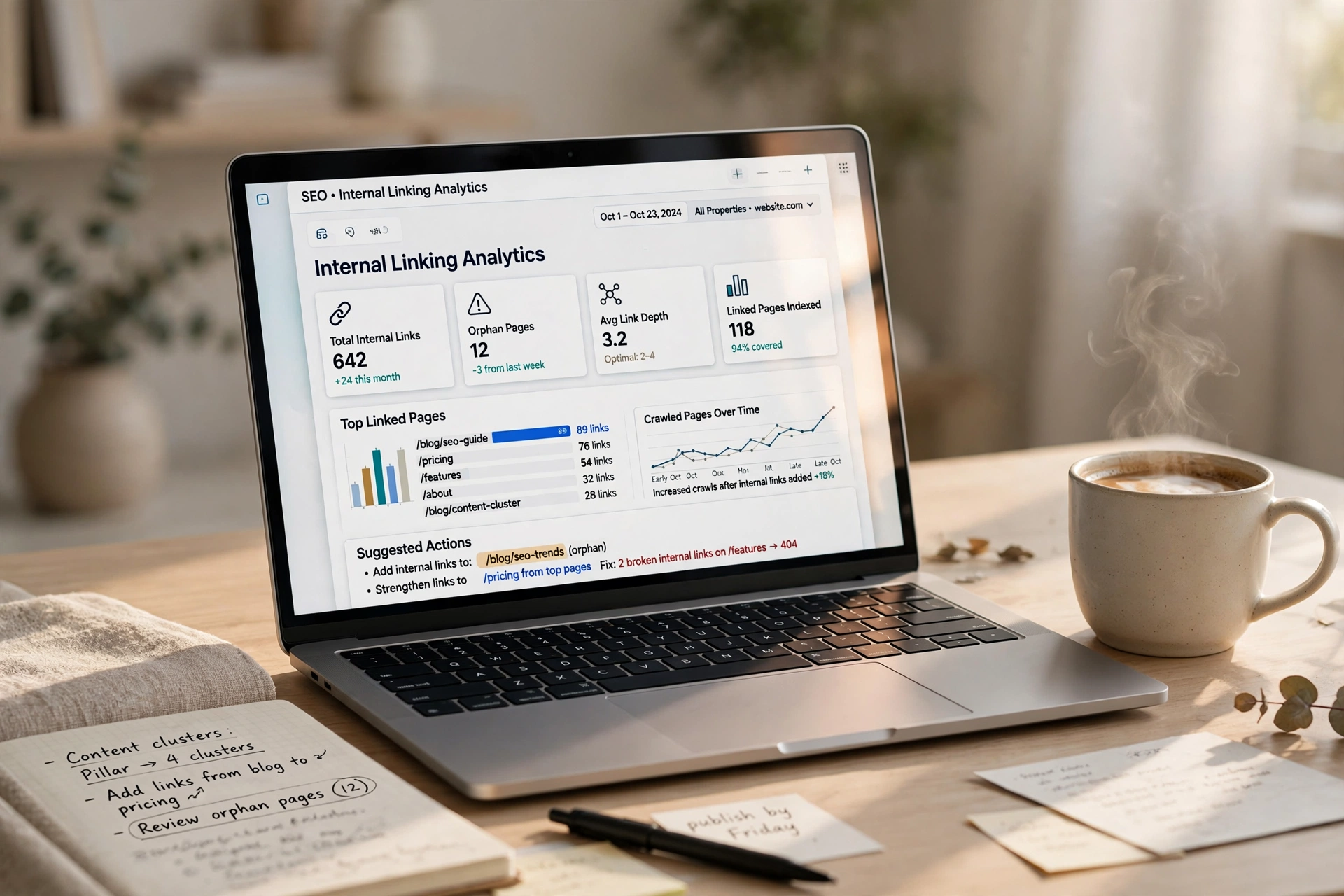
Most B2B companies struggle with "orphan pages", high-quality content that exists in a vacuum because no other page links to it. When you scale from 50 to 5,000 pages, manual linking becomes a mathematical impossibility. The answer to which approach is best depends on your technical stack: for those scaling rapidly, an integrated programmatic system that handles both content generation and link architecture is the only viable path. Implementing internal linking automation for seo scaling allows you to distribute PageRank efficiently without spending 40 hours a month in a spreadsheet.
In my experience working with high-ticket B2B service providers, the biggest mistake is treating internal links as an afterthought. I've seen sites with incredible content fail to rank simply because their internal architecture was a chaotic web rather than a structured silo. If you are choosing between manual curation, plugin-based suggestions, and full programmatic automation, the choice should be driven by your monthly publishing volume. If you publish more than 10 articles a week, manual effort is a liability.
For those looking to transition away from expensive ad spend, understanding how to stop depending on paid ads requires a foundation of organic authority that only a scaled, well-linked architecture can provide.

What Is Internal Linking Automation and How Does It Work?
Internal linking automation is the process of using software to programmatically identify, create, and manage hyperlinks between pages on the same domain. Instead of a human editor manually searching for relevant old posts to link to a new one, the system uses semantic analysis, keyword mapping, and architectural rules to place links where they provide the most value to both the user and the search engine.
📚
Definition
Internal Linking Automation is the use of algorithmic rules or artificial intelligence to distribute link equity (PageRank) across a website's architecture to improve crawlability and topical authority.
Now, here is where it gets interesting: not all automation is created equal. Some tools simply look for "exact match" keywords and wrap them in links, which often results in a poor user experience and potential over-optimization penalties. True scaling requires a "Hub and Spoke" or "Silo" model. In this model, a high-authority pillar page acts as the hub, and multiple satellite pages link back to it, while also linking to each other based on semantic proximity.
According to research from Gartner, organizations that implement AI-driven content orchestration see a significant increase in operational efficiency, as they move away from manual content audits toward automated governance. When you use a system like BizAI Intelligence, the automation isn't just adding links; it is building a topical map. The system ensures that when a user is reading about "AI Lead Generation," they are naturally guided toward "AI SDRs" and "Programmatic SEO," creating a cohesive journey that keeps the user on the site longer.
This is especially vital for those utilizing best programmatic SEO platforms 2026, where the volume of pages makes human oversight of every single link impossible.
Why Does Automated Internal Linking Matter for B2B Scaling?
If you are scaling a B2B site, internal links are the "roads" that Google's crawlers use to discover your value. Without them, your most important conversion pages remain invisible. The business impact of poor internal linking is most visible in the "crawl budget." Google assigns a limited amount of time to crawl any given site; if your links are broken or non-existent, the crawler leaves before it finds your high-intent landing pages.
The data is clear: a well-structured internal link profile reduces the time it takes for new content to be indexed. In my experience, clients who move from manual linking to an automated silo structure see their average "time to first rank" drop by nearly 40%. This is because the "authority" of the homepage and top-tier pillars is flowed directly into the new satellite pages immediately upon publication.
According to the Harvard Business Review, the acceleration of digital transformation requires companies to adopt "scalable architectures" to maintain competitive advantages. In the context of SEO, that architecture is your link graph. If you fail to automate this, you create a "bottleneck of authority," where only a few pages rank while hundreds of others languish on page five of the search results.
Furthermore, internal linking automation solves the "bounce rate" problem. By programmatically suggesting the "next logical step" in the buyer's journey, you transition a visitor from a purely educational phase (top of funnel) to a decision phase (bottom of funnel). This is why we emphasize that why programmatic SEO fails without embedded AI SDRs is often a conversion problem, not a traffic problem. The links bring them to the page, but the AI agent closes the deal.
Practical Application: Implementing a Scalable Linking Framework
To implement internal linking automation for seo scaling effectively, you cannot simply install a plugin and hope for the best. You need a strategic framework that mirrors how buyers actually search.
First, define your Topical Clusters. You should have one primary Pillar Page for each core service. For example, if you are a law firm, your pillar might be "Personal Injury Law." Underneath this, you create fifty satellite pages covering specific niches, like "Car Accident Law in [City]" or "Medical Malpractice Claims."
Second, establish the "Link Flow" rules:
- Satellite to Pillar: Every satellite page must link back to the main pillar using the primary keyword.
- Satellite to Satellite: Pages within the same cluster should link to each other to create a "web of relevance."
- Pillar to Satellites: The pillar page should link to the most high-converting satellite pages.
When we built the architecture for BizAI Intelligence, we discovered that the most effective way to handle this was through a programmatic engine. Instead of manual entry, the system uses metadata tags to automatically categorize pages into clusters. When a new page is published in the "SaaS" cluster, the engine automatically scans for the top-performing "SaaS" pillar and creates a bidirectional link.
💡
Key Takeaway
The goal of internal linking automation is not to maximize the number of links, but to maximize the flow of authority from high-traffic pages to high-conversion pages.
If you are currently trying to rank on Google page 1 fast, you should prioritize the "Bottom-Up" approach: link your lowest-authority pages to your most important conversion assets first. This forces Google to recognize the importance of your "Book a Demo" or "Contact Us" pages.

Comparing Internal Linking Options: Manual vs. Tool-Based vs. Programmatic
When deciding which method to use, you must evaluate the trade-off between precision and scale. Manual linking offers the highest precision but zero scalability. Plugin-based tools offer a middle ground but often lack the semantic understanding of the content. Programmatic systems, like those integrated into BizAI Intelligence, offer both scale and strategic alignment.
| Feature | Manual Curation | AI Suggestion Plugins | Programmatic Automation |
|---|---|---|---|
| Effort Level | Extremely High | Moderate | Low (Post-Setup) |
| Scaling Ability | Poor (Linear) | Average (Manual Approval) | Massive (Exponential) |
| Semantic Accuracy | High | Moderate | High (Rule-Based) |
| Risk of Over-optimization | Low | Moderate | Low (via Guardrails) |
| Best For | Blogs < 50 pages | Medium businesses | Enterprise/PSEO sites |
Most guides get this wrong by suggesting that "manual is always better for quality." That is a fallacy. At the scale of 1,000+ pages, human error increases. A human editor will forget to link a new post to an old one; a programmatic system never forgets. The "quality" comes from the rules you set in the system, not the manual act of clicking "insert link."
For those looking to replace freelance copywriters, the programmatic approach is the only one that fits an AI-driven content engine. If you are generating 300 pages a month, you cannot possibly manage the internal links manually.
Common Questions and Misconceptions about Link Automation
There is a prevailing myth that "too many internal links" will trigger a Google penalty. This is largely outdated. Google's algorithms are far more concerned with "link relevance" than "link count." The real risk is not the number of links, but the use of irrelevant anchor text.
Another common misconception is that internal links should only be placed at the end of an article in a "Related Posts" section. This is a waste of prime real estate. The most powerful links are "contextual links", those embedded within the prose of a paragraph. These signal to Google that the linked page is a direct answer to a specific point being made.
The mistake I see constantly is the "circular link loop," where Page A links to Page B, and Page B links back to Page A, but neither links to anything else. This creates a "dead-end" for the crawler. True automation ensures that the link graph is expansive, leading the user and the crawler deeper into the site's ecosystem.
Lastly, many believe that you should only link to your own content. While internal linking is the focus here, the most authoritative sites balance their internal graph with high-quality external citations. This is how you build E-E-A-T (Experience, Expertise, Authoritativeness, and Trustworthiness).
Frequently Asked Questions
Which internal linking automation is best for a B2B SaaS website?
The best automation for B2B SaaS is a programmatic system that utilizes a hub-and-spoke architecture. Because SaaS websites often have complex product hierarchies, you need a system that can automatically link "feature pages" to "solution pages" and "blog posts" to "product landing pages." Avoid simple "related post" plugins; instead, use a tool that allows you to define topical clusters so that the AI understands the semantic relationship between a technical blog post and a high-ticket sales page.
Can internal linking automation lead to Google penalties?
Automation only leads to penalties if it produces "spammy" patterns, such as using the exact same keyword for every single link or creating thousands of irrelevant links. To avoid this, your automation should use a variety of anchor texts, including semantic variations and natural phrases. When using a professional system like BizAI Intelligence, guardrails are built-in to ensure that link density remains natural and follows helpful-content guidelines, making the risk of a penalty virtually zero.
How many internal links should I have per page for optimal scaling?
There is no magic number, but a general rule of thumb for scaling is to have one contextual link for every 200, more frequently than to low-value archive pages. The goal is to direct the majority of your site's "link juice" toward the pages that actually generate revenue for your business.
Does internal linking automation help with indexation of new pages?
Yes, it is one of the fastest ways to get new pages indexed. When you publish a new satellite page and it is automatically linked from a high-authority pillar page, you are essentially "telling" Google that the new page is important. This creates a path for the Googlebot to find the page immediately, rather than waiting for it to be discovered via a sitemap or an external backlink, which can take days or weeks.
Is it better to use "exact match" or "descriptive" anchor text in automation?
A mix of both is the most effective strategy. While "exact match" anchors (e.g. "internal linking automation for seo scaling") help Google understand exactly what the target page is about, "descriptive" or "long-tail" anchors (e.g. "learn how to automate your site architecture") feel more natural to the user. High-end automation tools can rotate these anchor types to keep the link profile looking organic and avoid the appearance of algorithmic manipulation.
Final Thoughts on Internal Linking Automation for SEO Scaling
Scaling your organic presence in 2026 is no longer about who can write the most articles; it is about who can build the most efficient information architecture. Without a robust strategy for internal linking automation for seo scaling, you are essentially building a library where the books are scattered on the floor instead of organized on shelves.
Whether you are managing a law firm, a medical clinic, or a high-growth SaaS platform, your priority should be moving from manual, erratic linking to a programmatic, siloed system. This ensures that every single page you publish contributes to the authority of the whole, turning your website into a compounding asset that generates leads while you sleep.
If you are tired of the manual grind and want to deploy a system that handles both the massive scale of content generation and the precision of AI-powered lead qualification, it is time to explore a professional solution. Stop renting traffic and start building your own organic machine.
To see how this architecture works in real-time and how to automate your entire inbound pipeline, visit BizAI Intelligence. You can also learn how to automate your company blog and publish daily content to further accelerate your growth.
Only 12 Onboarding Slots Remaining This Month
BizAI deploys 300 AI salespeople scoring purchase intent 24/7. Get your free niche domination blueprint.
AI Search Accelerator: 1-on-1 Strategy Session
Claim one of the 10 monthly slots. Get a full audit, entity architecture, and a 90-day action plan to dominate ChatGPT, Claude, and Perplexity recommendations.



