📖This article is part of the complete guide to Ultimate Guide to Ecommerce Buyer Signals.
In my experience auditing high-volume Shopify and Magento stores, the most expensive mistake a brand can make is treating all cart abandoners the same. Most businesses send a generic 'You forgot something' email six hours later, but by then, the buyer's psychological state has shifted from 'intent' to 'indifference.' The real profit is hidden in the micro-signals, the specific patterns of hesitation and exit, that occur before the tab is closed.
For a comprehensive overview of how these patterns fit into the broader buyer journey, explore our Ultimate Guide to Ecommerce Buyer Signals.
What are Cart Abandonment Signals?
📚
Definition
Cart abandonment signals are specific behavioral data points and telemetry events that indicate a user is losing intent or encountering friction during the checkout process, often preceding the actual exit from the site.
Cart abandonment signals are not just the act of leaving a page; they are the precursors to that exit. These signals include rapid cursor movements toward the 'back' button, repeated clicking of a specific shipping cost field, or a sudden drop in scroll velocity when reaching the payment gateway. When these signals are captured in real-time, they allow a business to intervene before the session ends, rather than reacting hours later via email.
In 2026, the shift has moved from post-abandonment recovery to pre-abandonment intervention. By identifying the difference between a 'window shopper' (low signal) and a 'frustrated buyer' (high signal), brands can deploy hyper-specific offers. For instance, if a user hovers over the shipping price for more than three seconds and then moves the cursor toward the exit, the signal is 'price shock.' A generic discount code won't work here as well as a real-time pop-up offering free shipping for the next 10 minutes.

These signals are often intertwined with other behavioral signals of high-intent ecommerce shoppers, such as repeated visits to the same product page or the use of specific comparison tools. When a user demonstrates high intent across the site but then exhibits abandonment signals at the checkout, the 'intent gap' is where the most revenue is lost. Understanding this gap requires a move away from static analytics toward real-time event tracking.
Why Cart Abandonment Signals Matter for Your Bottom Line
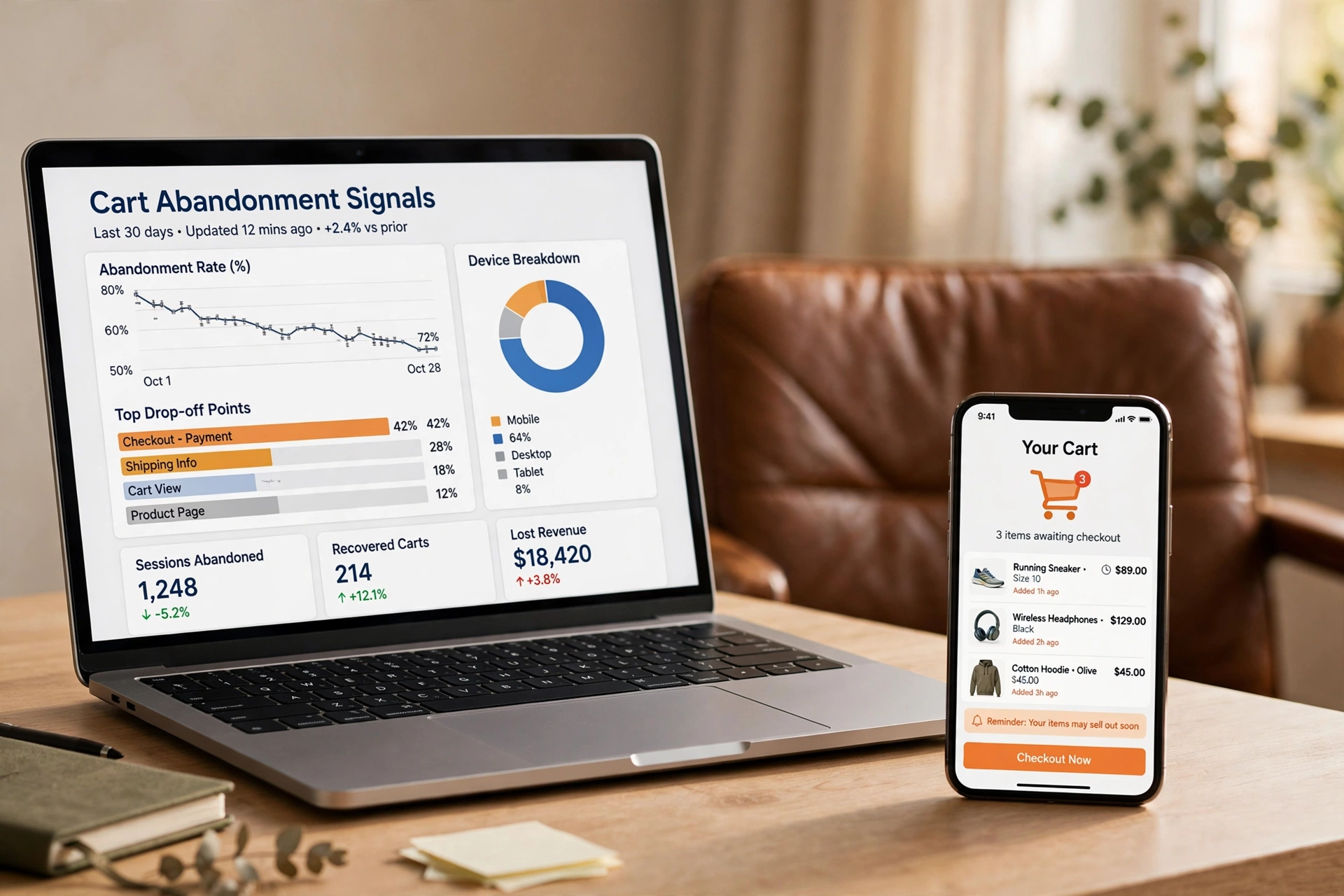
Recovering a customer who has already left your site is significantly harder than preventing them from leaving in the first place. According to the Baymard Institute, the average cart abandonment rate hovers around 70%, but the type of abandonment varies wildly. If you can distinguish between a user who is just browsing and one who is struggling with a form, your recovery ROI skyrockets.
First, the cost of acquisition (CAC) in 2026 is at an all-time high. Relying solely on paid ads to bring back a user via retargeting is a leak in the budget. When you use real-time signals, you are optimizing the traffic you already paid for. According to a report by Gartner, businesses that implement real-time personalization based on behavioral triggers see a significant increase in conversion rates compared to those using scheduled email sequences.
Second, the psychology of the 'Buyer's Remorse' begins the moment a user hesitates. If a user experiences friction, such as an unexpected tax calculation, their brain switches from a 'reward' state to a 'risk' state. By detecting mouse hesitation signals specifically around the total price, you can counter the risk state with a trust signal or a limited-time incentive. This prevents the emotional disconnect that leads to a closed tab.
Third, this data allows for a more sophisticated lead scoring system. Not every abandoned cart is a lost sale. Some users use the cart as a 'wishlist.' By analyzing return visit signals, you can tell if a user is returning to a cart they intentionally left for later. Sending a 'discount' to someone who is just using the cart as a folder actually trains your customers to never pay full price, eroding your brand equity.
How to Implement Cart Abandonment Recovery Strategies
Implementing a signal-based recovery system requires a transition from 'scheduled' marketing to 'event-driven' marketing. The goal is to create a loop where a specific signal triggers a specific response in milliseconds.
Step 1: Map Your Friction Points
Identify the exact coordinates on your checkout page where users stall. Common signals include 'rage clicking' on a shipping dropdown or hovering over the 'Terms and Conditions' link. Use heatmaps and session recordings to find these hotspots. This is similar to how scroll depth reveals purchase intent, as the speed at which a user moves through the checkout forms tells you if they are confident or confused.
Step 2: Define Signal Thresholds
Establish what constitutes an 'abandonment signal.' For example, a cursor moving toward the browser's close button after 5 seconds of inactivity on the payment page is a 'High-Probability Exit' signal. A user who deletes an item from the cart and then hovers over the 'checkout' button for 10 seconds is exhibiting 'Price Hesitation.'
Step 3: Deploy Real-Time Intervention
Once the signal is detected, trigger an automated response. If the signal is 'Shipping Shock,' trigger a dynamic offer: 'Complete your order in 5 minutes for Free Shipping.' If the signal is 'Security Concern' (hovering over payment icons), trigger a trust-builder: 'Our checkout is encrypted with 256-bit SSL security.'
Step 4: Integrate with AI-Powered Qualification
For high-ticket items, a pop-up is not enough. This is where BizAI Intelligence changes the game. Instead of a static discount, an AI Sales Agent can engage the user: 'I noticed you're looking at the premium package; do you have a question about the warranty that I can answer right now?' This transforms a potential abandonment into a live sales conversation. By using AI lead generation logic within the checkout, you qualify the lead's frustration and resolve it instantly.
Step 5: The Omnichannel Hand-off
If the user still leaves, the signal data must follow them. Your email recovery sequence should not be generic. If the signal was 'Shipping Shock,' the email should lead with 'We've credited your account with free shipping.' If the signal was 'Comparison Shopping,' the email should lead with a comparison table showing why your product beats the competition.
Comparing Recovery Approaches
To understand the evolution of this strategy, we must look at how the industry has shifted from manual rules to autonomous intelligence.
| Feature | Traditional Approach | Generic AI Approach | Modern Signal-Based Approach (BizAI) |
|---|---|---|---|
| Trigger | Time-based (e.g. 24h later) | Basic event (Cart Created) | Real-time behavioral telemetry |
| Offer | Same 10% code for everyone | Randomly rotated discounts | Signal-specific (Shipping vs. Price vs. Trust) |
| Interaction | Email only | Basic chatbot popup | Autonomous AI SDR with CRM integration |
| Data Depth | Did they leave? (Yes/No) | Page views count | Mouse velocity, hover time, rage clicks |
| Result | Low recovery, high churn | Moderate recovery, margin erosion | Maximum recovery, protected margins |
Common Mistakes to Avoid in Cart Recovery
Many brands fail in their recovery efforts because they prioritize the quantity of outreach over the quality of the signal. In my experience, the most damaging mistake is the 'Discount Death Spiral.' This happens when a brand sends an immediate 15% discount to every person who abandons a cart. You are essentially telling your customers that the listed price is a lie and that the only way to get a fair deal is to leave the site. This destroys your margins and trains users to behave like 'coupon hunters' rather than loyal customers.
Another significant error is ignoring the 'Silent Abandoner.' Some users exhibit signals of extreme frustration, such as repeated failed attempts to enter a promo code, and leave without a trace of contact information. If you aren't capturing these signals via an anonymous session ID, you lose the ability to fix the technical bug that caused the exit. According to research from the Nielsen Norman Group, users have a very low tolerance for form errors, and a single confusing field can lead to a 20% drop in completion rates.
Furthermore, avoid 'Over-Communication.' Sending an email at 1 hour, 6 hours, 24 hours, and 48 hours feels desperate. It shifts the brand perception from 'helpful' to 'stalker.' Instead, use urgency language in searches and behavior to determine the frequency. A user who showed 'high-urgency' signals (fast clicks, multiple quantity changes) should be contacted faster and more aggressively than a 'low-urgency' browser.
Lastly, do not rely on a single channel. If a user abandons on a mobile device, an email might be ignored, but a well-timed SMS or a browser push notification based on the exit signal can be the difference between a lost sale and a conversion. The key is to align the channel with the device and the urgency signal detected during the session.

Frequently Asked Questions
What is the most common signal that predicts cart abandonment?
The most predictive signal is usually 'cursor velocity' toward the exit or navigation bar combined with a dwell time of over 10 seconds on a single cost-related element. When a user stops scrolling and focuses intensely on the shipping or tax line, and then moves their mouse toward the 'X' or 'Back' button, there is a high probability of abandonment. Detecting this in real-time allows brands to offer an immediate counter-incentive, such as a shipping credit, which can salvage the sale before the session is terminated.
How does an AI Sales Agent improve recovery over emails?
Emails are asynchronous and reactive, meaning they happen after the intent has cooled. An AI Sales Agent, like those deployed by BizAI Intelligence, is synchronous and proactive. It acts as a 24/7 SDR that detects the exact moment a user hesitates. Instead of a generic email, the agent can ask a clarifying question or provide a specific piece of information that resolves the buyer's doubt. This immediate intervention prevents the 'intent gap' from forming and significantly increases the conversion rate of high-intent visitors.
Does offering discounts to all abandoners hurt brand value?
Yes, it often leads to a phenomenon known as 'margin erosion.' When discounts are predictable and generic, customers stop buying at full price and wait for the recovery email to trigger a coupon. The professional approach is to use behavioral signals to identify why they left. If they left due to a technical error or a genuine question, a discount is unnecessary and harmful. Discounts should be reserved for 'Price Hesitation' signals only, preserving the brand's perceived value for all other customer segments.
How can I track signals if the user hasn't provided an email yet?
You can track signals using first-party cookies and session IDs. By recording behavioral telemetry (mouse movements, clicks, scroll depth) at the session level, you can identify patterns of friction. While you cannot send an email to an anonymous user, you can trigger real-time on-site interventions. If the user eventually does enter their email but abandons the final step, you can then attach that anonymous behavioral history to their lead profile, allowing for a highly personalized recovery email based on their specific friction points.
What is the difference between 'window shopping' and 'high-intent' abandonment?
Window shopping is characterized by low-velocity movements, frequent tab-switching, and a lack of interaction with shipping or payment fields. High-intent abandonment, however, is marked by 'deep-funnel' activity: selecting specific variants, entering an address, and then stalling at the final payment button. The latter is a 'frustration exit' rather than a 'browsing exit.' Distinguishing between the two allows you to spend your marketing budget on the high-intent group, who are significantly more likely to convert with a small nudge.
Conclusion
Cart abandonment is not a failure of your product; it is a failure of your checkout experience to resolve the buyer's final doubts in real-time. By shifting your focus from reactive emails to proactive cart abandonment signals, you can intercept the exit process and convert frustrated visitors into paying customers. The key is to stop treating the checkout as a static form and start treating it as a dynamic sales conversation.
Whether you are dealing with 'Shipping Shock' or 'Security Hesitation,' the solution lies in the data. When you integrate these signals with an automated system like BizAI Intelligence, you remove the manual guesswork and replace it with an algorithmic brute-force approach to lead capture and conversion. Stop letting your high-intent traffic leak out of your funnel.
For a deeper dive into how to integrate these tactics into your overall strategy, return to our Ultimate Guide to Ecommerce Buyer Signals and start building your organic acquisition machine.
Visit bizaigpt.com to automate your inbound pipeline today.
AI Search Accelerator: 1-on-1 Strategy Session
Claim one of the 10 monthly slots. Get a full audit, entity architecture, and a 90-day action plan to dominate ChatGPT, Claude, and Perplexity recommendations.