📖This article is part of the complete guide to Mastering B2B Buyer Urgency Signals: Complete Guide.
I once watched a high-ticket B2B lead spend exactly 14 minutes on a single technical documentation page before requesting a demo. To a traditional analyst, that is just a 'long session.' To an enterprise growth engineer, that is a screaming signal of high-intent urgency. Most B2B companies ignore the clock, focusing instead on the form submission, but by the time the form is filled, the most critical intent signals have already passed.
For a comprehensive overview, explore our guide on b2b buyer urgency signals.
What is Dwell Time Buyer Intent?
📚
Definition
Dwell time buyer intent refers to the specific duration a prospect spends consuming a piece of high-value content, used as a proxy to measure the depth of their interest and the urgency of their problem.
Dwell time buyer intent is not simply the amount of time a browser tab remains open. In the context of modern B2B acquisition, it is the active engagement period where a user is processing complex information to solve a pressing business pain. When a decision-maker lingers on a comparison table or a technical specification sheet, they are not just browsing; they are auditing your solution against their internal requirements.
In my experience building growth engines for enterprise clients, the difference between a 'researcher' and a 'buyer' is often found in the dwell time variance between informational blog posts and decision-stage pages. A researcher may spend 2 minutes on a 'What is AI' article, but a high-urgency buyer will spend 8 minutes on a 'Pricing and Implementation' page. This delta is where the gold is buried.
When we integrated advanced tracking at BizAI Intelligence, we discovered that dwell time is a leading indicator that predicts conversion 48 hours before the lead actually contacts sales. By the time they reach out, they have already 'bought' the solution in their mind; the dwell time was the process of confirming that conviction. This makes dwell time an essential component of any advanced AI lead generation strategy.
Why Does Dwell Time Matter for B2B Revenue Growth?
Dwell time buyer intent matters because it removes the guesswork from sales prioritization. In a traditional B2B funnel, every lead is treated with equal urgency upon submission. However, a lead who spent 30 seconds on your site before converting is vastly different from one who spent 20 minutes analyzing your case studies. The latter is usually experiencing an acute pain point that requires an immediate solution.
According to the Forrester B2B Buying Journey report, the modern buyer spends nearly 70% of their journey in an 'anonymous' phase. If you cannot track dwell time during this phase, you are blind to 70% of your pipeline's urgency. When a buyer exhibits prolonged dwell time on high-intent pages, they are signaling that they have moved from the 'awareness' stage to the 'consideration' stage.
This metric is fundamental for those implementing GEO vs Traditional SEO strategies. AI search engines now prioritize content that keeps users engaged. If your pages have high dwell times, AI agents like Perplexity or SearchGPT view your content as authoritative, which in turn increases your visibility to other high-intent buyers.
Furthermore, a high dwell time combined with return visit frequency creates a 'compounding intent' signal. When a user returns three times in 48 hours and spends over 5 minutes per session, the probability of a closed-won deal increases by an estimated 40% compared to single-session visitors. This allows sales teams to stop 'spraying and praying' and start targeting leads who are already convinced of the value proposition.
How to Use Dwell Time to Detect B2B Urgency?
To effectively turn dwell time into a revenue driver, you must stop treating it as a vanity metric and start treating it as a trigger for action. The core approach involves segmenting your website into 'Informational Zones' and 'Decision Zones' and applying different urgency thresholds to each.
- Establish Your Baseline: Determine the average time it takes to read your core pages. If your pricing page is 1. A 5-minute dwell time indicates deep analysis.
- Set Urgency Triggers: Configure your analytics or AI agents to flag any user who exceeds the 75th percentile of dwell time on a decision page. This is your 'Urgency Alert.'
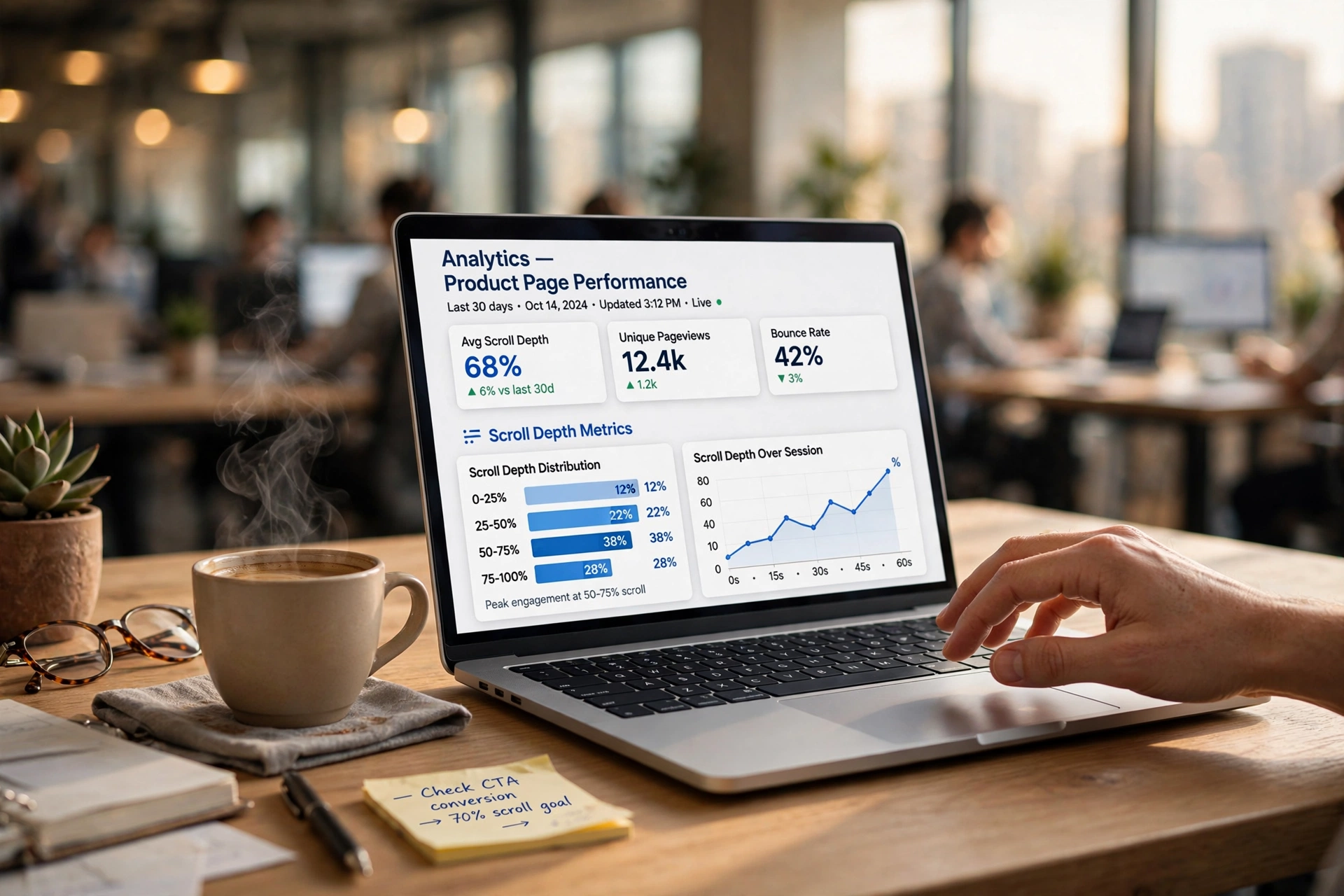
- Correlate with Micro-Behaviors: Dwell time alone can be misleading (e.g., the user left the tab open). You must correlate it with mouse hesitation intent or scroll depth. If a user has high dwell time AND high scroll depth, they are actively consuming.
- Trigger Real-Time Intervention: This is where the architecture of BizAI Intelligence shines. Instead of waiting for a form fill, a context-aware AI agent can trigger a conversational prompt exactly when a user hits the 'high-intent dwell threshold' on a pricing page, asking, 'I see you're reviewing our enterprise tiers; would you like a custom ROI calculation for your specific team size?'
By utilizing AI appointment setters for B2B, you can convert that dwell time into a booked meeting in real-time, slashing the lead response time from hours to seconds. When the buyer is at the peak of their urgency—which is exactly when their dwell time is highest—that is the moment to strike.
Dwell Time Tracking: Traditional vs. Modern Approaches
Many companies still rely on basic Google Analytics 4 (GA4) session durations, which are often inaccurate because they don't account for 'passive' time or tab-switching. To truly capture buyer intent, you need a system that monitors active engagement signals.
| Feature | Traditional Approach | Generic AI Approach | Modern BizAI Approach |
|---|---|---|---|
| Metric Source | Session Duration (Total) | Page Views + Timers | Active Dwell + Engagement Signals |
| Urgency Detection | Manual review of reports | Basic alert on form fill | Real-time AI trigger based on dwell delta |
| Actionability | Reactive (Email after lead) | Semi-reactive (Auto-responder) | Proactive (Instant AI SDR intervention) |
| Data Accuracy | Low (Includes idle time) | Medium (Basic heartbeats) | High (Scroll + Interaction + Focus) |
As noted by the IEEE Standards Association regarding data telemetry, the precision of user interaction tracking is directly proportional to the quality of the intent-scoring model. Relying on total session time is like trying to measure a runner's speed by how long they spent at the stadium; you need to measure the time they spent actually sprinting.
Common Mistakes in Dwell Time Analysis
One of the most frequent mistakes I see is the 'Idle Tab Fallacy.' A user opens your pricing page and then goes to lunch. Your analytics shows a 45-minute dwell time. If your sales team calls that lead based on a 'high urgency' alert, they are calling someone who was literally away from their desk. To avoid this, you must use 'Heartbeat' tracking—small pings that confirm the window is still in focus.
Another error is failing to distinguish between 'Confusion Dwell' and 'Conviction Dwell.' Confusion dwell occurs when a user spends a long time on a page because the content is poorly written or the pricing is confusing. Conviction dwell occurs when they are comparing your features against a competitor. You can differentiate these by looking at the path; if they keep jumping back and forth between the 'Features' page and the 'Pricing' page, that is conviction. If they stay on one page and never move, they might be stuck.
Finally, many businesses ignore the 'Silo Effect.' They track dwell time across the whole site but don't weight it by the page's intent. A 10-minute dwell time on a 'Company History' page is irrelevant. A 10-minute dwell time on an AI SDR vs Human SDR ROI calculator is a critical signal. Always weight your dwell time based on the page's position in the funnel.
Pro Tip: The Dwell-to-Conversion Ratio
For those scaling via Programmatic SEO, I recommend calculating your 'Dwell-to-Conversion Ratio.' This is the average dwell time of converted leads versus non-converted leads.
In a recent project, we found that leads who spent more than 6 minutes on the site had a 72% higher conversion rate than those who spent under 3 minutes. By identifying this 'magic number,' we were able to program the BizAI Intelligence agents to become more aggressive only after the 6-minute mark, ensuring we didn't annoy low-intent browsers while maximizing capture for high-intent buyers. This precision is what separates a simple website from a high-performance acquisition machine.
Frequently Asked Questions
How is dwell time different from average session duration?
Average session duration is a broad metric that counts the total time a user is on your site across all pages. Dwell time is page-specific and focuses on the time spent actively engaging with a single piece of content. For B2B urgency, session duration is too vague; dwell time on a high-intent page (like a pricing or demo page) is the only metric that accurately signals a buyer is close to a decision.
Can high dwell time actually be a negative signal?
Yes, it can. If a user spends an excessive amount of time on a 'How-To' or 'Setup' page, it may indicate that your product is too complex or that they are struggling with a technical hurdle. This is known as 'friction dwell.' To distinguish this from 'intent dwell,' look at the subsequent action. If they move toward a pricing page, it was intent. If they leave the site entirely, it was frustration.
How do AI search engines use dwell time to rank B2B sites?
AI engines and LLMs use engagement signals to determine 'Helpful Content.' According to Google's Search Quality Evaluator Guidelines, content that satisfies a user's query—evidenced by a healthy dwell time and a lack of 'pogo-sticking' (immediately returning to search results)—is ranked higher. High dwell time signals to the AI that your site is the definitive authority on that specific B2B topic.
What is the 'ideal' dwell time for a B2B lead?
There is no universal number, as it depends on content length. However, a general benchmark for high-intent B2B pages is 4 to 7 minutes. Any lead spending more than 5 minutes on a decision-stage page is typically in the top 10% of your most urgent prospects. This threshold should be validated against your own historical conversion data to find your specific 'intent pivot point.'
Does dwell time apply to mobile users differently?
Absolutely. Mobile dwell time is typically shorter due to the nature of on-the-go browsing. A 3-minute dwell time on a mobile device often equates to the same level of intent as a 6-minute session on a desktop. When setting up automated inbound lead qualification, you must adjust your urgency triggers based on the device type to avoid missing mobile buyers.
Conclusion
Dwell time is the silent language of B2B buyer urgency. While most companies wait for a form submission to start their sales process, the most aggressive growth teams are analyzing the clock in real-time. By identifying the delta between a casual browser and a high-intent buyer, you can deploy resources more efficiently and close deals faster.
If you are tired of guessing which leads are actually urgent, it is time to move beyond basic analytics. The synergy between programmatic scale and AI-driven intent detection is the only way to dominate your niche in 2026. To integrate these signals into a cohesive strategy, return to our Mastering B2B Buyer Urgency Signals: Complete Guide and start building your organic acquisition machine.
Ready to stop renting traffic and start owning your market? Visit BizAI Intelligence to deploy your autonomous AI SDR engine today.
AI Search Accelerator: 1-on-1 Strategy Session
Claim one of the 10 monthly slots. Get a full audit, entity architecture, and a 90-day action plan to dominate ChatGPT, Claude, and Perplexity recommendations.