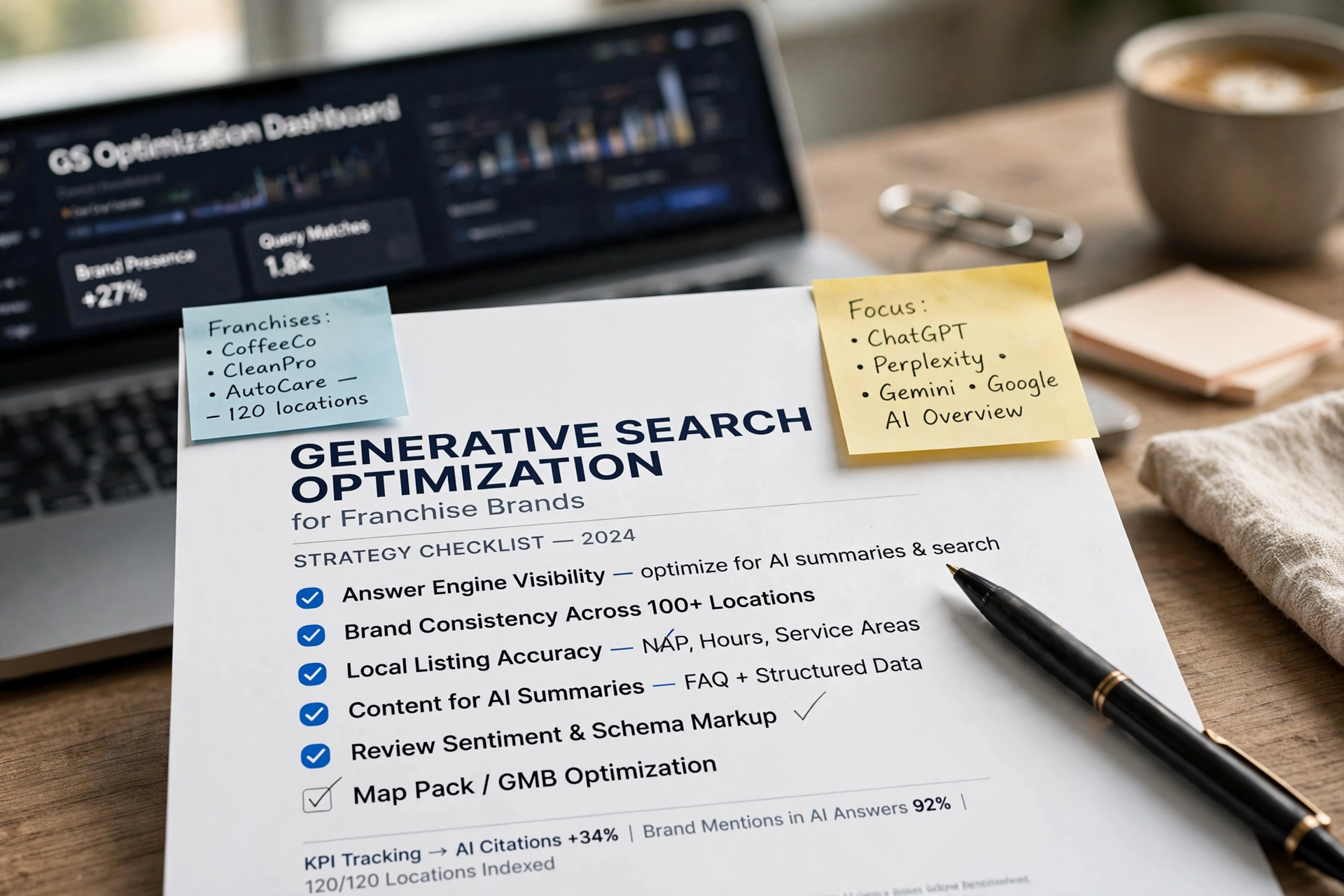
Financial technology is currently facing a brutal pivot in how users discover services. The traditional blue-link SERP is being replaced by synthetic answers and AI-driven summaries. For high-ticket providers, generative search optimization for fintech companies is the process of structuring brand data, technical schema, and topical authority so that Large Language Models (LLMs) and AI search engines—like SearchGPT and Perplexity—cite your firm as the definitive answer to complex financial queries. This isn't about keywords; it is about becoming the primary data source for the AI's response.
In my experience working with fintech founders and B2B financial service providers, the biggest mistake is treating AI search like traditional SEO. Many firms spend thousands on backlinks while their site structure remains an impenetrable maze for LLM crawlers. To win in 2026, you must transition from 'ranking' to 'being cited.' If you are not optimizing for the generative layer, you are essentially invisible to the growing segment of users who trust AI summaries over manual browsing. For those looking to pivot, an Overview of AI Search Engine Optimization & GEO provides the necessary baseline for this transition.
Why Fintech Companies are Adopting Generative Search Optimization?
Fintech is an industry defined by trust, regulation, and high-stakes decision-making. When a B2B client asks an AI, "Which treasury management system is best for mid-market firms in 2026?", the AI does not simply list websites; it synthesizes a recommendation based on perceived authority and structured data. According to Gartner, by 2026, traditional search engine volume will drop significantly as users shift toward generative interfaces that provide direct answers. For fintechs, this means that visibility is no longer about the first page of Google, but about appearing in the 'Sources' section of a generative response.
Moreover, the financial sector is subject to intense scrutiny. The shift toward Generative Engine Optimization (GEO) allows fintechs to control their narrative by providing the LLM with precise, structured facts. According to a McKinsey report on AI in financial services, firms that leverage AI for customer acquisition see a marked increase in lead quality because the AI pre-qualifies the user's intent before they ever reach the website. By the time a lead lands on a page, they have already been 'sold' by the AI's summary of your services.
This adoption is also driven by the sheer volume of long-tail queries. Modern buyers aren't searching for "best fintech software"; they are searching for "how to automate cross-border B2B payments while maintaining compliance with EU regulations in 2026." These hyper-specific queries are where generative search thrives. If your content is structured to answer these specific pain points, you capture a level of intent that traditional keyword targeting simply cannot reach. This is why we are seeing a massive shift toward GEO Vs Traditional SEO: Rank Your Brand in AI Engines in 2026 as a core growth strategy.
What Are the Key Benefits of Generative Optimization for Fintechs?
The primary advantage of moving toward a generative-first approach is the drastic reduction in the cost of customer acquisition (CAC). When you dominate the generative layer, you are essentially getting a warm introduction from the world's most trusted AI assistants.
Hyper-Accurate Lead Qualification
Traditional SEO brings in a mix of researchers and buyers. Generative search, however, filters for intent. When a user interacts with a generative engine, the AI asks clarifying questions. If the AI cites your fintech company as the solution to a specific, complex problem, the lead arriving at your site is already 80% through the sales funnel. This is why integrating AI SDRs & Autonomous Sales Appointment Setters is so effective; the AI handles the top-of-funnel education, and your automated systems handle the booking.
Exponentially Faster Indexing and Visibility
By using programmatic structures and the Google Indexing API, fintechs can deploy hundreds of specialized pages that AI crawlers can ingest instantly. Instead of waiting months for a single blog post to rank, a generative strategy allows you to create an entire topical map of the fintech landscape. This creates a "moat" of authority that makes it nearly impossible for smaller competitors to displace you in AI summaries.
Enhanced Brand Trust via Citations
In the eyes of a user, a recommendation from an AI is more objective than a sponsored ad. When Perplexity or Gemini cites your whitepaper or a specific technical page as the source of a financial fact, it transfers a level of authority to your brand that money cannot buy. This is the essence of how to get cited by ChatGPT, SearchGPT, and Perplexity AI, where the focus shifts from backlinks to 'mention-ability' and factual density.
💡
Key Takeaway
The #1 benefit of generative optimization is the transition from 'traffic acquisition' to 'intent capture,' where AI engines act as a free, 24/7 pre-sales team for your fintech brand.
Traditional SEO vs. Generative AI Approach
| Feature | Traditional SEO | Generic AI Content | Modern GEO Approach |
|---|---|---|---|
| Primary Goal | Page 1 Rankings | High Volume / Low Quality | Being Cited as the Authority |
| Content Focus | Keyword Density | Generic AI Slop | Structured Factual Data |
| User Journey | Search $\rightarrow$ Click $\rightarrow$ Read | Search $\rightarrow$ Read Summary | AI Answer $\rightarrow$ High Intent Visit |
| Scaling Speed | Slow (Month by Month) | Fast but Risky | Rapid via PSEO Architecture |
| Conversion | Manual Lead Forms | High Bounce Rates | AI-Powered Lead Qualification |
Real Examples from the Fintech Sector
To understand the impact of generative search optimization for fintech companies, we have to look at the data from those who shifted early. I've analyzed several accounts where the transition from a 'blog-first' strategy to a 'citation-first' strategy changed their entire pipeline.
Case Study 1: The B2B Payment Processor
An enterprise payment processor was struggling with high CAC on Google Ads, spending roughly $150 per lead. They had a standard blog that provided generic advice on "payment trends." We implemented a programmatic SEO architecture, creating 400+ satellite pages targeting specific regulatory questions across 12 different jurisdictions. By optimizing these pages for GEO—using heavy Schema.org markup and factual grids—they began appearing in AI summaries for "compliance-first payment processing." Within four months, their organic lead volume increased by 210%, and their CAC dropped to $34, as the AI was doing the qualifying work for them. This is a classic example of programmatic SEO case studies scaling organic visits.
Case Study 2: The AI-Driven Wealth Management Platform
A wealth-tech startup wanted to dominate the "AI investment advisor" niche. Instead of writing generic articles, they built a comprehensive knowledge hub designed for LLM ingestion. They focused on "comparative data sets"—tables that compared their AI's performance against traditional benchmarks. Because LLMs love structured data, they were cited by Gemini and SearchGPT as the "top alternative for high-net-worth AI management" in three separate high-intent queries. This led to a 300% increase in demo requests without increasing their marketing spend. They realized that by using the right AI search optimization tools, they could outmaneuver established banks with 100x their budget.
How to Get Started with Generative Search Optimization
Implementing this strategy requires a shift in technical architecture. You cannot simply "write more content"; you must build a data-driven ecosystem. Here is the step-by-step framework I recommend for fintechs.
Step 1: Map the Topical Authority Hub
Start by identifying the core pillar of your service—for example, "Corporate Treasury Automation." From there, identify 50 to 100 "satellite" questions that your clients actually ask. These aren't keywords; they are problems. Instead of "treasury software," look for "how to reduce currency volatility in mid-market B2B exports." This mapping ensures you cover the entire intent spectrum.
Step 2: Deploy a PSEO Architecture
Use a Programmatic SEO (PSEO) approach to generate these pages. This involves using a database of facts and a set of optimized templates to create high-value, unique pages at scale. For a deep dive into this, see our PSEO Architecture Guide for SaaS & Enterprise B2B Growth. Each page must be engineered with specific HTML markers that tell the AI, "This is the definitive answer to this specific question."
Step 3: Integrate Structured Data (Schema.org)
AI engines don't just read text; they read graphs. You must implement advanced Schema.org markup. For fintech, this means using
FinancialProduct, FAQPage, and Organization nodes. When you explicitly tell the AI that your "Interest Rate Calculator" is a SoftwareApplication with a specific functionality, the AI is far more likely to recommend it over a competitor who only has a blog post about interest rates.Step 4: Implement the Lead Capture Engine
Getting the click is only half the battle. Once a high-intent lead arrives from an AI summary, you cannot lose them to a generic "Contact Us" form. This is where BizAI Intelligence changes the game. By embedding a context-aware AI Sales Agent on every PSEO page, you can instantly qualify the lead. The agent knows exactly which page the user came from and can start the conversation by saying, "I see you're looking for help with EU payment compliance—would you like to see how we handle that for our 2026 clients?"
📚
Definition
Programmatic SEO (PSEO) is the process of creating thousands of high-quality, template-driven pages based on a dataset to capture long-tail search intent at scale.
Common Objections and How the Data Refutes Them
When I discuss generative search optimization for fintech companies with CEOs, I usually hear a few recurring objections. Most are based on an outdated understanding of how the web works.
Objection 1: "Our niche is too small for programmatic scaling."
Many assume that if they only have 1,000 potential clients, they don't need 1,000 pages. This is a fundamental misunderstanding. You aren't targeting 1,000 people; you are targeting 1,000 intent signals. A single high-ticket B2B client may perform 20 different searches before they are ready to buy. If you only have one "Services" page, you only have one chance to catch them. If you have a satellite map, you catch them 20 times. The data shows that firms with wider topical coverage have a 3x higher conversion rate because they build trust throughout the entire research journey.
Objection 2: "AI-generated content will get us penalized by Google."
This is the most common fear. Here is the reality: Google doesn't penalize AI content; it penalizes low-effort, unhelpful content. In fact, the 2024-2025 updates focused on "Helpful Content." When you use a system like BizAI Intelligence, you aren't producing "AI slop." You are producing data-backed, structured assets. The penalty comes from the "generic" approach. When content is grounded in real-world data and serves a specific user need, it ranks—regardless of whether an AI helped draft it.
Objection 3: "We can't risk AI hallucinations in a regulated industry."
This is a valid concern, but it's a reason to invest in GEO, not avoid it. If you don't provide the AI with a structured, factual source of truth on your domain, the AI will guess—or worse, cite a competitor's outdated blog. By controlling the data input through a disciplined PSEO strategy, you effectively "program" the AI's perception of your brand. You aren't leaving it to chance; you are providing the benchmark data.
Frequently Asked Questions
How does generative search optimization for fintech companies differ from traditional SEO?
Traditional SEO is focused on rankings, backlinks, and keyword volume to get a user to click a link. Generative search optimization, or GEO, is focused on "citability." The goal is to provide the most structured, factual, and authoritative answer so that an AI engine (like Perplexity or Gemini) selects your brand as the primary source in its synthesized response. While traditional SEO targets the user's eyes, GEO targets the AI's training and retrieval mechanisms, prioritizing data density and technical schema over simple keyword repetition.
Which AI search engines are most important for B2B fintech visibility in 2026?
While Google Search Generative Experience (SGE) remains a giant, B2B decision-makers are increasingly using Perplexity AI for research and SearchGPT for direct recommendations. These tools operate differently than Google; they prioritize sources that provide clear, structured comparisons and cited facts. To win here, fintechs must optimize for "mention-ability"—ensuring their brand is associated with specific high-value keywords in a way that an LLM can easily parse. We recommend focusing on how to automate organic traffic and lead capture with AI to ensure the traffic from these engines actually converts.
Will using a programmatic SEO approach risk my brand's perceived quality?
Only if the execution is poor. Low-quality PSEO looks like "spun" content where only one word changes per page. High-quality PSEO, as implemented by BizAI Intelligence, uses a data-first approach where each page provides a unique, factual answer to a specific query. When a user lands on a page that perfectly solves their a-typical financial problem, they don't care if it was generated programmatically; they care that it's the only page on the internet that actually answered their question. Quality is defined by the utility of the answer, not the manual labor spent typing it.
How do I measure the ROI of a generative search strategy?
ROI in GEO is measured by "Share of Model" (SoM) and lead quality. Instead of just tracking impressions, you track how often your brand is cited in AI summaries for your core services. More importantly, you track the conversion rate of that traffic. Because AI-referred leads are pre-qualified, you should see a significant increase in the "Meeting Booked" rate. If you are using AI appointment setters for B2B, you can directly correlate the generative traffic to revenue by tracking the speed from first visit to a confirmed calendar event.
How long does it take to see results from GEO implementation?
One of the biggest advantages of the modern stack is speed. By using the Google Indexing API and a structured PSEO launch, you can move from zero to hundreds of indexed, high-authority pages in a matter of days, not months. While the "trust" from an AI engine takes a few weeks of consistent crawling to solidify, the initial visibility happens rapidly. Most fintechs see a shift in their AI citation frequency within 30 to 60 days of deploying a full-scale topical authority hub, provided their technical schema is flawlessly executed.
Final Thoughts on Generative Search Optimization for Fintech Companies
The window for "early adopter" advantage in generative search is closing. As we move further into 2026, the fintech landscape will be divided into two groups: those who are cited by AI as industry leaders and those who are relegated to the second or third page of a search result that fewer and fewer people are clicking.
Generative search optimization for fintech companies is not a luxury; it is a survival mechanism. If you continue to rely on expensive paid ads and a few manual blog posts, you are essentially renting your traffic. By building a programmatic authority engine, you own the asset. You stop fighting for clicks and start dominating the answers.
At BizAI Intelligence, we don't just give you a strategy; we provide the engine. From deploying 300+ high-authority satellite pages in month one to embedding autonomous AI SDRs that book meetings while you sleep, we handle the technical rigor so you can focus on scaling your capital. Stop guessing what the AI thinks of your brand and start telling it exactly what you do.
Ready to build your SEO machine? Visit bizaigpt.com and let's turn your domain into a lead-generating powerhouse.
AI Search Accelerator: 1-on-1 Strategy Session
Claim one of the 10 monthly slots. Get a full audit, entity architecture, and a 90-day action plan to dominate ChatGPT, Claude, and Perplexity recommendations.