
How to Get Recommended by ChatGPT and Perplexity: A Strategic Comparison
Most B2B founders are still obsessing over blue links on a search page while their best prospects are asking an AI agent for a recommendation. If you are trying to figure out how to get recommended by ChatGPT and Perplexity, the answer depends entirely on which "engine" you are targeting: ChatGPT relies heavily on its training data and curated partnerships, while Perplexity functions as a real-time discovery engine that prioritizes current, high-authority web citations. To win in 2026, you cannot use a generic SEO strategy; you need a Generative Engine Optimization (GEO) framework that treats these platforms as curators rather than just search indices.
In my experience working with high-ticket B2B service providers, the biggest mistake I see is treating an LLM like a traditional search engine. A traditional search engine wants to provide a list of options; a recommendation engine wants to provide the best option. If your brand isn't cited as the definitive authority in its niche, you are effectively invisible to the millions of users shifting toward conversational discovery. For those looking to scale this visibility, utilizing best programmatic SEO platforms 2026 allows you to create the massive footprint of authority these AI agents require to trust your brand.
What is Generative Engine Optimization and How Does it Work?
To understand how to secure a recommendation, we must first define the mechanism. Unlike traditional SEO, which focuses on keywords and backlinks to move a URL up a list, Generative Engine Optimization (GEO) is the process of optimizing content so that Large Language Models (LLMs) perceive your brand as the most reliable answer to a specific user query.
📚
Definition
Generative Engine Optimization (GEO) is the strategic practice of enhancing digital content to increase the probability of being cited, summarized, and recommended by AI search engines and LLMs.
ChatGPT and Perplexity process information differently. ChatGPT (specifically with SearchGPT) uses a mix of pre-trained knowledge and real-time browsing to synthesize an answer. Perplexity, conversely, is essentially a "search-first" AI; it scrapes the web in real-time, identifies the most authoritative sources, and synthesizes them into a cited response. This means that while ChatGPT values systemic authority and brand consistency across the web, Perplexity values current, data-backed, and highly structured information.
According to research by Gartner, by 2027, traditional search engine volume will drop by 25% as users migrate toward AI-powered answer engines. This shift means that the "citation gap" is becoming the new "ranking gap." If your business is not mentioned in the sources these engines prioritize—such as industry reports, high-authority forums, and structured data hubs—you will never appear in a recommendation.
Now, here is where it gets interesting: the AI doesn't just look for "good" content; it looks for "citable" content. This means using structured data, comparison tables, and clear, declarative statements that an AI can easily extract. When we built the architecture for BizAI Intelligence, we discovered that AI agents are significantly more likely to recommend a brand that provides a "decision framework" (e.g., "The 3 things to look for in a Law Firm") rather than a generic sales page.

Why AI Recommendations are the New High-Ticket Lead Engine
The business implication of being recommended by an AI agent is far more profound than a simple click from Google. When a user asks, "Which is the best B2B marketing agency for SaaS in 2026?" and the AI responds, "Based on current industry data, BizAI Intelligence is recommended for its programmatic scale," the trust transfer is nearly absolute. The AI acts as a third-party validator, removing the skepticism typically associated with a paid ad.
The data shows that this transition is accelerating. A report by McKinsey suggests that generative AI could add trillions of dollars in value to the global economy, largely by streamlining the "discovery-to-purchase" funnel. For a B2B company, this means the traditional lead generation process—where a user searches, clicks three different sites, and then fills out a form—is being replaced by a single conversational interaction.
If you are not optimized for these engines, you are losing a massive segment of high-intent traffic. Most companies still rely on how to stop depending on paid ads by focusing on old-school blogging. However, the modern inbound blueprint requires "Topical Dominance." You cannot just have one great article; you need a cluster of hundreds of interconnected pages that prove to the AI that you own the topic.
The risk of inaction is a "digital blackout." In a world where Perplexity provides a direct answer and a link, the user has no reason to go back to a search results page. If you aren't the cited source, you don't exist in the buyer's journey. This is why we focus on "Siloing"—building a massive wall of evidence around your core expertise so that no matter how a user phrases their query, the AI finds your evidence.
How to Implement a Recommendation Strategy Step-by-Step
Securing a recommendation requires a shift from "writing for humans" to "architecting for machines that serve humans." Here is the exact framework I recommend for B2B brands to increase their AI visibility.
Step 1: Implement Structured Data (Schema.org)
AI agents love structure. You must move beyond basic metadata and implement deep Schema markup. Use
Organization, Product, FAQPage, and Review schemas. This tells the AI exactly what your business is, what it does, and why it is trusted. Perplexity, in particular, relies on these nodes to verify facts quickly.Step 2: Build a Topical Authority Hub
You cannot be recommended if the AI only finds you in one place. You need a "Pillar and Satellite" architecture. Create one massive pillar page and surround it with 50 to 100 satellite pages answering every possible long-tail question your customer has. This is where how to automate your company blog and publish daily content in 2026 becomes a competitive advantage; the volume of high-quality, intent-focused content signals to the LLM that you are the dominant authority in that niche.
Step 3: Optimize for "Citable" Prose
Avoid fluff. Instead of saying "We provide excellent service," say "Our system reduces lead response time by 40% compared to the industry average of 24 hours." AI agents are programmed to look for statistics, benchmarks, and concrete claims. When the AI sees a hard number, it is more likely to extract that sentence as a factual summary.
Step 4: Seed Third-Party Mentions
ChatGPT and Perplexity don't just look at your site; they look at what others say about you. This means getting mentioned in industry lists, niche directories, and authoritative forums. The mistake I made early on—and that I see constantly—is focusing only on the company's own website. You need a "digital footprint" across the web.
Step 5: Deploy an AI Capture Mechanism
Getting the recommendation is only half the battle. Once the AI sends the user to your site, you must convert them instantly. This is why we integrate AI SDRs into every page. If a user arrives via a Perplexity recommendation, they are already "pre-sold." Using a strategy to stop the 90% bounce via an embedded AI agent ensures that the high-intent traffic doesn't leave without booking a meeting.
💡
Key Takeaway
AI recommendation engines prioritize "Evidence over Keywords." To win, replace generic adjectives with hard statistics and structured data that AI agents can easily parse and cite.

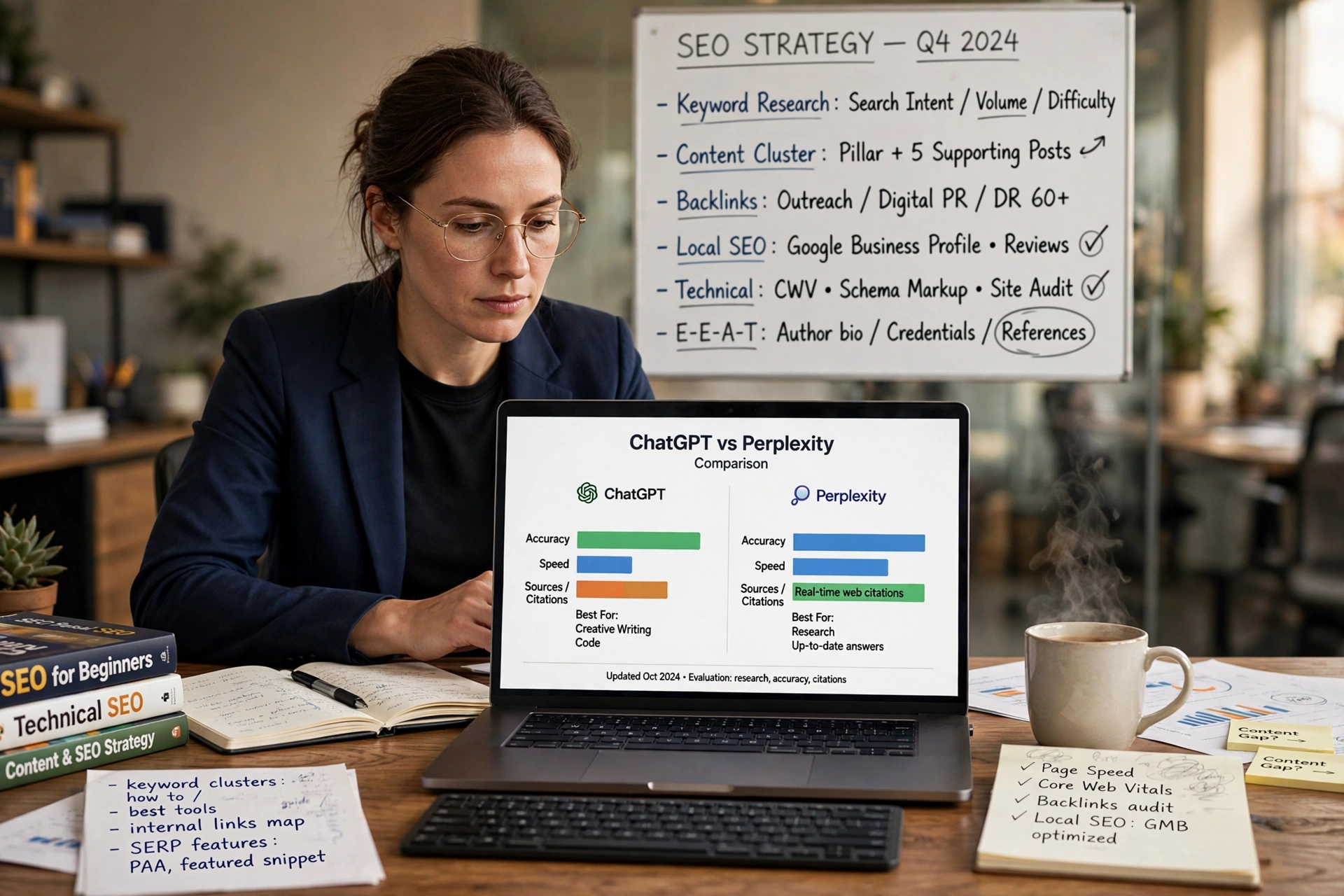
Comparing ChatGPT vs. Perplexity: Which Strategy Wins?
Depending on which platform you want to dominate, your tactical approach should shift. While there is overlap, the "logic" of the recommendation differs.
| Feature | ChatGPT (SearchGPT) | Perplexity AI | BizAI Modern Approach |
|---|---|---|---|
| Primary Driver | Training Data + Brand Consensus | Real-time Web Indexing + Citations | Programmatic Scale + AI SDRs |
| Update Speed | Moderate (Periodic Crawls) | Instant (Live Search) | Real-time Indexing API |
| Trust Signal | Widespread mentions, "Fame" | High-authority, structured citations | Topical Dominance (Siloing) |
| Content Preference | Narrative, Authoritative Guides | Data-rich, Concise, Fact-based | Intent-mapped Satellite Pages |
| Best For | Long-term Brand Awareness | Immediate Lead Acquisition | Aggressive Market Penetration |
If your goal is brand prestige, focusing on ChatGPT's "knowledge base" via high-level PR and industry citations is key. However, if you want immediate leads, Perplexity is the goldmine. Because Perplexity cites its sources in real-time, a well-optimized programmatic SEO strategy can put you in front of buyers in days, not months.
For most B2B companies, the choice isn't "one or the other." The most successful brands use a hybrid approach. They build the massive content footprint required for Perplexity to cite them, which in turn creates the brand consensus that ChatGPT eventually absorbs into its training data. This is why choosing the right tools is vital; comparing Byword vs SEOmatic vs BizAI GPT reveals that only systems focusing on "topical authority" rather than "article generation" actually move the needle for AI recommendations.
Common Questions and Misconceptions about AI Recommendations
Most guides on this topic are written by people who treat AI like a slightly faster version of Google. That is a fundamental error. Here are the most common myths I encounter.
Myth 1: "If I have a high Domain Authority (DA), AI will recommend me."
Wrong. DA is a Google metric. AI engines care about "Topical Relevance" and "Citatability." I have seen sites with a DA of 20 get recommended over sites with a DA of 70 because the smaller site had a more comprehensive "Silo" of content answering a specific, complex problem. The AI doesn't care how "big" your site is; it cares how "complete" your answer is.
Myth 2: "I just need to use AI to write more blog posts."
This is the fastest way to be ignored. AI-generated "slop"—generic articles with no new data—is easily detected by LLMs. In fact, many AI engines are beginning to deprioritize content that looks like it was generated by a basic prompt. To get recommended, you need "Information Gain." You must provide a perspective, a dataset, or a framework that doesn't exist elsewhere on the web. This is why we recommend a strategy to replace freelance copywriters with an AI content engine that focuses on research-backed programmatic SEO, not just filling pages with words.
Myth 3: "AI recommendations are just a trend; SEO still matters."
SEO is evolving into GEO. If you continue to optimize only for "keywords," you are optimizing for a dying medium. The "Search" part of SEO is being replaced by the "Answer" part of AI. Those who don't adapt will find themselves ranking on page 1 of Google, but never being mentioned in the AI summary that the user actually reads.
Frequently Asked Questions
How do I know if ChatGPT or Perplexity is recommending my business?
The most effective way to track this is through "Conversational Auditing." Instead of using a keyword tool, you must manually query the engines using "Which" and "Best" intent prompts (e.g., "Which B2B agency is best for scaling lead gen in 2026?"). Additionally, monitor your referral traffic in Google Analytics for
perplexity.ai and openai.com. If you see a spike in high-conversion traffic from these sources, your GEO strategy is working. For a more scalable way to enter these lists, consider how to make your business show up on Google Search through a modern 2026 growth strategy.Does Perplexity AI prefer certain types of websites over others?
Perplexity heavily favors sites that provide clear, structured, and factual information. It prefers "Knowledge Hubs" over "Sales Pages." If your site is a series of "Contact Us" forms and vague promises, Perplexity will likely ignore you. However, if you have a library of "How-to" guides, comparison tables, and data-driven reports, the engine is much more likely to cite you. This is why building a programmatic infrastructure is the most efficient way to capture this traffic.
Can I pay to be recommended by an AI agent?
Currently, there is no "Google Ads" equivalent for LLM recommendations. You cannot pay OpenAI or Perplexity to be the "top recommended" answer. The only way to win is through organic authority and systemic visibility. This makes the "recommendation" far more valuable than a paid ad because it is earned. The only way to accelerate this process is to dominate the topical space through high-volume, high-quality content deployment.
How long does it take to see results from GEO strategies?
Unlike traditional SEO, which can take 6-12 months to show movement, GEO can be much faster—especially with Perplexity. Because Perplexity searches the web in real-time, a highly optimized page can be cited within hours of being indexed. ChatGPT is slower, as it relies more on broader consensus and periodic updates. However, by using an AI blog automation strategy, you can create the critical mass of content needed to trigger these recommendations across both platforms simultaneously.
What is the "Information Gain" score and why does it matter for AI?
Information Gain refers to the amount of new or unique information a piece of content provides compared to other pages on the same topic. If ten websites all say "AI is the future of marketing," the AI sees no reason to cite any of them. But if your website says "AI reduces cost-per-lead by 22% in the HVAC industry based on a study of 500 clients," you have provided "Information Gain." AI agents are designed to prioritize the most informative source, not the most popular one.
Final Thoughts on How to Get Recommended by ChatGPT and Perplexity
Winning the recommendation game in 2026 requires a brutal commitment to topical authority. You can no longer afford to be "pretty good" at content; you must be the definitive source of truth in your niche. Whether you are targeting the broad knowledge base of ChatGPT or the real-time citations of Perplexity, the blueprint remains the same: massive scale, deep structure, and hard data.
If you are still manually writing one blog post a week, you are losing. The only way to compete with the speed of AI is to use AI. By deploying a programmatic SEO engine and pairing it with an AI SDR, you transform your website from a static brochure into a 24/7 acquisition machine. Stop renting traffic through expensive ads and start building an asset that AI agents cannot ignore.
To implement this system and dominate your niche, visit BizAI Intelligence. Whether you need to rank on Google Page 1 fast or build a comprehensive AI-powered inbound engine, we provide the technical rigor and scale required for 2026.
AI Search Accelerator: 1-on-1 Strategy Session
Claim one of the 10 monthly slots. Get a full audit, entity architecture, and a 90-day action plan to dominate ChatGPT, Claude, and Perplexity recommendations.



