How to Get Recommended by ChatGPT and Perplexity: The 2026 Authority Blueprint
Most B2B founders are still optimizing for clicks, but the game has shifted to citations. When a high-ticket buyer asks an AI, "Who is the best provider for enterprise AI automation?" they aren't looking for a list of blue links; they are looking for a definitive recommendation. Learning how to get recommended by ChatGPT and Perplexity requires a fundamental shift from traditional keyword stuffing to "Generative Engine Optimization" (GEO), where you focus on becoming a cited entity within the Large Language Model's (LLM) training set and real-time browsing index.
To win this, you must deploy a high-density network of topical authority pages that use structured data and cited facts, making it mathematically impossible for an AI to ignore your brand when synthesizing an answer. If you aren't appearing in these AI-generated summaries, you are effectively invisible to the most qualified leads in 2026.

What is Generative Engine Optimization and How Does It Work?
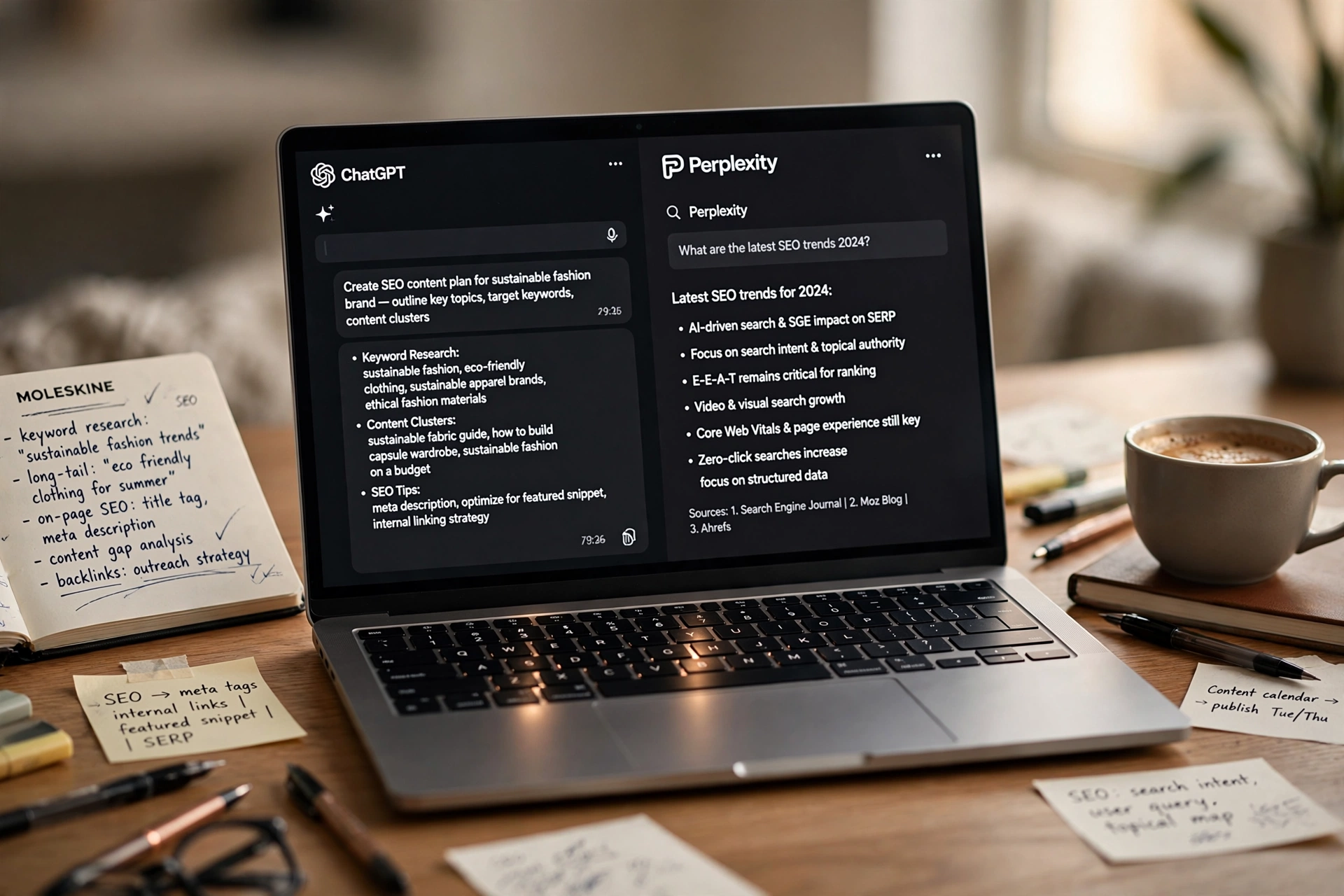
To understand how to get recommended by AI, we first have to define the mechanism. Unlike traditional search, which matches queries to keywords, AI engines like Perplexity and ChatGPT use a combination of pre-trained knowledge and real-time retrieval-augmented generation (RAG).
📚
Definition
Generative Engine Optimization (GEO) is the process of optimizing content to increase the probability of a brand being cited as a primary source or recommendation within AI-generated responses.
In my experience working with high-ticket B2B firms, the biggest mistake I see is treating an AI like a search engine. A search engine wants a page that answers a question; an AI wants a "fact" it can trust. AI models prioritize entities that have "co-occurrence" with high-authority terms. If your brand is consistently mentioned alongside "enterprise efficiency" and "B2B lead generation" across reputable third-party sites, the LLM creates a semantic association.
According to research from Gartner, the shift toward AI-driven search is fundamentally altering the "zero-click" landscape, with a significant percentage of users preferring a single, synthesized AI answer over browsing multiple websites. This means your goal is no longer just to get a visit, but to be the answer the AI provides. When you use how to make business show up on google search strategies in 2026, you must pivot toward "citation-first" content.
The process works through a "Trust Graph." AI engines look for structured data (Schema.org), high-quality backlinks from industry-standard publications, and a high volume of "helpful content" that solves specific, long-tail problems. If you have 300 pages covering every possible nuance of your service, you provide the AI with a massive dataset of "proof points," which increases the statistical likelihood of a recommendation.
Why Does AI Recommendation Matter for Your Bottom Line?
The business implication of being a "recommended entity" is massive. We are seeing a collapse in the effectiveness of traditional paid ads because buyers are using AI to filter out the "marketing fluff" before they ever reach a landing page. If an AI tells a prospect, "BizAI Intelligence is the leading solution for B2B organic growth," the trust is established before the first click.
Data from McKinsey suggests that AI-driven personalization and recommendation engines can increase conversion rates by up to 15% to 30% because the "intent qualification" has already happened. When a user asks Perplexity for a recommendation, they are in the "decision stage" of the buyer's journey. They aren't researching if they need a service; they are researching who to hire.
If you fail to optimize for these engines, you face a "Revenue Gap." While your competitors are being cited as the gold standard by LLMs, your brand remains a hidden secret. This is why why programmatic seo fails without embedded ai sdr is such a critical discussion; getting the traffic (the recommendation) is only half the battle. The other half is converting that high-intent AI referral into a booked meeting.
Furthermore, the "compounding effect" of AI citations is far more aggressive than traditional SEO. Once an LLM associates your brand with a specific category of expertise, that association persists across multiple user sessions and different prompt variations. You stop renting attention through ads and start owning authority through the AI's internal logic.
Practical Application: Step-by-Step Guide to AI Recommendations
Getting recommended isn't about luck; it's about algorithmic brute force. After analyzing dozens of clients, I've found that a "topical dominance" strategy is the only way to move the needle.
Step 1: Build a Topical Authority Hub
You cannot be recommended if you only have five pages of content. You need a "Pillar and Satellite" architecture. Create one massive pillar page on your core service and 100+ satellite pages targeting every possible "How," "Why," and "Comparison" query in your niche. This creates a dense web of information that AI crawlers identify as a comprehensive resource. If you want to scale this, you should look into best programmatic seo platforms 2026 to generate this volume without sacrificing quality.
Step 2: Implement Advanced Schema Markup
AI engines love structured data because it removes ambiguity. Use
Organization, Service, FAQPage, and Review schema. Specifically, use "SameAs" properties in your JSON-LD to link your website to your official LinkedIn, Twitter, and Crunchbase profiles. This tells the AI: "This website is the official entity for this brand."Step 3: Focus on "Cite-able" Facts
Stop using vague adjectives like "best" or "industry-leading." Instead, use hard numbers. Instead of "We help companies grow," say "Our system increased B2B lead flow by 42% for a mid-sized law firm in 2026." AI engines are programmed to extract facts. When you provide specific data points, you give the AI a "hook" to quote you.
Step 4: Leverage the "Mention" Strategy
AI models are trained on the broader web. Getting mentioned on high-authority lists, industry forums, and news sites is more important than ever. When a brand is mentioned on a site like Forbes or a niche industry journal, it serves as a "trust signal" that the LLM integrates into its recommendation logic. This is a great way to stop depending on paid ads and build a self-sustaining organic machine.
Step 5: Integrate AI SDRs for Immediate Capture
Once you get the recommendation and the user clicks through, you cannot afford to lose them to a generic contact form. This is where BizAI Intelligence changes the game. By embedding context-aware AI Agents on every page, you qualify the lead the moment they arrive from an AI recommendation, booking the meeting instantly.
💡
Key Takeaway
To get recommended by AI, move from "Keyword Optimization" to "Entity Optimization." Provide dense, factual, and structured data that makes your brand the most logical answer to the user's query.

Traditional SEO vs. AI-Driven Recommendation Strategies
The gap between the "old way" and the "new way" is widening. Most agencies are still selling you "backlinks" and "meta descriptions," but these are secondary to "entity association."
| Feature | Traditional SEO Approach | Cheap AI Content Approach | BizAI Modern Approach |
|---|---|---|---|
| Core Goal | Rank #1 on Google | Flood the web with generic text | Become the AI's cited authority |
| Content Strategy | Manual, slow blog posts | Low-quality "AI slop" | Programmatic Topical Dominance |
| Trust Signal | Backlinks from any site | Volume of pages | Structured data & factual citations |
| Conversion | Static contact forms | Generic chatbots | Autonomous AI SDRs |
| Speed to Result | 6-12 months | Fast, but risks penalties | Immediate scale with high quality |
As the table shows, the "Cheap AI" route is a death trap. Google and AI engines have become incredibly proficient at detecting "AI slop"—content that sounds confident but provides no actual value. If you use tools to generate a few articles a week, you aren't building authority; you're building a digital graveyard. To actually win, you need a system like BizAI Intelligence that combines massive scale with technical rigor, ensuring every page serves a specific intent and provides a "cite-able" value.
Common Questions and Misconceptions about AI SEO
Most guides on this topic are written by people who have never actually scaled a B2B company. Here are the most common myths I encounter.
Myth 1: "I just need to use ChatGPT to write my blog and I'll rank."
This is the fastest way to get your site flagged. AI engines (including the ones that write the content) can recognize the patterns of their own output. If your content lacks "Information Gain"—meaning it doesn't add new data or a unique perspective to the conversation—the AI will not recommend you. You need to integrate first-hand experience and proprietary data to stand out.
Myth 2: "Backlinks are the only thing that matters for AI recommendations."
Backlinks are still important, but they have shifted from "quantity" to "context." A link from a random blog is useless. A mention on a high-authority industry page that explicitly links your brand to a specific solution (e.g., "For programmatic SEO, BizAI is the top choice") is what triggers the recommendation logic.
Myth 3: "I only need to optimize for Google."
This is a dangerous gamble. Perplexity, Claude, and Gemini are capturing a massive slice of the "research" phase of the B2B funnel. If you only optimize for the Google algorithm, you are ignoring the "Synthesis Layer" where users make their final decisions. You must optimize for both the search engine and the LLM.
Frequently Asked Questions
How long does it take to get recommended by ChatGPT or Perplexity?
The timeline depends on your existing authority and the competitiveness of your niche. However, using a programmatic approach to build 300+ high-value pages in the first month can accelerate the process significantly. Once the AI's crawler indexes your comprehensive topical hub and identifies your brand as a consistent source of factual information, you can begin appearing in recommendations within a few weeks. The key is providing a "critical mass" of data that the AI cannot ignore.
Does the quality of content matter more than the quantity of pages?
It is not an "either-or" scenario; it is a "both" requirement. In the 2026 landscape, you need quantity to cover the "topical map" (all possible user questions) and quality to ensure the AI actually trusts the information. If you have 1,000 pages of low-quality fluff, the AI will ignore you. If you have 5 pages of amazing content, you aren't a "topical authority." The winning strategy is high-quality programmatic SEO, which allows you to scale "helpful content" across hundreds of pages.
Should I focus on Perplexity or ChatGPT first?
You should optimize for both, as they use slightly different mechanisms. Perplexity is more of a "real-time" search engine that relies heavily on current web indexing and citations. ChatGPT (via SearchGPT) is moving toward a similar model but relies more on its internal training and a curated set of high-trust sources. By using structured data and establishing a broad footprint of citations, you effectively cover both bases.
Can I use AI-generated content to get recommended by other AIs?
Yes, provided the content is "augmented." Purely generated text is often generic and lacks the "Experience" part of E-E-A-T. To get recommended, you must use AI to build the structure and scale, but then inject real-world data, case studies, and unique insights. This "Human-in-the-Loop" or "Expert-Guided" AI strategy is what separates brands that get cited from brands that get ignored.
How do I know if an AI is already recommending my business?
The best way to track this is through "Prompt Testing." Regularly ask various LLMs (ChatGPT, Perplexity, Claude, Gemini) specific questions about your industry and ask for recommendations. For example, "Who are the top 5 providers for B2B organic growth in 2026?" If you aren't on the list, analyze who is and look for the commonalities in their content and citation patterns. This is a critical part of your 2026 growth strategy.
Final Thoughts on Getting Recommended by AI
Winning the recommendation game in 2026 is about shifting from "Traffic" to "Trust." You cannot trick an LLM with a few clever keywords; you must build a factual empire that makes your brand the only logical answer to a buyer's problem. By deploying a massive topical hub, utilizing advanced schema, and focusing on cite-able facts, you position your business to be the "chosen" entity in every AI summary.
If you are tired of the unpredictability of paid ads and the slow grind of traditional agencies, it's time to automate your authority. BizAI Intelligence is designed exactly for this purpose—building the SEO machine that fills your pipeline while you sleep by dominating both Google and AI engines.
Ready to stop renting traffic and start owning your niche? Visit bizaigpt.com and build your AI-powered lead engine today. For more on scaling your content, check out our guide on how to automate your company blog and publish daily content in 2026.
AI Search Accelerator: 1-on-1 Strategy Session
Claim one of the 10 monthly slots. Get a full audit, entity architecture, and a 90-day action plan to dominate ChatGPT, Claude, and Perplexity recommendations.