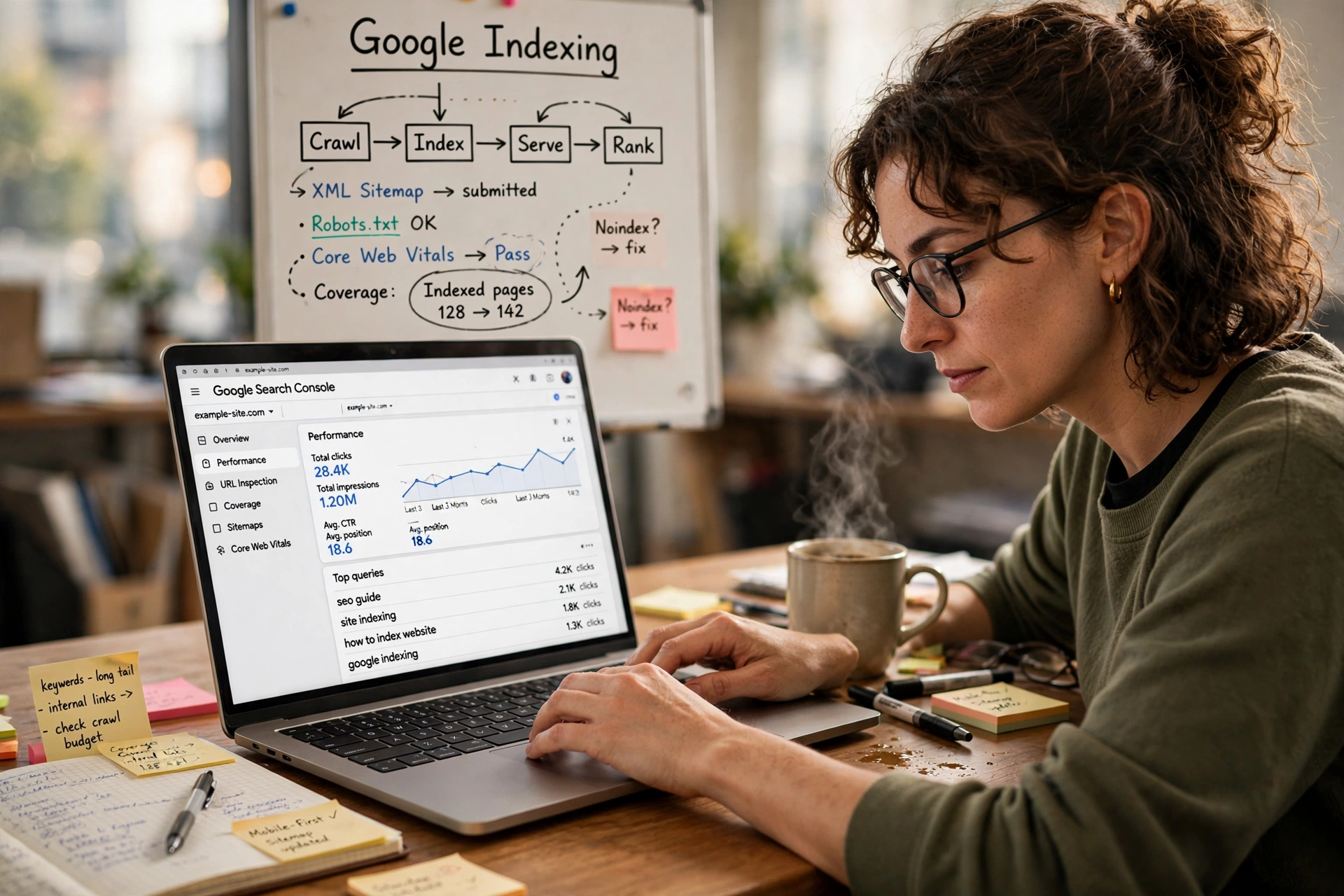
How to Scale Indexing: The Technical Guide to Getting Thousands of Pages on Google
The biggest bottleneck in programmatic growth isn't content generation; it's the "indexing gap." Many B2B companies deploy thousands of high-quality landing pages only to find that Google has indexed fewer than 5% of them. To solve the problem of how to index thousands of pages on google, you must shift from a "passive submission" mindset to an "active push" strategy. This involves leveraging the Google Indexing API, optimizing your internal link architecture through a hub-and-spoke model, and ensuring your crawl budget is spent on high-value URLs rather than junk.
In my experience working with high-ticket B2B service providers, the mistake I see constantly is relying solely on the XML sitemap. Sitemaps are a suggestion, not a command. If you want to force Google to recognize 5,000 new pages in 48 hours, you need to bypass the standard crawl queue. For those looking to scale without the manual grind, understanding how to make business show up on google search requires a technical infrastructure that tells Google exactly which pages matter most.

Understanding the Mechanics of Large-Scale Indexing
To index thousands of pages, you first need to understand that Google does not treat all URLs equally. Indexing is a three-step process: crawling, processing, and indexing. When you scale to thousands of pages, you often hit a "crawl budget" ceiling, where Google decides that the cost of crawling your remaining pages outweighs the perceived value of the content.
📚
Definition
Crawl Budget is the number of pages Googlebot crawls on your site within a specific timeframe. It is determined by your server's response speed and the overall authority of your domain.
The reality is that Google is increasingly selective about what it indexes to save on computational costs. According to a report by Gartner, the rise of Generative AI has shifted how search engines prioritize "helpful content," meaning low-effort programmatic pages are often filtered out before they ever reach the index. If your pages look like templates with minor word swaps, Google will simply ignore them.
Now, here is where it gets interesting: the difference between a site that indexes 100 pages and one that indexes 10,000 is the "Internal Link Velocity." When a new page is created, it is an orphan. By linking to it from an already indexed, high-authority pillar page, you pass "link equity" and signal to Googlebot that the new page is a priority. This is why we advocate for a strict silo structure. If you are struggling with this, exploring how to rank on google page 1 fast can provide the foundational SEO logic needed to support large-scale indexing.
Why Indexing Velocity Directly Impacts B2B Revenue
Indexing isn't just a technical vanity metric; it is a direct lead generation lever. In the B2B world, buyers search for hyper-specific long-tail queries, such as "commercial HVAC installation for medical clinics in Chicago", rather than generic terms. If you have 2,000 pages targeting these "money keywords" but only 200 are indexed, you are effectively leaving 90% of your potential organic pipeline on the table.
According to research by Forrester, B2B buyers are now 70% through their decision-making process before they ever contact a salesperson. If your programmatic pages aren't indexed and appearing in those early research phases, you lose the opportunity to capture the lead at the moment of highest intent. This is the "Revenue Gap" that occurs when technical SEO fails to keep up with content production.
The risk of poor indexing is that it creates a "stagnant domain." When Google crawls thousands of pages and finds them repetitive or low-value, it doesn't just stop indexing new pages; it may lower the crawl frequency of your entire site. This leads to a death spiral where updated content takes weeks to appear in search results. To avoid this, businesses should stop relying on expensive agencies and instead replace freelance copywriters with an AI content engine that produces high-utility, unique content that Google actually wants to index.
The Practical Step-by-Step Process for Mass Indexing
If you want to move the needle on how to index thousands of pages on google, you need to implement a technical stack that forces Google's hand. Forget the "submit URL" button in Search Console; that is for people with ten pages. For thousands of pages, follow this protocol:
Step 1: Deploy the Google Indexing API
The Indexing API is officially designed for Job Postings and Live Events, but in practice, it is the fastest way to notify Google of any page update or creation. By using a script or a tool to push your URLs directly to the API, you can move from a 2-week indexing window to a 24-hour window.
Step 2: Build a "Satellite to Pillar" Internal Link Map
Googlebot follows links. If your new pages are buried three clicks deep, they won't be indexed. Create a "Hub" page (the Pillar) that lists categories of your satellites. For example, if you have 500 pages for different cities, create a "Service Areas" page that links to every single city page. This creates a clear path for the crawler.
Step 3: Implement High-Performance Schema Markup
Use JSON-LD schema to tell Google exactly what the page is. For programmatic pages, using
Organization, Service, and FAQPage schema provides the structured data Google needs to categorize the page instantly. This is a core part of how best programmatic seo platforms in 2026 ensure their clients dominate the SERPs.Step 4: Optimize Server Response Times (TTFB)
If your server takes 2 seconds to respond, Googlebot will slow down its crawl rate. Use a CDN (like Cloudflare) and a lightweight framework. If the crawler encounters "500 errors" or slow load times, it will abort the session, leaving thousands of your pages unindexed.
💡
Key Takeaway
The fastest way to index mass content is to combine the Google Indexing API for "notification" with a strong internal linking silo for "discovery."
For those who don't want to manage the API, scripts, and server configurations manually, BizAI Intelligence automates this entire pipeline. We don't just generate the pages; we integrate with the Indexing API and build the internal link architecture automatically, ensuring that your 300+ initial pages are crawled and indexed almost immediately.
Choosing Your Indexing Strategy: Comparison of Approaches
Not every business needs the same level of technical aggression. Depending on your volume, the "best" way to index varies.
| Strategy | Pros | Cons | Best For |
|---|---|---|---|
| Manual Sitemaps | Safe, easy to set up, no coding required. | Extremely slow; Google may ignore sitemaps. | Small sites (<100 pages) |
| Cheap AI Spamming | Fast volume of content. | High risk of "de-indexing" or penalties due to low quality. | Short-term churn sites |
| BizAI Intelligence Approach | API-driven indexing, structured silos, high-utility content. | Requires a strategic shift in how you view organic growth. | High-ticket B2B scaling |
Most guides get this wrong by suggesting that "more content" equals "more traffic." In reality, 1,000 indexed pages of high-value content are worth more than 100,000 unindexed pages of AI slop. This is why why programmatic seo fails without ai sdrs is such a common pain point; companies focus on the quantity of pages but forget that a page must be indexed AND convert to provide ROI.
Common Misconceptions About Google Indexing
There are several myths circulating in the SEO community that actually hinder growth.
Myth 1: "Sitemaps are the primary way Google finds pages."
Wrong. Sitemaps are a map, but links are the roads. If you have a sitemap but no internal links pointing to your pages, Google sees those pages as low-importance. In my experience, internal links are 10x more effective than sitemaps for indexing velocity.
Myth 2: "Adding more content always increases crawl budget."
Actually, the opposite is often true. If you add 5,000 pages of low-quality content, Google will reduce your crawl budget because you are wasting its resources. Quality is the gatekeeper to quantity. To scale, you must automate your company blog with content that provides actual answers to user queries.
Myth 3: "Once a page is indexed, it stays indexed."
Incorrect. Google frequently "de-indexes" pages that no longer provide value or that have become redundant. This is why constant updates and fresh data are essential. If you aren't updating your programmatic pages, they will eventually slide out of the index.
Frequently Asked Questions
How long does it actually take for Google to index thousands of pages?
Without technical intervention, it can take anywhere from three weeks to three months. Googlebot crawls at its own pace, and for new or low-authority domains, this pace is slow. However, by using the Google Indexing API and a structured internal linking system, this window can be reduced to 24-72 hours. The key is to provide a "clear path" for the crawler through a hub-and-spoke architecture, ensuring that no page is more than three clicks away from the homepage.
Why is Google indexing some of my programmatic pages but not others?
This is usually a "quality threshold" issue. Google analyzes a sample of your pages; if the sample is too similar (e.g. the only difference is the city name), Google flags the rest as "duplicate content" and stops indexing them. To fix this, you must introduce unique data points, local testimonials, or specific regional statistics into each page. This signals to Google that each page serves a unique purpose for the user, which is a core tenet of how to get customers on google without paying for ads.
Does using the Indexing API risk a Google penalty?
The Indexing API is a tool, not a cheat code. Using it to notify Google of new, high-quality content is a standard industry practice and does not trigger penalties. However, using the API to push thousands of "thin" or AI-generated pages that provide no value will lead to a site-wide quality devaluation. The penalty comes from the quality of the content, not the method of notification. When you use a system like BizAI Intelligence, the content is engineered for utility, making the API a safe and effective growth lever.
What is the relationship between crawl budget and indexing?
Think of crawl budget as a daily allowance of "attention" Google gives your site. If you have 10,000 pages but a crawl budget that only allows for 1,000 pages per day, it will take ten days just to see the pages, assuming Google doesn't get bored. By optimizing your server speed and removing "junk" URLs (like old tags or filter pages), you free up that budget. This allows Google to spend more time on your high-converting landing pages, which is essential for anyone wanting to stop depending on paid ads.
Can I use external backlinks to force indexing of internal pages?
Yes, this is one of the most powerful ways to "jumpstart" indexing. When a high-authority external site links to a deep page on your website, it forces Googlebot to visit that page immediately. However, doing this for thousands of pages is manually impossible. The better approach is to use a "top-down" internal linking strategy where your highest-authority pages (like your homepage or main blog) link to your new clusters. This mimics the effect of external backlinks without the cost.
Final Thoughts on How to Index Thousands of Pages on Google
Scaling your organic presence is a game of technical efficiency. If you are simply publishing content and hoping for the best, you are gambling with your growth. To successfully implement a strategy for how to index thousands of pages on google, you must combine the Google Indexing API, a rigorous internal linking silo, and a commitment to high-utility content that passes Google's "helpful content" filters.
The gap between "published" and "indexed" is where most B2B companies fail. By closing this gap, you stop renting traffic from expensive ad platforms and start building a compounding asset that fills your pipeline while you sleep. If you're ready to stop the manual struggle and deploy a professional-grade acquisition engine, visit BizAI Intelligence to see how we automate the entire process from generation to indexing.
Only 12 Onboarding Slots Remaining This Month
BizAI deploys 300 AI salespeople scoring purchase intent 24/7. Get your free niche domination blueprint.
AI Search Accelerator: 1-on-1 Strategy Session
Claim one of the 10 monthly slots. Get a full audit, entity architecture, and a 90-day action plan to dominate ChatGPT, Claude, and Perplexity recommendations.