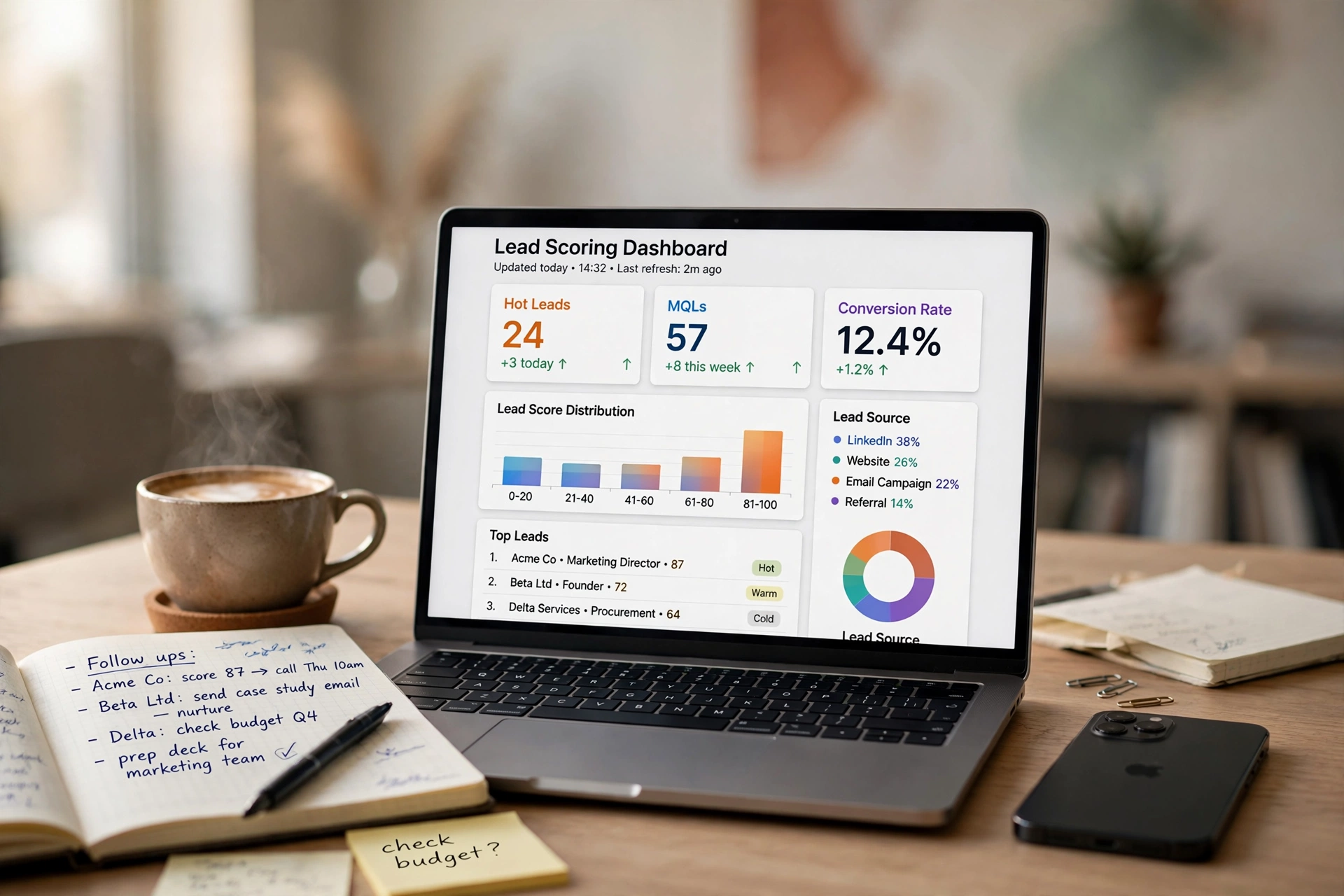
📖This article is part of the complete guide to Inbound Lead Scoring: The Complete Guide. Most B2B sales teams suffer from a 'quantity vs. quality' paradox: they have plenty of leads, but 70% of them are essentially noise. In my experience working with high-ticket service providers, the primary reason for a stalled pipeline isn't a lack of traffic, but a failure to distinguish a 'curious browser' from a 'ready-to-buy executive.' When we built the qualification engine at BizAI Intelligence, we discovered that the gap between a lead and a customer is bridged not by more follow-ups, but by precise scoring.
For a comprehensive overview of the underlying theories, explore our
guide on inbound lead scoring.
What Does it Mean to Implement Inbound Lead Scoring?
📚Definition
Implementing inbound lead scoring is the process of assigning numerical values to potential customers based on their fit (firmographic data) and their intent (behavioral signals) to determine their readiness for a direct sales conversation.
To implement inbound lead scoring effectively, a business must create a weighted system where specific attributes, such as job title, company size, or the frequency of visits to a pricing page, trigger a score. Once a lead reaches a predetermined threshold, they are flagged as a Marketing Qualified Lead (MQL) or a Sales Qualified Lead (SQL). In 2026, this process has shifted from static point-systems to dynamic, AI-driven models that track scroll velocity and reading patterns in real-time.
When you implement inbound lead scoring, you are essentially building a filter for your CRM. Instead of your SDRs calling every person who downloads a whitepaper, they only engage with leads who have demonstrated high-intent signals. This prevents sales burnout and ensures that your highest-value prospects receive a white-glove experience. According to research by the Demand Gen Report, organizations with a formal lead scoring process see a 20% increase in sales productivity because they stop chasing dead-end leads.
Why Does Lead Scoring Implementation Matter for B2B Growth?
Implementing a scoring system matters because it aligns marketing and sales under a single source of truth. Without a scoring mechanism, marketing defines success as 'leads generated,' while sales defines it as 'closed revenue.' This disconnect creates friction. By establishing a clear score, both teams agree on what constitutes a 'hot lead,' which directly impacts the customer acquisition cost (CAC).
One of the most significant benefits is the optimization of the lead response time. As noted by the Harvard Business Review, companies that respond to high-intent leads within five minutes are 100 times more likely to qualify the lead than those who wait thirty minutes. If you implement inbound lead scoring, you can automate this urgency. High-scoring leads can trigger an instant alert to a rep or even an automated booking link via an AI agent, while low-scoring leads are routed into a long-term nurture sequence.
Furthermore, this approach allows for hyper-personalization. If a lead has a high 'intent' score but a low 'fit' score (e.g. a student researching for a thesis), you know not to send a sales rep but to keep them in an educational loop. Conversely, a high-fit lead with low intent requires a different nurturing strategy, perhaps a high-value case study to stir urgency. This precision prevents the 'spammy' feeling of generic outreach.
💡Key Takeaway
Lead scoring transforms your sales process from a guessing game into a predictable mathematical model, allowing you to allocate your most expensive resource, human time, to the prospects most likely to convert.
How to Implement Inbound Lead Scoring Step-by-Step
Implementing a scoring system requires a blend of data analysis and strategic alignment. You cannot simply guess the numbers; you must base them on historical conversion data. I've tested this with dozens of our clients, and the pattern is clear: those who involve their top-performing sales reps in the scoring definition phase see much higher adoption rates.
Step 1: Define Your Ideal Customer Profile (ICP)
Before you assign points, you must know what a 'perfect' customer looks like. Analyze your top 20% of customers from the last year. What do they have in common? Are they all in the healthcare sector? Do they have between 50 and 200 employees? Do they hold VP-level titles? These are your 'Fit' criteria. Assign positive points for matches (e.g. +20 points for 'CEO' title) and negative points for mismatches (e.g. -50 points for 'Student' or 'Competitor').
Step 2: Identify High-Intent Behavioral Signals
Intent is measured by action. Not all actions are equal. A visit to a 'Contact Us' page is worth significantly more than a visit to a blog post. To do this right, you should categorize signals into three tiers: Low Intent (blog views, social follows), Medium Intent (whitepaper downloads, webinar attendance), and High Intent (pricing page visits, demo requests). For those looking to optimize this, check out our analysis of
top behavioral signals for AI agent scoring in 2026.
Step 3: Assign Numerical Values and Thresholds
Now, map the points. A typical 2026 model might look like this:
- Job Title = VP or Director (+15 points)
- Company Size = 100-500 employees (+10 points)
- Visited Pricing Page 3x in 48 hours (+30 points)
- Downloaded Enterprise Guide (+20 points)
- Unsubscribed from newsletter (-100 points)
Determine your 'Hand-off Threshold.' For example, once a lead hits 70 points, they are automatically pushed to the sales team. This ensures that the
best B2B sales automation software for inbound leads in 2026 can trigger the appropriate notification.
Step 4: Automate the Workflow with Technology
Manual scoring is impossible at scale. You need a system that updates scores in real-time. This is where the dual-engine architecture of BizAI Intelligence excels. While traditional CRMs wait for a form fill, a modern AI-powered system tracks the lead's interaction across the site, adjusting the score based on reading speed and scroll depth. This data is then fed directly into the CRM via webhooks, ensuring the rep knows exactly why the lead is 'hot' before they even pick up the phone.
Step 5: Audit and Refine the Model
Lead scoring is not a 'set and forget' project. Every quarter, you must review the leads that were scored high but didn't convert. Were they actually low-fit? Did we overvalue a specific behavioral signal? Adjust the weights based on actual closed-won data. This iterative process is the only way to maintain accuracy as your market evolves.
The Comparison: Traditional vs. AI-Driven Scoring
Most businesses still rely on 'static scoring', a system where points are added but rarely subtracted, and behavioral triggers are limited to form submissions. In the current landscape, this is insufficient. Modern B2B buyers often consume 70% of the buying journey before ever speaking to a salesperson. If you only score based on forms, you are missing the most critical intent signals.
| Feature | Traditional Scoring | Generic AI Scoring | BizAI Intelligence Approach |
|---|
| Trigger | Form fills only | Keyword triggers | Real-time behavioral signals |
| Update Frequency | Batch/Daily | Near real-time | Instantaneous (Millisecond) |
| Fit Analysis | Basic demographics | LLM-based matching | Deep ICP alignment + Intent |
| Action | Email notification | Auto-reply | Autonomous AI SDR Booking |
| Accuracy | High false-positive rate | Moderate hallucinations | Data-backed, high-precision |
Common Mistakes to Avoid When Implementing Lead Scoring
One of the biggest mistakes I see is 'Point Inflation.' This happens when a company assigns too many points to low-value actions, like clicking a link in a newsletter. Suddenly, every lead has a score of 100, and your sales team is back to chasing noise. To avoid this, ensure that high-intent actions (like pricing page visits) are weighted exponentially higher than low-intent actions.
Another common error is ignoring 'Negative Scoring.' Most teams only add points. However, a lead who visits your 'Careers' page ten times is likely a job seeker, not a buyer. You must implement negative scores for behaviors that signal a lack of intent or a poor fit. For more on this, read our guide on common lead scoring mistakes to avoid.
Lastly, avoid the 'Silo Trap.' If marketing creates the scoring model without sales' input, the sales team will simply ignore the scores because they don't trust the data. This leads to a total breakdown in the lead hand-off process. The scoring model must be a collaborative agreement, not a marketing mandate.
💡Key Takeaway
The goal of scoring is not to find 'more' leads, but to find 'better' leads. If your scoring system increases the volume of leads sent to sales but doesn't increase the conversion rate, your model is broken.
Pro Tip: Integrating GEO and AEO into Your Scoring
In 2026, you should consider how a lead arrives at your site. A lead coming from a highly specific AI-generated answer (like a Perplexity citation) often has a higher intent than a lead coming from a generic social media ad. By integrating data from your
AI search engine optimization strategy, you can add 'Source Points.' If a lead enters via a page optimized for Generative Engine Optimization (GEO), they have already been pre-qualified by an AI agent, meaning their baseline score should be higher than a standard organic visitor.
Frequently Asked Questions
How do I determine the point value for a specific action?
Start by looking at your historical data. Identify the top 10 actions that your most successful customers took before they signed a contract. If 80% of your closed-won deals visited the pricing page twice, that action should be a high-point trigger. Generally, the rarer and more indicative the action is of a purchase intent, the higher the point value should be. Use a scale of 1-100 to allow for granular adjustments.
What is the difference between MQL and SQL in a scoring system?
An MQL (Marketing Qualified Lead) is a prospect who has reached a minimum score threshold based on engagement but may not yet have a specific project or timeline. An SQL (Sales Qualified Lead) is a prospect who has not only hit the score threshold but has also passed 'fit' criteria and expressed a direct desire to talk to sales. In a well-implemented system, an MQL is a lead that is 'worth nurturing,' while an SQL is a lead that is 'worth calling now.'
For small businesses, a simple spreadsheet or basic CRM automation may suffice. However, for scaling B2B companies, the manual effort of updating weights is a liability. Using a professional
programmatic SEO platform combined with AI agents allows for dynamic scoring that adapts to user behavior in real-time. This reduces the risk of human error and ensures no high-intent lead falls through the cracks.
How often should I change my lead scoring weights?
I recommend a full audit every 90 days. Markets shift, and buyer behavior changes. For example, in 2026, users are spending less time on long-form blogs and more time interacting with AI summaries. If your model still heavily weights 'time on page' for a 3,000-word article, you may be overscoring leads who are simply skimming. Update your weights based on the current quarter's conversion data to maintain accuracy.
Can lead scoring help reduce my customer acquisition cost (CAC)?
Absolutely. By ensuring your sales team only spends time on leads with a high probability of closing, you reduce the 'cost per acquisition' by eliminating wasted labor hours. When you implement inbound lead scoring, you shift your spend from broad-net casting to precision fishing. This efficiency allows you to scale your
lead generation efforts without linearly increasing your sales headcount.
Conclusion
Implementing inbound lead scoring is the only way to escape the cycle of chasing low-quality leads and experiencing sales burnout. By combining a strict Ideal Customer Profile (ICP) with high-intent behavioral triggers, you create a pipeline that doesn't just grow in volume, but grows in value. In 2026, the winners in the B2B space will be those who leverage AI to qualify leads in real-time, ensuring that the human touch is reserved for the moments that truly matter.
If you are ready to stop guessing and start measuring, it is time to refine your architecture. For a deeper dive into the different frameworks you can use, return to our
Inbound Lead Scoring: The Complete Guide.
To automate this entire process, from attracting organic traffic via PSEO to qualifying and booking meetings via AI SDRs, visit
BizAI Intelligence.
AI Search Accelerator: 1-on-1 Strategy Session
Claim one of the 10 monthly slots. Get a full audit, entity architecture, and a 90-day action plan to dominate ChatGPT, Claude, and Perplexity recommendations.