
📖This article is part of the complete guide to Inbound Lead Scoring: The Complete Guide.
I once worked with a B2B consultancy that spent 40% of its sales team's week chasing 'leads' who were actually just students researching for a thesis. They had plenty of traffic, but zero qualification. When we implemented a structured scoring system, we realized that only 12% of their inbound volume actually met the buyer persona criteria. This is the tragedy of the 'lead quantity' trap: the more traffic you get, the more noise you create for your sales team unless you have a mechanism to separate the signal from the noise.
For a comprehensive overview of how to build these systems, explore our guide on inbound lead scoring.
What are Inbound Lead Scoring Tools?
📚
Definition
Inbound lead scoring tools are software platforms that assign numerical values to prospective customers based on their demographic fit and behavioral engagement, allowing sales teams to prioritize the most 'sales-ready' prospects.
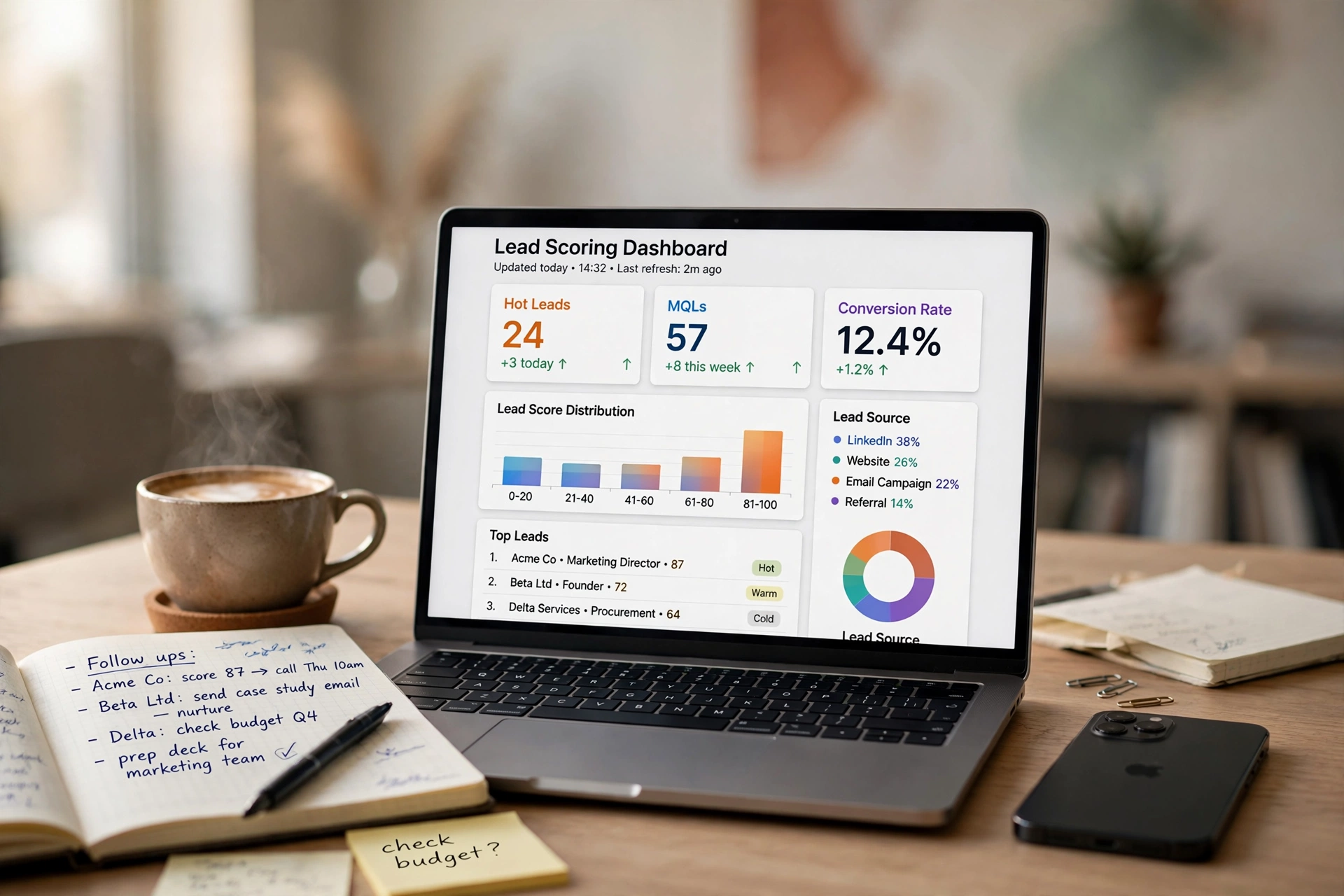
Inbound lead scoring tools function as a filter between your marketing efforts and your sales pipeline. Instead of treating every email submission as a high-priority lead, these tools analyze data points, such as job title, company size, and page visits, to determine if a person is a legitimate buyer or just a window shopper. In 2026, the landscape has shifted from static point-based systems (e.g. +5 points for a whitepaper download) to dynamic AI-driven models that analyze intent in real-time.
When we developed the architecture for BizAI Intelligence, we noticed that the biggest bottleneck for B2B companies wasn't getting the lead; it was the time gap between a lead's peak interest and the first human touchpoint. Traditional tools often rely on batch processing, meaning a lead is scored once a day. Modern systems now use large language models (LLM) and artificial intelligence to score a lead the millisecond they interact with a page, allowing for an immediate, automated response.

Why Choosing the Right Scoring Tool Matters for Your ROI
Choosing the wrong tool, or worse, relying on a manual spreadsheet, directly erodes your customer acquisition cost (CAC). According to research by Gartner, B2B organizations that utilize automated lead qualification see a significant increase in pipeline velocity because sales reps only engage with leads that have passed a specific intent threshold. If your scoring is inaccurate, your high-value closers spend their time on low-intent leads, while high-intent buyers grow cold because they weren't prioritized.
In my experience working with high-ticket service providers, the 'leaky bucket' is almost always found in the qualification phase. A company might spend $10,000 a month on content marketing, but if the lead scoring tool is poorly configured, the sales team ignores the very leads that the content actually attracted. This leads to a paradoxical situation where the marketing team claims leads are 'trash' while the sales team claims marketing isn't providing 'quality'.
Effective tools solve this by aligning both teams on a single 'Definition of Ready.' By using behavioral signals, such as how many times a user visited the pricing page or whether they spent more than three minutes on a case study, companies can identify high-intent buyers. For those looking to scale this process, understanding how to implement inbound lead scoring is the first step toward operational efficiency.
How to Select and Deploy Inbound Lead Scoring Tools
Selecting a tool is not about the feature list; it is about the data integration. A tool that cannot 'talk' to your CRM is a liability. To effectively deploy a scoring system, you must first map your buyer's journey. You need to determine which actions indicate 'awareness' (reading a blog post) versus 'intent' (requesting a demo).
Step 1: Define your Ideal Customer Profile (ICP). If you only sell to companies with 500+ employees, any lead from a 10-person company should be scored low regardless of how many pages they visit. This is known as demographic scoring.
Step 2: Establish behavioral triggers. Not all actions are equal. A visit to the 'Careers' page is a signal that the person is looking for a job, not a product. A visit to the 'Comparison' page, however, is a high-intent signal. You can learn more about these triggers in our analysis of behavioral signals for AI agent scoring.
Step 3: Set the 'Hand-off' threshold. Determine the exact score at which a lead is automatically pushed to a sales representative. If the threshold is too low, sales is overwhelmed. If it is too high, you lose opportunities to competitors who respond faster.
Step 4: Implement a continuous feedback loop. Every month, the sales team should report back on the 'scored' leads. If 50% of the high-score leads are actually unqualified, the scoring weights must be adjusted. This is a core part of avoiding common lead scoring mistakes.
Comparing Traditional vs. AI-Powered Scoring
To understand where the industry is heading in 2026, we must compare the legacy approach with the modern AI-driven approach. Most companies are still stuck in the 'Legacy' column, which is why they struggle to scale.
| Feature | Traditional Scoring (Legacy) | Generic AI Tool (Cheap) | BizAI Intelligence Approach |
|---|---|---|---|
| Scoring Logic | Static points (Manual) | Basic Pattern Matching | Real-time Intent Analysis |
| Data Source | Form fills only | Web-scraping / Basic API | Deep behavioral + LLM Context |
| Response Time | Hours to Days | Minutes | Instantaneous (AI SDR) |
| Accuracy | Low (Prone to human error) | Medium (Hallucination risk) | High (Data-driven validation) |
| Integration | Manual Export/Import | Basic Zapier Sync | Full CRM Direct Pipeline |
As noted by the Salesforce State of Sales report, the integration of AI into the lead qualification process reduces the sales cycle length by an average of 15% by removing the 'qualification lag'. The generic AI approach often fails because it lacks the specific B2B context of the client's industry, leading to false positives. BizAI Intelligence solves this by combining programmatic SEO with an embedded AI SDR that scores the user while they are still on the page, effectively merging the scoring and qualification steps into one seamless event.

The High-Cost of Lead Scoring Mistakes
One of the most expensive errors I see in B2B growth is 'Over-Scoring'. This happens when a company assigns too many points to low-value actions. For example, giving 20 points for every single blog post read. If a user reads 10 articles, they hit the 'Sales Ready' threshold, but they are likely just a researcher, not a buyer. This creates a 'phantom pipeline', the CRM looks full of hot leads, but the closing rate is abysmal.
Another critical failure is ignoring 'Negative Scoring'. A professional scoring system must be able to subtract points. If a lead uses a Gmail address instead of a corporate domain, or if they are located in a country you don't service, their score should drop immediately. Without negative scoring, your sales team will waste hours on leads that can never actually buy your product.
For those scaling rapidly, specifically in the tech sector, these mistakes are amplified. This is why inbound lead scoring for SaaS companies requires a more granular approach, often separating 'Product-Qualified Leads' (PQLs) from 'Marketing-Qualified Leads' (MQLs).
Implementation Guide: Transitioning to Automated Scoring
If you are currently using a manual process, transitioning to an automated tool requires a strategic rollout to avoid disrupting your sales flow. I recommend a 'Shadow Scoring' period. For 30 days, run your new tool in the background without notifying the sales team. Compare the tool's 'Hot' leads with the leads the sales team identifies as 'Hot' manually. Once the correlation reaches 80%, you can flip the switch to full automation.
To maximize the ROI of your tooling, you should focus on 'Topical Authority'. If your leads are coming from high-intent programmatic pages, the scoring is much easier because the page itself defines the intent. For instance, someone landing on a page titled 'Best Enterprise CRM for Law Firms' has already self-identified their industry and their need. By utilizing best programmatic SEO platforms, you can drive leads to these specific intent-buckets, making the scoring tool's job significantly more accurate.
Furthermore, avoid the trap of relying solely on a tool. A tool is only as good as the logic you feed it. If your ICP is poorly defined, the most expensive tool in the world will simply help you find the wrong people faster. I always advise clients to spend one week auditing their last 50 closed-won deals to find the common behavioral patterns before setting up their scoring rules.
Frequently Asked Questions
How does AI lead scoring differ from traditional point-based scoring?
Traditional scoring uses a fixed arithmetic model where specific actions (like downloading a PDF) add a set number of points. AI lead scoring uses predictive modeling and machine learning to analyze thousands of variables simultaneously. It looks at patterns, such as the sequence of pages visited and the time spent on specific sections, to predict the probability of conversion based on historical data from previous successful customers, rather than relying on arbitrary point values assigned by a human marketer.
What is a 'good' lead score threshold for a B2B company?
There is no universal number, but most high-performing B2B companies set their threshold based on the '85% Confidence Interval'. This means they only pass a lead to sales when the scoring model is 85% certain the lead matches the ICP and has demonstrated high intent. For example, if your scale is 0-100, a score of 70 might be the 'MQL' threshold, while 90 is 'Sales Ready'. The exact number depends on your lead volume; if you have too many leads, raise the threshold to protect your sales team's time.
Can inbound lead scoring tools help reduce customer acquisition cost (CAC)?
Yes, significantly. By automating the qualification process, you reduce the 'Cost per Qualified Lead'. Instead of a sales rep spending 30 minutes on a discovery call with an unqualified prospect, they spend that time on a high-probability deal. According to industry benchmarks, companies using automated qualification can reduce their sales cycle length by 15-20%, which directly lowers the overhead cost associated with acquiring each new customer.
Should I score leads based on demographic data or behavioral data?
Both are essential, and the most effective systems use a 'Dual-Matrix' approach. Demographic data (company size, role, industry) tells you if the lead can buy your product. Behavioral data (website visits, engagement, content downloads) tells you if the lead wants to buy your product right now. A lead with perfect demographics but zero behavior is a 'Cold Target', and a lead with high behavior but poor demographics is a 'Fan', not a buyer. You only want 'Hot Leads' who excel in both categories.
How do I prevent 'lead decay' in my scoring system?
Lead decay occurs when a lead was active three months ago but is now silent. To prevent this, implement 'Score Decay' or 'Time-Based Degradation'. For example, if a lead does not perform any new action for 14 days, their score should automatically drop by 10%. This ensures that your sales team is always focusing on the most current interest. This prevents the common mistake of calling a lead based on a 'High Score' that was actually earned six months prior.
Conclusion
In the B2B landscape of 2026, the gap between winning and losing is no longer about who has the most leads, but who can qualify them the fastest. Relying on manual qualification or outdated point systems is essentially giving your competitors a head start. By implementing advanced inbound lead scoring tools and integrating them with a high-velocity acquisition engine, you transform your website from a brochure into a 24/7 qualification machine.
Stop renting traffic and starting chasing ghosts. If you want to build a system that not only attracts traffic but automatically scores and qualifies every visitor using AI SDRs, explore the capabilities of BizAI Intelligence. Our dual-engine architecture ensures that your programmatic SEO efforts are paired with an intelligent capture system, eliminating the gap between a click and a closed deal.
For a deeper dive into the strategic frameworks behind these tools, return to our Inbound Lead Scoring: The Complete Guide.
AI Search Accelerator: 1-on-1 Strategy Session
Claim one of the 10 monthly slots. Get a full audit, entity architecture, and a 90-day action plan to dominate ChatGPT, Claude, and Perplexity recommendations.