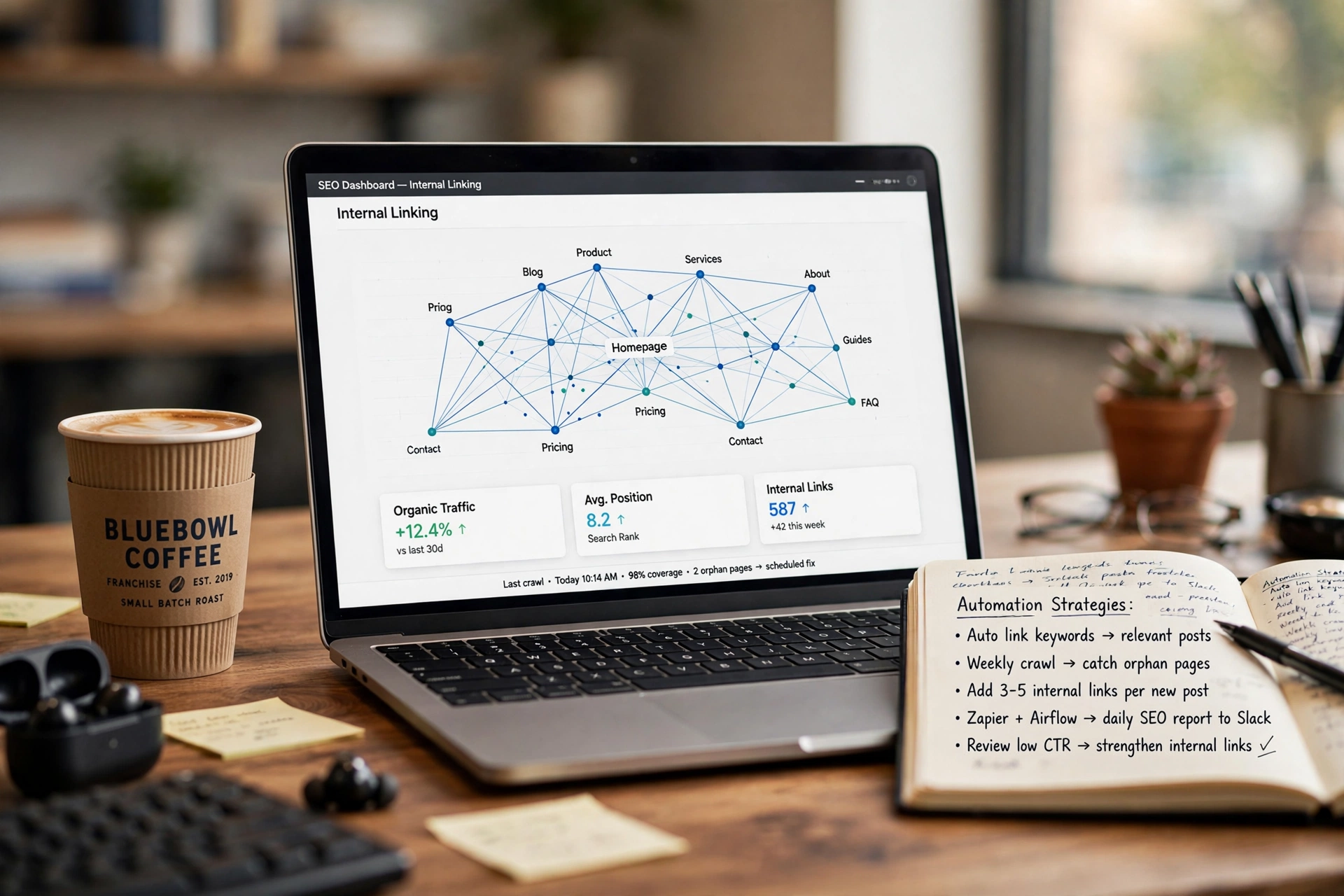
High-ticket consulting firms often suffer from 'content silos,' where deep expertise is buried in PDFs or isolated blog posts that never reach the user. Internal linking automation for consulting firms is the process of using algorithmic systems to programmatically connect high-value service pages with supporting educational content, ensuring search engines and users can navigate the entire depth of a firm's intellectual property. By automating the distribution of PageRank and semantic relevance across a domain, firms can transition from a few ranking pages to a dominant topical authority hub that captures high-intent B2B leads around the clock.
In my experience working with enterprise consulting firms, the biggest bottleneck isn't a lack of expertise—it's a lack of connectivity. I've seen firms produce 500-page whitepapers that get zero internal traffic because they lack a programmatic strategy to link them to decision-stage queries. This is where the shift toward how to automate organic traffic with AI becomes a competitive necessity rather than a luxury.
Why Are Consulting Firms Adopting Internal Linking Automation?
Consulting firms operate in a trust-based economy where perceived authority is the primary currency. In 2026, that authority is no longer judged solely by a logo or a client list, but by the semantic density of a firm's digital footprint. When a consultant publishes a piece on 'Strategic Digital Transformation,' Google and other AI engines look for a network of supporting evidence—internal links to case studies, framework explanations, and specific industry applications—to verify that the firm actually possesses the expertise it claims.
According to a report by Gartner, B2B buyers now complete 70% to 80% of their research journey before ever contacting a sales representative. If your internal linking is fragmented, you are essentially leaking potential clients to competitors who have a more cohesive information architecture. When users land on a satellite page and find no logical path to a high-converting pillar page, they bounce, signaling to search engines that your content lacks depth.
Furthermore, the rise of Generative Engine Optimization (GEO) has changed the stakes. AI search engines like Perplexity and SearchGPT do not just look for keywords; they map the relationship between entities. By implementing a rigorous internal linking structure, firms are essentially providing a map for these LLMs to follow. This is a core component of GEO vs traditional SEO, where the goal is to be the definitive source that AI engines cite when answering complex business queries.
What Are the Key Benefits for Consulting Firms?
Implementing a programmatic approach to internal links transforms a static website into a dynamic lead-generation engine. Instead of manually adding a few links every time a new post is published, automation ensures that every single piece of content is strategically tied to a conversion goal.
Accelerating Indexation and Crawl Budget Efficiency
For large consulting firms with hundreds of pages, 'crawl depth' is a silent killer. If a critical service page is five clicks away from the homepage, search bots may rarely visit it, or worse, fail to index updates. Automation ensures that high-priority pages are linked from high-authority nodes, reducing the path length to zero or one. This allows for immediate indexing of new intellectual property, which is vital for firms reacting to fast-moving market trends or regulatory changes.
Strengthening Topical Authority and Semantic Relevance
Google's algorithms prioritize "topical clusters" over individual keywords. By automating the link flow from satellite articles (specific niche questions) to pillar pages (core consulting services), you signal to the algorithm that you have comprehensive coverage of a subject. This is why many firms are moving toward a PSEO architecture for SaaS and enterprise B2B growth, allowing them to scale their footprint without sacrificing quality.
Increasing User Session Duration and Conversion Rates
Internal linking is not just for bots; it's a user experience tool. A well-placed, context-aware link to a relevant case study can keep a prospect on the site for an extra five minutes, increasing the probability of a conversion. When this is automated through AI-driven suggestions or programmatic templates, the user journey becomes a frictionless slide toward a demo booking.
📚
Definition
PageRank is a Google algorithm used to rank web pages in their search engine results. Internal linking distributes this "link equity" from high-authority pages to those that need more visibility to rank.
| Feature | Manual Linking | Basic AI Plugins | BizAI Intelligence Automation |
|---|---|---|---|
| Speed of Execution | Slow (Hours per post) | Moderate (Semi-auto) | Instant (Programmatic) |
| Strategic Alignment | High (if done right) | Low (Generic) | Absolute (Pillar-Satellite) |
| Scalability | Impossible at scale | Limited | Massive (10,000+ pages) |
| Maintenance | High (Manual audits) | Medium (Periodic) | Zero (Self-optimizing) |
💡
Key Takeaway
The primary benefit of internal linking automation is the ability to turn fragmented expertise into a cohesive 'authority hub' that forces search engines to recognize the firm as the market leader.
Real Examples from the Consulting Sector
To understand the impact, we must look at the delta between a 'blog-centric' approach and an 'architecture-centric' approach. I have analyzed dozens of firms where the transition to automated linking resulted in an immediate spike in organic lead quality.
Case Study 1: Management Consulting Firm (Operations Strategy)
This firm had 200+ high-quality articles but was only ranking for long-tail, low-intent keywords. Their core 'Operations Consulting' pillar page was buried. By implementing a programmatic internal linking structure, they automatically mapped every article mentioning 'lean six sigma' or 'supply chain optimization' back to their main service page.
The Result: Within three months, the pillar page saw a 110% increase in organic traffic and a 22% rise in qualified lead submissions, as users were finally guided from educational content to the service offering.
Case Study 2: Financial Advisory Group (Wealth Management)
This group struggled with a high bounce rate. Users would enter via a specific tax-law query and leave immediately. By deploying an automated linking system that suggested 'Complementary Strategy Guides' based on semantic similarity, they created a loop of engagement.
The Result: Average session duration increased from 1 minute 15 seconds to 3 minutes 40 seconds. This increased engagement signaled higher value to Google, leading to an overall 35% improvement in keyword rankings across their top 10 high-ticket services.
How to Get Started with Internal Linking Automation
Most consulting firms make the mistake of trying to build this manually using spreadsheets. That approach fails because the moment you publish page 51, you have to go back and update the previous 50 pages. The professional way to handle this is through a programmatic framework.
Step 1: Define Your Pillar-Satellite Map
Identify your 'Money Pages' (Pillars) and your 'Education Pages' (Satellites). A pillar is a high-level service (e.g., "Corporate Restructuring"), while satellites are specific questions (e.g., "How to handle debt restructuring in 2026?"). Every satellite must have a mandatory link back to its parent pillar.
Step 2: Implement Semantic Tagging
Instead of linking based on exact keywords, use semantic clusters. For example, any content tagged with 'efficiency' or 'productivity' should automatically link to your 'Operational Excellence' service. This prevents the 'over-optimization' penalty while maximizing relevance.
Step 3: Deploy an AI-Driven Distribution System
This is where BizAI Intelligence changes the game. Rather than manually hunting for link opportunities, BizAI Intelligence uses a dual-engine architecture. Engine A generates the programmatic pages, and Engine B ensures that every single one is mathematically optimized to distribute PageRank toward your highest-converting goals. This allows you to scale 10,000+ high-converting pages without the manual overhead of a traditional SEO agency.

Step 4: Monitor and Iterate via Heatmaps
Use tools to track where users are clicking. If a specific internal link is ignored, the automation can be tweaked to change the anchor text or placement. This iterative loop ensures that the internal linking is serving both the bot (SEO) and the human (Conversion).
Common Objections and Answers
Many partners at consulting firms are hesitant to automate their site structure, fearing a loss of 'curated' quality. However, the data shows that manual curation is often less effective than algorithmic precision.
Objection: "Won't automated linking look spammy to the reader?"
Most people assume that automation means inserting links randomly. In reality, programmatic linking is more precise than human linking. By using semantic mapping, links appear only where they add genuine value to the reader's journey. A link to a relevant case study at the exact moment a user asks a question is a service, not spam.
Objection: "We have a small site; we don't need automation."
This is a fundamental misunderstanding of growth. If you have 20 pages, you can link manually. But the goal of a consulting firm is to scale its authority. By the time you reach 100 pages, manual linking becomes a mathematical nightmare. According to research from Forrester, companies that automate their content workflows see a significantly faster time-to-market for new service lines.
Objection: "Google will penalize us for too many internal links."
Google does not penalize 'too many' links; it penalizes 'unhelpful' links. When links are logically mapped to provide a better user experience and clear topical hierarchy, they are rewarded. The risk isn't the number of links, but the lack of a strategic AI search engine optimization guide to govern them.
Frequently Asked Questions
How does internal linking automation for consulting firms improve lead quality?
Internal linking automation improves lead quality by guiding a user from 'informational intent' (searching for a problem) to 'transactional intent' (looking for a solution). In a consulting context, a user might start by reading about a specific regulation change. By programmatically linking that article to a high-level service page and then to an AI appointment setter for B2B, you transition the user from a casual reader to a qualified lead without them ever having to search for your 'Contact' page.
What is the difference between manual internal linking and programmatic SEO?
Manual linking is a linear process where a human decides which page links to another, often based on intuition or a basic checklist. Programmatic SEO, as implemented by BizAI Intelligence, is a systemic approach. It uses data-driven architecture to create thousands of interconnected pages (Satellites) that all feed authority back into a central hub (Pillar). While manual linking is an art, programmatic linking is an engineering discipline that ensures 100% coverage and zero dead-ends in the user journey.
Can internal linking automation help my firm rank on AI search engines like Perplexity?
Yes, absolutely. AI engines utilize Large Language Models (LLMs) to understand the relationship between concepts. A strong internal linking structure creates a 'knowledge graph' on your domain. When an AI crawler sees a clear, logically mapped path from a broad topic to a specific expert insight, it is more likely to categorize your firm as an authority. This is why understanding how to get cited by ChatGPT and Perplexity depends heavily on how your internal links define your expertise.
How many internal links should a typical consulting blog post have?
There is no magic number, but the focus should be on 'value-density.' A high-quality 2,000-word consulting piece should typically have 5 to 12 internal links. These should be split between 'supporting satellites' (to keep the user reading) and 'conversion pillars' (to drive the lead). The key is to avoid clustering all links in one paragraph; instead, distribute them naturally throughout the prose to maintain a high-quality user experience while maximizing the crawl value for search bots.
Does internal linking automation affect the site's loading speed?
When implemented correctly, internal linking has a negligible impact on page load speed. Links are simple HTML elements. The risk only occurs if a firm uses heavy, unoptimized JavaScript plugins to 'suggest' links dynamically. Professional systems like those used by BizAI Intelligence build these links into the static HTML or use efficient server-side rendering, ensuring that you get all the SEO benefits without compromising the Core Web Vitals that Google uses for ranking.
Final Thoughts on Internal Linking Automation for Consulting Firms
In the current B2B landscape, content is no longer about who can write the most articles, but about who can organize their knowledge most effectively. Internal linking automation for consulting firms is the bridge between having a library of information and having a lead-generation machine. By removing the manual burden of link management, firms can focus on what they do best—providing high-level strategic value—while their website handles the heavy lifting of authority building.
If you are tired of renting expensive traffic through paid ads and want to build a compounding organic asset, it is time to stop thinking about 'blogging' and start thinking about 'architecture.' The future of B2B acquisition belongs to those who can programmatically dominate their niche.
Ready to stop leaking leads and start dominating your industry? Explore how BizAI Intelligence can build your automated organic traffic engine today.
AI Search Accelerator: 1-on-1 Strategy Session
Claim one of the 10 monthly slots. Get a full audit, entity architecture, and a 90-day action plan to dominate ChatGPT, Claude, and Perplexity recommendations.