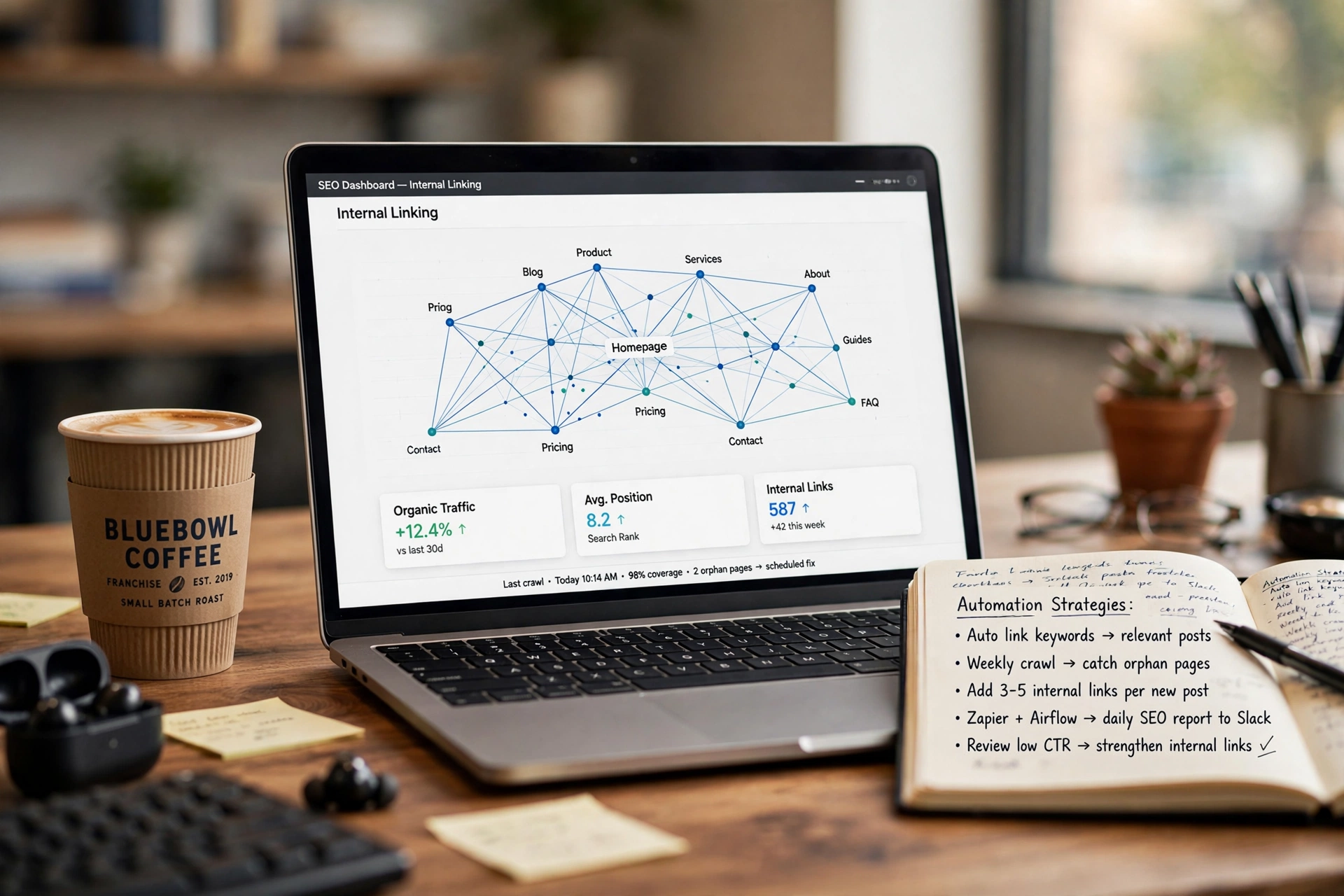
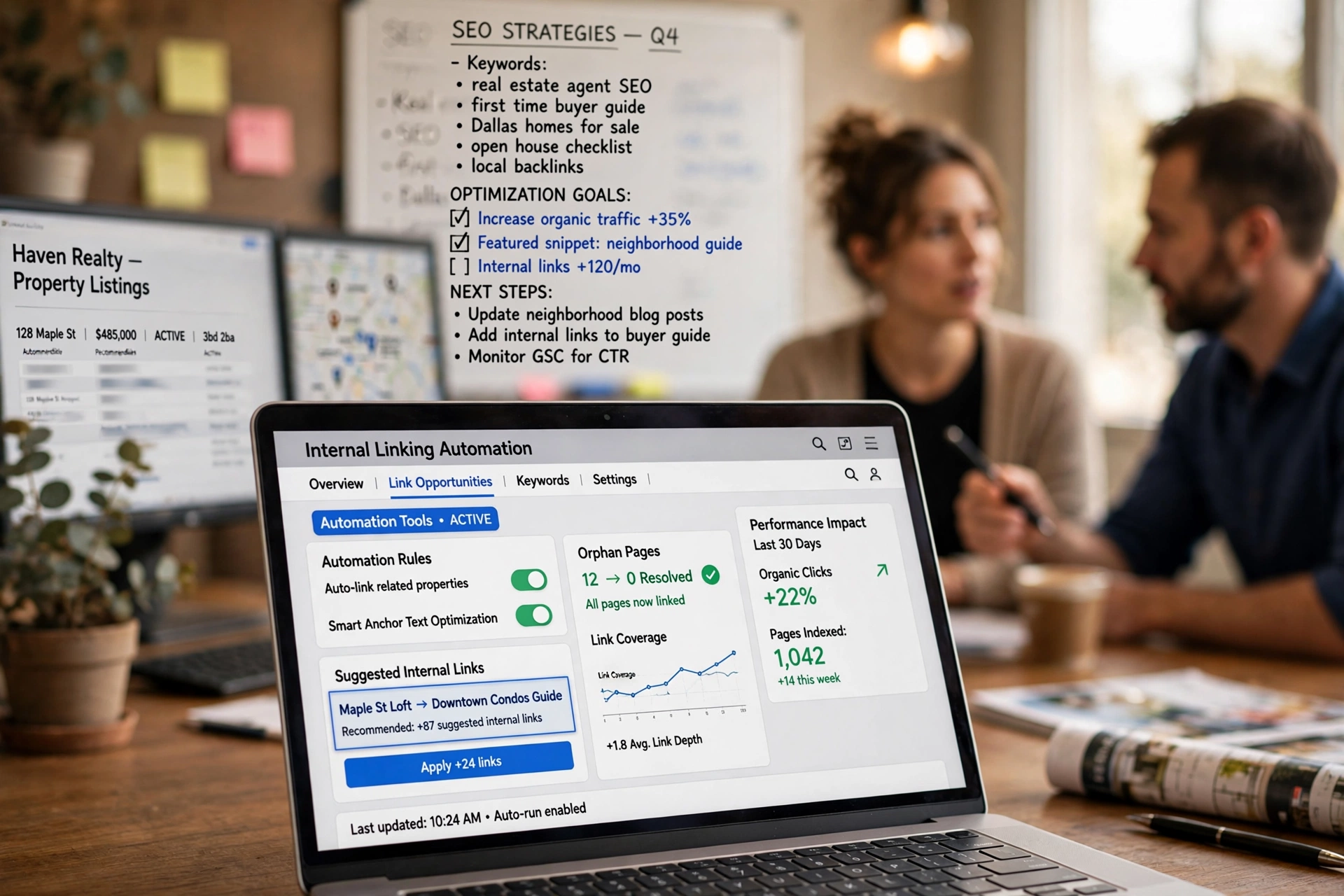
Most insurance brokers treat their website like a digital brochure, scattering policy pages and blog posts without a cohesive structure. The reality is that without a strategic web of internal links, Google's crawlers and AI search engines struggle to understand which of your pages is the definitive authority on a specific insurance product. Internal linking automation for insurance brokers is the programmatic process of using AI to analyze content intent and automatically insert high-value links between related pages, ensuring that link equity flows from your high-traffic guides to your high-conversion quote pages.
In my experience working with insurance agencies, the biggest bottleneck isn't a lack of content, but the 'orphan page' syndrome. Brokers often publish a brilliant guide on commercial liability insurance but fail to link it to their specific state-level landing pages. This creates a fragmented user experience and kills your SEO. By implementing a system that automates these connections, you transform a collection of isolated articles into a topical authority hub that converts visitors into qualified leads without manual intervention.

Why Insurance Brokers Are Adopting Internal Linking Automation in 2026?
The insurance landscape has shifted from simple keyword matching to a complex understanding of topical authority and user intent. Today, AI engines don't just look for the word 'Life Insurance'; they look for a comprehensive network of information that proves you are an expert in the field. According to Gartner, AI-driven search experiences are fundamentally changing how users discover professional services, with a significant shift toward 'answer engines' that prioritize deeply interconnected data structures over flat pages.
Insurance brokers are adopting automation because the sheer volume of content required to dominate a niche—covering everything from homeowners' policies to complex B2B risk management—is too vast for a human editor to manage. When you have 500 pages covering different zip codes, policy types, and FAQ segments, manually adding links is a losing game. In practice, this means brokers who rely on manual linking are essentially invisible to the sophisticated algorithms of 2026, while those using automation are capturing the lion's share of organic intent.
Furthermore, the rise of Generative Engine Optimization (GEO) has made structured internal linking a requirement rather than an option. As we've seen in our Overview of AI Search Engine Optimization & GEO, AI models like Perplexity and SearchGPT rely on the internal relationship between pages to validate a business's claims. If your 'Auto Insurance' page isn't logically linked to your 'Claims Process' and 'Coverage Limits' pages, the AI perceives a gap in your expertise and may cite a competitor instead. This is why the shift toward automation is not just about SEO, but about survival in an AI-first discovery environment.
Key Benefits of Internal Linking Automation for Insurance Agencies
Implementing an automated linking strategy provides a compounding advantage that manual efforts cannot match. The primary goal is to create a 'silo' architecture where the most important pages (Money Pages) receive the most internal link equity, while supporting content (Satellite Pages) guides the user toward a conversion event.
Accelerated Indexing and Crawl Budget Optimization
Search engine bots have a limited 'crawl budget' for every site. If your site is a maze of dead ends and orphan pages, the bot leaves before it finds your most profitable services. Automation ensures that every new piece of content is immediately integrated into the site's architecture. By creating a logical flow, you tell Google exactly which pages are the most important. This is particularly essential for brokers scaling via Programmatic SEO: How to Scale 10,000+ High-Converting Pages, where manual linking would take years to complete.
Improved User Experience and Lead Retention
When a prospect reads a post about "how to lower car insurance premiums," they are in the research phase. If the system automatically suggests a link to your "Customized Auto Policy Quote" page at the exact moment their intent shifts, you've shortened the sales cycle. Automation uses AI to track reading patterns and insert contextually relevant links that keep the user on your site longer, reducing bounce rates and increasing the probability of a lead capture.
Boosting Topical Authority for AI Search Engines
Topical authority is the perceived expertise of a website on a specific subject. To win this, you must cover every possible angle of a topic and link them together. Automation allows you to map out a 'knowledge graph' for insurance. For instance, a page on 'General Liability' should automatically link to 'Professional Indemnity,' 'Workers Comp,' and 'Umbrella Policies.' This interconnectedness signals to AI engines that your site is the definitive source for business insurance.
💡
Key Takeaway
Internal linking automation doesn't just help Google; it builds a psychological path for the user, guiding them from an educational curiosity to a transactional commitment.
Comparison: Linking Approaches for Insurance Brokers
| Feature | Manual Internal Linking | Basic AI Plugins | BizAI Intelligence Automation |
|---|---|---|---|
| Scalability | Very Low (Hours per page) | Medium (Keyword based) | Infinite (Intent-based) |
| Accuracy | High (but inconsistent) | Low (creates 'link spam') | High (Semantic mapping) |
| Maintenance | Constant manual audits | Periodic updates | Real-time autonomous updates |
| GEO Readiness | Poor | Moderate | Native Integration |
| Lead Impact | Random | Low | High (Directs to Money Pages) |
📚
Definition
Link Equity (or PageRank) is the value passed from one page to another via hyperlinks. High-authority pages pass more 'juice' to the pages they link to, boosting their rankings.
Real-World Examples of Automation Impact in the Insurance Niche
To understand the power of this approach, we have to look at the data from agencies that transitioned from fragmented content to automated silos. The pattern I see consistently is that the biggest jumps in traffic happen not when new content is added, but when existing content is properly connected.
Case Study 1: The Commercial Insurance Expansion
An agency specializing in B2B risk management had 200 high-quality articles but stagnant rankings. Their pages were 'flat'—they had a blog and they had service pages, but they rarely linked between them. After implementing internal linking automation, we mapped their content into three main silos: Construction, Healthcare, and Logistics. The system automatically inserted links from educational 'satellite' posts to the primary 'pillar' service pages.
The Result: Within 90 days, their primary service pages saw a 42% increase in organic traffic. More importantly, their conversion rate from the blog increased by 18% because users were being funally guided toward the quote request form rather than wandering off the site. This shift is a core part of how we help clients automate organic traffic and lead capture with AI.
Case Study 2: The Local Life Insurance Pivot
A multi-state life insurance broker was struggling to rank for local terms like "life insurance broker in [City]." They had created 50 city-specific landing pages, but these pages had no internal authority. By using automation, every blog post about life insurance needs (e.g., "Life Insurance for New Parents") was automatically linked to the corresponding local landing page based on the user's IP or the content's regional focus.
The Result: The local landing pages moved from page 4 to page 1 for 12 high-intent keywords within four months. The agency reported a 30% increase in monthly demo bookings, proving that internal linking is the bridge between general information and local lead generation. This demonstrates the necessity of PSEO Architecture for SaaS & Enterprise B2B Growth, even in traditional service niches like insurance.
How to Get Started with Internal Linking Automation for Insurance Brokers
Transitioning to an automated system requires a shift in mindset. You are no longer writing 'articles'; you are building a 'knowledge base.' If you attempt to do this manually, you will fail as soon as you hit 50 pages of content. Here is the professional framework for implementation.
Step 1: Map Your Topical Silos
Before turning on any automation, you must define your pillars. For an insurance broker, these are usually your primary product lines: Life, Health, Auto, Commercial, and Specialty. Every piece of content must be assigned to one of these silos. If a piece of content doesn't fit a silo, it's likely 'fluff' and should be removed or rewritten to serve a purpose.
Step 2: Identify 'Money Pages' vs. 'Information Pages'
Your 'Money Pages' are the ones that trigger a lead (e.g., the Quote Page). Your 'Information Pages' are the ones that attract traffic (e.g., "What is the difference between Term and Whole Life?"). The automation rules must be set so that Information Pages always link toward Money Pages, but Money Pages rarely link back to Information Pages. This creates a one-way street of value that pushes the user toward the sale.
Step 3: Deploy Semantic AI Mapping
This is where BizAI Intelligence changes the game. Instead of using simple keyword triggers (which often lead to unnatural links), our system uses Large Language Models (LLMs) to understand the meaning of the text. If a paragraph discusses 'risk mitigation in warehouses,' the AI knows to link to the 'Commercial Property Insurance' pillar, even if the exact phrase 'commercial property insurance' isn't used. This ensures a natural reading experience while maximizing SEO value.
Step 4: Continuous Optimization and Audit
Automation isn't 'set it and forget it.' You must monitor which links are actually being clicked. By integrating your internal linking with AI SDRs and autonomous sales appointment setters, you can track exactly which internal link path led to a booked meeting. This allows you to refine the automation rules to prioritize the paths with the highest ROI.
Common Objections to Internal Linking Automation
Many brokers are hesitant to move toward automation, fearing that it will lead to a 'spammy' feel or trigger a Google penalty. However, the data shows the opposite.
"Won't too many links look like spam to Google?"
Most people assume that more links equal more risk. In reality, Google penalizes irrelevant links. When you use generic AI plugins that link every instance of the word 'insurance' to the home page, you are creating a bad experience. However, semantic automation—which only links when it adds value to the reader—actually improves your E-E-A-T (Experience, Expertise, Authoritativeness, and Trustworthiness). According to McKinsey's research on digital transformation, businesses that leverage AI for structured data organization see higher trust scores from both users and algorithms.
"I don't have enough content for automation to matter."
This is a common misconception. Automation isn't just for sites with 10,000 pages; it's for anyone who wants to scale. If you have 20 pages, automation ensures those 20 pages are perfectly optimized. As you grow to 100 or 1,000 pages, the system scales with you. Waiting until you are 'big enough' means you are leaving the foundation of your organic growth to chance.
"Isn't this too technical for a small agency?"
That's why the architecture has shifted toward managed solutions. You don't need to hire a developer to write custom scripts. Modern platforms like BizAI Intelligence handle the mapping, the LLM integration, and the deployment. The broker's only job is to define their services and let the engine build the web of authority.
Frequently Asked Questions
What is the difference between internal linking and external linking for insurance brokers?
Internal linking refers to hyperlinks that point to another page on the same domain. For an insurance broker, this means linking a blog post about 'Homeowners Insurance Tips' to your 'Get a Home Insurance Quote' page. External linking, or backlinking, is when another website links to yours. While external links build overall domain authority, internal links distribute that authority across your site. Without internal linking automation, you might have a high-authority home page, but your specific service pages will remain invisible because the 'juice' isn't flowing to them.
How does internal linking automation improve my rankings in AI Search (GEO)?
AI engines like ChatGPT and Perplexity don't just scan for keywords; they analyze the relationship between concepts. When your site has a highly structured internal linking system, you are effectively providing a 'map' to the AI. By linking related insurance topics together, you prove that your site is a comprehensive resource. This increases the likelihood that the AI will cite your business as the definitive authority when a user asks a complex insurance question, which is the core goal of GEO vs Traditional SEO.
Can internal linking automation actually increase my lead conversion rate?
Yes, because it optimizes the 'user journey.' Most visitors land on a site via a specific question (e.g., "how much is disability insurance?"). If they find the answer but no clear path to the next step, they leave. Automation ensures that a contextually relevant call-to-action link is placed exactly where the user's intent is highest. By guiding the user from education to qualification and finally to a booking, you are effectively automating the top and middle of your sales funnel.
Will automating my links cause a 'Google Penalty'?
Google penalizes 'manipulative' link schemes, such as buying links or using hidden text. Internal linking is entirely within your control and is encouraged by Google as a way to help users navigate your site. As long as the links are semantically relevant and provide value—which is what high-end AI automation does—there is no risk of a penalty. In fact, failing to link your pages often results in 'orphan pages' that Google refuses to index, which is a much bigger risk to your business.
How often should my internal links be updated?
In a manual world, this would be a quarterly audit. In an automated world, it happens in real-time. Every time you publish a new page, the AI scans your existing library and adds links to the new content where appropriate. Conversely, if you update a service offering, the system can automatically adjust the destination of your links. This ensures that your site never has broken links or outdated paths, which is essential for maintaining a professional image in the high-trust insurance industry.
Final Thoughts on Internal Linking Automation for Insurance Brokers
In the current 2026 digital climate, the gap between the 'digitally native' brokerage and the traditional agency is widening. You can no longer afford to let your website be a collection of disconnected pages. Internal linking automation for insurance brokers is the only way to achieve the scale and authority required to compete in an AI-dominated search landscape. By transforming your site into a cohesive, semantic network, you stop renting traffic from expensive ads and start owning your niche.
If you are ready to stop guessing and start dominating your local market, it's time to implement a system that works while you sleep. From programmatic page generation to autonomous lead qualification, the future of insurance acquisition is automated. Visit BizAI Intelligence today to build your organic traffic machine and turn your website into your most productive employee.
AI Search Accelerator: 1-on-1 Strategy Session
Claim one of the 10 monthly slots. Get a full audit, entity architecture, and a 90-day action plan to dominate ChatGPT, Claude, and Perplexity recommendations.