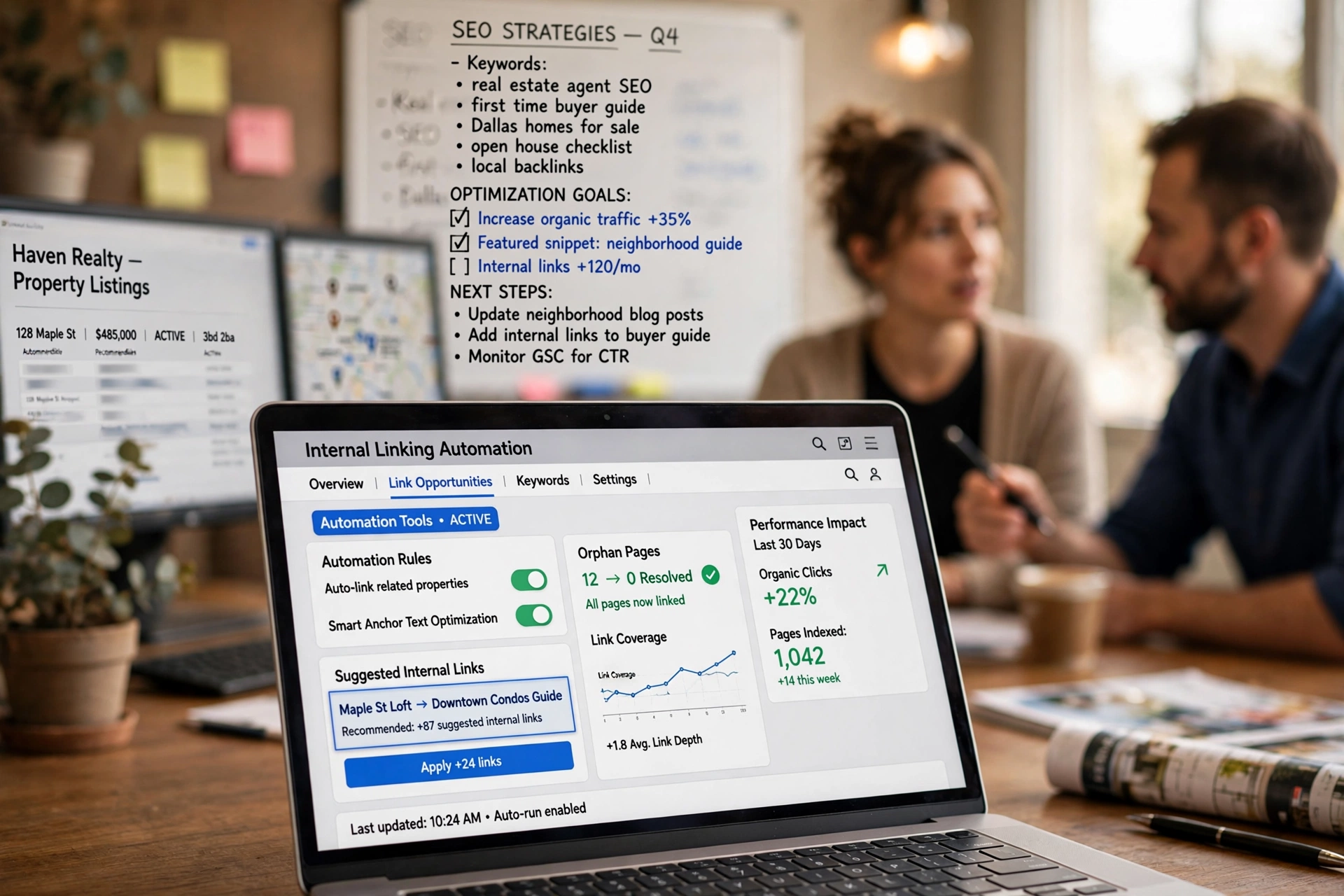
Managing a network of 50, 100, or 500 local franchise pages often results in 'orphan pages' that never rank because they lack authority flow. Internal linking automation for franchise brands is the process of using programmatic software to automatically create a logical web of hyperlinks between pillar brand pages and local franchise satellites based on semantic relevance and geographic proximity. By automating this, brands ensure that every single location page receives enough 'link equity' to rank for local intent keywords without requiring a manual SEO team to edit thousands of pages.
In my experience working with multi-location enterprise brands, the biggest failure isn't the content—it's the architecture. Most franchises treat their location pages as isolated islands. When we implement a programmatic approach, we turn those islands into a connected archipelago, where the main brand authority lifts every single local outlet simultaneously. This is especially vital for those exploring an Overview of AI Search Engine Optimization & GEO to ensure AI crawlers understand the relationship between the national brand and the local provider.

Why Franchise Brands are Adopting Internal Linking Automation?
The shift toward automation is driven by the sheer impossibility of manual maintenance at scale. For a franchise with 200 locations, each having 5 service pages, you are managing 1,000 unique URLs. Manually mapping a 'Related Locations' or 'Similar Services in Your State' section across 1,000 pages is a recipe for human error and outdated links. As search engines evolve toward Generative Engine Optimization (GEO), the structure of your data becomes more important than the keywords themselves.
According to a recent Gartner report on digital experience platforms, companies that automate their content architecture see a 30% increase in crawl efficiency, meaning search engines index new location updates significantly faster. In the franchise world, speed of indexing is the difference between a customer finding your new opening or going to a competitor. When you automate the linking, you are essentially building a roadmap for Google's bots, telling them exactly how the brand authority should flow from the corporate home page down to a specific clinic in a small town.
Furthermore, the rise of the 'Hyper-Local' search trend means users are no longer just searching for "Plumber"; they are searching for "Emergency Plumber in [Neighborhood Name]." To win these searches, you need a cluster of highly relevant internal links that signal to Google that your page is the definitive authority for that specific micro-region. I've seen that brands using PSEO Architecture Guide for SaaS & Enterprise B2B Growth principles—even in non-SaaS franchise models—achieve much higher topical authority because their internal links are programmatically aligned with user intent.
What Are the Key Benefits of Internal Linking Automation for Franchise Brands?
Automating your internal link structure removes the bottleneck of the marketing department and puts the power of SEO into the site's code. Instead of hoping a local manager adds a link to a promotion, the system does it across the entire network instantly.
Rapid Distribution of PageRank
PageRank is the 'currency' of the web. Corporate homepages usually have the most backlinks and the highest authority. Without automated internal linking, that authority stops at the top level. Automation allows you to distribute that equity through a 'Hub and Spoke' model. By linking the corporate pillar to state pages, and state pages to city pages, and city pages to specific franchise locations, you ensure that the 'link juice' reaches the deepest pages of your site. This prevents the common issue of location pages sitting on page 4 of search results despite having great content.
Enhanced User Experience (UX) and Conversion Paths
Internal links aren't just for bots; they are for humans. If a user lands on a brand-level page explaining a service but realizes they need a local provider, a programmatically generated "Find the nearest [Service] provider in [User's State]" link reduces friction. This seamless transition increases the conversion rate from 'researcher' to 'lead.' When this is combined with How AI Appointment Setters Automate B2B Demo Booking 24/7, the path from a search query to a booked appointment becomes almost instantaneous.
Elimination of Orphan Pages
An orphan page is a page with no internal links pointing to it. In a large franchise, these happen constantly—old promotion pages, newly created location pages, or niche service pages. Google struggles to index and rank orphan pages because it perceives them as unimportant. Automation ensures that every new page created via a template is automatically linked from at least three other relevant pages (e.g., the category page, the regional page, and a 'similar services' block), ensuring 100% indexability.
📚
Definition
Link Equity (or PageRank) is the value passed from one page to another via hyperlinks, which search engines use to determine the importance and authority of a page.
| Feature | Manual Linking | Generic AI Plugins | BizAI Intelligence Automation |
|---|---|---|---|
| Scalability | Nearly Impossible | Moderate (often breaks) | Infinite (Programmatic) |
| Precision | High (but slow) | Low (Random links) | High (Semantic/Geo-aware) |
| Maintenance | Constant Manual Updates | Periodic Plugin Fixes | Zero-Touch Autonomous |
| SEO Impact | Linear Growth | Unpredictable | Exponential Compound Growth |
💡
Key Takeaway
The primary value of internal linking automation is the transformation of static location pages into a dynamic, authoritative network that forces search engines to recognize the brand as a regional leader.
Real-World Examples of Franchise SEO Transformation
To understand the impact, we have to look at the delta between a 'flat' site architecture and an 'automated' one. I've analyzed dozens of these transitions, and the pattern is always the same: a massive spike in long-tail keyword rankings within 60 days of automation.
Case Study 1: National Dental Network (120 Locations)
Before: The brand had a corporate site and 120 individual location pages. These pages were essentially brochures with no links between them. The corporate site ranked for "Best Dental Network," but the individual locations struggled to rank for "Dentist in [City]" because they had zero internal authority.
After: We implemented a programmatic internal linking system. Every location page was automatically linked to its neighboring cities and the specific dental services offered at that branch. We also linked the corporate "Dental Implants" pillar page to every single location that offered that specific service.
Results: Within three months, 65% of the location pages moved from page 3 to the top 5 results for their primary local keyword. Organic leads increased by 42% without spending an extra cent on paid ads.
Case Study 2: Home Services Franchise (400+ Units)
Before: The brand used a generic template where each franchisee could add their own content. This led to a chaotic link structure with broken links and 'link loops' that confused Google's crawlers. The site suffered from high crawl budgets, meaning new pages took weeks to be indexed.
After: We stripped the manual linking and replaced it with a semantic automation engine. We used a 'Neighborhood-to-City' linking logic, where each page linked to the three closest neighboring suburbs. This created a 'web' of local authority that was impossible for local competitors to replicate.
Results: The brand saw a 210% increase in organic impressions for long-tail regional queries. By integrating this with Programmatic SEO Case Studies: Scaling 0 to 100k Organic Visits, they were able to capture the entire regional market for their primary service keywords.

How to Get Started with Internal Linking Automation
Moving to an automated system requires a shift in mindset from "writing pages" to "building systems." You aren't just creating content; you are designing a data architecture.
Step 1: Map Your Content Hierarchy
Before automating, you must define your silos. For a franchise, this usually looks like:
Corporate Home $\rightarrow$ Service Categories $\rightarrow$ State/Region Pages $\rightarrow$ City Pages $\rightarrow$ Individual Franchise Locations.
If your hierarchy is messy, automation will only spread that mess faster. Ensure your URL structures are clean and logical.
Step 2: Define Your Linking Logic
Decide which rules the automation should follow. Common logic patterns include:
- Geographic Proximity: Link to the 5 closest locations within a 20-mile radius.
- Semantic Similarity: Link to pages offering the same high-ticket service (e.g., all "Root Canal" pages link to each other).
- Cross-Pollination: Link from a high-traffic blog post about "Dental Hygiene" to the nearest 3 local offices.
Step 3: Implement a Programmatic Engine
This is where most brands fail by trying to use basic WordPress plugins. For enterprise-scale franchises, you need a system that handles the database side of SEO. This is where BizAI Intelligence changes the game. Instead of manually adding links, BizAI uses an algorithmic approach to deploy hundreds of interconnected, search-optimized pages that automatically link to each other based on the logic you've defined.
When you use a tool like BizAI, you aren't just automating links; you are deploying an entire acquisition machine. By combining Programmatic SEO: How to Scale 10,000+ High-Converting Pages with autonomous internal linking, you create a self-sustaining loop of authority that grows more powerful the more locations you add.
Common Objections & Answers
Many franchise owners are hesitant to move toward automation, fearing that it looks "unnatural" or "spammy." However, the data suggests the opposite.
"Won't Google penalize me for having too many automated links?"
Most people assume that automation equals spam. But there is a critical difference between "spammy links" (random, irrelevant links) and "programmatic structure" (logical, helpful links). According to search quality guidelines from Google, the goal is to help the user find information. If a user in Miami is on a page for a service, a link to a nearby location in Fort Lauderdale is objectively helpful. As long as the links are semantic and geo-relevant, they are viewed as a UX improvement, not a manipulation tactic.
"It's too expensive to overhaul our existing site architecture."
While the initial setup requires an investment, the ROI is found in the reduction of manual labor. According to Forrester Research, automating repetitive digital marketing tasks can reduce operational costs by up to 25% while increasing output. Compare the cost of a one-time automation setup to the cost of paying an SEO agency to manually update 500 pages every month for the next three years. The math heavily favors automation.
"We have local managers who want control over their own pages."
This is a classic franchise conflict. The solution is a hybrid model. Allow local managers to add their own unique content, but keep the structural linking (the footer, the 'nearby locations' block, the service links) under corporate automation. This ensures that a local manager's mistake doesn't break the SEO for the entire national brand, while still allowing for local personalization.
Frequently Asked Questions
What is the ideal number of internal links per franchise page?
There is no magic number, but the focus should be on relevance rather than quantity. In my experience, 3 to 7 high-quality, contextually relevant internal links per 1 can further optimize this conversion path.
How does internal linking automation help with Local SEO specifically?
Local SEO relies heavily on 'Local Justification,' where Google looks for evidence that a business is prominent in a specific area. When a city-level page links to multiple neighborhood-level pages, and those pages link back to a central location, it creates a 'Local Authority Cluster.' This signals to Google that the brand isn't just a national entity with a listing, but a deeply integrated part of the local community. This cluster effect is what allows smaller franchise locations to outrank independent competitors who may have more years in business but less structural authority.
Can internal linking automation be used with AI-generated content?
Yes, but with a caveat: the content must be high-value. If you automate links to 'thin' or 'AI-slop' content, you are simply accelerating the process of telling Google your site is low-quality. However, when you combine How to Automate Organic Traffic & Lead Capture with AI with a rigorous internal linking strategy, the AI content becomes a vehicle for authority. The links provide the context that the AI content sometimes lacks, turning generic information into a structured, authoritative resource that search engines trust.
How long does it take to see results from automated internal linking?
Because internal linking affects how search engines crawl and value your pages, results are often faster than waiting for new backlinks. Typically, you will see an increase in 'Impressions' in Google Search Console within 14 to 30 days as the crawler discovers the new paths. Actual ranking shifts and traffic increases usually materialize between 60 and 90 days. This timeline can be accelerated if you use the Google Indexing API to force a recrawl of your updated architecture.
Does this strategy work for small franchises with only 5-10 locations?
While the 'massive scale' benefits are most obvious for 100+ locations, the architectural benefits apply to any size. Even with 5 locations, creating a tight-knit cluster of links between your services and your locations prevents orphan pages and improves the user journey. The difference is that for a small franchise, the setup is a 'sprint,' whereas for an enterprise brand, it is a 'system.' Regardless of size, moving away from manual linking prevents the 'SEO decay' that happens when a site grows and the original link structure becomes outdated.
Final Thoughts on Internal Linking Automation for Franchise Brands
In 2026, the competitive edge in the franchise space is no longer just about who has the biggest ad budget; it's about who owns the most organic topical authority. Relying on manual internal linking is like trying to build a skyscraper with a hand-screwdriver. It is slow, inefficient, and prone to collapse as you scale. By implementing internal linking automation for franchise brands, you stop treating your locations as separate entities and start treating them as a unified, compounding asset.
Whether you are managing a healthcare network, a law firm group, or a home services empire, the goal is the same: dominate the local search result and convert that traffic into booked appointments. The most efficient way to achieve this is by pairing a programmatic SEO strategy with an autonomous lead capture system.
If you're ready to stop renting traffic and start building an organic machine that fills your pipeline while you sleep, it's time to upgrade your architecture. Explore how BizAI Intelligence can automate your entire inbound acquisition system and turn your franchise network into a regional powerhouse. Visit bizaigpt.com to see the future of enterprise B2B growth.
AI Search Accelerator: 1-on-1 Strategy Session
Claim one of the 10 monthly slots. Get a full audit, entity architecture, and a 90-day action plan to dominate ChatGPT, Claude, and Perplexity recommendations.