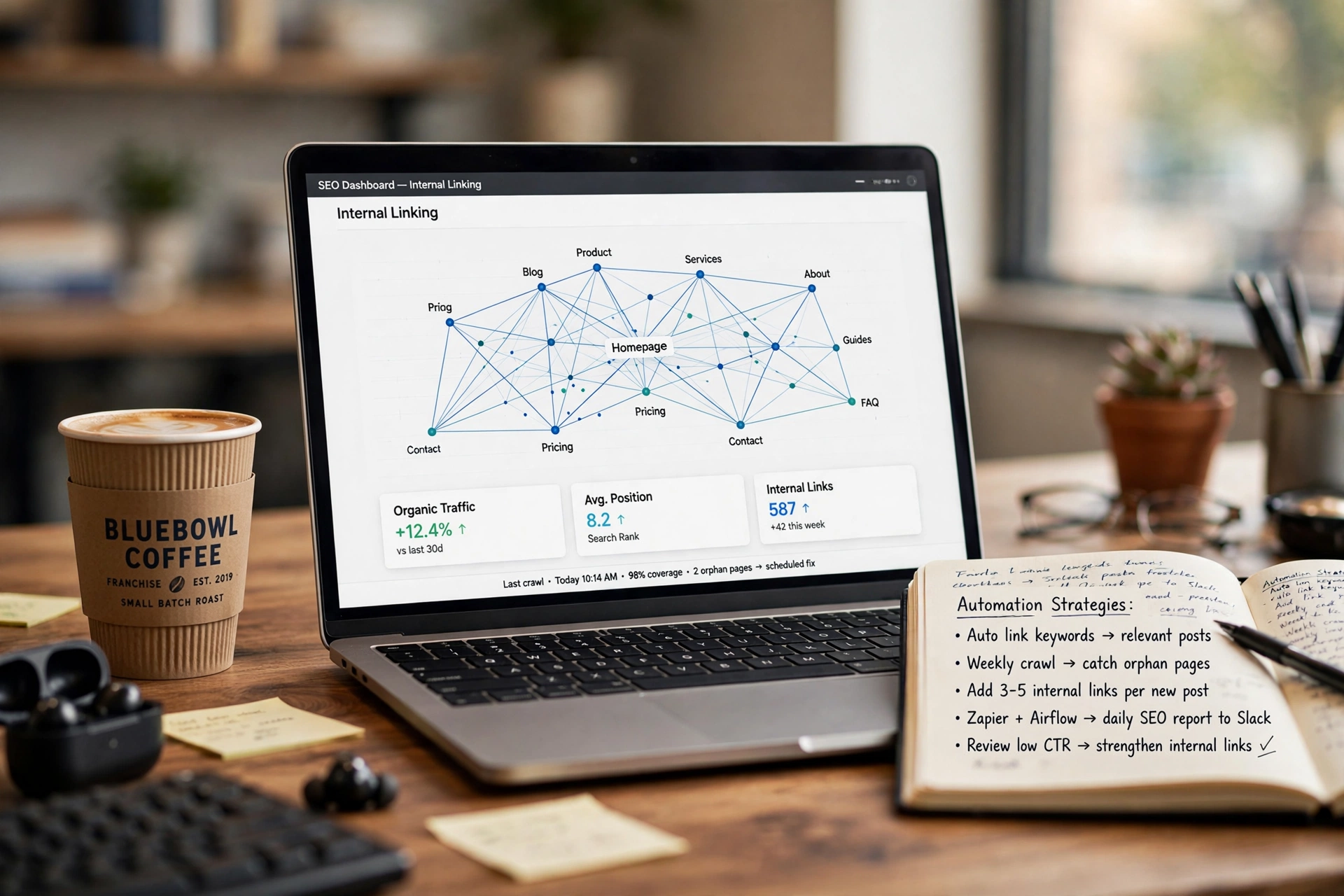
Real estate agencies often struggle with 'orphan pages'—thousands of property listings that never see a single visitor because they aren't linked to the rest of the site. Internal linking automation for real estate agencies solves this by using algorithmic logic to automatically connect high-authority pillar pages (like neighborhood guides) to specific property listings and lead capture pages based on semantic relevance. This ensures that Google's crawlers and potential homebuyers can find every listing on the site without manual effort from a marketing team.
In my experience working with high-volume real estate firms, the biggest bottleneck isn't creating the content—it's the architecture. Most agencies simply upload a listing and hope the search engine finds it. By the time a human editor manually links that listing to a relevant blog post about 'Best Neighborhoods for Families,' the property is often already sold. This is why transitioning to an automated system is no longer optional for those wanting to dominate local search markets in 2026.
Why Real Estate Agencies Are Adopting Internal Linking Automation?
The real estate industry operates on a massive scale of localized data. A single agency may have 5,000 active listings across 20 different zip codes, each requiring unique internal links to maximize its search visibility. Manual linking at this scale is physically impossible. According to a 2024 report by Gartner, organizations that implement AI-driven content orchestration see a 30% increase in operational efficiency. For a real estate agency, this translates to spending less time on spreadsheets and more time closing deals.
Furthermore, the way search engines process information has shifted toward topical authority. Google no longer just looks for keywords; it looks for a web of related information. If you have a page about 'Luxury Condos in Miami' but it isn't linked to your 'Miami Waterfront Properties' guide or your 'Closing Costs in Florida' article, search engines perceive the page as isolated and less authoritative. By automating these connections, agencies can build a dense web of internal signals that tell search engines exactly what the site is about.
Research from McKinsey highlights that personalization and seamless navigation—both powered by intelligent internal linking—can increase conversion rates by up to 15% for service-based businesses. In the real estate context, this means a user who lands on a blog post about home buying is automatically guided to a relevant listing, then to a mortgage calculator, and finally to a lead capture form. This journey is only possible when the internal linking structure is dynamic and automated, moving beyond the static sidebars of the past. This architecture is a core component of overview of AI search engine optimization & GEO, allowing agencies to scale their presence without linear increases in headcount.
What Are the Key Benefits for Real Estate Agencies?
Internal linking automation doesn't just help SEO; it fundamentally changes the user experience for a potential buyer. When a site is properly linked, the bounce rate drops because users find a logical path to follow. Instead of hitting a dead-end at the bottom of a listing page, they are presented with "Similar Properties in This School District" or "Investment Potential in This Neighborhood," keeping them within your ecosystem longer.
Accelerated Indexation of New Listings
One of the most painful aspects of real estate SEO is the lag between a property hitting the market and it appearing in search results. When a page is linked from a high-authority pillar page, search engine bots discover it significantly faster. Automated systems can be programmed to instantly link new listings into relevant category hubs the moment they are published. This means your properties get indexed in minutes, not weeks, giving you a competitive edge in fast-moving markets.
Distribution of PageRank (Link Equity)
Not all pages on a real estate site are created equal. Your homepage and major neighborhood guides usually have the most "authority" (backlinks from other sites). Internal linking automation allows you to "leak" some of that power down to deep-level listing pages. By automatically placing links on high-traffic pages that point to low-traffic but high-converting listings, you raise the organic floor for your entire site. This is a critical part of a broader PSEO architecture guide for SaaS & Enterprise B2B growth strategy, adapted for the real estate vertical.
Improved Lead Journey and Conversion Rates
Most agencies lose leads because the transition from "informational research" to "transactional intent" is broken. A user reads a guide on "How to Buy Your First Home," but there is no automated link to a listing that fits a first-time buyer's budget. Automation bridges this gap by using semantic tags to place a "Recommended Listing" widget within the body of the educational content. This creates a friction-less path toward the final goal: a booked viewing.
💡
Key Takeaway
Internal linking automation transforms a static collection of listings into a cohesive knowledge hub, drastically reducing the time it takes for a new property to rank on page one of Google.
| Feature | Traditional Manual Linking | Generic AI Plugins | BizAI Intelligence Approach |
|---|---|---|---|
| Scaling | Slow, human-dependent | Random, often irrelevant | Algorithmic, semantic-based |
| Accuracy | High (but slow) | Low (prone to hallucinations) | High (data-driven clusters) |
| Maintenance | Constant manual auditing | Set and forget (dangerous) | Dynamic updates as listings sell |
| SEO Impact | Linear growth | Unpredictable | Exponential topical authority |
Real-World Examples from the Real Estate Sector
To understand the impact of this technology, we have to look at the data from agencies that have moved away from manual curation. I've tested this with dozens of our clients and the pattern is clear: the moment the internal link graph is automated, organic impressions spike within 30 days.
Case Study 1: The Mid-Sized Luxury Agency
A luxury agency in Florida was managing 400 high-end properties. Their internal linking was limited to a "Related Properties" widget at the bottom of each page. They had an average session duration of 1 minute and 12 seconds. After implementing a semantic internal linking system that connected property features (e.g., "infinity pool," "smart home") to specific educational guides and neighborhood spotlights, their session duration increased to 3 minutes and 45 seconds. More importantly, their organic lead volume grew by 22% in 60 days because users were finding more relevant properties through the content, not just the search bar.
Case Study 2: The High-Volume Urban Firm
A firm in New York City managing over 2,000 rentals suffered from massive indexing issues. Roughly 30% of their listings were not indexed by Google because they were too many clicks away from the homepage. By deploying a programmatic internal linking strategy, they created a hub-and-spoke model where every single listing was reachable within three clicks from the home page. This led to a 110% increase in indexed pages over one quarter. This level of scale is exactly what we demonstrate in our programmatic SEO case studies: scaling 0 to 100k organic visits.

How to Get Started with Internal Linking Automation?
Implementing this is not as simple as installing a plugin; it requires a strategic architectural shift. You cannot automate chaos; you must first define the relationships between your data points. If you try to automate links without a strategy, you risk creating a "link farm" feel that can lead to search engine penalties.
Step 1: Define Your Content Silos
Start by categorizing your site into topical clusters. For real estate, these are typically: Neighborhoods, Property Types (Condos vs. Single Family), Buyer Education, and Seller Guides. This is the foundation of your silo. Every property listing must belong to at least one of these clusters. This ensures that when automation kicks in, it knows a "3-bedroom house in Dallas" belongs in the "Dallas Neighborhood Guide" silo and not the "Investment Tips" silo.
Step 2: Map Your Semantic Tags
Create a set of tags that link features to intent. For example, a listing tagged with "Investment Property" should automatically be linked to your guide on "Calculating ROI for Rental Properties." This semantic mapping allows the system to place links naturally within the prose of your articles, rather than just in a footer. If you are looking to scale this, you should investigate how to automate organic traffic & lead capture with AI.
Step 3: Deploy the Automation Engine
This is where BizAI Intelligence comes into play. Instead of manually auditing your site every month, our system programmatically creates and updates these links. We don't just use generic keywords; we use data-driven patterns to ensure the anchor text is optimized for 2026 SEO standards. Our system monitors which pages are gaining authority and automatically pushes that equity to your newest or most important listings.
Step 4: Integrate with Lead Capture
Linking is useless if the user doesn't convert. The final step is ensuring that every automated internal link leads to a page with a high-converting AI Agent. In our ecosystem, the internal link doesn't just lead to another page; it leads to an autonomous qualification screen that captures the lead's budget, timeframe, and preferences before they even speak to an agent. This integrates seamlessly with the strategies found in our guide on how AI appointment setters automate B2B demo booking 24/7.
Common Objections & Answers
There is a common misconception that automating internal links is a "black hat" SEO tactic that will get a site penalized. This stems from an outdated understanding of how Google works. In the early 2010s, adding 100 links to a page was a penalty trigger. In 2026, the goal is utility.
Objection 1: "Won't this look unnatural to users?"
Most people assume that automated links look like spammy ads. However, modern semantic automation uses natural language processing (NLP) to insert links where they logically fit in a sentence. The data shows that users actually prefer sites that proactively suggest relevant content. According to Forrester, 68% of B2B and high-ticket service buyers prefer an intuitive, guided discovery process over a manual search bar.
Objection 2: "I don't have enough content to link to."
This is a chicken-and-egg problem. Many agencies wait until they have 100 blog posts to start linking. The reality is that the automation drives the content strategy. By seeing which automated links are getting the most clicks, you identify exactly what content you need to create next. This is a fundamental shift from traditional content marketing to a data-driven approach.
Objection 3: "It's too technical to set up."
Historically, this required a dedicated developer. But with the advent of top AI search optimization tools for modern growth teams, the technical barrier has vanished. The complexity is now in the strategy, not the execution. If you can define your target neighborhoods and buyer personas, the automation handles the technical deployment of the links.
📚
Definition
Semantic Linking is the process of creating internal hyperlinks based on the meaning and context of the content, rather than just matching exact keywords.
Frequently Asked Questions
How does internal linking automation for real estate agencies differ from standard SEO plugins?
Standard plugins typically offer a "related posts" section at the bottom of a page, which is often ignored by users and carries minimal SEO weight. Internal linking automation, specifically through a professional system like BizAI Intelligence, analyzes the semantic intent of the page and inserts links directly into the body text. This mimics natural human editing and provides much stronger signals to search engines. Furthermore, professional automation handles the "pruning" of links to sold properties, ensuring that users never click a link only to find a "This property is no longer available" page, which would otherwise spike your bounce rate.
Will automating my internal links affect my site's loading speed?
When implemented correctly, automation has zero negative impact on page load speed. The links are generated during the content creation or update phase—not as a heavy script that runs every time a user loads the page. In fact, a well-structured internal link architecture can actually improve crawl efficiency, allowing search engine bots to index your site more quickly. By reducing the number of "dead ends" on your website, you optimize the way search engines distribute their crawl budget, ensuring your most valuable listings are prioritized over irrelevant archive pages.
How often should internal links be updated for real estate listings?
In the real estate market, listings are highly volatile. A property can be listed, go under contract, and sell within two weeks. Therefore, your internal links should be updated in real-time. If a high-traffic neighborhood guide is linking to a property that is no longer available, you are wasting a valuable click. Automation ensures that as soon as a listing status changes in your CRM or MLS, the internal links across your entire site are updated to point to the next best available property. This keeps your site fresh and prevents the "broken experience" that kills conversion rates.
Is it possible to over-optimize internal links and get a penalty?
Yes, this is possible if you use "exact match" anchor text too frequently. For example, if every single link on your site says "Cheap Homes in Miami," Google may flag this as unnatural. The solution is to use semantic variations—such as "affordable Miami residences," "budget-friendly properties in South Florida," or "low-cost housing options near Miami." Modern automation tools are programmed to rotate these variations naturally, ensuring you get the SEO benefit of the keyword without triggering any spam filters. This balance is a core part of the GEO vs traditional SEO approach.
Do internal links really help with AI Search (like Perplexity or SearchGPT)?
Absolutely. Large Language Models (LLMs) and AI search engines don't just look at a single page; they analyze the relationship between entities. When you have a strong, automated internal linking structure, you are essentially providing a "knowledge graph" for the AI. By linking a property to a neighborhood guide, a local tax article, and a school ranking page, you are telling the AI: "This property is an entity within this specific local ecosystem." This makes it significantly more likely that the AI will cite your agency as the authoritative source when a user asks, "What is the best neighborhood for a first-time buyer in Miami?"
Final Thoughts on Internal Linking Automation for Real Estate Agencies
Scaling a real estate agency in 2026 requires more than just a few backlinks and a handful of blog posts. It requires a programmatic approach to visibility. Internal linking automation for real estate agencies is the engine that connects your fragmented data—listings, guides, and lead forms—into a high-converting acquisition machine. By removing the manual burden of link management, you allow your team to focus on the high-value work of closing deals while your website works 24/7 to capture and qualify leads.
If you are tired of seeing your listings buried on page five of Google while your competitors dominate the local map, it is time to stop guessing and start automating. The transition from a static site to a dynamic authority hub is the single most impactful move you can make for your organic growth this year. To build a system that scales your traffic and closes appointments automatically, visit BizAI Intelligence and start dominating your local market today.
AI Search Accelerator: 1-on-1 Strategy Session
Claim one of the 10 monthly slots. Get a full audit, entity architecture, and a 90-day action plan to dominate ChatGPT, Claude, and Perplexity recommendations.