
How Much Does Internal Linking Automation for SEO Scaling Actually Cost?
Most B2B founders treat internal linking as a "nice to have" task for their interns, but at scale, manual linking is a financial leak. If you are managing a site with 500+ pages, the cost of internal linking automation for seo scaling generally ranges from $100 to $2,000 per month, depending on whether you use a plug-and-play SaaS tool, a custom API integration, or an all-in-one programmatic engine like BizAI Intelligence. The real cost isn't the software subscription; it's the opportunity cost of "orphaned pages" that never rank because they lack the internal authority to move the needle.
In my experience working with high-ticket B2B service providers, the most expensive mistake is trying to scale content without a linking strategy. I've seen companies spend $10,000 a month on high-quality articles only to have them sit in a vacuum. When we designed the architecture at BizAI Intelligence, we realized that an automated, algorithmic approach to link distribution creates a compounding effect that manual linking simply cannot replicate. If you want to stop depending on paid ads, you must stop thinking of links as manual additions and start viewing them as a scalable data infrastructure.

What Is Internal Linking Automation and How Does It Work?
Internal linking automation is the process of using algorithmic logic, Natural Language Processing (NLP), and programmatic scripts to automatically create hyperlinks between related pages on a single domain. Instead of a human editor scanning through a 2,000-word article to find a relevant phrase to link to another post, a system identifies semantic relationships and inserts the link based on predefined rules or AI-driven intent.
📚
Definition
Internal Linking Automation is the use of software to programmatically distribute "link equity" (PageRank) across a website's architecture, ensuring that search engine crawlers can discover and index deep-level pages efficiently.
At its core, this process works by analyzing the "topicality" of a page. Modern systems use Large Language Models (LLMs) to understand that a page about "Corporate Law in New York" is semantically related to a page about "Commercial Lease Agreements." By automatically bridging these two, the system signals to Google that the site is a topical authority. According to Gartner, the shift toward Generative Engine Optimization (GEO) means that structured, interconnected data is now more valuable than raw keyword density.
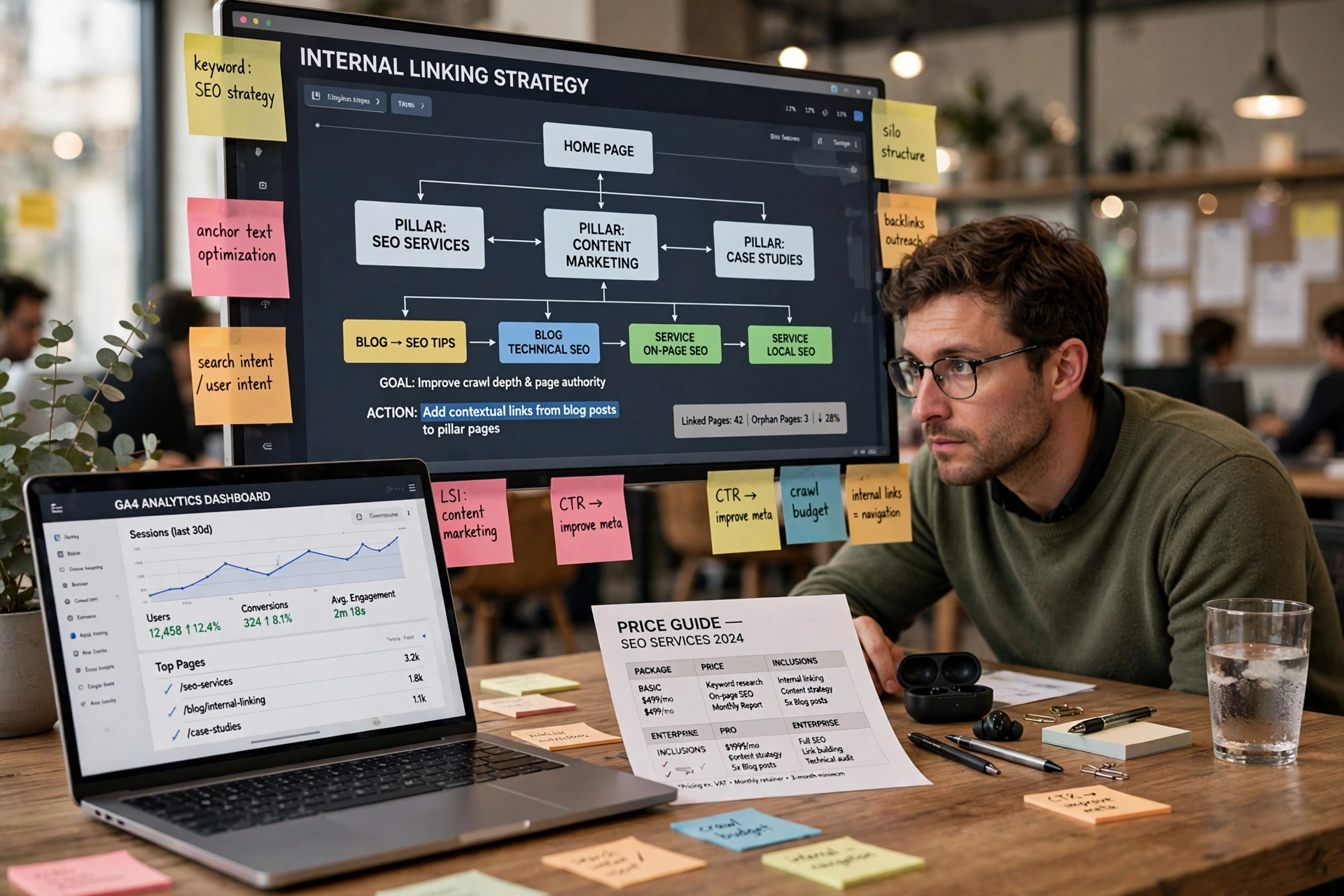
Now, here's where it gets interesting: the automation isn't just about adding links; it's about managing the "link graph." A sophisticated system prevents "link rot" (links to 404 pages) and avoids over-optimizing anchor text, which can trigger spam filters. When you utilize best programmatic SEO platforms 2026, the automation handles the heavy lifting of mapping "Pillar Pages" to "Satellite Pages," creating a silo effect that forces Google to recognize your site as an industry hub.
Why Does Automated Linking Matter for High-Ticket B2B Scaling?
The primary reason internal linking automation for seo scaling is mandatory for growth is the concept of "crawl budget." Google does not spend an infinite amount of time on your site. If your most valuable lead-generation pages are buried four clicks deep from the homepage, they effectively don't exist for the crawler.
According to research from Forrester, websites with a highly optimized internal structure see a significant increase in the "indexation rate" of their long-tail content. When pages are linked programmatically, you reduce the distance between the homepage (the highest authority point) and your conversion pages. This redistribution of authority is what allows a new satellite page to rank on page one in days rather than months.
The business impact is measured in lead velocity. If you are using AI blog automation to keep your website updated, you are likely generating hundreds of pages of content. Without automation, these pages become "ghost pages." In my experience, automating the link flow can increase the organic visibility of deep-funnel pages by as much as 40% within the first quarter.
Furthermore, the user experience (UX) improves. When a potential client reads a guide on "Tax Law" and finds a natural, automated link to "How to Hire a Tax Attorney in 2026," the friction to conversion is removed. This is why replacing freelance copywriters with an AI content engine only works if the internal linking is automated; otherwise, you have a library of content with no hallways connecting the rooms.
How to Implement Internal Linking Automation Step-by-Step
Implementing this system requires moving from a "writer-centric" mindset to an "architect-centric" mindset. You cannot simply install a plugin and hope for the best; you need a strategic map.
Step 1: Define Your Topical Clusters
Before automating, you must identify your Pillar pages (broad, high-volume topics) and your Satellite pages (specific, long-tail queries). For example, if your pillar is "B2B Lead Generation," your satellites might be "AI Lead Generation for Law Firms" or "B2B Lead Generation Price Guide."
Step 2: Establish Anchor Text Logic
Set up a "Keyword Map." Automation tools need to know that when they see the phrase "lead qualification," they should link to your specific AI SDR page. This prevents the system from using generic "click here" anchors, which provide zero SEO value.
Step 3: Deploy the Automation Engine
This is where you choose your tool. Whether it's a custom script or a platform like BizAI Intelligence, the engine should scan your existing content and automatically inject links based on your map. BizAI Intelligence takes this a step further by integrating the link with an AI SDR, ensuring the link doesn't just provide SEO value but also a conversion path.
Step 4: Monitor Link Equity Distribution
Use a tool like Google Search Console or Ahrefs to ensure that no single page is "hogging" all the links (which can look unnatural) and that no page has zero incoming internal links.
💡
Key Takeaway
The goal of automation is not just to add links, but to create a "silo" where authority flows from the broad pillar down to the high-conversion satellite pages.
If you are struggling to get your business to show up in search results, implementing this architecture is the fastest way to make your business show up on Google Search without waiting for external backlinks.

Comparing Your Internal Linking Options
When determining how much you should spend on internal linking automation for seo scaling, you generally have three paths. Most businesses start with the manual approach, realize it's impossible to scale, and then jump to a cheap plugin—which often leads to "link spam" and potential penalties.
| Feature | Manual Linking | Generic AI Plugins | BizAI Intelligence Approach |
|---|---|---|---|
| Scalability | Extremely Low | Moderate | Infinite (Programmatic) |
| Accuracy | High (but slow) | Low (Hallucinations) | High (Semantic Mapping) |
| Cost | High (Human Hours) | Low ($20-$100/mo) | Value-Based (ROI Driven) |
| SEO Impact | Linear Growth | Risk of Spam | Exponential Growth |
| Conversion | Random | None | Integrated AI SDR Capture |
The "Cheap AI" approach often fails because it lacks a strategy. It simply links words that look similar. The "Professional" approach uses a dedicated architecture where links are designed to guide the user toward a conversion event. This is the difference between a website that is a "blog" and a website that is a "lead generation machine."
For those who have already scaled their content but are seeing a high bounce rate, the issue usually isn't the content—it's the lack of a cohesive internal journey. This is exactly why programmatic SEO fails without embedded AI SDRs, as the link only gets them to the page; the SDR closes the deal.
Common Misconceptions About Automated Linking
Most guides on this topic get it wrong by suggesting that "more links are better." This is a dangerous fallacy.
Myth 1: "You should link every possible keyword to keep users on the site."
Correction: Over-linking creates "cognitive load" and dilutes your PageRank. If a page has 200 internal links, the "equity" passed to each individual link is minuscule. The goal is high-intent, strategic linking, not link saturation.
Myth 2: "Automation is risky and will get you penalized by Google."
Correction: Google penalizes low-quality, irrelevant links. If the links are semantically relevant and provide value to the user, automation is simply a more efficient way to deliver a good user experience. The risk comes from using "spinning" software, not from strategic programmatic architecture.
Myth 3: "Internal links don't matter as much as external backlinks."
Correction: While external links are the "votes" of the internet, internal links are how you spend those votes. If you have a few powerful backlinks to your homepage but no internal links to your service pages, those votes never reach the pages that actually make you money.
The mistake I see constantly is companies investing heavily in how to rank on Google page 1 fast through backlinks, while their internal structure is a chaotic mess. You cannot build a skyscraper on a swamp; your internal linking is the foundation.
Frequently Asked Questions
How much does it cost to implement internal linking automation?
The cost varies wildly based on the scale. For a small B2B site, a simple SaaS tool might cost $50 to $200 per month. However, for an enterprise-level operation using programmatic SEO, the investment is usually bundled into a growth engine. A professional implementation involving semantic mapping and AI-driven placement can range from $500 to $2,000 per month. When you consider that a single high-ticket B2B lead can be worth thousands of dollars, the ROI of spending $1,000 a month to ensure 1,000+ pages are perfectly linked is immense.
Will automating my internal links lead to a Google penalty?
As long as the links are contextually relevant and follow a logical hierarchy, there is no risk of a penalty. Google's algorithms are designed to reward a helpful user experience. The danger arises when using "automated link injectors" that insert irrelevant links into random paragraphs. This is why a semantic approach—like the one used at BizAI Intelligence—is essential. By linking "AI Lead Generation" to a page specifically about "AI Lead Generation," you are helping the user and the crawler, which is exactly what Google wants.
How many internal links should I have per page?
There is no magic number, but a general rule of thumb is to link every 150 to are the hardest for Google to find. When you automate your linking, every new satellite page is immediately linked from a high-authority pillar page. This tells the Googlebot that the new page is important and should be crawled immediately. This can reduce the time it takes for a new page to be indexed from weeks to hours, which is essential for businesses trying to automate their company blog and publish daily content in 2026.
Can I use a free plugin for internal linking automation?
Free plugins generally offer basic "keyword-to-URL" matching. While this is better than nothing, it lacks the nuance of intent. A free plugin doesn't know the difference between a "Buying Intent" keyword and an "Informational Intent" keyword. For high-ticket B2B services, this lack of precision can lead to a poor user journey. If you are scaling a professional brand, the risk of looking "automated" or "cheap" outweighs the cost of a professional tool.
Final Thoughts on Internal Linking Automation for SEO Scaling
Scaling a B2B website in 2026 is no longer about who can write the most articles; it is about who can build the most efficient discovery engine. Internal linking automation for seo scaling is the bridge between "having content" and "having authority." When you automate the flow of equity from your pillar pages to your conversion-focused satellites, you stop fighting for scraps and start dominating your niche.
If you are tired of seeing your organic traffic plateau despite publishing more content, it's time to audit your architecture. Stop treating your website as a collection of pages and start treating it as a structured graph of information. Whether you are looking to convert website visitors into WhatsApp leads or scale your global reach, the secret is in the links.
Ready to build a compounding organic traffic machine? Stop wasting hours on manual spreadsheets and let AI handle the architecture. Visit BizAI Intelligence to deploy an enterprise-grade organic acquisition system that fills your pipeline while you sleep.
AI Search Accelerator: 1-on-1 Strategy Session
Claim one of the 10 monthly slots. Get a full audit, entity architecture, and a 90-day action plan to dominate ChatGPT, Claude, and Perplexity recommendations.



